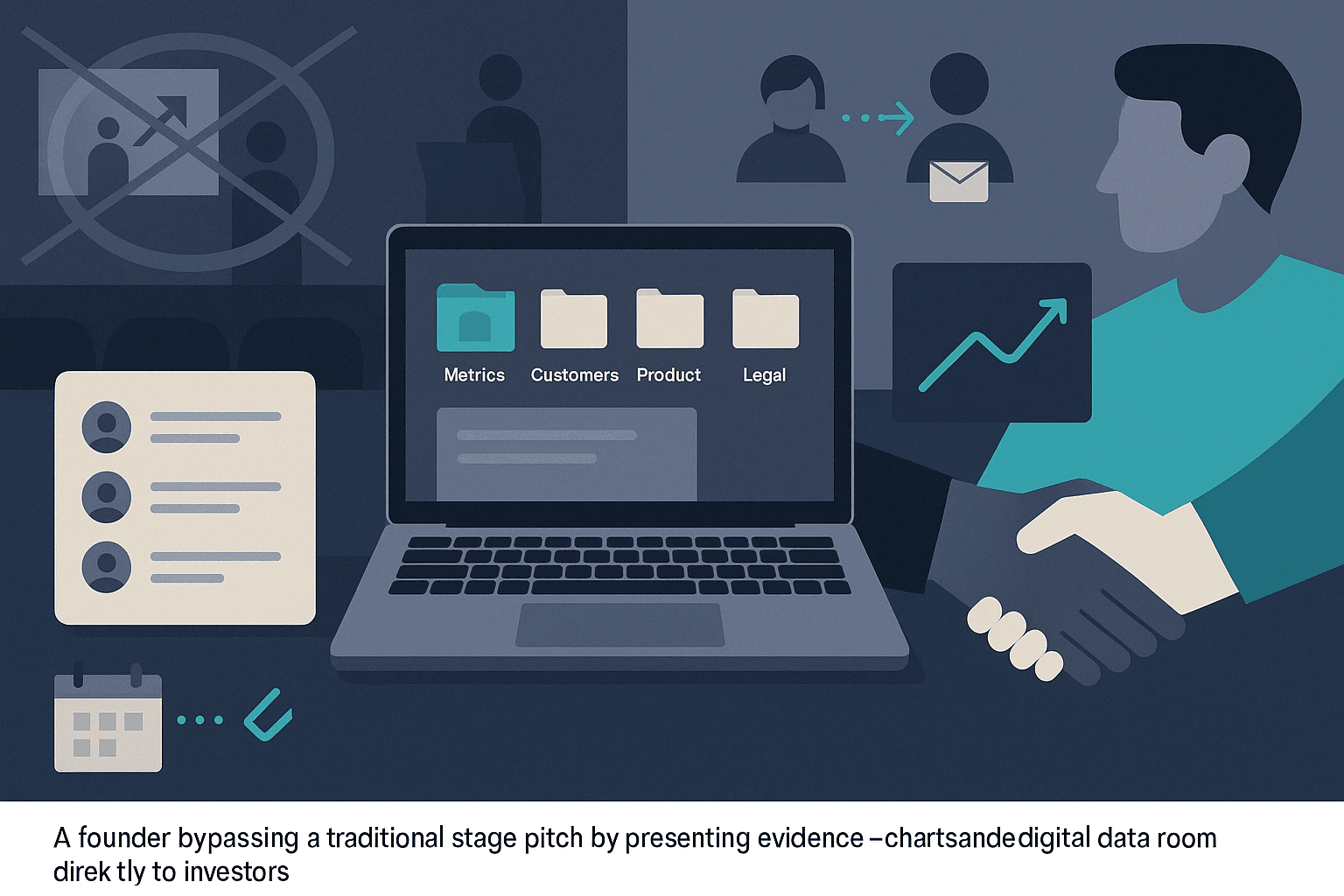
How to close a seed round without a pitch deck, a demo day, or a warm introduction, by letting hard proof do the work that polish usually does.
The premise: you don’t need a stage, a deck, or an introduction, if you have proof
“Demo Day fundraising” is a bundled product: a short pitch deck, a warm intro, a 20-minute meeting, and a hope that investor excitement will outrun diligence. It works best when (a) the brand of the accelerator or introducer carries trust, and (b) you can compress a complex story into a few slides.
But seed rounds are increasingly won by companies that can reduce perceived risk quickly. That doesn’t require a stage. It requires a repeatable way to answer the investor’s core questions, credibly, fast, and with evidence.
This article is a contrarian playbook for closing a seed round without:
The substitution is not “hustle.” It’s a proof-driven process built around:
This is not for everyone. If you have no traction, a weak network, and no clear wedge, removing the deck and intros will not magically improve outcomes. The anti-demo day approach works when you can create trust through artifacts.
What VCs actually need to say “yes” (and what they really mean)
Seed investors often describe decisions as “gut,” but the gut is responding to a pattern match plus evidence. Most seed deals, especially institutional seed, still boil down to a few necessary conditions.
1) A credible path to a big market
Investors need to believe the market is large enough to return the fund.
What they mean: “If things go well, does this become unavoidable?”
References:
2) Evidence of product pull (not just product push)
At seed, “traction” is contextual. For dev tools, a strong open-source adoption curve can be traction. For B2B SaaS, early revenue and retention signals matter. For marketplaces, liquidity and repeat behavior.
What they mean: “Will customers keep showing up if you stop selling for a week?”
References:
3) A team that can iterate to the truth
Seed is the stage where you’re buying a team’s ability to learn and ship.
What they mean: “If the first approach is wrong, will these founders find the right one quickly?”
4) A financing narrative that makes sense
The seed round is not just capital; it’s a plan.
What they mean: “Is this a coherent step on a credible ladder?”
5) Clean execution on diligence
A surprising number of “no’s” are really “this seems messy.” A disorganized company is assumed to be disorganized in product, sales, and hiring.
What they mean: “If I say yes, will this drag for eight weeks and then blow up?”
The anti-demo day method is designed to address these conditions directly, without relying on social proof from a warm intro.
Why skip the pitch deck?
Let’s be precise: you’re not skipping storytelling. You’re skipping slideware as the primary artifact.
Pitch decks are optimized for a specific environment:
But decks also create predictable failure modes:
A memo + data room approach can outperform a deck because it front-loads substance and makes diligence feel safer.
This mirrors how some of the best internal decisions are made at scaled companies: narrative memo + appendix, rather than slides (Amazon’s memo culture is a well-known example of this style).
Why warm intros are overrated (but still useful)
Warm intros do two things:
But warm intros can also:
Outbound is hard, but it scales. It lets you target partners who truly invest in your category and stage.
The anti-demo day philosophy is: use proof as the intro.
The core tactic: replace the deck with four artifacts
You’re going to raise with a package that looks more like an acquisition diligence binder than a demo day pitch.
Artifact A: The 1–2 page narrative memo (your “readable thesis”)
This is not a deck. It’s a document an investor can forward internally.
Structure (opinionated, seed-stage):
If you only write one thing, write this.
Artifact B: A tight data room (built to answer predictable questions)
Your data room is your trust engine. It should be tidy enough that an associate can run diligence without chasing you.
Suggested folder structure:
- fundraising timeline, what’s in the room, definitions of metrics
- product overview, roadmap, architecture (if relevant)
- KPI dashboard export, cohort retention, funnels
- customer list (permissioned), case studies, call notes, testimonials
- pipeline report, pricing, sales cycle, channels, experiments
- market map, ICP definition, competitor teardown
- model, assumptions, burn, hiring plan
- cap table, incorporation docs, IP assignments, material contracts
- SOC2 plans, security overview, data handling (esp. B2B)
Tools: Google Drive, Notion, DocSend, Dropbox are fine. The point is clarity, not sophistication.
Artifact C: Customer proof that reads like diligence
Customer proof is not a quote on a slide. It’s a bundle of signals:
If you’re pre-revenue, show:
Artifact D: A live metrics view (the anti-handwavy chart)
If you can, provide a read-only dashboard or regularly updated metrics snapshot.
Key principle: define every metric.
Examples:
This reduces the most common seed diligence failure: investors distrust the numbers.
Step-by-step: running the anti-demo day seed process
Step 1: Decide if you are fundable via outbound
Outbound works when there’s something that breaks the default skepticism.
A founder with none of the following will struggle:
If you are truly pre-everything, your best bet may still be: angels who know you, an accelerator, or building longer until you have proof.
Step 2: Build your investor list like a sales pipeline
Treat fundraising as enterprise sales. The amateur move is “top firms.” The professional move is “partners who lead seed in my category.”
Create a spreadsheet/CRM with:
Sourcing tips:
Step 3: Craft outbound that behaves like a “proof packet,” not a pitch
Cold outreach fails because it looks like spam. You need to look like a low-risk opportunity.
A good cold email has:
Example structure (short):
Avoid:
Step 4: Use a two-step disclosure model (memo first, then data room)
You want to move fast without leaking sensitive data.
Practical compromise:
Step 5: Run calls like technical diligence, not theater
Without a deck, the meeting changes. Good.
Agenda (30–45 minutes):
Your goal is to trigger the investor’s internal checklist:
Step 6: Make diligence easy by pre-answering the standard questions
Expect these themes:
Put answers in the data room before they ask.
Step 7: Create momentum ethically (process design, not hype)
You’re replacing the social proof of warm intros with the market proof of a tight process.
Tactics:
This is not about pressuring. It’s about preventing the default investor behavior: “interesting, circle back.”
Step 8: Engineer a lead (because most seed rounds still need one)
A seed round without a lead is possible, but harder. A lead provides:
How to get a lead without intros:
Step 9: Terms: keep it simple unless you have leverage
At seed, complexity kills deals.
Common instruments:
Your job is to avoid becoming your own lawyer. Use standard docs when possible.
References:
Step 10: Close like a project manager
The close is execution:
A founder who closes cleanly creates immediate trust for the next round.
The data room: what “good” looks like in practice
A strong seed data room is not a Series C data room. It’s curated.
Metrics folder: include definitions and cohorts
Include:
Add a one-page “Metrics Dictionary.” Investors hate metric ambiguity.
Customer folder: make references real
Include:
Be careful: unsolicited investor outreach to your customers can be disruptive. Offer structured reference calls.
Legal folder: reduce perceived mess
Have:
Messy legal is a silent killer. Clean it early.
The outbound system: turning “cold” into “contextual”
Outbound works best when it looks like you belong in the recipient’s inbox.
Personalization that matters
Mention:
Avoid:
Proof selection: pick signals investors trust
The most trusted signals at seed:
Vanity metrics are less persuasive:
Follow-up cadence (polite, systematic)
A reasonable cadence:
If no response, move on. Fundraising is high-volume.
The risks of the anti-demo day approach
This method is not a free lunch. It has real tradeoffs.
Risk 1: You lose the “performance” advantage
Some founders can sell through charisma and narrative compression. A memo-first process forces substance. If your story depends on stage energy, you may lose edge.
Risk 2: You expose weaknesses faster
A good data room reveals problems: churn, unclear ICP, messy pipeline. That’s the point, but it can reduce investor optimism.
Risk 3: You may undershoot brand-sensitive firms
Some firms rely heavily on trusted networks to filter deals. Outbound won’t penetrate those filters easily.
Risk 4: You can accidentally run an unbounded diligence treadmill
If you give full access too early, some investors will “research” indefinitely. Your process must set timelines.
Risk 5: Information leakage
Sharing detailed metrics and customer lists can create competitive exposure. Use staged disclosure.
Multiple perspectives: when a deck and intros are still rational
A contrarian playbook shouldn’t pretend the mainstream is always wrong.
Use a deck when:
Use warm intros when:
The more your round depends on belief rather than evidence, the more you want warm intros.
How to run a “tight process” without being performative
A tight process is not manufactured scarcity. It’s operational clarity.
The operating system
This is aggressive but plausible for a company with real proof.
Weekly investor update template
Send a short update to active investors:
This creates ongoing momentum and demonstrates operational maturity.
What to do if you don’t have traction yet (but still want this style)
If you’re earlier, you can still avoid a deck by focusing on high-integrity proof.
Examples:
But be careful: pretending LOIs are revenue or implying certainty will backfire in diligence.
FAQ-style objections (and blunt answers)
“Won’t investors demand a deck?”
Some will. Many won’t if the memo is good and the proof is clear. If an investor insists on a deck as a gating item, that’s a signal about how they process information.
A practical compromise: you can keep a minimalist “appendix deck” for partners who prefer slides, while running the process off the memo and data room.
“How do I handle investors who won’t sign NDAs?”
Assume most won’t. Redact sensitive details early, share deeper access later, and control customer references.
“Isn’t cold outreach a waste of time?”
Cold outreach is inefficient if untargeted. It becomes efficient when:
Treat it like sales: volume with qualification.
“What if I get multiple term sheets, does this still work?”
Yes, and it can work even better because your artifacts make comparisons easier and accelerate close. Don’t over-optimize on vanity. Optimize on partner quality and future support.
A practical checklist
Before you start
During the raise
At close
The deeper idea: fundraising is a trust transfer
Demo day and warm intros are ways to transfer trust from an institution or person to you.
The anti-demo day approach transfers trust from evidence to you.
If you build those, you can raise seed without the usual props.
References and further reading
---
Disclaimer: This article is educational and does not constitute legal or financial advice. Consult qualified counsel for fundraising documents and securities compliance.
RaiseSimpli Team
Author