Anti-Dilution Myths: Full Ratchet vs Weighted Average
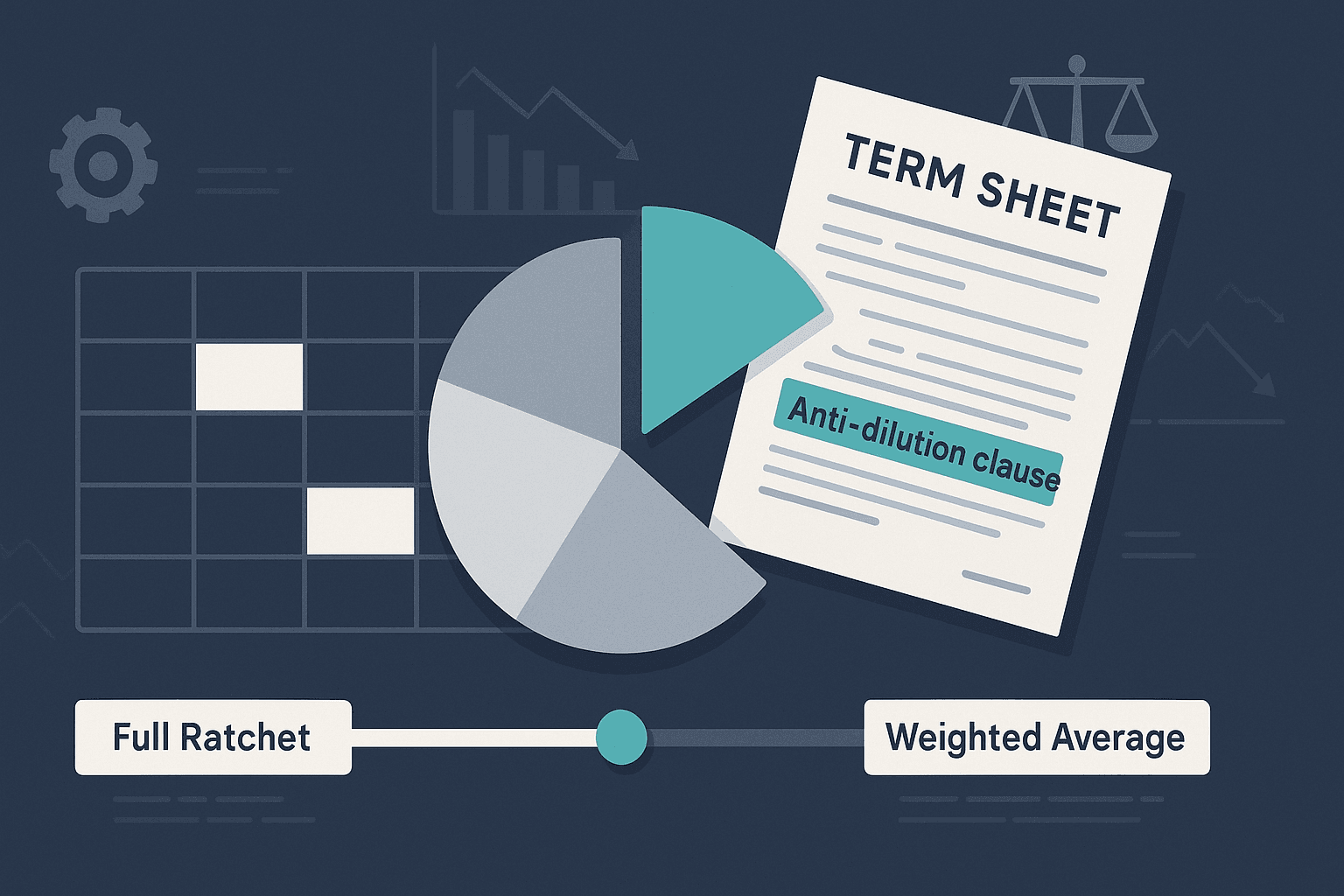
What full ratchet and weighted-average anti-dilution clauses actually do to your cap table, and which myths founders believe about both.
The reason it feels subtle is that anti-dilution typically doesn’t show up as a line item in the pre-money valuation. It hides inside the conversion math of preferred stock. But when triggered, the effect is real: it can shift meaningful percentage points from common (founders/employees) to preferred (investors), alter option pool math, and complicate future financing.
This article is a founder-first, technically grounded walkthrough of:
I’m going to be opinionated: full ratchet is almost never justified in standard VC priced rounds. Weighted-average is the market default because it’s closer to “risk-sharing” than “risk transfer.” But even weighted-average can be engineered to be harsher than it sounds.
> Disclaimer: This is not legal advice. Anti-dilution clauses are implemented through a company’s charter (certificate of incorporation) and financing documents; always have counsel model the cap table and review the exact language.
---
1) The core concept: anti-dilution is a conversion-price rewrite
Most venture financings issue convertible preferred stock. Investors pay a price per share, get preferred shares, and those preferred shares convert into common at some conversion ratio, usually 1:1 at issuance.
Anti-dilution provisions typically adjust the conversion price (or equivalently, increase the conversion ratio) if you later sell stock at a lower price per share than the investor paid.
This is why you can’t evaluate dilution by looking only at the headline valuation.
What anti-dilution is not
Anti-dilution is often confused with:
A canonical reference for the industry-standard framing is the NVCA model legal documents and term sheet discussions (National Venture Capital Association). See: NVCA Model Legal Documents and term sheet resources: https://nvca.org/model-legal-documents/
---
2) Why down rounds happen (and why anti-dilution becomes existential)
Down rounds occur when the next priced round’s per-share price is lower than the last round’s.
Common causes:
In a down round, you’re already dealing with:
Anti-dilution can add a separate crisis: cap table whiplash. Founders discover that “raising at $X” implies something like “founder ownership drops by an additional Y% because of conversion repricing.”
---
3) The two dominant anti-dilution regimes
A) Full ratchet anti-dilution
Full ratchet resets the earlier investor’s conversion price all the way down to the new round price, regardless of how many shares are sold in the down round.
If the Series A paid $10/share and the down round is at $5/share, full ratchet effectively treats the Series A investor as if they paid $5/share.
That means their conversion ratio doubles (they get 2 common for every 1 preferred) when they convert.
Why it’s harsh: it ignores the size of the new round. Even a small “bridge” priced round can trigger massive dilution transfer.
Full ratchet is common in some non-VC contexts (e.g., distressed financings, certain strategic situations, or when the investor has extraordinary leverage). In mainstream VC, it’s widely viewed as an outlier because it can poison the future financing market.
References and background discussion frequently appear in venture law overviews; a practical explainer is also in Fenwick & West / Cooley-style venture financing primers (many law firms publish similar guides). Example overview: Cooley GO resources (various term explanations): https://www.cooleygo.com/
B) Weighted-average anti-dilution
Weighted-average anti-dilution adjusts the conversion price based on both:
1) the magnitude of the price drop, and
2) how many shares are issued at the lower price.
This is closer to “proportional protection.” A tiny down round doesn’t justify rewriting the whole prior round.
There are two flavors:
Weighted-average is generally the market default in standard VC term sheets, but the exact definition of “fully diluted” matters tremendously.
NVCA documents and many venture law primers discuss broad vs narrow weighted average and how it’s defined. See NVCA resources: https://nvca.org/
---
4) The mechanics: the weighted-average formula (intuitively)
Different charters implement this with slightly different formulas, but the common idea is:
The adjustment sets CP2 somewhere between CP1 and P2, leaning closer to CP1 when the down round is small and closer to P2 when the down round is large.
A common expression (conceptual):
> CP2 = CP1 × (A + B) / (A + C)
Where:
This is why definitions matter:
---
5) Scenario modeling: the same down round, two very different outcomes
Let’s use a simplified cap table to show how this “quiet rewrite” happens.
Baseline setup (post-Series A)
Assume:
Total fully diluted (ignoring other complexities):
Series A invested: 3,000,000 × $10 = $30M
Now a down round: Series B at $5/share
Company raises $10M at $5/share.
#### Case 1: Full ratchet
Series A conversion price resets from $10 to $5.
That’s 3,000,000 “extra” shares created via conversion adjustment.
Post-B (conceptually, on an as-converted basis):
Total = 15,000,000
Ownership:
Before the down round (post-A), founders were 6,000,000 / 10,000,000 = 60%.
After the down round under full ratchet: 40%.
Yes, some dilution is expected when you issue new shares (Series B), but full ratchet transfers an additional, often shocking chunk from common to Series A.
#### Case 2: Broad-based weighted average (illustrative)
We’ll use the intuitive weighted-average logic: because only 2,000,000 new shares were issued at $5 (not enormous relative to the 10,000,000 pre), the conversion price should move part way.
Compute the ingredients:
So:
New conversion ratio = CP1/CP2 = 10 / 9.1667 ≈ 1.0909x
Series A as-converted shares become:
Extra shares from anti-dilution ≈ 272,727 (vs 3,000,000 extra under full ratchet).
Post-B total (as-converted):
Total ≈ 12,272,727
Ownership:
Compare outcomes:
That ~9 percentage points is not academic. It’s the difference between “founders still control the narrative” and “this now feels like someone else’s company.”
---
6) The sneaky part: broad-based vs narrow-based definitions
Weighted-average sounds founder-friendly until you read the definition of A.
The typical battleground is what counts in the “fully diluted capitalization” used in the formula:
A narrower definition reduces A, making the conversion price adjust more aggressively (closer to the down-round price).
Rule of thumb
This is one of those places where a single definition can swing dilution by multiple points.
Reference: NVCA term sheet conventions and many venture law firm commentaries cover the distinction. See NVCA model docs: https://nvca.org/model-legal-documents/
---
7) What triggers anti-dilution (and what’s usually excluded)
Anti-dilution generally triggers on issuance of equity securities at a price below the prior preferred price (“down issuance”). But most charters include carve-outs for “Exempt Issuances,” commonly including:
Two founder-relevant points:
1) Exemptions are negotiable. If the list is narrow, you can accidentally trigger anti-dilution through what you thought was routine financing engineering.
2) Pay attention to “shadow” financings. Some structures (e.g., warrants, deeply discounted bridge rounds) can look like something else but function like a down issuance.
---
8) Anti-dilution’s second-order effects (where founders get surprised)
Anti-dilution doesn’t only change ownership percentages. It can ripple into:
A) Option pool math
Many term sheets require the option pool to be “topped up” pre-money. If anti-dilution increases preferred as-converted shares, the pool may need to be larger than expected to maintain post-money targets, further diluting common.
B) Control and voting
Even if preferred votes on an as-converted basis, increasing the conversion ratio can increase voting power.
C) Liquidation stack dynamics
Anti-dilution doesn’t directly change liquidation preference dollars, but it changes how much common investors get upon conversion in an upside case and changes relative bargaining positions in future financings.
D) Signaling and financing friction
A harsh anti-dilution clause can make new investors wary:
This is why some investors argue that full ratchet can be self-defeating: it protects the earlier investor in one scenario while reducing the probability of a clean next round.
---
9) Mythbusting: the most common founder misconceptions
Myth 1: “Anti-dilution only matters in a down round, and we won’t do one.”
Most founders don’t plan on a down round. Many still have one. Macro shifts, product timing, and competitive dynamics don’t care about your plan.
Practical takeaway: Model it anyway. A clause you never expect to trigger is often the one that hurts the most because you didn’t prepare.
Myth 2: “Weighted-average is always reasonable.”
Not necessarily. Narrow-based definitions, aggressive exclusions, and tricky “Exempt Issuance” lists can produce outcomes closer to full ratchet than founders expect.
Practical takeaway: Ask counsel for a one-page summary: “What counts in A? What is excluded? Run the numbers.”
Myth 3: “It only dilutes founders, not employees.”
Employees hold common or options. Anti-dilution typically shifts value away from common, so it hits employees too, often when retention is hardest.
Practical takeaway: anti-dilution is also a talent risk.
Myth 4: “If we have anti-dilution, investors won’t push for pay-to-play.”
They still might. Anti-dilution and pay-to-play solve different problems. Anti-dilution protects price; pay-to-play forces continued funding.
---
10) Negotiation levers founders can actually use
You rarely win by saying “no anti-dilution.” Standard priced rounds will have it. The goal is to avoid unbounded founder punishment and to preserve financing flexibility.
Lever 1: Push hard against full ratchet
If a VC insists on full ratchet, ask why. Common “reasons” and founder responses:
- Founder: “That risk is shared through valuation and ownership. Full ratchet transfers it almost entirely onto common in the worst moments, which can kill the company’s ability to raise later.”
- Founder: “Weighted-average is far more standard in institutional VC. If you need more protection, let’s discuss valuation, board composition, or milestone-based tranching instead.”
Alternatives include:
Lever 2: Make it broad-based, and define A carefully
If you accept weighted-average, fight for:
This is legal drafting, but it’s not “just legal.” It’s economics.
Lever 3: Expand the Exempt Issuances list
You want flexibility to:
Be careful: too-broad exemptions can gut investor protection; too-narrow can handcuff you.
Lever 4: Pay-to-play as a more company-friendly protection
Pay-to-play provisions penalize investors who don’t participate in a down round (e.g., their preferred converts to common or loses certain rights).
Founder-first argument: pay-to-play rewards the investors who keep supporting the company, rather than automatically rewarding those who simply negotiated the most leverage early.
Pay-to-play is also discussed widely in venture financing literature and law firm primers (e.g., Wilson Sonsini / Cooley resources).
Lever 5: Consider a “shadow series” or carve-outs that avoid cap table chaos
Sometimes the cleanest path in a difficult financing is to create a new series with tailored rights while preventing retroactive cap table explosions.
This is highly situation-dependent and needs counsel, but the point is: anti-dilution interacts with the entire preferred stack.
Lever 6: Solve the underlying problem, don’t over-optimize the clause
The best anti-dilution negotiation is often avoiding the down round:
This is not moralizing; it’s simply acknowledging that anti-dilution is an emergency-room clause. Avoid the ER.
---
11) A more nuanced view: why investors ask for anti-dilution at all
It’s easy to treat anti-dilution as purely adversarial. There’s a rational investor case:
Weighted-average is the compromise: it corrects mispricing in proportion to the size of the down issuance.
Full ratchet is the extreme: it corrects mispricing as if the earlier investor always deserved the later price, ignoring round size.
From a system design standpoint, full ratchet can create perverse incentives:
This is why many practitioners view full ratchet as a sign of unusual leverage or distress rather than “standard VC.”
---
12) Cap table hygiene: how to spot hidden dilution before signing
Here’s a practical checklist founders can use.
A) Demand scenario models, not just legal redlines
Ask your counsel (or do it yourself in a spreadsheet) to model at least:
1) flat round (same price)
2) mild down round (e.g., -20% price)
3) severe down round (e.g., -50% price)
4) tiny down round (small dollars at low price) to test full ratchet sensitivity
Measure:
B) Identify the “A” definition and test broad vs narrow
If your term sheet says “weighted-average,” you still need to know:
C) Read the Exempt Issuances definition like a product spec
Don’t skim it. It determines what you can do without triggering repricing.
D) Check interactions with notes/SAFEs
If you have SAFEs/notes, confirm how they convert and whether their conversion is exempt. The goal is to avoid unexpected triggers.
For background on SAFEs and notes, Y Combinator’s SAFE documentation is a widely referenced starting point (though it’s not a substitute for counsel): https://www.ycombinator.com/documents/
---
13) A second scenario: when the down round is small but the clause is huge
This is where full ratchet becomes almost absurd.
Using the same Series A as above ($10/share), imagine you do a small priced bridge:
Economically, you might think: “That’s small; dilution will be limited.”
Because full ratchet ignores the $1M size, Series A conversion price still resets to $5, doubling their as-converted shares. You have effectively given Series A a massive ownership boost to raise a comparatively tiny amount of capital.
This is why full ratchet is dangerous even if you “don’t plan a big down round.” A small emergency raise can trigger a massive reallocation.
---
14) Practical founder guidance: what’s “market” and what’s “red flag”
Markets vary by stage and geography, but as a general venture norm:
- the company is distressed,
- the investor is providing rescue financing,
- or the investor is not a typical institutional VC and is pricing risk differently.
The red flag isn’t “investors are evil.” The red flag is: the term changes the company’s future fundraising viability.
If you accept full ratchet early, you may pay for it later in one of two ways:
1) with founder/common dilution at the worst time
2) with future investor resistance (because they don’t want their round to be an implicit bailout of earlier economics)
---
15) How to discuss it in the room (without sounding naïve)
A good founder negotiation style is calm, specific, and math-backed:
You don’t need to moralize; just be clear about second-order effects.
---
16) Bottom line
Anti-dilution is not a minor legal detail. It’s a price-reset mechanism that can materially change who owns your company when things are hardest.
Founders should treat anti-dilution like any other system-critical component: understand it, model it, and negotiate it deliberately.
If you do just one thing after reading this: ask your counsel (or your finance lead) for a cap table model that shows founder ownership under (1) a -20% down round and (2) a -50% down round, with your exact anti-dilution language. If the results surprise you, that’s the point.
---
References (starting points)
(Many top venture law firms publish primers on anti-dilution, broad vs narrow weighted average, and charter drafting. The exact implementation is always document-specific, read the charter language, not just the term sheet summary.)
RaiseSimpli Team
Author