The Anti-Pitch Deck: Winning Funding Without Slides
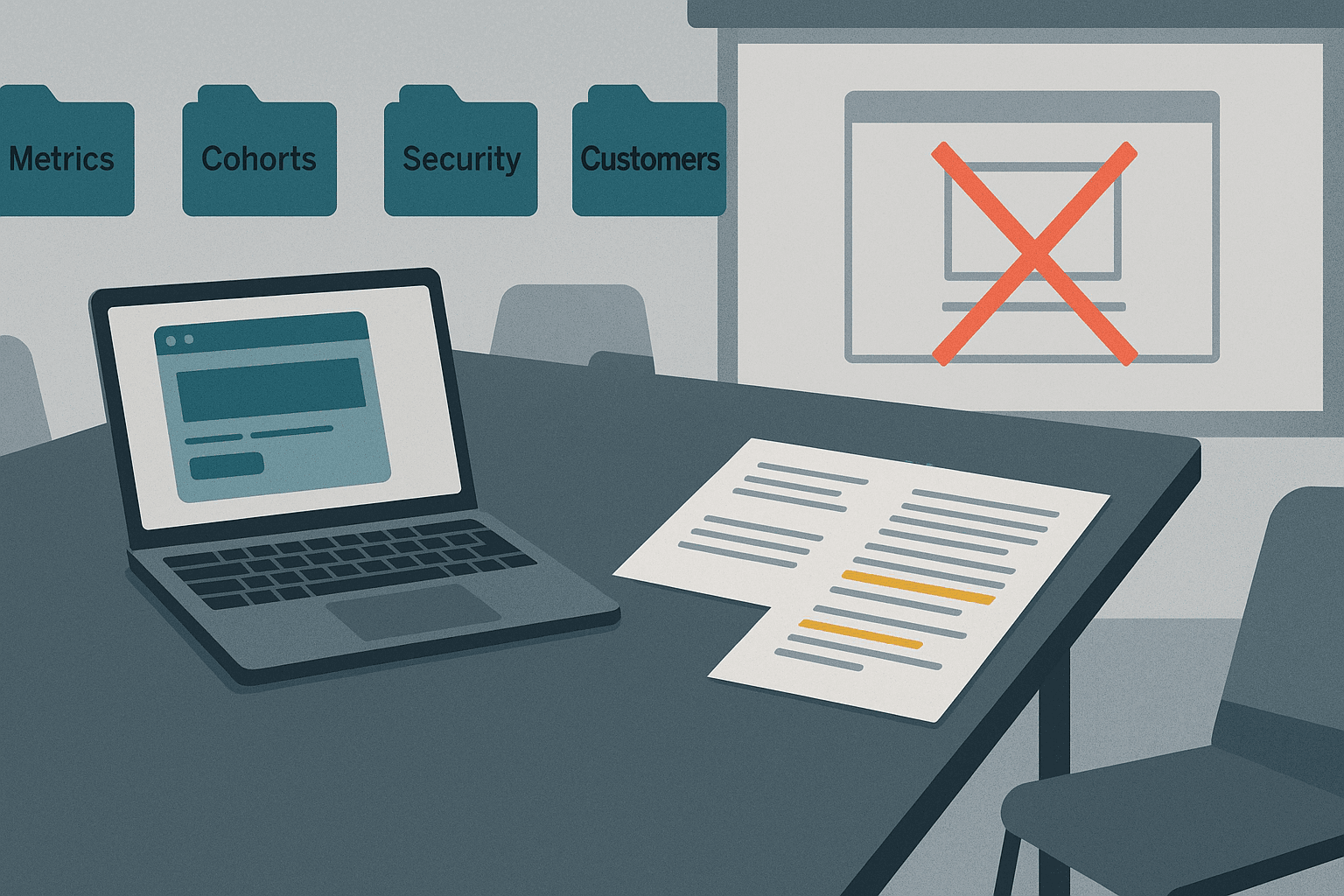
How some founders win funding with memos, data rooms, and live demos instead of slides, and when skipping the pitch deck makes sense.
The slide deck is losing its monopoly
For two decades, the startup pitch deck has been the default interface between founders and capital. It’s portable, compresses a narrative into 10–15 slides, and, crucially, it’s easy for firms to forward internally.
But the deck is no longer the only “standard document” in modern fundraising. A growing number of founders are quietly winning rounds while refusing to send slides at all, or sending them only at the very end. Instead, they run processes anchored on:
This isn’t theater. It’s a deliberate strategy: reduce the investor’s ability to shop your narrative around, force higher-quality evaluation, and differentiate on substance rather than design.
Not every company can (or should) do this. But the “anti-pitch deck” strategy is real, and it’s worth understanding because it changes the power dynamics of a round.
Why some VCs are increasingly willing to fund without slides
A no-deck process only works because the buy-side has changed.
1) Slide decks got too optimized for persuasion, not truth
The pitch deck has become a genre with predictable tropes: oversized markets, tidy competition grids, forward projections with hockey sticks, and traction charts that hide more than they reveal.
Investors know this. As a result, many firms now treat decks as marketing collateral: useful to get oriented, but weak evidence for underwriting.
This aligns with a broader shift in venture toward verification over vision where possible (especially post-2021 repricing and tighter capital markets). In down or normal markets, investors spend more time on fundamentals: retention, gross margin, payback, sales efficiency, and product adoption patterns. A deck can gesture at these; it rarely proves them.
2) Memos match how many firms actually decide
Many firms already make decisions based on internal memos. Some have formalized this practice publicly:
A founder-written memo is attractive because it maps more directly onto how partners debate:
A strong memo reduces ambiguity and forces coherence.
3) Live demos reveal what slides can’t
For technical products, developer tools, security, infrastructure, AI workflows, data platforms, a live demo can surface real differentiators:
Slides are often a proxy for “we have something.” A demo answers the sharper question: does it work, and does it feel inevitable?
4) Data rooms fit a world of fast diligence
As more funds compete and rounds compress, diligence becomes parallelized. A data room lets investors (and their analysts) self-serve:
That’s not only convenient; it reduces the risk of misunderstandings that happen when a founder “talks through” metrics without letting the investor inspect them.
5) The best companies can demand it
The anti-deck approach works best when a company has one or more of:
When capital wants you, it will tolerate nonstandard process.
The founder’s motivation: slides are a leakage vector
Founders often dislike decks for soft reasons (they’re time-consuming, they get outdated). But the strategic reason is harder:
A deck is easily forwarded, and often is
Once you send a deck, you lose control over:
Even at well-intentioned firms, decks can travel. Sometimes they travel outside the firm (less common, but founders worry about it for good reason).
A no-deck approach reduces the “copy-paste” risk of your positioning, pricing strategy, roadmap, or technical architecture being spread broadly.
Decks encourage premature pattern-matching
Investors are trained to pattern-match quickly. Decks accelerate this, often unfairly.
If your story doesn’t fit the canonical slide narrative (e.g., unconventional GTM, open-source adoption, bottom-up enterprise conversion, services-assisted software, regulated markets), a deck can cause an investor to reject you before they understand you.
A memo or demo slows the reader down.
Decks can reduce leverage by freezing your narrative too early
Fundraising is iterative. Your positioning evolves as you learn what resonates.
When you send a deck, you “lock” language that may be suboptimal, and investors will quote it back to you weeks later. A memo can be versioned too, but founders often distribute it more selectively, and can update it between meetings.
The anti-deck process: what “no deck” actually means
Refusing to send slides doesn’t mean refusing to communicate.
A credible no-deck process is usually more structured than a standard deck-driven process. The difference is that the artifacts are built for diligence and decision-making, not for persuasion theater.
A strong no-deck motion typically includes:
The key is sequencing: you want to reveal information in a way that maintains leverage while keeping momentum.
What to use instead of slides: the founder memo
The memo’s job: reduce ambiguity and invite scrutiny
A great founder memo doesn’t mimic a deck. It does what slides struggle to do: show reasoning.
A typical structure that works well:
Two important notes:
Opinionated guidance: include a “pre-mortem” section
Most fundraising materials pretend risk doesn’t exist. That’s a missed opportunity.
A short pre-mortem (5–10 bullet points) can differentiate you as a serious operator:
This is not self-sabotage. It signals maturity and gives the investor language to defend the deal internally.
The data room: how to do it without giving away the store
The anti-deck strategy often fails because founders either:
The right approach is a tiered data room.
Tier 1 (after first call): proof of reality
Goal: confirm you’re not vaporware.
Tier 2 (after partner-level interest): underwriting
Goal: let them evaluate economics.
Tier 3 (late stage / pre-term sheet): legal and risk
Goal: reduce surprises.
Practical leverage move: watermark and log access
Use a data room tool that:
This won’t stop everything, but it sets norms and deters casual forwarding.
Live demos: the highest-signal replacement for slides
A live demo can either be a superpower or a self-own.
What investors actually learn from a demo
How to demo without theater
For AI companies: demo reliability, not magic
Given investor skepticism about AI demos (prompt tricks, cherry-picked outputs), it helps to show:
This aligns with broader best practices emerging in applied AI product development (see documentation and talks from teams building eval-driven AI systems; OpenAI, Anthropic, and others have published guidance on evaluation and safety, though implementations vary).
How to say “no deck” without sounding evasive
The line matters. If you sound defensive, you’ll trigger suspicion.
A good default script
> “We don’t circulate a standard deck. What’s worked well for us is a short memo and a live demo, plus a structured data room once there’s partner-level interest. Happy to start with a 30-minute conversation and then share the memo if it feels like a fit.”
This communicates:
When to make exceptions
Sometimes the fastest path is to send something.
Consider sending a lightweight deck (or a one-pager) if:
A hardline stance can be costly if it slows down scheduling or creates friction with associates who are just trying to help.
The no-deck process doesn’t mean “no narrative”
A common mistake: founders treat decks as the narrative, and without them they become purely reactive.
You still need a crisp narrative arc:
The memo and demo are just different containers.
Multiple perspectives: why VCs sometimes dislike no-deck founders
There are legitimate reasons some investors will push back.
1) Internal coordination is harder
A deck is a convenient artifact for partnership meetings. Without slides, the investor champion has to do more work to summarize.
If the partner is busy, your process can stall.
2) No deck can look like you’re hiding weak fundamentals
Some founders use “no deck” as camouflage for:
Investors have seen this, so you must overcompensate with clarity and evidence.
3) It can signal inflexibility
Venture is a relationship business. If you’re rigid about the format, investors may worry you’ll be rigid with customers, hiring, or board management.
The best anti-deck founders are firm on principles, flexible on logistics.
When the anti-pitch deck strategy works best (and when it doesn’t)
Works best
Works poorly
Tactical playbook: running a no-deck round without losing momentum
Step 1: Use a one-paragraph teaser instead of a deck
In outreach, don’t attach anything. Send:
Example template:
> “We’re building X for Y. Teams use us to achieve Z in under N days. Since Month, we’ve grown from A to B in weekly active usage (or ARR), with retention of R% at 90 days in our core cohort. We’re raising a $__ seed to scale GTM and harden the platform. Open to a 25-minute intro next week?”
Step 2: First call: qualify hard
Your goal is not to educate them fully, it’s to decide whether to invest time.
Qualify on:
If they’re not a fit, don’t open the data room.
Step 3: After interest: send the memo + schedule the demo
Don’t send a memo and wait. Pair it with a calendared next step.
Step 4: Run a metrics deep dive early
If you have real numbers, use them.
A “numbers meeting” (60 minutes) should cover:
Founders often hide this until late, but bringing it forward builds trust, and filters out tourists.
Step 5: Open Tier 2 data room only after partner sponsorship
Set a clear rule:
This keeps you from doing free diligence for people who won’t run point.
Step 6: References as a closing tool, not a discovery tool
Customer calls are expensive social capital.
Use them when:
And curate references:
Step 7: Keep optionality with “comparable artifacts”
Some firms need something deck-like for IC.
Instead of a full deck, offer:
This preserves your anti-deck stance while respecting their workflow.
The subtle leverage benefit: controlling the narrative surface area
Refusing to send slides is partly about IP paranoia, but mostly about narrative discipline.
Decks encourage founders to over-claim:
A memo and data room force specificity:
In other words, the anti-deck strategy reduces your surface area for skepticism.
Common failure modes (and how to avoid them)
Failure mode 1: “No deck” becomes “no clarity”
Fix: invest in a memo with sharp structure and a real executive summary.
Failure mode 2: The demo is too slow
Fix: script the first 3 minutes. Hit the value moment immediately.
Failure mode 3: Data room overwhelm
Fix: index it. Provide a simple README:
Failure mode 4: You look combative
Fix: make it about efficiency and accuracy, not distrust.
Bad framing:
> “We don’t send decks because investors leak them.”
Better framing:
> “We’ve found memos + demos lead to better discussions and faster diligence.”
Failure mode 5: You lose investors who require slides
Fix: decide your boundary:
Most founders should choose “no deck until late” unless they have extreme leverage.
References and further reading (selected)
You asked for frequent references; below are sources that inform the broader trends behind this strategy:
A balanced conclusion: anti-deck is a tactic, not a personality
The “anti-pitch deck” strategy is not about being contrarian. It’s about choosing higher-signal artifacts, memos, data, demos, over a format that has become easy to ignore and easy to misuse.
If you have real product pull and credible evidence, refusing to send slides can:
But it also introduces risks: slower internal coordination, perceived evasiveness, and lost meetings with firms that rely on decks.
The founders who pull this off aren’t allergic to communication, they’re unusually disciplined about it. They replace the deck with a process that is harder to fake and easier to believe.
If you want to run no-deck fundraising, the standard to hit is simple:
You must look more prepared than the founders with slides.
RaiseSimpli Team
Author