Circular Rounds: Recycled Money That Fakes Demand
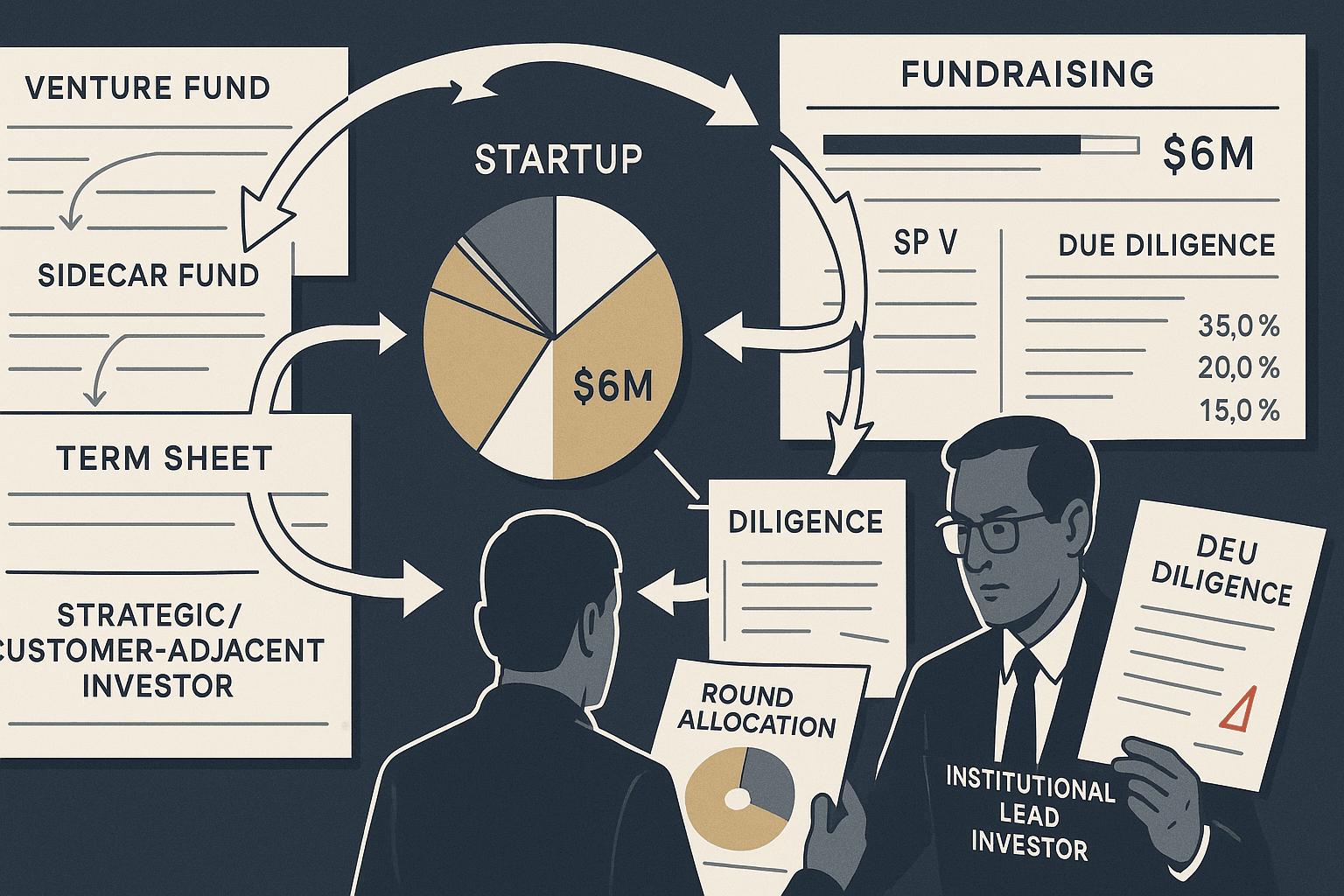
How cross-fund, SPV, and angel recycling can fake demand in startup financings, and how investors and founders can spot circular rounds.
Then the diligence starts.
The “new” SPV is funded primarily by angels already on the cap table. The scout vehicle is tied to a GP whose main fund already owns the company through another entity. The customer-adjacent investor is partially financed by a founder-friendly credit line and soft side arrangements. A pro rata exercise from an insider has been repackaged through a separate vehicle so it screens as fresh demand. The round isn’t fabricated in the criminal sense. Money is coming in. Documents are signed. But the signal being marketed to outsiders is false. What looks like independent validation is often just capital doing a lap around the block.
This is the circular round trap.
It matters because venture financings are not priced only by spreadsheets. They are priced by who is buying, why they are buying, and whether those buyers are economically and informationally independent. Once independence erodes, the round can still close, but the market reads it differently. Sophisticated leads know this. Crossover-style seed funds know this. Series A partnerships absolutely know this. And when they discover synthetic demand under the hood, they don’t merely dislike it on principle; they discount the financing because the round no longer carries the same signaling value.
The contrarian point is not that insider support is bad. Quite the opposite. Some of the best financings are heavily supported by insiders. Strong companies often deserve concentrated follow-on backing. The problem begins when supportive capital is marketed as independent third-party demand, especially when the structure is intentionally designed to manufacture oversubscription, hold a price that true outsiders would not clear, or create the appearance of “new investor validation” for customers, employees, and future funds.
This article breaks down how circular financing actually works, how it differs from legitimate insider support, what diligence trails expose it, how leads underwrite around it, and how founders can take supportive money without poisoning the signal for the next round.
The problem: when demand is real dollars but fake information
A financing round does two jobs at once.
First, it brings in cash.
Second, it produces information for the market: does a fresh set of investors, with fresh underwriting, believe this company is worth funding at this price on these terms right now?
The first job is mechanical. The second is reputational and probabilistic. It drives how future investors, senior hires, partners, and even customers interpret the company.
Circular rounds corrupt the second function while preserving the first.
The company still gets the cash, but the market signal gets distorted.
The distortion usually appears in one of five forms:
None of this necessarily violates law or documents by itself. The issue is whether the company and its backers are representing internally recycled demand as independent price discovery.
That distinction sounds subtle. In practice it is enormous.
A legitimate insider extension says: “Our existing investors know the business best and are doubling down. We also brought in one truly independent new lead at a modest step-up.”
A circular round says: “We have substantial new investor demand and broad market validation,” when the new logos are mostly wrappers around the same underlying people and incentives.
Founders often underestimate how visible this becomes later. Venture is a small market. LPAs, side letters, scout arrangements, feeder structures, operator SPVs, and angel networks are opaque to the public, but not opaque to people who finance companies for a living.
Why current approaches fail
Founders usually fall into circular signaling for one of three reasons.
1. They confuse capital formation with signal formation
A founder under pressure to close the round may think: if money clears, the source does not matter. At one level that is rational. Payroll does not care whether the check came from a clean institutional lead or from five friendly insiders through a fresh SPV.
But future rounds care.
Series A and B investors don’t just ask, “Who invested?” They ask, “Who independently chose to invest despite having no prior exposure, no social obligation, and no hidden affiliate relationship?”
If the answer is “fewer than the announcement implied,” the company’s prior round gets mentally repriced.
2. Funds, angels, and intermediaries have incentives to support optics
Existing investors may have perfectly understandable motives for supporting a company:
Those motives are not inherently bad. In fact, many are good portfolio management. But they become dangerous when the structure of the support is chosen specifically to look like outside conviction rather than insider defense.
Intermediaries can amplify the problem. Angel syndicate leads want access. SPV managers want fees and logo density. Friendly microfunds want association with hot rounds. Scouts want to look early and differentiated. Everyone benefits from momentum theater until a real lead asks awkward questions.
3. The market overindexes on oversubscription language
“Filled in 48 hours.” “Round upsized due to excess demand.” “Could have raised 2x more.” These phrases are standard startup theater. Some of it is true. Some of it is tactical framing. But once the market normalizes storytelling around scarcity, participants start manufacturing the underlying ingredients.
The easiest ingredient to manufacture is demand from familiar pockets of capital.
That is why circularity is more common in:
Core insight: independence matters more than novelty
The central mistake founders make is thinking the market cares about whether the investor is new. What sophisticated investors actually care about is whether the investor is independent.
A “new” SPV funded by old angels is not independent.
A “new” scout allocation financed by a GP complex that already owns the company elsewhere is not independent.
A “new” strategic whose economics are bound up with a commercial relationship may not be independent enough to count for pricing signal.
By contrast, an insider can be extremely valuable signal if it is presented honestly:
This is why sophisticated leads discount synthetic demand. They are not moralizing. They are isolating whether the round provides fresh information.
If ten checks are all economically linked to one relationship cluster, you do not have ten independent observations. You may effectively have one.
In Bayesian terms, circularity reduces the evidentiary value of the round.
In term sheet terms, it reduces bargaining power.
In cap table terms, it often leaves founders with the dilution of a priced round but the signaling quality of a bridge.
That is the worst combination.
What legitimate insider support looks like
Let’s draw the line clearly.
Legitimate insider support typically has these characteristics:
Example:
A company raises a $6 million Series Seed at a $24 million pre-money valuation. One new institutional lead commits $3 million. Existing insiders take $2 million pro rata and another $500,000 super pro rata. A respected operator writes a genuine new $500,000 check.
That is a good round. Heavy insider support, yes. Synthetic demand, no.
The company should say exactly that: “Led by X, with strong insider participation.”
Now compare that with a circular version.
The company markets $5 million of the round as “new demand.” But $1.5 million sits in an SPV funded 70% by existing angels, $1 million sits in a scout vehicle linked to an affiliate of an existing VC, and another $750,000 came from a customer-related investor whose economics are tied to a rebate side agreement. Legally separate entities, yes. Independent validation, no.
Same cash proceeds. Completely different information value.
How circular rounds are engineered in practice
Most circular rounds are not one dramatic fraud. They are built from a series of individually defensible choices that, in aggregate, produce a misleading picture.
Pattern 1: The affiliated-fund stack
A venture platform may have:
A company already backed by one part of the platform raises a new round. Rather than clearly presenting follow-on support from the platform, checks arrive through multiple wrappers.
What the founder says: “We brought in three new funds.”
What the lead eventually learns: one GP ecosystem effectively supplied most of the support.
This does not mean the platform acted improperly. Sometimes different vehicles truly do have separate mandates. But for signaling purposes, the lead will collapse them into one relationship cluster unless the underwriting was genuinely separate and adverse-capable.
Pattern 2: The friendly SPV that fills the book
Suppose a company wants to raise $4 million at a $20 million pre. True outsider demand is only $2.2 million at that price. Existing angels and seed funds still believe, and they want to avoid a painful reset.
A sponsor forms an SPV to “open access” to operators. Existing backers quietly anchor most of it.
Cap table view:
Public narrative: broad operator demand, round oversubscribed.
Look-through reality on the SPV:
Again, the cash is real. The narrative is not.
Pattern 3: Angel recycling through syndicates
A well-known angel wrote $100,000 in the pre-seed. In the next round, she “introduces” her syndicate, which writes $750,000. Sounds like great external pull.
But the syndicate is composed largely of:
This may still be useful money. But a serious lead will treat it as network-amplified insider support, not broad market validation.
Pattern 4: Customer-adjacent capital as synthetic endorsement
These are especially dangerous because they can distort both fundraising signal and commercial independence.
Imagine an enterprise software startup raising a $10 million Series A. A large prospective customer encourages its venture arm, a channel partner investment vehicle, or a founder-friendly industry SPV to join the round. The startup then cites that participation as proof of product-market pull.
Yet the investor’s incentives are not clean:
Strategic money can be excellent. But if it is used to manufacture the impression of neutral third-party underwriting, later investors will heavily discount it.
Cap table math: why circular rounds can create hidden damage
Founders often say: “Even if the signal is softer, we still got the valuation.” Sometimes. But valuation on paper is not the same as value created.
Let’s run the numbers.
Scenario A: Clean independent round
Company raises $8 million at a $32 million pre-money valuation.
Post-money = $40 million.
New investors own 20.0% post-close.
Existing holders dilute by 20.0%.
Suppose the lead is independent and writes $4 million. Two other true new funds write $2 million total. Insiders do $2 million.
This round sends a strong signal. Eighteen months later, the company raises a Series A at $80 million pre, doubling the price.
Scenario B: Same economics, circular signal
Company also raises $8 million at $32 million pre-money.
On paper, same dilution: 20.0%.
But composition is different:
The company tells the market this was heavily contested. In reality, only $3.5 million was truly independent.
At the next round, Series A investors discover the prior round composition and conclude the $32 million pre was weakly supported by external demand. They don’t just ignore the signal; they actively de-rate it.
Suppose instead of an $80 million pre, the best clean offer is now $56 million pre.
That difference matters.
If the company raises $12 million:
The four-point extra dilution in the next round can easily outweigh any short-term pride from preserving a flattering prior headline.
Founders’ dilution over two rounds
Assume founders own 60% before the seed and no option pool refresh for simplicity.
Scenario A
Scenario B
Difference: 2.21 percentage points of founder ownership lost because the market discounted the synthetic prior round.
On a future $500 million exit value, that is $11.05 million of founder economics.
Circular signaling is not cosmetic. It can be very expensive.
Why sophisticated leads discount synthetic demand
Good leads are trying to answer a simple question: if they set this price and invest, will the next financing market trust the round they are creating?
They discount circular rounds for four reasons.
1. Synthetic demand weakens price discovery
Price discovery requires participants with separate information sets, separate incentives, and real willingness to walk away.
If the round is held up by investors who are already committed socially, strategically, or economically, then the observed price tells a lead less about market clearing value.
2. Circularity can conceal desperation
A round with lots of insider recycling may indicate:
Those are not always fatal. But they matter.
3. It predicts next-round signaling problems
If a seed lead knows a future Series A partnership will look through the current round and see mostly repackaged insiders, the lead must underwrite not just the company but the future explanation burden.
That burden shows up in:
4. It raises governance and independence questions
When many “new” allocations are actually friendly or affiliated, a lead worries about whether the founder is building a cap table optimized for long-term governance or for short-term optics.
The wrong cap table can create:
Diligence trails that reveal the pattern
Founders often assume circularity is hard to detect because the legal entities are distinct. That is naive. Good investors ask look-through questions.
Here is what reveals the pattern.
1. Beneficial ownership and funding-source questions
Leads may ask, directly or indirectly:
You may not always be required to disclose every LP in a vehicle, but if the answer changes the interpretation of the round, expect the truth to surface.
2. Allocation pattern analysis
Round composition leaves fingerprints.
Examples:
Experienced lawyers and funds notice this quickly.
3. Side letter and rights review
A lead’s counsel will examine:
If customer-adjacent or affiliate capital carries non-standard economics or strategic controls, the signal quality drops further.
4. Reference triangulation
Investors talk.
A lead may ask other market participants:
One candid answer from someone who saw the process can collapse a carefully built oversubscription story.
5. Historical support behavior
Some investors repeatedly use SPVs, scouts, or friendly operators to support soft rounds. Others do not. Funds build pattern recognition. A company attached to a known support-ecosystem will get more look-through diligence automatically.
Negotiation scenarios: how the discount shows up in term sheets
Circularity rarely leads to a dramatic accusation. It usually shows up as a worse term sheet.
Scenario 1: Lead reduces valuation but keeps headline polite
Founder seeks:
Lead’s view after diligence:
Lead responds:
Many founders fixate on the valuation cut. But the deeper message is: “We are underwriting this as a partially insider-supported extension, not as a fully validated external round.”
Scenario 2: Lead holds price but adds structural protection
Founder seeks:
Lead thinks the round is circular but likes the company enough to proceed. Instead of repricing, the lead asks for:
Founders sometimes celebrate “keeping the price,” while ignoring that the economics moved elsewhere.
Example:
If a 10% option pool refresh is inserted pre-money, founders absorb that dilution immediately. On a $28 million pre, that can be economically similar to a notable valuation reduction.
Scenario 3: Lead insists on allocation cleanup
A better outcome.
Lead says:
“I will invest at your price if we clean the syndicate. I want transparency on the SPV. Existing investors can participate, but not be counted as new demand. Strategic-adjacent money is capped at 10% of the round and gets no special rights.”
This is the right instinct. The founder keeps supportive capital but protects the round’s interpretability.
A term sheet comparison: clean round vs synthetic round
Here is a simplified comparison.
Clean round
Synthetic round
At first glance, same valuation. In reality, the synthetic round is inferior because:
How founders should evaluate supportive capital
The right question is not “Can we use this money?”
The right question is “If a future lead looks through this investor to the underlying incentives, does the round still make sense?”
Use this framework.
1. Is the investor economically independent?
Would they invest if they had:
If not, classify the money as supportive, not validating.
2. Is the investor informationally independent?
Are they underwriting on their own work, or mostly following insiders who need the round to clear?
Followers are fine. But followers do not create the same signal as true leaders.
3. Could the investor credibly walk away?
Real price discovery requires the ability to say no. If the investor’s broader incentives make “no” unrealistic, treat their participation accordingly.
4. Will their presence complicate future governance or commercial freedom?
If the capital introduces hidden pressure on roadmap, procurement, pricing, exits, or future lead allocations, the cash may be more expensive than it appears.
How to accept supportive money without creating future problems
This is where founders can be disciplined.
1. Tell the truth about round composition
The safest formulation is often the simplest:
Do not claim broad new validation if you do not have it.
2. Maintain a clear distinction between lead capital and supportive capital
Your internal fundraising materials should classify participants into:
That clarity helps with board communication and later diligence.
3. Avoid SPV structures designed mainly to disguise source overlap
SPVs are not bad. They are often useful. But if the primary purpose is to make old money look new, you are borrowing trouble.
If an SPV includes prior investors, say so to the lead.
4. Cap strategic-adjacent participation
As a rule of thumb, customer or strategic-adjacent capital should be a minority component of a financing unless there is a compelling reason otherwise.
Why? Because future investors want to know the company can attract financial buyers who are not entangled in operating relationships.
5. Protect board and rights simplicity
Supportive capital should not come with disproportionate governance complexity.
Avoid:
6. Leave room for the next real lead
If insiders and friendly vehicles crowd the round, the company can end up with too little allocation left for a future anchor relationship. That is a strategic mistake.
A clean, independent 15–25% ownership bloc for a real lead often matters more than squeezing every supportive dollar into the current round.
7. Write the board memo you want discovered later
This is a useful test. Imagine the next lead sees your board materials.
Could you comfortably say:
If not, the structure is probably too cute.
A practical example: saving a round without faking demand
Let’s say a startup needs $5 million to hit a key regulatory milestone in 15 months.
Initial market feedback:
The wrong move:
Bundle the $1.75 million insider support into a “healthtech operators SPV,” frame the round as broad external demand, and imply the lead had to fight for allocation.
The right move:
Structure the round openly:
Post-money = $23 million.
New money ownership = 21.74%.
Assume founders own 55% pre-round.
After financing: 55% × 78.26% = 43.04%.
Now the market understands what happened: one real lead validated the company, insiders strongly supported it, and the financing was built honestly around the milestone plan.
At Series A, that story is defensible.
If instead the company had stretched for a headline $22 million pre using disguised circularity, then missed the exact milestone timing, the next lead might price at $24 million pre anyway, effectively no real step-up, but after a year of signaling damage. Better to take the honest round.
What investors should do when they spot circularity
For investors reading this, the answer is not automatic hostility. It is classification.
Ask:
A founder who says, “Yes, some of this SPV is existing angel support; we’re not counting it as independent validation,” is very different from a founder who keeps pushing a false oversubscription story after being asked directly.
The first case is manageable. The second is a trust problem.
The blunt takeaway
Supportive money is not the problem.
Misclassified supportive money is the problem.
Cross-fund checks, SPVs, syndicates, scouts, and strategic-adjacent investors can all play legitimate roles in startup financings. But once those structures are used to manufacture the appearance of independent demand, the round stops functioning as reliable market evidence. Sophisticated leads know this and price accordingly.
The irony is that founders often create circular rounds to defend valuation, then lose more value later through weaker signaling, tougher diligence, and lower-confidence future pricing.
A good financing does not need theatrical oversubscription. It needs honest composition, clean incentives, and enough independent conviction to make the next round easier rather than harder.
If the same dollar keeps changing costumes on its way into your cap table, don’t ask whether it counts as cash.
Ask whether it counts as truth.
RaiseSimpli Team
Author