Comp Cleanup Discount: Legal Issues That Cut Series A
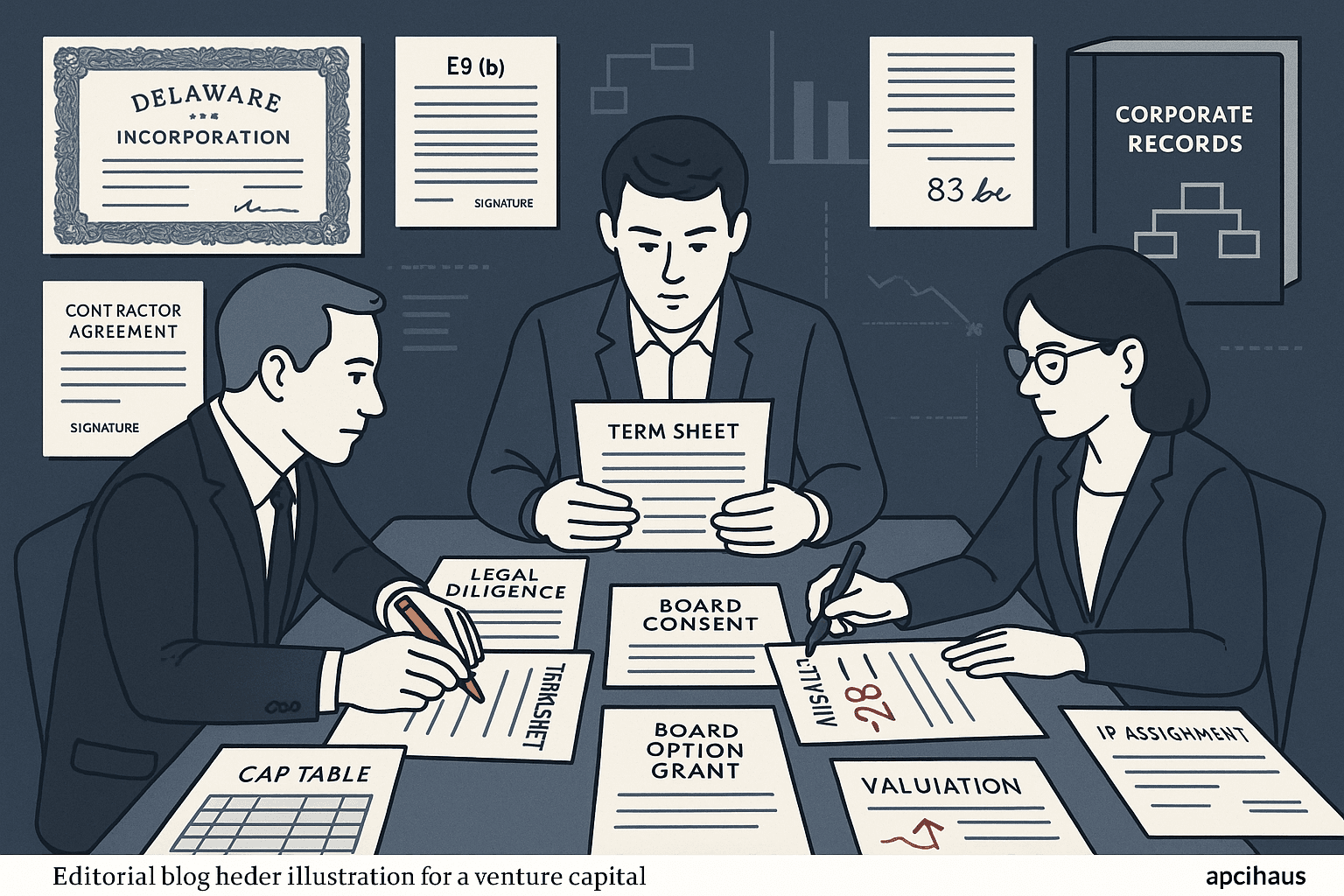
Why Series A leads mark down startups with contractor IP gaps, unapproved grants, and sloppy Delaware records, and how to fix them early.
Counsel asks for the invention assignment agreements for the three senior contractors who built the first version of the product. One is signed, one is unsigned, and one is a generic consulting agreement with no present-tense IP assignment. The option ledger doesn’t match the board consents. Several early grants were approved after their stated grant dates. Two employees filed 83(b) elections, but the company cannot prove mailing or timely filing. Delaware franchise taxes were calculated on the wrong method for two years, then paid late with penalties. The India subsidiary exists, but the intercompany paperwork is thin and the local director appointment resolutions are incomplete.
Nobody says the company is unfinanceable. That is the wrong mental model. What actually happens is worse for founders: the company becomes financeable at a discount.
This is the comp cleanup discount. It is the quiet valuation haircut and deal-friction tax that sophisticated Series A leads apply when a startup’s legal housekeeping creates uncertainty around who owns the IP, who owns the shares, whether grants were validly issued, and whether corporate actions were properly authorized. It rarely appears as a line item in the term sheet. Instead it shows up in lower pre-money, more aggressive reps and warranties, indemnity pressure, escrow or holdback requests in edge cases, expanded closing conditions, or a slower process that weakens your leverage with other investors.
Founders routinely underestimate this because the issues feel “fixable.” And they usually are fixable. But investors do not price based on whether something is theoretically curable. They price based on risk, cost, delay, and negotiating leverage. A mess that can be fixed in three weeks with perfect cooperation is not the same as a mess that might take three months, trigger tax exposure, require third-party signatures from unhappy former contractors, or create a non-zero chance that a future acquirer will retrade.
That difference is where the discount lives.
The real problem is not legal perfection. It is uncertainty with asymmetric downside.
Series A leads are not trying to become your outside counsel. They are trying to answer a narrower question: if we wire $12 million at a $48 million pre-money valuation, what are the odds that hidden legal defects will impair the asset we are buying, create future dilution fights, generate tax liabilities, or blow up an exit?
Most founders frame diligence issues as operational annoyances:
Investors frame them differently:
That last question matters most. Legal diligence problems are classic asymmetric-risk issues. The upside from “we clean it up and move on” mostly accrues to founders because they preserve price. The downside from “it turns out worse than expected” lands partly on the new money investor, who just paid a valuation set as if these defects did not exist.
So the investor marks down for uncertainty.
Why current founder approaches fail
Most founders make one of four mistakes.
1. They confuse cure with no cost.
Yes, many defects can be ratified, papered, or remedied. But cure has cost:
A missing invention assignment from a contractor is not just a request for a signature. It is a negotiation with someone who may know they have leverage. A ratification of backdated option grants is not just a board vote. It may require securities analysis, tax review, updated 409A work, and employee communication.
2. They think issues are isolated when investors interpret them as a signal.
One missing consent can be a typo. Five categories of sloppiness imply a control problem. Series A investors are underwriting not just your current state but your ability to operate a venture-backed company for the next 5–8 years. If the records around equity and IP are loose now, investors infer higher future execution risk in hiring, compliance, international expansion, and M&A readiness.
3. They let company counsel run a “can this be fixed?” analysis instead of a “how will a lead price this?” analysis.
Good startup lawyers know how to solve issues. But founders need a financing lens too. The key question is not merely whether counsel can eventually clean something up. It is how the issue affects:
4. They wait until after investor diligence starts.
That is the most expensive time to fix anything. Once a lead finds a defect, it becomes part of the negotiating record. Even if cured later, the investor has learned something useful: the company did not discover and remediate it before market exposure. That can justify further diligence, broader reps, or simply a more conservative price.
The core insight: Series A leads convert legal mess into pricing through four mechanisms
Founders often expect investors to say, “Because of your contractor IP problem, we are reducing valuation by exactly $3 million.” That almost never happens. The translation is subtler.
Mechanism 1: Direct valuation haircut
The investor lowers pre-money because the company is no longer a clean, low-friction asset. The haircut is often justified internally as compensation for risk and process drag, even if not explicitly tied to a single defect.
Example:
On a $12 million Series A, dropping from $48 million pre to $43 million pre increases founder dilution meaningfully.
At $48 million pre:
At $43 million pre:
That 1.8 percentage point difference may not sound massive, but on a company that later exits for $1 billion, that is $18 million of value shifted from existing holders to the new investor, before considering the compounding effect of future rounds.
Mechanism 2: Expanded reps, warranties, and indemnity pressure
In priced venture rounds, investors usually expect broad company reps and warranties. If diligence reveals messes, they push for more specific representations, more detailed disclosure schedules, tougher bring-down conditions, and in unusual situations stronger recourse if something proves false.
Even if there is no true post-closing indemnity escrow in a standard venture financing, the practical burden still rises:
In edge cases, especially where a bridge round converts into a larger financing, secondary is involved, or there are unusual side arrangements, investors may ask for holdbacks, side letters, or transaction structures that functionally reserve against cleanup risk.
Mechanism 3: Closing-condition leverage and timing risk
Investors weaponize fixability through conditions precedent. They say, in effect: “We are happy to invest at this price, assuming all cleanup is completed to our satisfaction before closing.”
That sounds harmless until you realize timing changes power.
If you need:
then the investor can keep the term sheet live while your company burns time and momentum. If another bidder was interested but not deeply engaged, they may disappear during the delay. Your negotiating leverage deteriorates precisely when the lead has the most information.
Mechanism 4: Process skepticism that depresses competitive tension
The cleanest companies run cleaner fundraising processes. Why? Because counsel can answer data-room requests quickly, investor questions get resolved fast, and no one worries about hidden defects. That confidence helps create urgency.
Messy diligence kills urgency. Potential investors become reluctant to spend partner time if they suspect legal cleanup will drag. A company that might have had three serious term sheet candidates ends up with one, and one-bidder processes almost always clear at lower prices.
The three buckets investors care about most
Not all sloppiness is equal. Series A leads usually care most about three categories.
1. Ownership risk: Does the company actually own what it is selling?
This is why contractor IP issues are so toxic. Early startups rely heavily on contractors, studios, agencies, advisors, and offshore teams. Founders assume paying for work means owning the output. Often it does not, at least not cleanly.
Common problems:
Why investors care:
If core product code, models, or design assets are not clearly assigned, the company’s principal asset may be impaired. In an acquisition, buyer counsel will fixate on this. In litigation, a disgruntled contractor could create leverage far beyond the amount originally paid.
#### Numerical example: how a contractor IP gap becomes a discount
Suppose your company is raising $10 million. You believe market-clearing price is $40 million pre based on ARR growth.
Facts revealed in diligence:
What does the lead think?
Not “this costs $120,000.”
The investor thinks:
So maybe the lead says:
That is the comp cleanup discount in action. A legal defect with uncertain cure cost can easily create a $2 million to $4 million pricing swing on a $50 million-ish post-money round.
2. Equity validity risk: Were securities and options properly approved and issued?
Improperly approved grants are a silent killer because they strike at cap table integrity. If your board did not approve grants properly, or approved them on the wrong dates, or exceeded plan reserves, or issued restricted stock without proper documentation and 83(b) follow-through, then investors start wondering whether the equity stack is reliable.
Common issues:
Why investors care:
A broken cap table is expensive to repair and corrosive to trust. If employees think they own one number of options and legal reality says another, you have morale, retention, and disclosure problems. If grants were made below fair market value without proper process, tax issues may arise. If approvals were defective, some grants may need ratification, cancellation/regrant, or more invasive remediation.
#### Practical cap table math: the hidden cost of unapproved grants
Assume the company has:
Investor proposes:
Now diligence finds:
There are several possible outcomes:
Suppose counsel concludes you need to add 400,000 shares to the option pool to resolve historical mistakes and preserve recruiting capacity after regranting. If the investor insists this pool increase be included in the pre-money, founders absorb it.
Revised fully diluted pre becomes:
At a nominal $48 million pre, implied per-share value falls from:
to:
Founders feel like they preserved the headline valuation. In reality, they took dilution through the pool math. This is another version of the discount.
3. Governance and compliance risk: Did the company validly do what it says it did?
Board-consent gaps, Delaware sloppiness, and subsidiary documentation problems often feel less dramatic than IP ownership or cap table defects. But they matter because they indicate process weakness and can impair the legal validity of corporate actions.
Common issues:
Why investors care:
Because sloppiness compounds. If you did not maintain board records for basic equity approvals, what confidence should investors have in your treatment of revenue recognition, privacy compliance, export controls, or employee classification? Legal diligence is partly forensic accounting for process discipline.
How investors actually negotiate these issues
Founders need to understand the playbook. Sophisticated leads do not usually blow up the deal over “fixable” legal problems. They use them.
Negotiation scenario 1: Price retrade after legal diligence memo
Initial discussion:
Legal diligence memo then identifies:
Investor response:
What happened economically?
On a $15 million raise:
At $50 million pre:
At $44 million pre:
Difference: 2.34 percentage points of the company.
That is a major transfer of value. On a future $500 million exit, that difference is worth $11.7 million.
Negotiation scenario 2: Headline price preserved, terms worsen
Sometimes investors know founders are anchored on headline valuation. They keep price but tighten structure.
Example:
Instead of cutting pre-money, investor asks for:
Economically, this can be as painful as a valuation cut. A pre-money pool increase from 10% to 15%, borne entirely by existing holders, can materially dilute founders while preserving the vanity number.
Illustration:
Pre-financing fully diluted shares before pool expansion: 10,000,000
Current unallocated pool: 5%
Investor requires pool expansion to 15% post-closing, with increase counted pre-money.
Assume this requires adding roughly 1,176,471 shares pre-closing to hit the negotiated pool target after financing mechanics. The exact number depends on round size and definitions, but the point is simple: founders can lose over 10% of pre-round ownership economics without any headline change in valuation.
This is why smart founders negotiate economics, not press-release optics.
Negotiation scenario 3: Timing leverage kills the process
Investor says:
The company assumes this is effectively done. Then:
Four weeks pass. Pipeline momentum dies. Another investor who might have bid at $52 million pre has moved on. The original lead now knows they are the only real option and nudges price to $45 million pre due to “market conditions” and “ongoing diligence burden.”
The legal mess did not just create legal cost. It broke competitive tension.
The specific diligence issues that trigger the discount
Let’s go issue by issue.
Missing IP assignments from contractors
This is usually the highest-sensitivity issue because it maps directly to asset ownership.
What investors will ask:
Why this gets priced hard:
Because if the answer is murky, the investor cannot be sure the company owns core code or inventions. Even if everyone behaved in good faith, bad paperwork creates future hold-up risk.
Improperly approved option grants
This often shows up when founders moved fast, promised grants by email, and treated board approvals as back-office cleanup.
What investors will ask:
Why this gets priced hard:
Because invalid grants create tax, securities, employee relations, and cap table uncertainty all at once.
Stale or poorly documented 83(b) handling
The 83(b) issue is usually less existential than IP ownership, but it matters because it affects employees and founders economically and reveals process quality.
What investors will ask:
Why this gets priced:
If there is uncertainty, there may be employee tax pain, requests for compensation adjustments, or later disputes around what was intended. More broadly, if the company mishandled foundational founder/employee equity paperwork, investor confidence falls.
Board-consent gaps
If consents are missing, post-dated, or inconsistent, the investor has to worry whether actions were validly authorized at all.
What investors will ask:
Why this gets priced:
Because authority defects spread. A financing approved incorrectly can contaminate the cap table. An officer acting without proper appointment can complicate contract authority. Missing records also suggest the diligence file may still be incomplete.
Delaware franchise-tax mistakes
On paper this sounds administrative. In practice, it matters because delinquency can interrupt good standing, create penalties, and signal weak back-office controls.
What investors will ask:
Why this gets priced:
Not because penalties are usually huge in venture terms, but because investors do not want to discover at closing that certificates are delayed or status is impaired. It is also one more mark against process discipline.
Subsidiary and documentation sloppiness
Especially common where startups hire abroad quickly.
What investors will ask:
Why this gets priced:
Because offshore teams often touch code, data, customer support, or payroll. If local entities are badly documented, the parent may not clearly own outputs, compliance exposure may exist, and cleanup can be slow because it depends on foreign counsel.
A founder pre-raise cleanup framework
If you want to avoid the comp cleanup discount, do not just “organize the data room.” Run a red-team cleanup process 8 to 12 weeks before launching the round.
Step 1: Build a diligence issue list before investors do
Ask company counsel for a founder-facing memo, not just a file inventory. The memo should identify:
Force prioritization:
Step 2: Reconstruct the cap table from first principles
Do not trust only Carta or only the law firm’s files. Reconcile:
Output a clean schedule showing for every issuance:
This is tedious. It is also vastly cheaper than litigating it in the middle of a Series A.
Step 3: Fix IP chain-of-title aggressively
For every founder, employee, contractor, advisor, agency, and subsidiary contributor who touched product, IP, models, data pipelines, branding, or inventions:
If someone may be difficult, approach early and pragmatically. Paying a former contractor $10,000 to sign a clean assignment before the round is often far cheaper than eating a multimillion-dollar valuation retrade later.
Step 4: Audit equity approvals and 83(b) records
For each founder and employee grant or purchase:
If there are many historical mistakes, ask counsel to produce a formal remediation roadmap, including Delaware ratification analysis where needed. Investors are far more comfortable with a diagnosed and actively remediated issue than with founder hand-waving.
Step 5: Clean the corporate record book
Create a complete minute book with:
Your goal is simple: when investor counsel asks for authority records, your response should be immediate and boring.
Step 6: Bring Delaware and subsidiary compliance current
This includes:
Again, the issue is not just legal correctness. It is reducing excuses for investor retrading.
Step 7: Prepare the explanation, not just the fix
If an issue cannot be fully remediated before launch, prepare a crisp memo:
This matters because investors hate discovering founders do not understand their own mess. A controlled narrative can preserve confidence even where perfection is impossible.
How to respond when investors try to weaponize cleanup
Even with preparation, some investors will use legal issues opportunistically. Your response should be commercial, not emotional.
If they demand a valuation cut
Ask them to separate:
Then respond with specifics.
Example:
When you convert vague fear into bounded facts, investors have less room to justify a broad haircut.
If they preserve price but demand a larger pool
Do the math, not the theater. A 3% to 5% pre-money pool increase can be more expensive than a modest valuation move. Push to:
If they drag timing through conditions precedent
Force a timeline. Ask for:
Ambiguity is where leverage abuse happens.
The blunt takeaway for founders
At Series A, legal mess is rarely binary. It is priced.
Contractor IP gaps, unapproved grants, stale 83(b) handling, board-consent holes, Delaware errors, and subsidiary sloppiness do not usually kill financings outright. They do something more predictable and more damaging: they lower confidence. Lower confidence becomes lower valuation, broader reps, uglier pool math, longer timelines, and weaker fundraising leverage.
The market does not reward founders for saying issues are “fixable.” The market rewards founders who fixed them before the process began.
If you are 2 to 3 months from raising, the highest-ROI work may not be one more deck tweak or another investor coffee. It may be a full cleanup sprint across IP chain of title, cap table validity, board approvals, Delaware compliance, and subsidiary records. Every unresolved defect is a chip investors can cash in during negotiation.
And unlike product risk or market risk, this is one category of discount that is unusually self-inflicted and often avoidable.
That is the real lesson of the comp cleanup discount: legal sloppiness is not merely an admin problem. It is dilution in disguise.
RaiseSimpli Team
Author