Customary Closing Conditions: A Second Negotiation
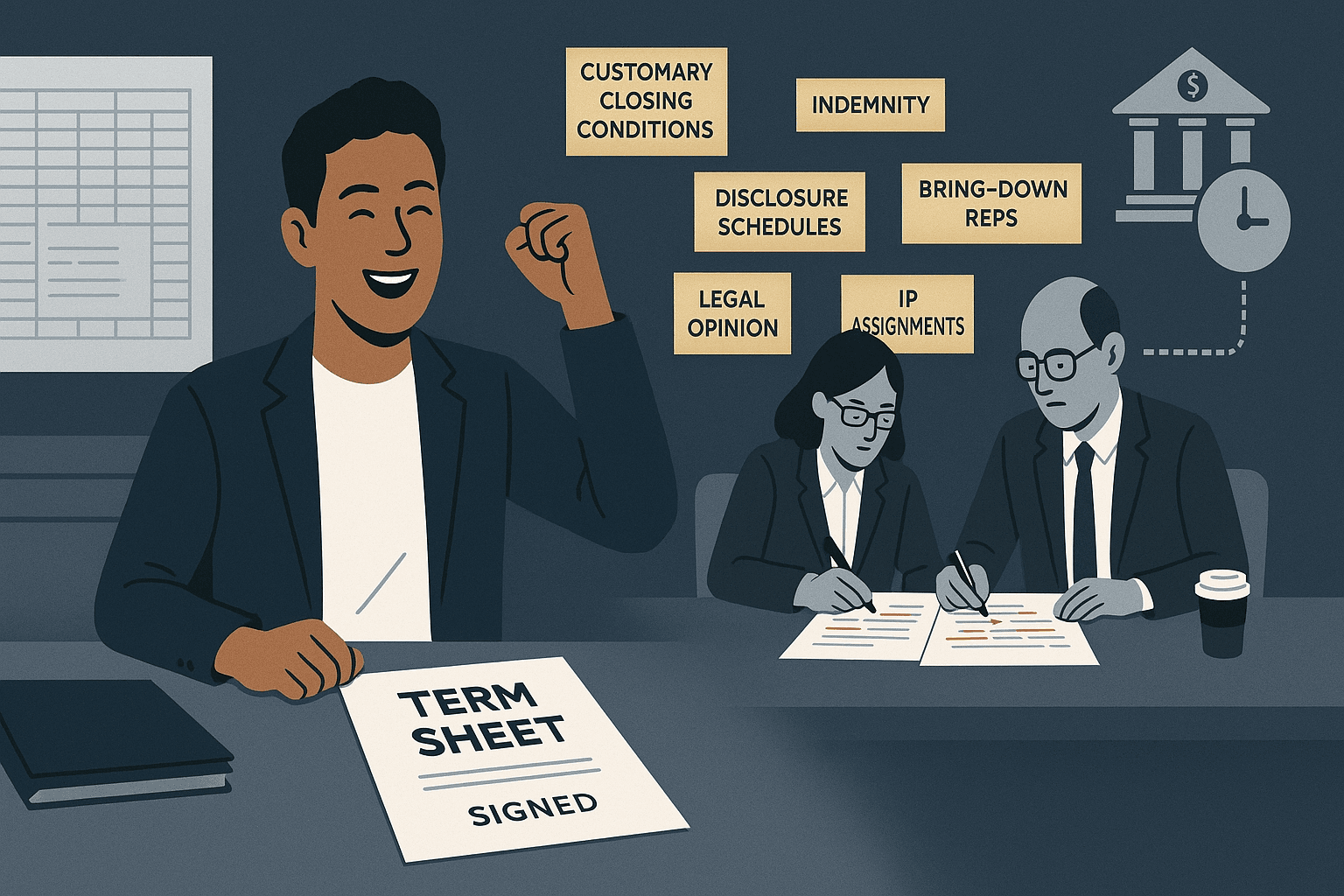
How VC counsel can turn customary closing conditions into a second negotiation after a signed term sheet, and how to head it off.
A founder thinks the hard part is over: valuation is set, board structure is agreed, pro rata is understood, liquidation preference is on paper, option pool is modeled, and the investor has sent the congratulatory email saying they are “excited to partner.” Internally, the company tells key employees the round is done. A press strategy gets drafted. Hiring plans start moving. Sometimes the founder even begins spending against the expected cash.
Then the financing documents arrive.
Suddenly, the deal that looked crisp at the term sheet level turns into a sprawling legal process: stock purchase agreement, investors’ rights agreement, voting agreement, right of first refusal and co-sale agreement, amended charter, management rights letter, disclosure schedules, secretary’s certificates, officer bring-downs, board approvals, stockholder approvals, payoff letters, side letters, employment cleanup, IP assignment repairs, 409A questions, data-room requests, and closing conditions described as “customary.”
This is the trap. Not because closing conditions are fake. Many are real, and some are necessary. The trap is that “customary closing conditions” is often treated as a neutral administrative phrase when, in practice, it is a source of leverage. It gives investor counsel room to reopen risk allocation, timing, and in some cases economics without changing the headline terms of the signed term sheet.
Founders who do not understand this dynamic often discover too late that a signed term sheet is not the end of negotiation. It is the end of only the first negotiation.
The second one happens in the papering and closing process, where the pressure is asymmetric. The company needs the money on a timeline. The investor has not wired yet. Counsel can frame asks as market-standard diligence or routine protection. Every extra disclosure, indemnity, rep, cleanup item, and closing deliverable increases the cost of saying no.
If you are a founder, the right way to think about closing conditions is simple: they are not just legal plumbing. They are a leverage system.
The real scenario founders walk into
Consider a company raising a $12 million Series A at a $48 million pre-money valuation. Post-money is $60 million. The lead is taking $8 million, two smaller funds are taking $4 million collectively, and the option pool increase from 8% to 12% is already baked into the pre-money.
On the model the founder and CFO circulated, the round is painful but manageable:
Approximate ownership after close:
The founder signs the term sheet believing the key dilution points are settled.
Then company counsel receives the first draft financing documents from investor counsel, and the following issues surface:
That last line is where founders get hurt.
Because of course it changes economics. Not always in stated price per share, but in real value transfer:
A delayed wire is an economic term even if it does not appear in the valuation line.
Why current founder approaches fail
Most founders make three mistakes.
1. They treat “customary” as non-negotiable
“Customary” is one of the most abused words in venture financing.
Sometimes it means “this appears in the NVCA forms.” Sometimes it means “our counsel likes this.” Sometimes it means “we do this for all deals above $X.” Sometimes it means “we are using legal process to get protection we did not negotiate commercially.”
The mistake is accepting the word as if it ends analysis.
The right question is not whether a provision is customary in the abstract. The right questions are:
A $4 million seed extension and a $75 million growth round should not carry the same diligence expectations. A company selling developer software to mid-market customers should not be held to the same privacy compliance representation package as a company monetizing sensitive health data at scale.
2. They assume legal details cannot move business terms
Founders often distinguish “business points” from “legal points,” then spend attention only on the former.
That is backwards.
The biggest closing-stage shifts often happen through legal drafting that indirectly changes leverage or economics:
These are business points wearing legal clothing.
3. They start diligence cleanup after signing
By the time diligence turns up assignment gaps, bad cap table records, unsigned options, missing board approvals, open-source issues, tax nexus questions, or non-compliant contractor arrangements, the company is negotiating from weakness.
The investor has an executed term sheet, reputational cover, and no obligation to fund until conditions are met. The founder has a shrinking runway and internal momentum built around expected capital.
The founder’s best leverage on closing conditions exists before signing the term sheet, not after.
The core insight: closing conditions are a pricing mechanism in disguise
The central mistake is thinking price is only valuation.
In real financings, price is a package made up of:
A round priced at a $48 million pre can be worse than a round priced at $45 million pre if the higher-valuation deal comes with brutal closing conditions, broad reps, side-letter creep, a large pre-close option pool reset, and a high risk of delay.
Investors know this. Good ones manage it responsibly. Aggressive ones use it deliberately.
Here is how the stealth repricing happens.
The mechanisms counsel uses to reopen the deal
1. Disclosure schedules as pressure multipliers
Disclosure schedules are supposed to qualify representations. Properly used, they protect both sides by identifying known exceptions.
In practice, they also expose every organizational weakness under deadline.
If your financing docs say the company represents that it owns all IP, is compliant with all laws in all material respects, has no defaults under material contracts, and has properly issued all equity, then the schedules become a scavenger hunt for exceptions.
That hunt becomes leverage when:
Example:
A company with $300,000 monthly burn expects a close in 21 days. Diligence reveals:
None of these alone should kill the round. But together they create document friction. The close slips 30 days. That costs roughly $300,000 in additional burn, plus perhaps $35,000 extra legal fees, plus lost recruiting momentum.
If the lead then says, “We can still close this month if the company agrees to expand the option pool by another 3% pre-close so you can hire the VP Engineering we think you need,” that is not separate from the delay. The delay created the leverage for the ask.
On an 10,727,273 share post-close cap table, an extra 3% pool reserve is about 321,818 shares. At a $6.00 Series A price, that is about $1.93 million of implied value shifted from existing holders to future hires. Maybe the company needs the pool. Maybe it does not. But if the ask arises because closing pressure weakened the founder, the legal process has functionally repriced the deal.
2. Reps and warranties broaden until normal startup mess looks like breach risk
Many startup financings use NVCA-style rep packages. That does not make every rep package founder-friendly.
The danger is not the existence of reps. It is scope, qualifiers, knowledge standards, and interaction with closing conditions.
Watch for:
If those reps must be “true and correct” at signing and closing, the investor has a tool to revisit perceived risk after the term sheet.
A better founder position is usually:
3. Bring-down conditions turn paper breaches into funding vetoes
A bring-down condition says the company’s representations are true at closing, often with some qualifier.
This seems normal. It is normal. But the drafting matters enormously.
If the condition says all reps must be true and correct in all material respects at closing, you have one standard. If “fundamental reps” must be true in all respects and all others true in all material respects, you have another. If some reps are MAE-qualified and some are not, investor counsel can weaponize the distinction.
Founders should care because many startup facts evolve during the weeks between signing and closing:
A hard-edged bring-down can give investor counsel grounds to delay closing while “evaluating” whether the new fact breaches a rep. Again, that pressure often ends in concessions outside the term sheet.
4. Indemnity language that does not belong in a plain-vanilla financing
In a standard preferred stock financing, the company makes reps. Some post-close survival is common. But broad indemnification concepts can become abusive if they effectively convert startup risk into a post-close claim regime.
Red flags include:
If an investor wants protection for a known issue, force precision. Example: if there is a specific sales tax exposure estimated at $80,000 to $150,000, do not accept vague indemnity language covering all tax noncompliance everywhere forever. Quantify the issue, disclose it, discuss whether it is immaterial in context of a $12 million round, and limit any special treatment to that issue if treatment is warranted at all.
5. Legal opinions and counsel deliverables as timing choke points
A legal opinion from company counsel can be routine, but it is never free.
It costs money, takes drafting cycles, and requires company counsel to get comfortable with the underlying records. If your corporate housekeeping is weak, opinion prep can reveal problems late.
Investors sometimes insist on opinions that go beyond what the stage justifies. Founders should ask:
A 10-day slip caused by opinion wrangling at $300,000 monthly burn costs about $100,000 of runway. Add $20,000 to $40,000 in extra legal work and the “customary” opinion has real economic weight.
6. Employee invention assignment fixes as leverage on governance or vesting
One of the most common real diligence issues is missing or defective invention assignment documentation.
Sometimes it is minor. Sometimes it is existential, especially if core product code was built by contractors or former employees before proper assignment paperwork existed.
Investors are right to care. Founders are wrong if they ignore it. But this is also fertile ground for overreach.
A sensible response to missing assignments might be:
An aggressive response might be:
That is a different deal from the one in the term sheet.
7. Side letters and “operational covenants” that creep into governance
After diligence, investors often feel they understand the company more specifically than they did at term sheet stage. This is when bespoke asks appear:
Some of these are fine. Some are direct governance expansion that should have been negotiated as control terms, not introduced as closing cleanup.
If the investor wants a board-level governance right, it should be discussed as a governance right.
Where founders actually have room to push back
Founders are often told they have no leverage after signing. That is false. Their leverage is narrower, but it exists.
Push back area 1: scope, not existence
You will rarely win by rejecting entire categories of closing conditions. You can often win by narrowing them.
Examples:
This is the practical founder move: not “no,” but “narrow, specific, and proportional.”
Push back area 2: convert closing conditions into post-close covenants
If an issue is real but not fundamental to funding risk, try to move it out of closing.
For example:
A company on 6 weeks of runway should not lose a financing because one legacy consulting agreement needs a better exhibits package. Offer a covenant: fix within 30 or 60 days post-close, report completion to the board, and disclose the issue now.
Investors may agree if the issue does not truly undermine the financing.
Push back area 3: resist founder personal liability for company messiness
One of the cleanest founder lines in the sand is this: ordinary company diligence issues should not mutate into founder personal indemnity.
Fraud is different. Intentional misconduct is different. But sloppy early-stage company process is common and should generally be handled through disclosure, company reps, and targeted remediation, not by turning founders into guarantors.
Push back area 4: force consistency with the term sheet’s commercial allocation
If the investor negotiated a 1x non-participating preferred, standard board, and normal protective provisions, then asks during closing for covenants that effectively create extra control or downside protection, call it what it is: a new business ask.
You can say, directly:
“This wasn’t part of the commercial agreement. If there is a company-specific risk you want addressed, let’s address that risk narrowly rather than introducing a broad new right.”
That framing matters. It strips away the “just legal” disguise.
Push back area 5: use competitive dynamics even after signing
If you had multiple interested funds before signing, do not let that optionality disappear psychologically. You may not want to restart the process, but investor counsel should know the company will not accept endless expansion of terms under the label of customary.
The strongest founders remain willing, at least credibly, to slow-roll or replace an overreaching lead rather than accept a bad final package.
Term sheet comparison: same valuation, very different actual deal
Here is a simplified comparison.
Deal A: “clean” term sheet and closing package
Deal B: same headline terms, aggressive closing package
Now quantify some effects.
Assume monthly burn is $300,000. Deal B takes 28 days longer, costing roughly $280,000 in runway relative to Deal A. Extra company legal fees are $65,000. The additional 3% option pool top-up shifts about 321,818 shares away from existing holders.
If the post-money value proxy is $60 million, 3% of that is $1.8 million of dilution impact before considering future upside. Add the $345,000 combined timing and legal hit, and the practical value transfer versus Deal A is already over $2.1 million. That is before assigning value to added investor control from the side letter or downside from survival/indemnity exposure.
Same valuation. Different deal.
Negotiation scenario: how stealth repricing actually sounds in the room
Investor counsel rarely says, “We’d like to change the economics.”
It sounds more like this:
The founder response should also be calm, but precise:
This is how sophisticated founders separate real diligence from opportunistic leverage.
The pre-signing closing-issue checklist founders should prepare
If you do one thing before signing a term sheet, do this: build a closing-risk memo with your counsel.
Not a generic data room. A specific memo on the issues most likely to become closing leverage.
Corporate and cap table
IP chain of title
Employment and contractor issues
Commercial contracts
Compliance and regulatory
Litigation and disputes
Financing process mechanics
That last category is underused. Founders should negotiate process terms in the term sheet more often than they do.
Terms to consider adding before signing
If you expect any diligence complexity, try to anchor expectations in the term sheet or side email before signing.
Examples:
These are not magic words. But they create reference points. If investor counsel later overreaches, company counsel can point to the process understanding embedded at signing.
How founders should work with counsel during the second negotiation
The quality of company counsel matters enormously here.
You want counsel who does three things well:
Ask your counsel explicitly, line by line:
If your lawyer cannot answer those questions clearly, you may have a documents lawyer when you need a financing strategist.
What good investors do differently
Not all investors abuse closing mechanics. The best ones do the opposite.
They surface likely diligence sensitivities before signing.
They distinguish real risk from startup mess.
They do not use legal process to claw back commercial concessions.
They limit company-side costs and aim to close on time.
They push for targeted fixes where needed and avoid turning every imperfection into a condition precedent.
Founders should notice this behavior. It is predictive. Investors who are fair in papering are often fair in board dynamics later. Investors who use ambiguity and process to extract value before first wire often do it again when the company is under stress.
The takeaways
A signed term sheet is not a finished financing. It is a framework for a financing that can still be reshaped materially during closing.
“Customary closing conditions” are not harmless boilerplate. They are a zone where leverage, timing, and risk allocation get renegotiated.
The investor does not need to change valuation to change the deal. Delay, legal cost, option pool creep, broad reps, harsh bring-downs, side covenants, and overreaching indemnity can transfer real value while preserving headline optics.
Founders have room to push back, but mostly on scope, proportionality, and sequencing. The best moves are to narrow reps, qualify bring-downs, cap opinions, disclose specifically, and convert non-fundamental issues into post-close covenants.
The most important moment is before signing the term sheet. If you know your weak spots in cap table records, IP chain of title, employment paperwork, tax, privacy, and contract deviations, you can prevent legal diligence from becoming a stealth repricing tool.
The right founder mindset is blunt: if a purportedly customary closing condition changes leverage, timing, control, cost, or dilution, it is not “just legal.” It is part of the price.
Treat it that way before the celebration, not after.
RaiseSimpli Team
Author