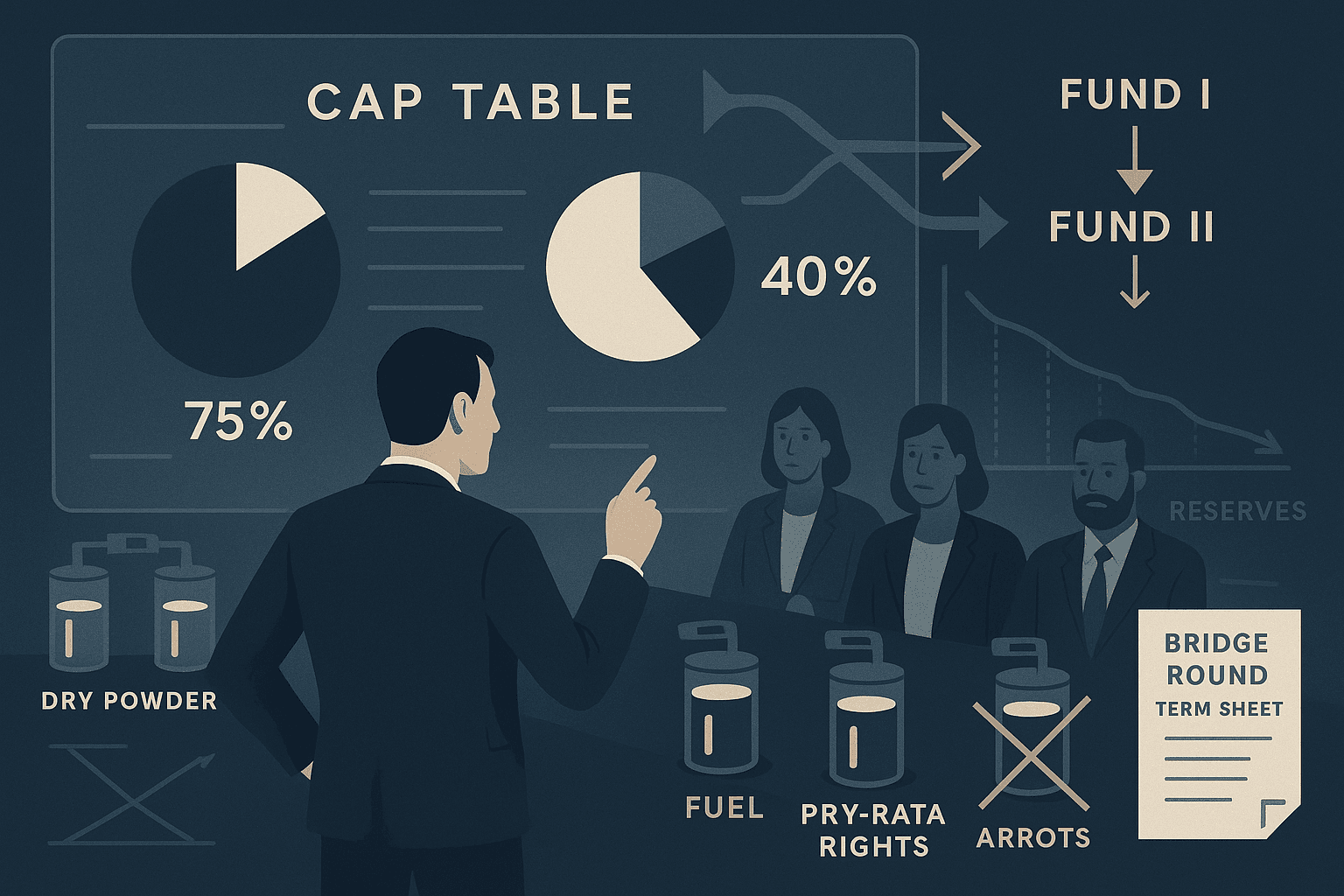
How VC reserve models can kill your inside round before it starts, and how to test whether existing investors can really fund their share.
The company is not dead. Growth has slowed but not collapsed. The new product is working, just later than planned. Cash runs out in five months. Management proposes a $3 million insider bridge to buy 12 more months, hit the next product milestone, and raise a proper Series B.
On the call, the signals sound good. One existing investor says, “We’re supportive.” Another says, “We don’t want this company to fail on our watch.” A third says, “We should all do our pro rata.” Nobody is hostile. Nobody is walking away. The board leaves with a rough sense that the round should come together.
Three weeks later, it is obvious the money is not there.
The largest insider can only do a fraction of its share. Another wants to participate but says the fund is “fully reserved.” A third says the opportunity is attractive but falls outside the fund’s concentration limits. One firm asks whether its newer fund can invest, then disappears into conflict-check purgatory. Another offers a tiny check conditioned on a punitive structure that effectively resets the company. Suddenly the “supportive insider bridge” was never real capital. It was emotional support masquerading as financing capacity.
This is one of the least understood failure modes in venture-backed companies: the dry powder mismatch. Founders hear positive board-level intent and infer actual funding ability. But insider follow-on behavior is driven less by sentiment than by reserve models, fund age, portfolio construction, ownership targets, internal mandate rules, and cross-fund politics. The result is brutal: the people most aligned in principle may be structurally unable to save you in practice.
If you do not understand how your investors underwrite reserves, what they are optimizing for, and what constraints govern follow-ons, you can walk straight into a financing process built on money that never existed.
This matters even when your insiders are genuinely founder-friendly. In fact, it matters most then. Bad actors are easy to identify. Good actors with no dry powder are much more dangerous because they keep signaling support long after the economics say no.
The problem is not whether insiders like you
Founders often frame insider financing as a relationship question.
Do they believe in us? Are they willing to defend the mark? Do they want to avoid signaling risk in the market? Will they support us through a temporary drawdown?
Those questions matter. But they are secondary.
The primary question is mechanical: does this specific investor, in this specific fund, at this specific moment, have both the legal ability and portfolio-level economic incentive to put more money into your company?
That sounds obvious. In practice, founders rarely diligence it. They rely on softer heuristics:
All five heuristics can be wrong.
A venture firm may manage billions, but your board partner is investing out of one aging $250 million fund with a nearly exhausted reserve bucket. The firm may reserve heavily at the platform level, but only for companies above a strict graduation threshold. They may have done pro rata in your last round because the mark was moving up and the decision fit the fund’s ownership maintenance model; that tells you little about a bridge at flat or down economics. They may have led your A but only budgeted one expected follow-on check. And “defending the company” may be impossible if doing so would push exposure to a single asset beyond internal limits.
The boardroom language of support hides a simple reality: venture funds are not bank accounts. They are constrained pools with pre-committed portfolio math.
Why current founder approaches fail
When founders realize they may need insider capital, they usually make one of three mistakes.
1. They ask for support too late
By the time the company needs the bridge, the investor’s reserve decisions have already effectively been made.
Reserve planning is not improvised the week your cash dips below six months. A fund has usually mapped expected follow-ons across the portfolio years in advance, then revised allocations as winners emerge and laggards stall. If you arrive asking for $2 million to $5 million on short notice, your investors are not deciding from a blank slate. They are deciding whether to reallocate from another portfolio company, violate a concentration limit, ask LPAC counsel about edge-case latitude, or spend political capital inside the partnership to back a company no longer on the internal “must defend” list.
That is not impossible. But it is very different from “our insiders are supportive.”
2. They model pro rata as available capital
This is probably the biggest analytical error in venture-backed fundraising.
Founders see an investor owning 15% and assume that investor can write 15% of the next round. Or they hear “we always try to maintain ownership” and build financing plans around that sentence.
But pro rata is a right, not a budget. Ownership maintenance is a preference, not a guarantee. And in many funds, the reserve model is explicitly designed to maintain ownership only in a subset of breakout companies.
A fund may invest in 30 companies and expect to defend maybe eight aggressively, selectively support another 10, and let the rest dilute. Unless you know which bucket you are in, “we have pro rata” means almost nothing.
3. They interpret board enthusiasm as investment committee approval
Partners can be sincere and still not control the decision.
A board partner may want to support you but need approval from an internal investment committee, valuation committee, conflicts committee, or the other partners whose reserves would effectively be diluted by your bridge. Supportive language at the company level often collides with discipline at the fund level.
This is especially acute in down markets. When distributions are weak and fresh fundraising is harder, firms protect reserves more tightly. The phrase “we’re still evaluating support” often means “we have not won the internal argument.”
The core insight: inside rounds are shaped by reserve math, not narrative loyalty
Founders need a harder mental model.
Your insiders are not one thing. Each is a fund with a finite reserve strategy, a portfolio construction model, and internal constraints that may have little to do with what they say in the boardroom.
The practical question is not “Will they support us?” It is:
If you can answer those five questions for each major insider, you will have a much cleaner picture of what your “inside round” really is.
How reserve models actually work
Not every VC fund reserves the same way, but the patterns are consistent enough to matter.
Imagine a $300 million early-stage fund.
A simplistic founder view says: if they deploy $2 million initial checks into 30 companies, that is $60 million deployed, leaving $240 million for follow-ons. Great, tons of dry powder.
That is fantasy. Real reserve modeling is tighter.
A more realistic sketch might look like this:
Still sounds large, until you remember that reserve pools are not free-floating.
Suppose the fund’s strategy assumes:
That might translate to something like:
Total: $180 million
Now imagine you are one of the middle 10 companies. Your board partner may like you, but your reserve envelope may effectively be $6 million for the entire remaining life of the company from that fund, not “whatever is needed.” If the fund already put $2 million of follow-on into your last extension round, there may only be $4 million left in the internal model, and even that may require hitting milestones.
That is before accounting for markups, reallocations to stronger performers, and concentration caps.
The five hidden constraints that kill insider rounds
1. Reserve exhaustion
This is the most obvious and the most underestimated.
A fund can run out of practical reserves long before it runs out of legal life.
Suppose your lead investor owns 18% of the company after the Series A. You need a $4 million bridge. If everyone invested pro rata, that lead would contribute $720,000. Founders hear that and assume it is manageable.
But if the fund has 22 active portfolio companies and five of them are now demanding inside support at the same time, the reserve problem compounds fast.
Example:
The partner may believe your company deserves support. The reserve model says the marginal dollar is worth more elsewhere.
This is how firms become “supportive but unavailable.”
A useful founder distinction:
These are not the same thing.
2. Fund-age constraints
Older funds behave differently, even if they technically can still invest.
A classic venture fund has a 10-year life, often with extension options. Early in the fund, follow-on decisions are flexible. Later, they tighten. Why?
Because older funds are managing for:
Consider two identical companies needing a bridge.
Investor A would fund through a year-3 fund.
Investor B would fund through a year-8 fund.
The same $1 million check has different economics. In year 3, the fund may still have years to support subsequent rounds and wait for exit timing. In year 8, that check may imply one more bridge, then another, and an exit that lands deep into extension years. Even if the company could be a good outcome eventually, it may no longer fit the fund’s time horizon.
Founders regularly miss this. They hear “we still have reserves in that fund.” That does not answer whether the fund wants to start a new support cycle this late.
3. Ownership maintenance targets
Many firms do not reserve based on simple “company support.” They reserve based on target ownership in likely winners.
That changes everything in insider rounds.
Suppose a fund’s model requires maintaining at least 10% in companies believed capable of returning the fund. If a company has already diluted from 18% post-A to 11% post-B and now needs a bridge likely followed by a priced round led by outsiders, the internal question becomes: can this investor defend enough ownership to keep the eventual upside meaningful?
Here is the uncomfortable math.
Assume:
This is why you sometimes see an investor either do much more than pro rata or nothing meaningful at all. Incremental support that fails to preserve strategic ownership can be economically irrational under their model.
For founders, this creates a trap: a reasonable-sounding bridge may be too small to re-convince outsiders and too dilutive to justify insider reserve usage. Everyone likes the bridge in theory, but no one likes the ownership math.
4. Recycling limits
Recycling is one of the least discussed constraints outside LP circles.
Some funds can recycle a portion of realized proceeds or early exits back into new or follow-on investments. Some can do this only up to a cap, often expressed as a percentage of commitments. Some have much narrower authority in practice than their documents suggest.
Why founders should care: firms often talk about “we have more room because we’ve had exits,” but that room may not be fully recyclable or may already be earmarked.
Example:
If your board partner informally references prior realizations as support for a bridge, that is nice context, not proof of capacity.
5. Cross-fund conflicts
This is where many founder assumptions go to die.
Let’s say your original investor used Fund III for the Series A. Fund III is tight. The partner says, “Maybe Fund IV can participate.” Founders hear this as a solution.
It is often a minefield.
Cross-fund investing raises hard questions:
Some firms allow this. Many restrict it heavily. Even when allowed, it may require external valuation support, conflicts committee approval, or pricing terms that make the deal unattractive.
A founder hearing “we might use the next fund” should translate that as: we have not solved the problem yet.
A real cap table example: why the bridge falls apart
Let’s model a company heading into a bridge.
Current cap table
Total: 100%
The company raised:
Now revenue growth slows. The company has 5 months runway. It wants a $5 million bridge via convertible notes or SAFE-equivalent structure to reach 12 months runway and launch a new enterprise product.
Management’s assumption:
Looks plausible.
Now let’s look through investor lenses.
Series A lead’s reserve lens
Fund facts:
That leaves, in practical terms:
Sounds okay, until the partner’s IC memo classifies the company as mid-tier, not top-third. Under the reserve model, this company may only merit another $500,000 to $750,000, not $900,000 or more.
Seed fund’s lens
Your bridge plan assumes $600,000. The seed fund may offer $150,000 as a signal check or decline entirely.
Other A investors’ lens
These smaller funds may each own 2% to 3%. Pro rata checks are not huge individually, but each requires internal justification. For a small fund with a 2.5% stake, pro rata on a $5 million bridge is just $125,000. Founders assume that is easy.
But tiny checks are often the first to disappear because they do not buy influence, do not preserve meaningful ownership, and still consume process time. Ironically, checks small enough to seem “obvious” are often economically irrelevant to the investor.
Result
Expected insider round:
Total expected from modeled pro rata: $1.9 million
Total realistically available: maybe $750,000 to $850,000
That is the dry powder mismatch.
Your financing plan is short by over $1 million before the process really begins. And because management has delayed external outreach while “organizing insider support,” runway has deteriorated and leverage is gone.
Why term sheet structure often makes the mismatch worse
Founders commonly propose inside rounds in structures investors say they like but reserve models quietly hate.
Structure 1: Uncapped or lightly capped SAFE/notes to “move fast”
Problem: if the bridge is really buying time to a repriced round, investors may dislike the uncertainty. The reserve committee cannot clearly model resulting ownership. For funds optimizing minimum ownership thresholds, that ambiguity reduces willingness to commit meaningful follow-on dollars.
Structure 2: Flat-priced insider extension
Problem: sounds fair, but may create cross-fund conflict if newer funds participate, and may still not be attractive enough for outsiders later. Existing investors worry they are spending reserves at a valuation that neither resets the story nor protects downside.
Structure 3: Deeply discounted insider bridge with punitive terms
Problem: this may solve insider downside protection but can poison the next round, crush morale, and trigger founder resistance. It also signals the insiders themselves do not believe the prior mark.
Structure 4: Pay-to-play
This can work because it forces decision clarity.
If the company needs $4 million and existing preferred holders must invest pro rata or lose certain rights/conversion preferences, investors are pushed to reveal true capacity. Pay-to-play flushes out fake support quickly.
But it only works if:
Without those conditions, “we’ll do a soft pay-to-play” often becomes another boardroom fantasy.
Negotiation scenario: supportive partner, impossible fund
Here is a realistic dialogue.
Founder: “Can you do your pro rata in a $3 million bridge?”
Partner: “We want to support the company.”
Founder: “Great. That would be about $540,000 for you.”
Partner: “We need to see the full plan and what the rest of the syndicate does.”
Translation: we do not want to commit before understanding whether our check would be catalytic or just stranded.
Founder: “If we had 60% of the round covered, could you anchor?”
Partner: “Our fund is a bit tight, but we’re looking at options across the platform.”
Translation: the original fund may not have reserve room, and using another fund is politically difficult.
Founder: “What size check could clear internally?”
Partner: “It depends on round terms and milestone confidence.”
Translation: a small check might clear, but only if structure and expected dilution fit ownership math.
The founder hears ambiguity and keeps hoping. The better move is to force specifics:
This feels confrontational. It is not. It is basic financing diligence.
How to reverse-diligence insider capacity before you need money
Do this when you have 12 to 18 months runway, not 12 weeks.
1. Map each insider by fund, not by firm
You do not have “Sequoia” or “Benchmark” or “BigName Ventures” on your cap table. You have a specific fund vehicle and partner.
Ask and record:
This alone clarifies more than most board conversations.
2. Ask reserve philosophy explicitly
You are not asking for confidential portfolio details. You are asking how they think.
Questions:
Good investors can answer these cleanly. Evasive answers are themselves useful data.
3. Stress-test their pro rata language
When an investor says, “We intend to do our pro rata,” the founder-grade follow-up is: “Under what conditions would that no longer be true?”
Push until you understand the actual caveats:
That is the real pro rata statement.
4. Ask about bridge appetite before you need one
Not because you plan to need it, but because every company should understand syndicate behavior under stress.
Questions:
If that process takes six weeks and two committees, you should know that before runway compresses.
5. Look for portfolio-level signals
You may not see exact reserve balances, but you can infer a lot.
Signals of tighter insider capacity:
None of these prove reserve exhaustion. Together, they often indicate it.
How to structure rounds that fit investor reserve math
If you understand investor constraints, you can design rounds with much higher odds of closing.
1. Right-size the round to a specific milestone, not maximum comfort
A bridge should buy exactly enough time to reach a financing inflection, not enough time to feel safe.
If insiders can realistically support $2.5 million and you ask for $5 million “to have cushion,” you may kill the round. Smaller rounds can fit reserve envelopes and concentration rules better.
Example:
Option B is often more financable because investors can underwrite a nearer milestone and smaller ownership hit.
2. Match structure to ownership logic
If a fund cares about preserving meaningful ownership, a simple priced extension may work better than an uncapped note. If newer-fund participation is necessary, independent pricing support may reduce conflicts. If syndicate free-riding is a concern, pay-to-play may be appropriate.
There is no universally best structure. There is only structure that fits the reserve and governance realities of your cap table.
3. Anchor with one real check, not broad soft support
A round with one committed $1 million insider check is worth more than four “likely” $250,000 checks.
Force early specificity:
Inside rounds die from diffusion of responsibility. Everyone waits to see what everyone else does.
4. Consider an external micro-lead early
Sometimes the smartest move is not persuading insiders to fully fund the bridge but using one credible new investor to price and validate it. Even a $1 million to $2 million external anchor can unlock insider participation by solving valuation ambiguity and signaling discipline.
Yes, this may be more expensive. It is often cheaper than discovering too late that insiders cannot coordinate around an unsupported bridge.
Practical founder checklist
Before you ever rely on insider capital, answer these questions in writing.
For each major investor:
Then build three financing cases:
Case A: Full insider support
Example:
Case B: Partial insider support
Case C: Minimal insider support
n- Others: $0 to $100,000 total
If Case C breaks the company, your funding plan is too dependent on goodwill.
The uncomfortable truth about pro rata promises
The venture industry overuses a phrase founders should treat with caution: “We reserve for our winners.”
That sounds founder-friendly. It is not a commitment. It is a sorting mechanism.
Your investor may genuinely reserve for winners and still not reserve for you.
The harder truth: by the time a bridge is needed, many funds have already revealed their internal view through reserve allocation, even if they have not said it out loud. If they are hesitant, opaque, or strangely process-heavy about a modest insider round, the issue is often not your deck. It is that your company no longer fits their reserve priorities.
Founders should stop treating insider support as an abstract relational asset and start treating it as a per-fund underwritable resource. Reverse-diligence it early. Ask what conditions break pro rata. Understand whether your round structure fits investor ownership logic. And never mistake board warmth for fund capacity.
Because the inside round that dies “unexpectedly” usually did not die in the meeting where investors passed. It died much earlier, inside a reserve model you never saw.
Takeaways
The founders who navigate hard financings best are not the ones with the most supportive-sounding boards. They are the ones who understand the hidden portfolio math on the other side of the table.
RaiseSimpli Team
Author