Founder Vesting Resets: A Series A Negotiation Guide
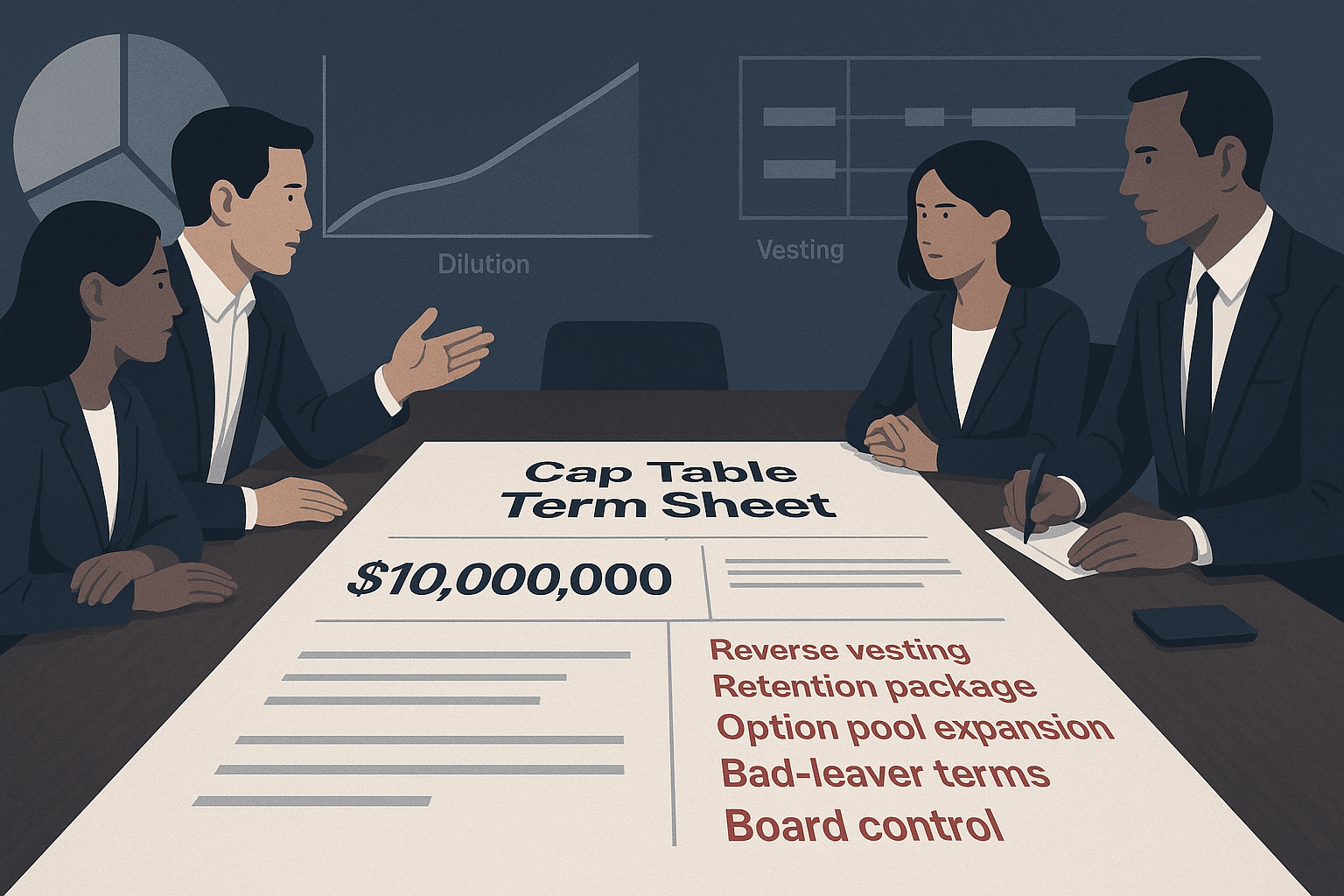
How new lead investors re-underwrite founder earn-in through vesting resets at Series A, and how to negotiate credit for time already served.
Then the legal docs arrive.
Buried outside the headline economics is a different transaction entirely: part of the founder’s already-earned equity is put back at risk. Some shares become subject to reverse vesting. Some future ownership is shifted into a board-controlled retention grant. Some acceleration rights are narrowed. Some bad-leaver definitions get rewritten. An option pool expansion is layered on top. A founder secondary is framed as “liquidity,” but it becomes the justification for a tougher vesting reset. Nothing in the announcement says recap. Nothing in the valuation says haircut. But the founder has, in substance, been re-underwritten.
This is the founder vesting reset trap.
It matters because many Series A financings are no longer just capital raises. They are control events. The visible price per share tells you one thing. The combination of vesting refreshes, board-linked retention packages, and post-closing governance tells you something more important: who really owns the next four years of value creation, and on what conditions.
The contrarian point is simple: a vesting reset is not automatically abusive. Sometimes it is the right answer. If a company has meandered for years pre-institutional financing, the founding team has changed roles, and the lead is taking genuine company-building risk, some re-vesting can be entirely market. But founders routinely make the mistake of evaluating these terms as HR mechanics rather than economic and control terms. They are neither cosmetic nor secondary. They are another pricing layer.
If you do not model them like dilution, governance transfer, and downside reallocation, you will sign away economics while telling yourself you protected valuation.
The problem: headline valuation hides a second underwriting
Investors say they are underwriting the company. In practice, at Series A they are underwriting three things simultaneously:
The first shows up in valuation. The second shows up in governance. The third often shows up in vesting mechanics.
That is where the trap begins.
A lead investor may agree to your target pre-money valuation, but ask for one or more of the following:
Each one can materially change founder economics without changing the advertised Series A price.
This is not semantics. It is equivalent to saying: “We agree the company is worth $40 million pre. We do not agree that you, founder, have fully earned your 18% stake in the next chapter.”
That distinction is the entire game.
Why founders misread vesting resets
Founders usually process these terms through the wrong lens for three reasons.
1. They compare them to employee vesting, not investor pricing
Employee vesting is a forward-looking incentive design. Founder vesting resets at Series A are often a re-trade of already accumulated ownership. If 50% of your founder common becomes subject to a new 4-year schedule, that is not mere retention architecture. It is a conditional re-grant of equity you thought you had already earned.
The investor is effectively saying your stake should behave less like owned capital and more like contingent compensation.
2. They focus on dilution from the round, not dilution from conditional ownership
Founders can calculate financing dilution. They know how a 20–25% round works. They know a 10–15% option pool expansion matters. But they often fail to assign expected-value discounts to vesting conditions.
A share you own outright is not equivalent to a share that can be repurchased if you leave, are terminated without cause under a sloppy definition, or lose a board vote tied to your role.
3. They assume “market” means “benign”
Many lead investors present vesting resets as standard governance hygiene: “Institutional money needs founders locked in.” But market does not mean harmless. Plenty of terms are common precisely because they are useful to the party with leverage.
The relevant question is not whether a reset exists in other deals. The question is whether the specific structure fairly reflects company stage, founder contribution to date, succession risk, and the actual financing context.
What a founder vesting reset really does
A founder vesting reset changes at least four things at once.
1. It re-prices the founder’s role without re-pricing the company
Suppose a founder owns 8,000,000 shares out of 20,000,000 fully diluted pre-financing, or 40%.
The company raises a Series A:
Ignoring deeper details, the founder may think: “I diluted from 40% to roughly 29–31%, depending on pool math. Not ideal, but acceptable.”
Now layer in a term that 50% of the founder’s remaining shares are subject to new 4-year reverse vesting with a 1-year cliff waived but monthly vesting thereafter, plus repurchase rights if service ends.
Economically, the founder still “has” the shares. But a meaningful portion of that stake is now contingent on continued service. In expected-value terms, especially where board control has shifted, that stake is worth less than unrestricted common.
The company valuation stayed the same. The founder valuation did not.
2. It transfers practical control to the board
Unvested founder shares are governed by service conditions. Service is often determined by the board. At Series A, the board often shifts from founder-controlled to investor-influenced.
A typical post-Series A board might be:
That sounds balanced. It often is not.
If the independent is selected effectively with investor veto power and the founder is no longer board majority, then any future dispute over role, CEO replacement, strategic direction, or M&A can affect whether unvested equity remains at risk.
That means vesting is not just economics. It is leverage.
3. It reshapes M&A incentives
If a founder has weak acceleration rights and substantial unvested equity, the board can approve a sale where investors do fine, management gets selective retention packages, and the founder receives materially less than they expected.
This is especially acute in acqui-hire or sub-scale exits, where transaction consideration may be allocated partly to purchase price and partly to retention compensation.
A vesting reset makes it easier to classify founder upside as future service consideration rather than current ownership value.
4. It can convert dead equity concerns into recap mechanics
The charitable justification for founder resets is straightforward: we need active founders fully committed. Fair enough. But that rationale becomes dangerous when used to re-paper a company that over-granted founder ownership relative to current contribution, yet avoids openly negotiating a recap.
In other words, instead of saying “the cap table no longer reflects reality,” the investor says “let’s refresh vesting for alignment.” Same practical direction, softer language.
When a vesting reset is actually market
Not every reset is predatory. Some are sensible. Founders should be precise enough to distinguish the two.
A vesting reset is more likely to be defensible when most of these are true:
A practical market range might look like this:
That is very different from a de facto restart.
When it is a hidden recap by another name
A vesting reset becomes economically recap-like when it does not merely incentivize future service but materially reclaims past-earned equity under board-controlled conditions.
The red flags are obvious once you stop calling them “retention.”
Red flag 1: Full reset on most or all founder shares
If a founder who built the company for 3–5 years is told that 75–100% of their stake must vest again over 4 years, that is not alignment. That is a statement that the prior earn-in is being discounted heavily.
Red flag 2: Reset plus investor-controlled board majority
The combination matters more than the headline term. If the board can influence employment status and employment status governs vesting, the investor has acquired a major economic lever over the founder.
Red flag 3: Reset plus broad bad-leaver language
Bad-leaver terms can include termination for cause, violation of restrictive covenants, fraud, willful misconduct, or material breach. In bad paper, “cause” is drafted so broadly that ordinary disputes can become forfeiture fights.
Worse, some documents allow repurchase of unvested shares at the lower of cost or fair market value, and occasionally impose penalties on vested shares in bad-leaver situations. That is where vesting architecture starts functioning like a confiscation tool.
Red flag 4: Reset justified by founder secondary
A founder selling some shares in the round is not inherently problematic. In many cases it is healthy. But some investors use a modest secondary sale to frame the founder as “de-risking,” then demand a much harsher vesting reset to offset perceived commitment risk.
If you are selling 3–5% of your holdings for basic financial security and, in return, 50% of your remaining stake is re-vested, you may be making an awful trade.
Red flag 5: Reset plus oversized option pool expansion
This is the classic layering problem. A company raises at a nice valuation, but simultaneously:
The founder is diluted on paper and de-risked off paper.
Red flag 6: Performance-based re-vesting with investor-shaped milestones
Milestone vesting sounds meritocratic. It often is not. If vesting depends on ARR, EBITDA, product launch dates, or a next financing, and those outcomes depend partly on board-approved budgets, hiring plans, or strategy shifts, then the founder’s vesting is being tied to variables they do not fully control.
Investors love measurable accountability. Founders should love measurable accountability only when measurement is fair, objective, and not strategically gameable.
Cap table math: how the reset changes real economics
Take a concrete example.
Starting cap table pre-Series A
Series A terms
Assume the pool top-up is effectively borne pre-money, which is standard in investor math even when founders do not say it that way.
After the financing and pool increase, imagine the founder CEO drops from 35.0% to roughly 26.5%, and founder CTO from 15.0% to roughly 11.4%.
On paper, that is ordinary venture dilution.
Now add the investor’s founder retention package:
The founder CEO still legally owns 26.5% post-round. But only 10.6% is fully free and clear if 60% is re-vested. The remaining 15.9% is contingent on continued service.
If you apply any probability that the CEO is replaced, forced into a non-CEO role, or exits before the vesting period ends, the expected economic value of that 15.9% drops sharply.
For example, suppose there is a rough 30% chance over four years of a role transition or termination event that cuts vesting short halfway. That does not mean the founder loses everything, but the expected retained value of those re-vested shares is materially less than headline ownership implies.
Very crudely:
That difference is enormous. It is the difference between “I diluted 24% from my prior stake” and “I effectively gave up another 3–5 points of founder economics without calling it price.”
Now add one more layer: if an M&A event occurs in year two and acceleration only covers 50% of unvested shares, the founder may lose another chunk of purchase-price participation unless the acquirer separately hires them.
Again: same valuation, very different economics.
Term sheet comparison: clean vs loaded Series A
Here is what founders should actually compare.
Term Sheet A: Clean institutional round
Term Sheet B: Higher headline price, loaded founder reset
Most founders instinctively prefer Term Sheet B because of the higher pre-money and personal liquidity.
That can be the wrong answer.
Why? Because the extra $5 million of headline pre-money may be more than offset by:
If the founder’s expected-value ownership under B is 3–6 points lower than under A after adjusting for re-vesting and board control, then the “better” valuation was fake precision. The investor simply moved economics into legal architecture.
The interaction with founder secondaries
Founder secondaries are where this gets politically delicate.
There is a simplistic investor line that any founder liquidity before Series B means reduced hunger. That is nonsense when applied rigidly. A founder taking enough money to eliminate existential personal stress can become more, not less, durable.
But there is also a real issue: once a founder de-risks personally, investors will underwrite retention more aggressively.
That means secondaries and vesting resets are often negotiated together.
Here is the danger pattern:
The real trade may be much worse.
Suppose the founder sells $1.5 million worth of common at the Series A price. Nice outcome. But if the reset materially raises the chance that 4–6% of their remaining stake becomes vulnerable or discounted in an M&A or leadership transition, the founder may have sold cheap and re-bought risk expensively.
The right framing is not “Did I get some liquidity?” It is “What total package of control, remaining ownership certainty, and downside protection did I exchange for that liquidity?”
If there is founder secondary, founders should push harder, not softer, on these points:
A founder secondary should not become an excuse for a silent economic clawback.
Option pool expansions: the other quiet transfer
Vesting resets rarely travel alone. They are usually part of a package with option pool expansion.
Investors defend pool increases because the company needs to hire. Often true. But the timing and burden matter.
A pre-money pool increase means existing holders, mostly founders, pay for future hires before the new investor comes in. If, at the same time, founder equity is re-vested and a fresh management retention grant is authorized, you have multiple claims against the founder stack:
This is where founders should stop discussing “valuation” in isolation.
If your round is advertised as founder-friendly because the pre-money is strong, but your effective ownership, board influence, and retention protections all worsen, then the investor did not overpay. They just paid differently.
Bad-leaver provisions: the nuclear term most founders under-lawyer
Bad-leaver language is often treated as boilerplate until it matters, at which point it matters more than almost anything else.
A standard, fair regime distinguishes clearly between:
And “cause” should be narrow: conviction of a felony, fraud, embezzlement, willful misconduct causing material harm, or material uncured breach.
An abusive regime stretches cause to include failure to follow lawful board directives, breach of policy, reputational harm, or restrictive covenant disputes. That gives the company too much room to transform ordinary conflict into punitive treatment.
Now connect this to re-vesting.
If a founder has substantial unvested stock and broad bad-leaver language, then a board dispute can become an ownership dispute. The investor does not need to openly renegotiate economics later. The legal architecture already gives them optionality.
Founders should insist on:
If those points are not there, your vesting reset is carrying far more risk than the term sheet summary suggests.
M&A outcomes: where founders discover what they really signed
The worst time to understand your vesting package is during a sale process.
Three outcomes are common.
1. Good exit, good protections
The company sells for a strong price. Founder has either no reset or balanced double-trigger acceleration. Everyone participates largely according to ownership. Retention packages may exist, but they are incremental, not substitutive.
Fine.
2. Middling exit, selective allocation
The company sells below breakout expectations but above preference overhang. Investors get acceptable returns. Acquirer wants continuity from key management. The founder has unvested shares and weak acceleration. Some consideration is shifted into retention bonuses or rollover equity for whoever the acquirer keeps.
The founder then learns a painful lesson: ownership percentages are not the same thing as transaction proceeds when service-based conditions sit on top.
3. Acqui-hire or soft landing
The company is sold mainly for team value. Purchase price may barely clear preferences. The board negotiates employment packages with the acquirer. Founders with re-vested stock and weak leaver protections can see much of their theoretical upside evaporate.
In these scenarios, reset mechanics effectively subordinate founder economics to board-managed retention outcomes.
What founders should negotiate instead
If the investor’s real concern is retention and commitment, there are better structures than a blunt reset.
1. Partial reset only on a minority portion of holdings
If some re-vesting is necessary, cap it. For example:
That preserves the distinction between past-earned ownership and future incentive.
2. New top-up grants instead of resetting old shares
Rather than re-papering existing founder common, issue a new incentive grant on top. That is cleaner and more intellectually honest.
If the board believes the founder needs forward incentives, grant additional options or RSAs tied to future service, rather than pretending previously earned stock was never really earned.
Yes, this dilutes everyone slightly. That is the point. If retention is a company need, the cost should be shared, not loaded disproportionately onto founders through hidden recap mechanics.
3. Time-based vesting, not performance-based vesting
Where possible, avoid milestone-heavy re-vesting. Time-based vesting aligns retention without making equity hostage to board-shaped metrics. If performance metrics must exist, keep them objective, binary, and outside ordinary budget manipulation.
4. Strong good-reason and no-cause protections
If any meaningful founder shares are unvested, founders should negotiate:
This one change can dramatically reduce the investor’s ability to weaponize service conditions.
5. Full double-trigger acceleration on sale plus termination
At minimum, unvested founder shares should fully accelerate if:
Anything less invites value reallocation in M&A.
6. Role-transition protection
Many founder disputes are not clean firings. They are “evolutions”: you are no longer CEO, but maybe Chief Product Officer; you report to a hired executive; your responsibilities are materially altered.
Documents should specify that a founder who transitions to another agreed executive or strategic role does not automatically stop vesting. Otherwise “leadership upgrade” becomes a disguised forfeiture tool.
7. Cap option pool sizing and sequence carefully
If the investor wants both pool expansion and founder retention packages, founders should negotiate the combined burden, not each item separately.
Practical asks:
8. Separate liquidity from retention negotiations
If there is a founder secondary, negotiate it as a distinct issue. Do not allow vague “alignment” language to justify broad re-vesting elsewhere.
A reasonable framework might be:
9. Sunset investor control over vesting disputes
If practical, founders should seek procedural protections:
You may not get all of this at Series A, but asking reveals how aggressively the investor wants optionality.
A negotiation scenario with real trade-offs
Imagine a lead says:
“We’re in at $45 million pre, but we need 50% of your shares to re-vest over four years because you’re taking $2 million of secondary and we need retention.”
A weak founder response is: “Can we make it 40%?”
A stronger response is to reframe the issue entirely:
“If your concern is future retention, let’s solve future retention with future incentives, not by re-trading past-earned equity. I’ll limit my secondary to $1 million. In exchange, no reset on vested founder shares. If you need additional alignment, create a new 3-year top-up grant equal to 5% fully diluted, subject to standard double-trigger acceleration and no-cause vesting protection. We can also agree to a market board and a hiring plan-backed option pool.”
That counter does three things:
The investor may resist because transparency is exactly what the reset structure avoids.
Another scenario:
Lead says:
“We can do no reset, but then price is $38 million pre instead of $42 million.”
Now you have a real comparison. Good. Make them surface the economics.
Founders should then model:
In many cases, the clean lower price wins.
That is the contrarian conclusion founders need to internalize: the best term sheet is often not the one with the best valuation line. It is the one where ownership means ownership.
The practical test: is this retention, or is this silent reallocation?
Ask five blunt questions.
- commitment, role clarity, dead equity, secondary optics, or leverage?
- 15% is one conversation; 75% is another.
- if the board controls service status and the board is investor-influenced, price accordingly.
- if the answers are fuzzy, assume the risk is real.
- if not, they know exactly what they are doing.
Takeaways
The founder vesting reset is one of the cleanest examples of how venture deals move economics outside valuation.
Sometimes it is reasonable. Often it is not. The difference lies in scale, governance context, leaver definitions, acceleration treatment, and whether the reset honestly addresses future retention or quietly revises the founder’s historical earn-in.
Founders should stop treating these provisions as background employment terms. They are pricing terms. They are control terms. In weak M&A outcomes, they are proceeds-allocation terms.
A fair Series A can include some founder re-vesting. But a fair reset should be limited, credited, procedurally protected, and paired with strong no-cause, good-reason, and double-trigger safeguards. It should not be stacked with oversized pool refreshes, broad bad-leaver language, and board structures that make forfeiture risk investor-controlled.
The right question is not: “Is this market?”
The right question is: “After all the hidden conditions, what ownership am I actually being asked to earn again?”
If you cannot answer that in cap table math and M&A scenarios, you are not negotiating a financing. You are sleepwalking into a recap with better branding.
RaiseSimpli Team
Author