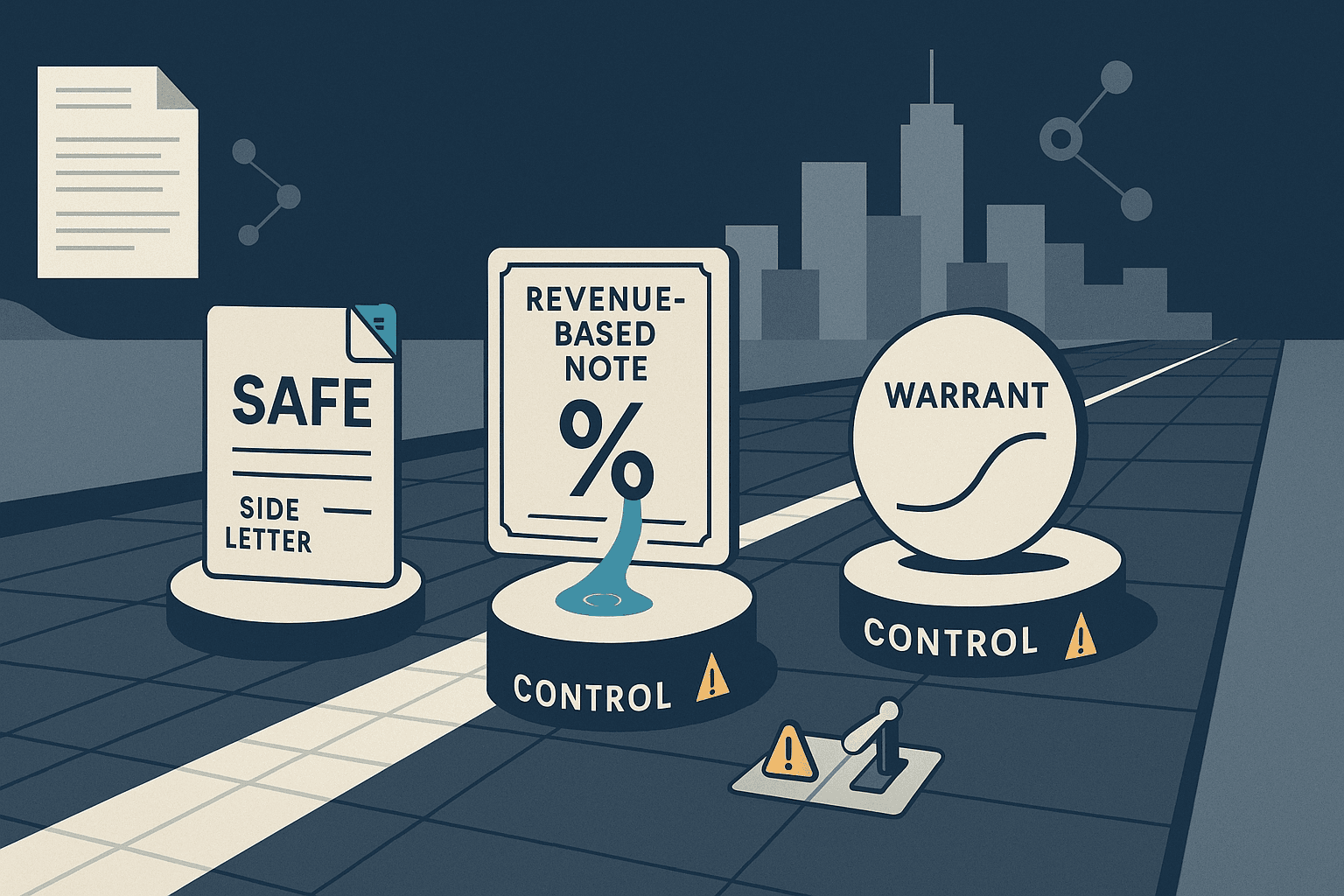
How a synthetic seed uses SAFE side letters, revenue-based notes, and warrants to avoid a priced round, and the tradeoffs founders should weigh.
The premise: why a “synthetic seed” exists
By 2026, the seed market is neither the 2021 party nor the 2008 famine. It’s something more annoying: selective liquidity. Capital exists, but it’s increasingly gated by proof, proof of distribution, proof of retention, proof of margins, proof of security posture, proof you’re not about to get disrupted by the next model release.
In that environment, many teams face a classic dilemma:
They need 9–18 months of runway to reach a “Series A-leadable” milestone.They don’t want to set a low price today (and lock it in) because the next 2–3 quarters could meaningfully change their trajectory.They also don’t want to stack so much non-priced paper that the next lead investor feels they’re inheriting a messy cap table and a set of investor landmines.A “synthetic seed” is a contrarian way to solve that: you engineer the economic and governance outcomes of a seed round without actually doing a classic priced equity round.
In practice, this often means mixing:
SAFEs with side letters (to provide select investors with additional rights, information, or economics without repricing the whole company),Revenue-based notes (a repayment instrument tied to revenue performance, used carefully so it doesn’t strangle growth), andWarrants (to bridge valuation disagreements and compensate for risk without forcing a full equity price).This is not legal advice. It’s a pragmatic, opinionated playbook meant to help founders ask better questions and avoid the most common traps. You should involve counsel experienced in venture and securities law.
---
What you’re trying to optimize (and what you’re trying to avoid)
A synthetic seed should optimize for:
Runway: enough capital to reach a clear value inflection.Optionality: ability to raise a clean priced round later without apology.Fairness: economics that can be defended to both current investors and the next lead.Simplicity: fewer bespoke terms, fewer “special” rights, fewer surprises.And it should avoid:
Hidden control: rights that effectively give seed investors veto power over ordinary company operations.Debt overhang: repayment terms that scare a future lead (or cripple growth).Stacked preferences in disguise: economic terms that behave like preferences but aren’t labeled as such.Governance ambiguity: side letters that conflict with your charter, SAFEs, or each other.A useful test: Can you explain your full financing structure in five minutes to a partner at a top-tier VC without them asking “what else is in there?”
---
Why not just do a priced seed?
Sometimes you should.
A priced seed round is often best when:
You have multiple credible leads (competition makes price discovery easier).The business is already “fundable on metrics,” and you want to set a clean baseline.You want to reset option pool, governance, and investor rights in a standardized way.So why avoid it?
Price anchoring risk: If you’re mid-pivot, pre-distribution, or pre-repeatability, a low price becomes a long-lived scar. Many later investors (fairly or unfairly) anchor on it.Over-negotiation: A priced round invites more governance terms and protective provisions than a simple SAFE round.Time cost: In selective markets, priced rounds can take longer due diligence cycles.The synthetic seed argues: if the company’s value is likely to change materially soon, and you can structure something that is clean enough for the next round, don’t force price discovery today.
---
The three building blocks (and what each one is really for)
1) SAFEs + side letters: standardize the base, customize the edges
SAFEs (Simple Agreements for Future Equity) remain the default early-stage instrument in the U.S., popularized by Y Combinator. They are not debt; they convert into equity upon a priced financing (and sometimes other events).
Side letters are separate agreements granting additional rights to specific investors, commonly information rights, pro rata rights, MFN (most favored nation) protections, or other covenants.
What SAFEs are good for:
Fast fundraisingAvoiding a hard valuationKeeping governance lightWhat side letters are good for:
Giving a lead investor comfort without forcing those terms onto everyoneHandling special cases (strategics, angels who need info rights, funds with policy requirements)The danger: side letters can easily become a shadow term sheet.
If your side letters include vetoes, approval rights over budgets, hiring, product scope, or future financings, you’ve created control without calling it a board seat. That can chill future investors.
Reference points:
Y Combinator SAFE documentation and explanations are widely used as market baselines (see YC’s public SAFE resources).The National Venture Capital Association (NVCA) provides model legal documents and guidance for venture financings; while SAFEs aren’t NVCA’s main focus, NVCA norms strongly influence what later-stage investors expect.2) Revenue-based notes: financing that is paid from revenue, not exits
A revenue-based note (often grouped with revenue-based financing, or RBF) typically repays investors as a percentage of revenue until a cap (e.g., 1.3x–2.0x) is hit, sometimes with a maturity date, sometimes with a conversion option.
What it’s good for:
Businesses with predictable revenue streams (B2B SaaS with low churn, certain marketplaces, vertical software)Bridging to profitability or to a metrics-driven priced roundAvoiding valuation negotiationWhat it’s not good for:
Businesses that need to aggressively reinvest revenue to grow (high CAC, land-and-expand with long paybacks)Pre-revenue companies (RBF becomes either irrelevant or punitive)The 2026 nuance: many “AI-native” companies have revenue early but uncertain durability. RBF can look tempting, until repayments reduce the very growth rate that proves durability.
Reference points:
SEC guidance on what constitutes a security and disclosure obligations remains relevant; many RBF instruments are securities.Broader market commentary from firms like SVB (historically), a16z, and industry legal blogs often discuss venture debt and alternative financing structures; the key is ensuring your structure is understandable to equity leads.3) Warrants: a valuation disagreement solver (and a risk compensator)
A warrant gives the investor the right to purchase shares at a fixed price (exercise price) within a period. Warrants are common with venture debt and sometimes with bridge financings.
What warrants are good for:
Compensating an investor for taking early risk without forcing a lower capAdding “kicker” economics to a note or RBF instrumentSolving the “you want a higher valuation cap than I can justify” stalemateWhat warrants can screw up:
If the warrant coverage is too high, you’ve essentially created hidden dilution.If the strike price or treatment upon conversion is confusing, later investors may demand a cleanup.Reference points:
NVCA venture debt resources and common market practice typically treat warrants as modest percentage coverage, designed to align but not dominate.---
Designing the synthetic seed: a structured approach
Step 1: Decide the minimum amount you need and the milestone it buys
Do not start with “how much can we raise?” Start with:
What milestone makes the next lead VC say yes?How many months to reach it with a realistic burn?What’s the smallest amount that gets you there with a buffer?A synthetic seed should be a bridge to a specific value inflection, not a lifestyle round.
A useful framing:
Base: 12 months to milestoneBuffer: +3 months for varianceConstraint: keep dilution / overhang low enough that a priced round is still attractiveStep 2: Choose your “base instrument” and keep it boring
In most venture ecosystems, the cleanest base is:
Post-money SAFEs with a valuation cap (often YC-style) or pre-money SAFEs if your counsel strongly prefers.Opinionated take: If your goal is “keep the next lead comfortable,” use the instrument they see every day and minimize cleverness.
Where founders get into trouble:
Multiple SAFE templatesMultiple conversion definitionsSide letters that change conversion economicsIf you want to be sophisticated, be sophisticated in how you set economics, not in inventing new legal mechanics.
Step 3: Use side letters to satisfy institutional needs, but cap the surface area
Common side-letter terms that are generally “digestible”:
Pro rata rights (with clear scope: “in the next equity financing,” not forever)Information rights (quarterly financials, annual budget, lightweight)MFN (careful: MFNs can explode complexity if you issue multiple later SAFEs)Side-letter terms that often trigger discomfort:
Consent rights over future financingsAny operational veto (hiring/firing execs, budget approvals)Board observer rights that function like controlRequirements that the company take on debt only with consent (can block venture debt later)How to keep it sane:
One side letter template with optional addendaExplicit statement that side letter does not amend company charter or SAFE termsSunset clauses: rights terminate at Series A or at a defined financing thresholdStep 4: Add revenue-based notes only when revenue quality can support them
Ask three blunt questions:
Is revenue recurring and durable? (Retention, contract length, concentration)Is gross margin high enough? (Otherwise repayments come straight out of oxygen)Does the business require reinvestment of revenue to grow? (If yes, RBF can slow you at the worst time)If you still want RBF, structure it to be non-strangling:
Revenue share low enough to avoid starving growth (often low single digits)Repayment cap that is fair for early risk but not extractiveOptionality to refinance/repay early without punitive penaltiesClear subordination rules relative to future venture debt (later lenders will ask)A common “hybrid” approach in a synthetic seed:
SAFEs for most investorsA revenue-based note for one investor who wants downside protectionThat can work only if the note is clearly bounded and does not create a cash drain that spooks the next equity lead.
Step 5: Use warrants as the bridge between conservative money and growth money
Warrants are a way to say:
“We won’t drop the SAFE cap, but we’ll give you upside if we crush it.”You can attach warrants to:
Revenue-based notesConvertible notesEven, in some cases, equity-like instrumentsKeep warrant economics readable:
A modest coverage percentageClear exercise price logicClear treatment in a priced financing (cashless exercise? net exercise?)A later lead VC will model fully diluted ownership. If your warrants require a forensic audit, you’ve lost the plot.
---
Setting “fair economics” without a priced round
This is where synthetic seeds either become elegant or become poison.
The core challenge: you can’t avoid valuation, only where you encode it
When you set:
a SAFE cap,a discount,a repayment multiple,a warrant coverage,…you are making valuation decisions indirectly.
Your job is to make those decisions defensible.
A defensible way to set a SAFE cap in 2026
What a serious investor will look at:
Comparable seed caps in your sectorYour traction vs peers (revenue, retention, growth rate)Team and domain credibilityTechnical moat (data, workflow lock-in, distribution)Market timing risk (especially in AI categories)A founder-friendly approach:
Pick a cap that you believe is fair if the company stays roughly on planUse discounts or small warrant coverage as the give to early risk-takersAvoid artificially high caps that force punitive “extras” elsewhere (which later investors hate)Discounts vs warrants vs lower caps
If investors push back on cap:
Lower cap: simplest, but most anchoringDiscount: modestly founder-friendly; still converts based on next round priceWarrants: can preserve headline cap while compensating risk, but adds complexityOpinionated guideline:
If the gap is small: use discount.If the gap is medium: consider a small warrant kicker.If the gap is large: you probably have a pricing problem, either accept the cap reality or don’t raise from that investor.Avoiding “stacked economics” that look like preferences
The easiest way to scare off a Series A lead is to create economics that feel like hidden liquidation preferences.
Examples:
RBF note with a high repayment cap plus warrants plus a SAFE side letter with super pro rata.Multiple layers of MFN that allow earlier investors to retroactively upgrade economics.A future lead will ask: “Who gets paid first and how much?” If your answer is complicated, you’ll likely pay for it in the Series A price or in cleanup demands.
---
Hidden-control traps: the stuff that kills deals quietly
Most founders understand dilution. Fewer understand how control dynamics and consent rights can freeze a company.
Common hidden-control terms in side letters
Consent rights over future financings: investor can block a priced round unless they like it.Consent over budget / hiring: operational veto.“No senior securities” covenants: can block preferred stock issuance (i.e., your Series A).Information rights that are too heavy: effectively force you into public-company style reporting.Why these are dangerous:
They create a situation where your next lead must negotiate not just with you, but with a small investor who may be misaligned.How to keep investors comfortable without giving control:
Offer pro rata (participation rights) rather than vetoOffer milestone-based transparency rather than approvalsPut sunsets on rights (end at Series A, or end after 18 months)Most-favored-nation (MFN) clauses: useful, but explosive
MFNs can be reasonable when you’re doing a rolling close and want early investors to feel protected.
But if you keep issuing new SAFEs with tweaks, MFN can force you to retroactively harmonize everything.
If you include MFN:
Use a clear definition of what terms are coveredLimit it to economic terms onlyConsider a time limit (e.g., MFN applies only for 90–120 days)---
Keeping the next lead VC comfortable: design for diligence
A “synthetic seed” only works if it doesn’t spook the future Series A lead.
What a lead VC wants to see
A cap table they can model quicklyStandard documentsNo weird vetoesNo cash drains that impair growthClear path to closing a priced round without renegotiating with 10 partiesBuild a diligence packet as you go
Maintain:
A single, updated cap table (fully diluted), including SAFEs and warrantsA side letter schedule (who has what rights)A one-page summary of repayment obligations for any RBF notesBoard and stockholder consents organized and signedWhen you run a synthetic seed, you’re effectively running a mini “structured finance” exercise. The discipline pays off later.
Don’t surprise the Series A with “we promised X”
Founders often casually promise:
“You’ll definitely get pro rata in Series A”“We’ll give you a board observer”“We won’t raise more SAFEs without asking you”If it’s not written cleanly, it becomes an awkward he-said-she-said. If it is written, it becomes a constraint. Either way, surprises are bad.
---
Example synthetic seed architectures (patterns, not prescriptions)
Pattern A: The “clean SAFE stack” (recommended default)
Post-money SAFEs with one cap and one discountOptional: a single MFN for first-close investors (time-limited)Side letters: pro rata + light info rights for institutional checksUse when:
You have limited revenue but strong narrative and early tractionYou want maximum Series A friendlinessPattern B: SAFE + RBF “downside sleeve”
Majority of capital via SAFEsOne investor provides an RBF note sized modestly (e.g., 10–25% of the total raise)Warrants attached to the RBF note rather than lowering the SAFE capUse when:
You have meaningful revenue and marginOne capital source is more credit-orientedWatch-outs:
Make sure repayments don’t materially change your burn multipleEnsure subordination and payoff mechanics are clearPattern C: “Bridge note with warrants” for a tight runway
Small convertible note (not SAFE) with maturity, interest, and warrant coverageDesigned as a short bridge to a priced roundUse when:
You’re 3–6 months from a priced financing, but need certaintyWatch-outs:
Notes create maturity riskCan introduce default remedies that scare future investors---
The ethics and signaling of avoiding a priced round
Some founders worry that avoiding a priced seed signals weakness.
It can.
But it can also signal discipline: you refuse to lock in a mediocre price when the next milestone is in reach.
The key is coherence:
If you’re avoiding a priced round because you can’t get one at any price, a synthetic seed may just be procrastination.If you’re avoiding a priced round because your next milestone is close and you want to minimize dilution and negotiation overhead, it can be rational.A practical signaling tip: frame it as milestone financing.
“We’re raising $X to reach Y (measurable milestone) by Z date. We’re using standardized SAFEs and a small structured component for one investor, all designed to keep Series A clean.”---
Operational advice: how to run the process
1) Pick a financing lead (even if it’s not a priced round)
Synthetic seeds fail when there is no center of gravity.
Even if you don’t have a “lead investor” in the priced-round sense, you need:
one person or fund anchoring terms,one closing timeline,one document set.2) Close in one or two tranches, not six
Rolling closes are sometimes necessary, but too many closes create:
MFN chaoscap table driftinvestor resentment (“I came in early; why did later investors get better terms?”)Aim for:
first close at ~50–70% of targetfinal close within 30–60 days3) Communicate dilution and obligations transparently
Send investors (and keep for your records):
a dilution model showing SAFE conversion at capa sensitivity case for Series A priceany repayment projections for RBF notesThis reduces the chance of later disputes and helps future diligence.
---
Common failure modes (and how to avoid them)
Failure mode 1: the “Christmas tree” side letter
You add one right, then another, then another. Soon one investor has a bespoke governance package.
Fix: one side letter template; anything beyond it requires a high bar and a sunset.
Failure mode 2: RBF that quietly becomes senior to growth
Revenue share payments increase just as you need to reinvest.
Fix: model worst-case; cap the revenue share; allow payment deferrals or buyouts; keep it small relative to total capitalization.
Failure mode 3: warrant overhang
Warrants pile up and the fully diluted cap table looks worse than a priced round would have.
Fix: keep warrant coverage modest; consolidate into one warrant plan if possible; disclose clearly.
Failure mode 4: “We’ll clean it up in Series A”
Series A leads hate cleanup risk. They will either:
reduce price,demand pay-to-play,force renegotiations,or walk.Fix: build for Series A from day one.
---
Legal and regulatory footnotes you should not ignore
Even if your investors are sophisticated, you’re still issuing securities.
Key considerations:
Securities law compliance: offerings typically rely on exemptions (e.g., Regulation D in the U.S.). Work with counsel.Disclosure: side letters and different economics can create disclosure expectations to other investors.Tax: warrants and certain debt instruments can have tax consequences; 409A valuation interacts with equity grants, not SAFEs directly, but cap table planning matters.Most-favored-nation and fiduciary duties: if you give special rights to one investor, ensure you’re not accidentally disadvantaging common stockholders in ways that create later disputes.References:
SEC resources on private offerings and Regulation D.NVCA model documents and guidance for venture financings.YC SAFE documents and explanatory notes.---
When a synthetic seed is a bad idea
Avoid this playbook if:
You are already in a position to run a competitive priced seed.Your business has no revenue visibility and RBF would be speculative.You anticipate needing heavy venture debt soon and can’t tolerate covenants.You have a fragmented investor base that will demand bespoke rights.In those cases, a straightforward priced round, or a clean SAFE round without extra instruments, may be better.
---
A practical checklist (founder-facing)
Before you sign anything, confirm:
Instrument inventory: One SAFE template; one side letter template; one RBF note template (if any); one warrant template.Rights map: A table of investor rights (pro rata, info, MFN, observers) with sunset dates.Economic model: Fully diluted cap table including warrant exercise and SAFE conversion.Cash obligation model: RBF repayment schedule under base and downside scenarios.Control audit: No investor has a veto over future financings or ordinary operations.Series A readiness: You can explain everything in five minutes and send a clean diligence packet.---
The contrarian conclusion
A synthetic seed isn’t about being clever. It’s about being honest about uncertainty.
If you believe your company’s valuation is likely to change materially with one more product cycle, one more distribution channel, one more security certification, or one more retention cohort, a priced seed can be premature.
But avoiding a priced round does not absolve you from fairness, simplicity, or investor alignment. The best synthetic seeds are boring at the core (standard SAFEs), selective at the edges (minimal side letters), and disciplined about downside instruments (RBF and warrants used sparingly, modeled carefully, and documented cleanly).
Do it right, and you extend runway without repricing. Do it wrong, and you create a cap-table artifact that your next lead VC will demand you remove, usually at your expense.