IC Partner Memo Gap: Win Meetings, Lose the Vote
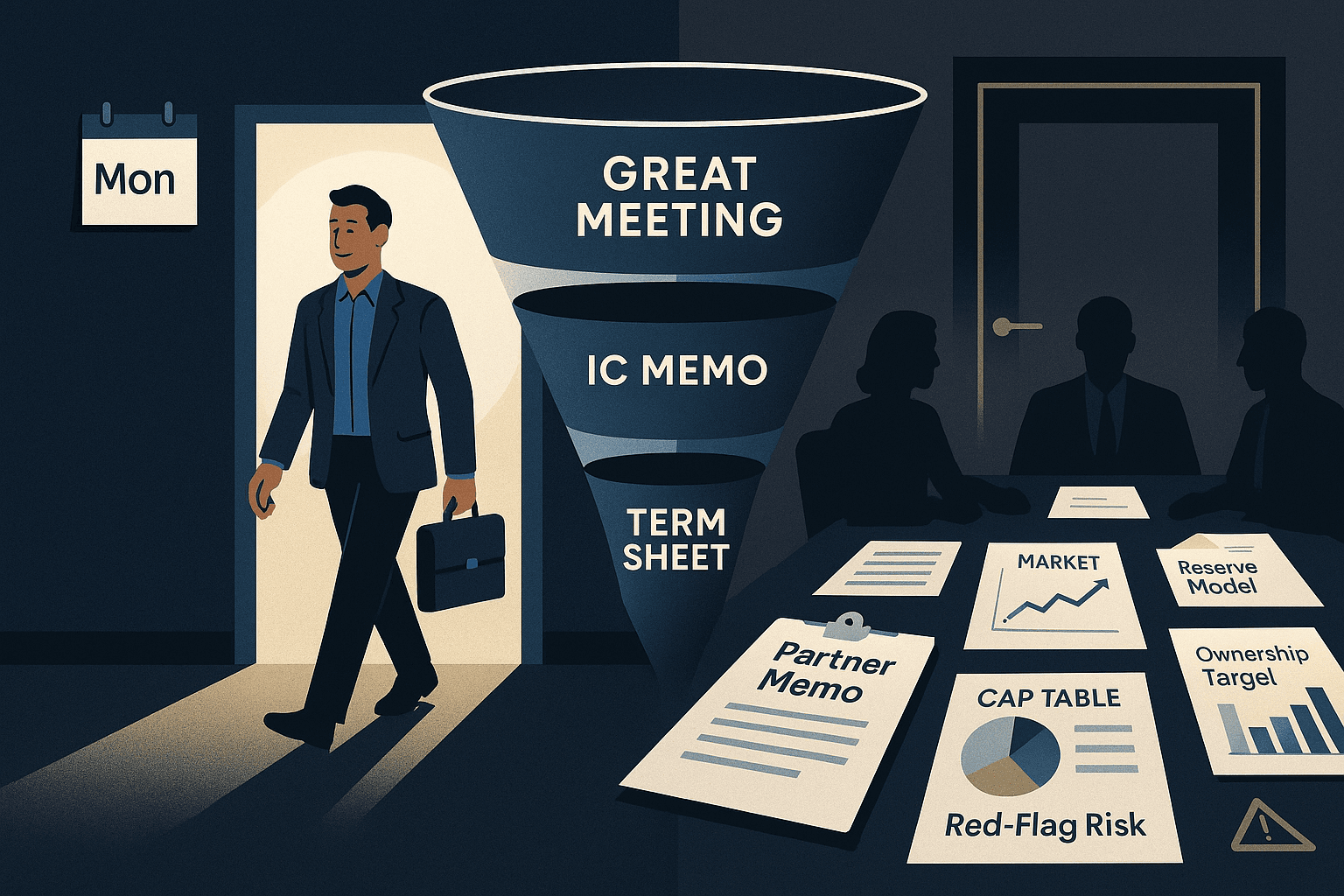
Why you can win partner meetings and still lose the Monday investment committee, and how to arm your champion with a stronger internal memo.
The partner leaned in. They asked sharp questions. They told you the market was huge, your metrics were ahead of where comparable companies were at your stage, and they wanted to "move quickly." They introduced a second partner. They asked for customer references. They told you they were "excited" and that your company felt like a strong fit.
Then Monday happened.
The investment committee met. The sponsoring partner presented your deal. Other partners, some outside your category, asked questions that felt simplistic, skeptical, or detached from the nuance you had already covered. Someone focused on ownership. Someone else on reserves. Another partner questioned whether the market was actually venture-scale. A senior voice asked whether the company was truly leading a category or just showing early hustle. One partner worried the round price implied too much perfection too early. Another pushed for a different deal in the pipeline.
By Wednesday, the tone changed.
"We still really like what you’re building, but we’re going to pass for now."
Founders usually interpret this as randomness, cowardice, or dishonesty. Sometimes it is. More often, it is a translation failure.
You won the meeting. Your sponsor lost the memo.
That is the IC partner memo gap: the distance between a compelling founder story in a live room and an investable internal case that survives committee scrutiny. Many fundraising processes break not because the company is weak, but because the sponsor cannot convert founder energy into an internal document that answers the firm’s actual decision criteria: market size, risk, ownership, reserve fit, portfolio construction, and partnership politics.
This gap is one of the least discussed reasons good rounds stall. Founders optimize for the partner conversation they can see. They do not optimize for the memo battle they cannot.
That is a mistake.
The real problem is not partner enthusiasm. It is internal legibility.
A partner meeting rewards charisma, narrative coherence, product intuition, and quick command of your metrics. Investment committee rewards something different: internal legibility.
Can your deal be explained in a few pages by someone who is not you?
Can that explanation survive adversarial reading by people who may not specialize in your market, may have different portfolio incentives, may care more about check construction than product nuance, and may only engage with your company through a memo and a 20-minute discussion?
Inside most firms, the sponsoring partner is not simply saying, "I like this founder." They are making a claim with career consequences:
If the memo is weak on any one of those, the deal can die even when the meeting felt excellent.
Founders underestimate how brutal this compression is. Your company might represent five years of work, 50 customer conversations, 20 product decisions, and dozens of operating tradeoffs. The partner memo may get 1,500 to 3,000 words, a handful of charts, and a discussion slot after three other deals.
That is the game. If your company does not compress well internally, your odds fall.
Why current founder approaches fail
Most founders still run a fundraising process built for visible theater rather than invisible conversion.
They do four things wrong.
1. They optimize for excitement, not transferability.
A charismatic meeting can create emotional momentum. But emotional momentum is fragile if the evidence behind it does not transfer into written form.
Many founders are strong live explainers and weak memo enablers. They can answer objections in conversation, but they do not package those answers in a way that a sponsor can lift directly into an internal case.
The result: the sponsor leaves impressed but under-equipped.
2. They assume the partner who gets it is the only audience that matters.
Inside committee, not everyone gets your space. In fact, the people who matter most to the final vote may be the least fluent in your category.
If you are selling developer tooling, fintech infrastructure, climate software, defense tech, workflow AI, or a vertical SaaS wedge with a non-obvious expansion path, your sponsor must often persuade generalists. Generalists do not underwrite nuance by default. They underwrite pattern recognition.
If the memo depends on category-specific context to make sense, you are vulnerable.
3. They treat valuation as a market outcome, not an IC argument.
Founders think, "Two firms liked us at $18 million pre, so $20 million pre should be fine."
Committee may hear something else:
What looked like "market pricing" outside the firm becomes "subscale ownership for risk taken" inside the firm.
4. They misread politeness as progress.
VCs are socially incentivized to sound interested longer than they are economically committed.
Why? Optionality. Reputation. Access. Signaling. Internal uncertainty.
A partner can sincerely like you and still lack conviction strong enough to spend internal capital. A firm can ask for data, references, and follow-ups because they want to keep the option alive, not because they are moving toward a term sheet.
Founders often mistake diligence activity for memo strength. They are not the same.
The core insight: you are not pitching a partner, you are helping a partner author a winning internal case
The hidden unit of conversion in venture is not the meeting. It is the internal memo plus oral defense.
Once you understand that, your fundraising strategy changes.
The relevant question is no longer, "Did they like me?"
It becomes:
If not, the deal is weak no matter how warm the meeting felt.
This is especially true in competitive rounds where speed creates the illusion of certainty. Inside firms, speed often means the sponsor has less time to build a robust internal case. If you are asking for a fast decision at a high price, you are increasing the burden on memo quality. That can work, but only if the sponsor is armed.
What investment committee is actually testing
Different firms are different. But most ICs, formally or informally, test some version of the following.
1. Is the market actually venture-scale?
This is where many deals quietly die.
Founders often pitch market size using top-down TAM language: "The logistics software market is $30 billion," or "Healthcare admin spend is over $200 billion." Committee often discounts this immediately.
What they want is not broad spend. They want a plausible path to a company large enough to justify the entry price and risk.
That means the sponsor needs to answer:
If your sponsor cannot articulate the market in bottoms-up terms, the broad TAM slide is almost useless.
Practical example: two versions of the same market story
Weak memo version:
"The company sells AI tooling for compliance teams in financial services. Compliance software is part of a global regtech market expected to exceed $40B by 2030. The founders have early traction with mid-market customers."
Strong memo version:
"The company starts with automated surveillance review for broker-dealers with 50 to 500 compliance staff. There are ~3,800 target institutions across the US and Europe. Average starting ACV is $65,000 for workflow automation in a narrow use case, but paid pilot conversion suggests expansion into adjacent review, audit trail, and policy monitoring modules can push mature account ACV above $250,000. At 1,000 customers and $180,000 blended ACV, revenue exceeds $180M before international and enterprise expansion. Buyers already budget for manual review labor, creating clear ROI from headcount reduction and faster regulatory response."
The second version gives committee a path. The first gives them a slogan.
2. Is the risk profile legible and acceptable?
Committee is not asking whether risk exists. All venture deals are risky. They are asking whether the risks are known, bounded, and offset by evidence.
The sponsor memo usually needs to address some combination of:
Founders make a big mistake when they present only upside. Committees are more persuaded by a deal where the risks are named cleanly and then mitigated with evidence.
For example:
The memo gets stronger when the sponsor can say, "Here are the three real risks and why we believe they are acceptable," instead of pretending there are none.
3. Can the firm get enough ownership to matter?
This is one of the most underappreciated filters in early-stage venture.
A firm may love your company and still pass because the ownership opportunity does not work.
Suppose you are raising a $4 million Seed at a $20 million pre-money valuation.
If a fund invests $1.5M, ownership is:
If they invest $2.0M, ownership is:
For some seed funds, 8% may be fine. For others, especially multi-stage firms with target initial ownership thresholds, this is too low relative to the risk.
Now add reserve math.
Assume the fund wants to maintain pro rata through Series A and B.
- Pro rata requires 8.33% of new money = about $1.0M
- Pro rata requires 8.33% of new money = about $2.08M
Total capital to maintain is already over $5M, and that assumes the company performs well enough to deserve follow-on capital. If the fund’s construction expects many portfolio companies to need reserves, a partner may ask whether 8.33% initial ownership is enough to justify the reserve burden.
Now compare with a lower entry price.
If the same company raises $4M at a $12M pre, $16M post:
That extra 4.17 points of ownership dramatically changes the memo. The sponsor can more credibly argue the position has fund-return potential.
Founders often hear, "Valuation is a bit rich," and think this means the VC wants to negotiate for its own sake. Sometimes. But in committee, valuation is often being translated into ownership math, not just price aesthetics.
4. Does the deal fit the fund’s reserve strategy?
This point is related to ownership but not identical.
A good company can be a bad fit for a particular fund if the likely financing path clashes with reserve strategy.
For example:
If your round size and valuation imply a financing path that strains the fund’s reserve model, the sponsor must work harder internally.
Founders rarely ask this directly, but they should. "How does this check fit your target ownership and reserve strategy?" is a better question than "Are you interested?"
5. Does this deal win against other internal uses of capital?
Here is where partnership politics enter.
Every deal competes not just against an abstract bar, but against:
Imagine two live opportunities inside the same Monday IC.
Deal A: your company
Deal B: another company
These deals are not judged in a vacuum. Even if your company is objectively stronger, Deal B may be easier to approve because it fits existing internal comfort zones and ownership logic.
This is frustrating, but it is not irrational from the firm’s point of view. Venture is a portfolio business run by humans with incentives and history.
The hidden economics of memo-writing incentives
Not all partner enthusiasm is equal because not all partners are equally motivated to write and defend a hard memo.
Founders should understand what memo-writing actually costs inside a firm.
A sponsor must:
This means a partner can like a deal and still not want to "own" it politically.
The strongest positive signal in venture is not excitement. It is labor.
When a partner starts doing real work on your behalf, that matters. Examples:
Performative interest tends to look different:
Founders should track work, not vibes.
Why non-specialist scrutiny kills more deals than founders realize
One of the odd realities of venture is that your company may be filtered by people who are not experts in what you do.
This does not mean they are stupid. It means your sponsor must translate specialized insight into plain investment logic.
In committee, non-specialists often ask the most important questions because they expose memo fragility:
If your case cannot survive simple questions, it probably does not deserve a term sheet.
Founders sometimes resent these questions because they feel reductive. But that is precisely the point: if your company’s attractiveness depends on 40 minutes of category education, your sponsor is carrying too much translation burden.
Your job is to reduce that burden.
How valuation asks get reframed inside IC
Founders often present valuation as external proof of market demand. "Other funds are circling at this price." Committee often reframes valuation in harsher, more mechanical ways.
Let’s use a concrete Seed example.
You are raising:
A fund considering a $2.0M check gets:
Now imagine the company has $500K ARR growing 15% month-over-month with decent early retention.
Founders may frame this as:
Committee may frame it as:
None of that means the valuation is wrong. It means the sponsor has to build a very specific argument for why the price still creates enough expected value.
Now compare term sheet structures.
Option 1: Higher price, smaller check from lead
Option 2: Same price, larger lead allocation
Option 3: Lower price, standard lead check
A sponsor may be able to get Option 2 approved even at a higher price if they can secure enough allocation. Conversely, they may fail to get Option 1 approved despite liking the deal because sub-7% ownership is too thin.
This is why round construction matters as much as price. Many founders focus only on headline valuation when the internal debate is really about ownership concentration.
Practical negotiation scenario: why “we need to stay disciplined on price” may mean something else
Imagine this conversation.
Founder: "We have strong demand and are targeting a $24M pre for a $4M Seed."
Partner: "That may be hard for us."
Founders often hear: low conviction.
What the partner may actually mean is:
That is not just a negotiation posture. It is an internal memo problem.
A better founder response is not defensive outrage. It is clarification.
Try:
These questions surface the true constraint. Once you know it, you can solve it.
How rounds stall despite apparent momentum
Some rounds do not die cleanly. They stall.
This usually happens when the sponsor likes the deal but cannot get the memo to “yes” and does not want to force a “no” too early.
Common stall patterns include:
1. The memo has one unresolved hole.
Maybe market expansion is unclear. Maybe churn data is too immature. Maybe pricing power is unproven. The sponsor keeps asking for more because they want one more piece of evidence that closes the gap.
2. The partner has interest but not enough internal capital.
They are trying to recruit another partner, get sector support, or wait for a senior voice to bless the case.
3. The firm likes the company more at a different round shape.
They might be waiting to see if valuation softens, if allocation opens, or if another lead sets terms they can join.
4. The firm is balancing internal timing.
A partner may have multiple live deals and can only push one through decisively. Your deal becomes a maybe while attention is allocated elsewhere.
5. The sponsor is protecting optionality.
They are not ready to commit, but they also do not want to lose access if the round firms up with stronger signals from others.
This is why founders need to distinguish diligence from decision progress.
A process is advancing when the sponsor is converging on a specific internal claim. It is not advancing merely because activity continues.
Tactics: how founders can arm a sponsor with IC-ready proof
This is the part founders can control.
Do not just pitch well. Package well.
1. Build an “IC packet,” not just a deck
After a strong partner meeting, send a tight follow-up package designed for internal use. Not a data dump. A memo-enabling packet.
Include:
Write this in language a generalist can understand.
Your sponsor should be able to lift sentences directly.
2. Give them bottoms-up market math
Do not rely on TAM theater.
Provide a simple market build:
Example:
This is infinitely more useful in committee than a giant top-down slide.
3. Pre-answer the dumb-sounding but lethal questions
The questions founders dismiss as unsophisticated are often the ones that kill deals.
Create direct, one-paragraph answers to:
These answers should be plain English, not founder poetry.
4. Make customer proof legible to non-specialists
Customer references are often underused because they are anecdotal rather than transferable.
Better evidence:
Instead of: "Customers love us."
Use: "In 7 of the last 9 deployments, the product reached live workflow usage within 21 days. At Customer A, analyst review hours dropped 38%, supporting expansion from a $42K pilot to a $118K annual contract within 8 months."
That survives memo translation.
5. Frame risks yourself
Send a short section titled "What investors usually worry about here." Then list the top three objections and your evidence-based response.
This does two things:
Example:
Objection: Sales has been founder-led.
Response: True so far. But 62% of pipeline created in the last 90 days came from a non-founder AE plus channel referrals. Pilot-to-paid conversion across that cohort is 44%, versus 47% for founder-sourced deals.
That is useful internal ammunition.
6. Clarify the ownership opportunity explicitly
If you want a firm to lead, make it easy for them to see how they can get to a meaningful position.
Say:
Sometimes a sponsor loses energy because they infer there is not enough room to matter. Founders can solve this with transparency.
7. Help them defend valuation with comparative logic, not bravado
Bad founder line: "That’s just where the market is."
Better founder line:
"At this price, a $2.5M lead check gets 10.4% ownership. We believe that is consistent with our current traction and the speed of the round. Compared with companies at similar ARR and growth profiles, the premium reflects shorter time-to-value, stronger gross margin profile, and unusually early expansion within accounts."
Now you are speaking memo language.
8. Ask process questions that reveal memo reality
You do not need to be confrontational. But you do need clarity.
Useful questions:
A serious sponsor will usually give a more concrete answer than founders expect.
Detecting real interest versus performative interest
You will never get perfect information. But you can get better signal.
Real interest often looks like:
Performative interest often looks like:
Here is a blunt heuristic: if a partner cannot tell you what they need to believe internally, they probably are not close.
A cap table lens founders should use before setting terms
Before you choose your price and round size, model the deal from the investor side.
Suppose your current cap table pre-Seed is:
You plan to raise $5M.
Scenario A: $15M pre
Post-round cap table:
Scenario B: $25M pre
Post-round cap table:
Founders naturally prefer Scenario B. But now ask:
How many funds can lead meaningfully?
If the typical lead check in your target universe is $2M to $3M:
Scenario B may narrow your lead universe materially. If your traction truly justifies it and the market is competitive, fine. But many stalled rounds are self-inflicted by setting terms that sound good externally and fail ownership screens internally.
A founder-friendly way to pressure-test your own IC readiness
Before launching, ask a friendly investor or advisor to answer these five questions in writing, using only your materials.
If they struggle, a partner memo will struggle too.
The contrarian point: more meetings can make this worse
Founders often think more partner meetings equal more momentum. Sometimes the opposite is true.
If multiple firms are excited but none can clear IC, you create broad social proof with weak conversion. That can inflate your perceived price externally while lowering actual close probability. Everyone sees interest. Nobody sees commitment.
This can trigger a bad loop:
In other words, superficial demand can make the deal less investable.
The goal is not maximum enthusiasm. The goal is one or two sponsors with enough conviction, ownership room, and internal political capacity to carry the deal through committee.
What to do when you sense the memo gap in real time
If you feel the process cooling after a strong meeting, do not just keep repeating the pitch.
Instead:
For example:
"It sounds like the open question is whether our initial wedge expands broadly enough and whether the round leaves enough room for a meaningful lead position. I’m sending a one-page market build and current allocation view. We have room for a $2.5M lead, which would represent 10.4% ownership at the target terms. I’m happy to walk through how we see expansion and round construction if that helps for internal discussion."
That is sophisticated. It helps the sponsor solve the real problem.
The practical takeaways
Most founders think fundraising is about winning rooms. It is not. It is about surviving rooms you will never enter.
The hidden conversion gap between great VC meetings and actual term sheets often comes down to whether the sponsoring partner can write and defend an internal memo that makes your company legible on the dimensions the firm actually underwrites.
Those dimensions are usually not mysterious:
If you want better fundraising outcomes, stop treating investor enthusiasm as the finish line.
Arm your sponsor.
Give them language, math, and proof that survive non-specialist scrutiny.
Show market size as a path, not a slogan. Show risks as known variables, not avoided topics. Show valuation in ownership terms, not just ego terms. Show round construction in a way that lets a fund matter. Ask process questions that reveal whether internal conviction is real.
And most of all, learn to distinguish interest that creates labor from interest that creates theater.
A partner saying "we’re excited" is nice.
A partner who can write the memo that gets you through Monday is what actually matters.
RaiseSimpli Team
Author