Indemnity Stacks: M&A Escrow and RWI Exclusions
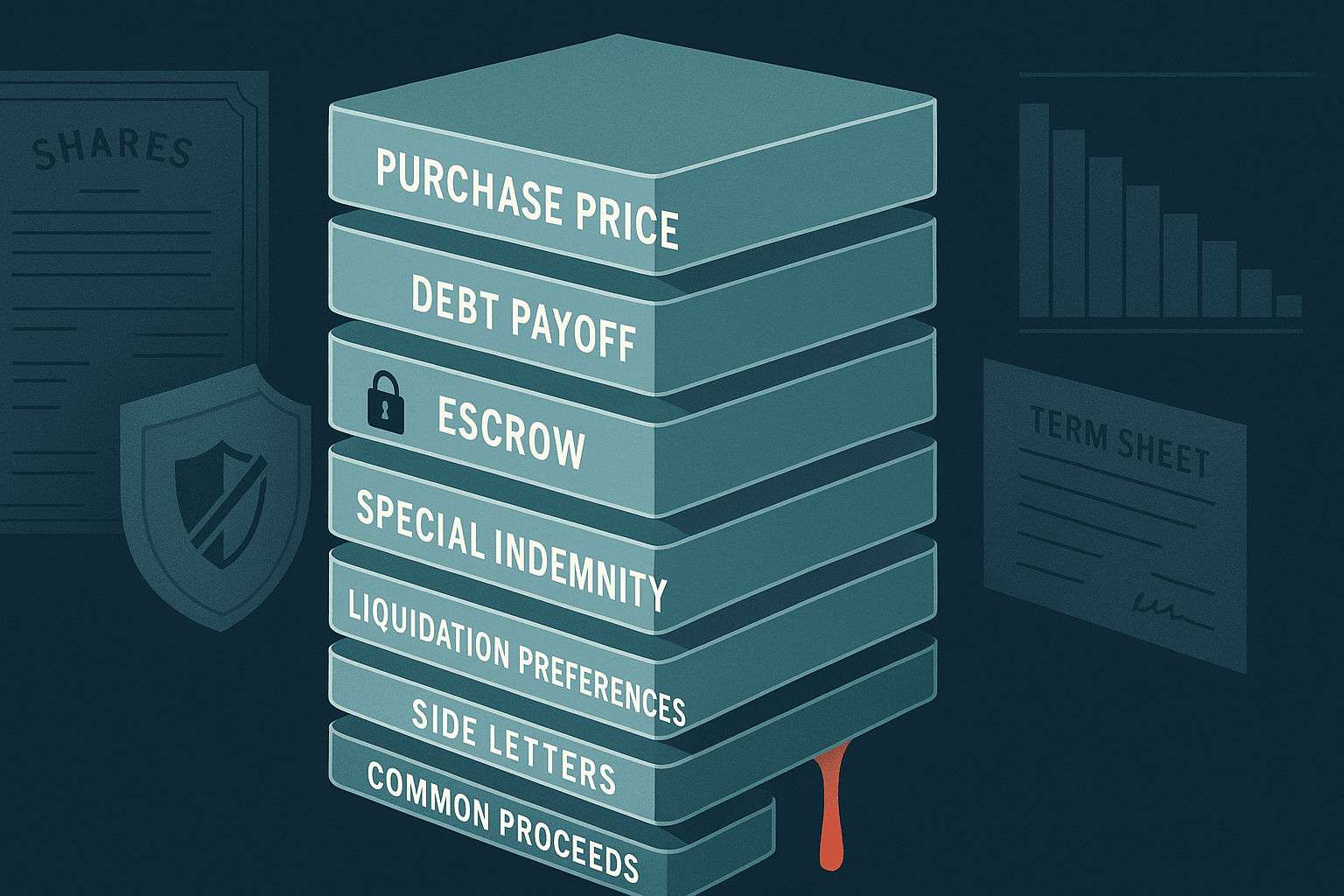
How M&A escrow, RWI exclusions, and venture terms reprice founder outcomes long before exit, and what to review in your documents now.
First, the buyer withholds 10% into escrow for indemnity claims. Then the rep and warranty insurer excludes payroll tax, data privacy, and a known contractor classification issue, so there is a separate special indemnity holdback. Venture debt must be repaid at par plus end-of-term fees. A side letter from the Series B requires a minimum return threshold before management carve-outs are funded. The Series Seed and Series A have a 1x non-participating preference, which sounded harmless in the financing. The Series B has a senior preference and a participation feature capped at 2x. Option holders discover the exercise window and withholding treatment are worse than expected. By the time proceeds move through the waterfall, common gets a result that feels disconnected from the headline price.
This is not unusual. It is the product of what I call the indemnity stack: the combined effect of M&A escrow mechanics, representations and warranties insurance exclusions, debt payoffs, transaction bonuses, investor protective terms, and financing-era side obligations that all sit ahead of or effectively ahead of common proceeds at exit.
The contrarian point is simple: founders usually model dilution, but they do not model indemnity economics with the same seriousness. That is a mistake. In many venture-backed exits, the economic pain does not come from one brutal liquidation preference alone. It comes from many smaller priority claims layered together over years, each of which looked manageable when negotiated in isolation. At exit, they act like a hidden second liquidation preference.
If you are a founder, the right time to negotiate your M&A outcome is not when the buyer’s first draft purchase agreement arrives. It is in the Seed, Series A, and Series B documents, in debt facilities, in side letters, in option plan design, and in how you document known risk areas that insurers will later exclude.
The problem: headline value is not distributable value
Founders and employees talk about exit value as if enterprise value and take-home value are roughly the same thing after taxes. They are not. In a venture-backed sale, proceeds are filtered through a sequence of senior claims:
Only after all of that does common receive the residual.
In practice, founders spend 95% of negotiation energy on pre-money valuation and board control, and maybe 5% on terms that shape distributable proceeds years later. Investors, debt providers, and sophisticated counsel do the opposite. They know that a one-line side letter, a special rep package, or an investor consent right can move millions at exit without ever changing the financing headline.
That is why two companies sold for the same enterprise value can produce wildly different founder outcomes.
Why current approaches fail
1. Founders underwrite financing terms but not exit plumbing
Most founders are trained to think in ownership percentages. If the company sells for $100 million and I own 20%, I get $20 million, adjusted for preferences. That is a dangerously incomplete model.
A real exit model should include:
Without that, founders are not negotiating economics; they are negotiating optics.
2. Investors correctly view indemnity risk as economic seniority
Preferred investors do not need a formal participating preference to gain priority over common. If they can negotiate sale process terms, board approvals, or side-letter protections that shape indemnity allocations, they can improve their downside recovery indirectly.
Example: if a buyer requires a 12% escrow and the board agrees that all holders contribute pro rata but preferred receives distributions earlier through preference mechanics while common bears more timing risk, the practical effect can look like extra seniority. If certain investor side letters also require consent before using insurance or settling claims, preferred can influence the release mechanics around proceeds.
3. RWI is often misunderstood as a universal fix
Founders hear that reps and warranties insurance reduces seller liability. Sometimes it does. But in venture-backed deals, RWI often leaves the most painful risks uninsured or only partly addressed.
Common exclusions include:
When these issues are excluded, buyers seek special indemnities. Special indemnities usually come with separate caps, separate escrows, or direct recourse. If you are not prepared, your “insured” deal quickly becomes a holdback-heavy deal.
4. Debt is frequently modeled too late
Venture debt is often discussed as cheap dilution minimization. At exit, it is not cheap if it compresses common proceeds in middling outcomes. Debt payoff, accrued interest, final payment fees, prepayment premiums, and liens all come out before equity sees proceeds.
This matters most in the exact zone where many startup exits happen: not zero, not unicorn, but modestly positive. In that zone, every dollar of debt payoff and every dollar of escrow has an amplified effect on common.
5. Side letters and bespoke rights create silent leakage
Not all economic rights sit in the charter. Some sit in:
A side letter granting an investor approval over settlement of claims, or requiring a minimum return threshold before management carve-outs are paid, may look procedural when signed. At exit, it becomes a distribution term.
Core insight: indemnity economics are deferred pricing terms
Here is the central idea: many venture and debt terms do not change valuation when you raise capital, but they change realized price when you sell the company.
That means they are economically equivalent to deferred pricing terms.
If a financing term increases the likelihood that, at exit, there will be:
then it has repriced the founder outcome, even if the post-money looked attractive on signing day.
The right question is not, “What valuation did I raise at?”
The right question is, “What percentage of a plausible sale price will actually reach common after all senior claims and indemnity structures operate?”
That is a much more uncomfortable question. It is also the one that matters.
The anatomy of the indemnity stack
Let’s break down the major components.
A. M&A escrow
In a traditional private company acquisition, the buyer often escrows 5% to 15% of purchase price for general indemnity claims, sometimes for 12 to 24 months. In software deals with clean diligence and RWI, that may compress. In messy deals, it can expand or split into multiple buckets.
Important details founders miss:
Timing matters because investors with preferences may effectively recover more certainty upfront, while common waits on the contingent tail.
B. RWI exclusions
RWI does not insure everything. If your company has known weak spots, those become negotiating focal points.
Suppose the insurer excludes contractor misclassification exposure and data processing consent issues in Europe. The buyer may insist on:
All four options reduce founder economics. The mechanism varies. The effect is the same.
C. Debt payoff and lien clearance
Debt is often the first hard subtraction in the flow of funds.
If you have:
then a nominally modest debt facility consumes $9.7 million at closing before any escrow is funded and before equity sees cash.
In a $60 million or $80 million exit, that is enormous.
D. Preference stack and participation
Even plain-vanilla 1x non-participating preferred changes how indemnity burdens feel.
Why? Because preferred often has stronger downside protection and may elect the preference if the outcome is middling. If escrow and holdbacks reduce distributable proceeds at closing, common is more likely to sit below the threshold where conversion makes sense. That increases effective preference usage.
Participating preferred is even harsher. A participation right capped at 2x may look moderate in a fundraising deck. In an exit after debt and escrow leakage, it can absorb a much larger percentage of what remains than founders modeled.
E. Special rep packages
Founders often agree during financing to governance and reporting structures that make future rep packages more onerous.
Examples:
At exit, these operational gaps become special reps with escrow consequences. The cap table and legal hygiene you tolerate in growth mode become cash leakage later.
F. Side-letter obligations
This is the most underappreciated category.
Examples include:
These terms may not be visible in a simple cap table model. They absolutely belong in an exit model.
A concrete example: the $120 million “good” exit that disappoints common
Let’s model a realistic case.
Capital structure before sale
Assume total fully diluted shares: 10,000,000.
Ownership by class:
Assume original invested capital:
Total preferred invested: $34 million.
Headline deal terms
At first glance, founders say: “$120 million exit, we own 42%, this should be excellent.”
Now run the waterfall.
Step 1: gross-to-net seller proceeds
Start with $120.0 million.
Subtract:
Remaining at nominal seller equity value: $107.0 million.
Now subtract amounts withheld at closing:
Cash distributed at closing: $87.0 million.
Already, the “$120 million exit” is functionally an $87 million immediate-distribution event, with $20 million contingent and $13 million gone outright before equity.
Step 2: preferred election analysis
Now determine whether each preferred class takes preference or converts.
Assume seniority stack where Series B is senior to A and Seed, and A/Seed are pari passu with each other after B. Series B is participating preferred capped at 2x total return.
#### Series B
Invested capital: $18 million.
Series B takes its senior 1x preference first: $18 million.
Remaining distributable-at-closing pool after B preference: $87 million - $18 million = $69 million.
Because B is participating, it also shares pro rata in the remainder on an as-converted basis until hitting 2x total return.
B owns 15% as-converted, so its participation on the $69 million remainder would initially be $10.35 million.
Total B received at closing if uncapped: $28.35 million.
Its 2x cap on $18 million invested is $36 million, so cap not yet reached. B receives $28.35 million at closing.
Remaining pool after B full participation allocation: $69 million - $10.35 million = $58.65 million.
#### Series A and Seed
Now compare preference versus conversion for A and Seed.
A owns 20%, invested $12 million.
Seed owns 10%, invested $4 million.
If they both converted, they would share in the remaining pool with common and options according to as-converted ownership excluding B’s already-satisfied participating preference mechanics. For simplicity, use original fully diluted economics for remainder allocation among all non-B holders, but note in actual legal waterfalls this requires precise charter math.
A conversion value approximation on total closing pool before their election:
Seed conversion value approximation:
Both exceed their preferences, so economically they likely convert rather than take 1x.
That means the remaining $58.65 million is allocated among A, Seed, founders/common, and options based on as-converted ownership percentages relative to those groups totaling 85% of FD shares.
Relative ownership among non-B groups:
Allocate $58.65 million:
At closing, total distributions are therefore approximately:
This already surprises founders. On a $120 million headline acquisition, the founder/common bloc with 42% only sees about $29 million at closing, not $50.4 million.
And we are not done.
Step 3: escrow risk does not hit all holders equally in experience
Legally, escrow may be allocated pro rata across all seller recipients. Economically, however, common often feels the pain more acutely because:
Assume after 18 months:
Total withheld and lost from contingent buckets:
Total permanent leakage from contingent consideration: $7.2 million.
Released back to sellers:
Now total seller value is not $107 million. It is $99.8 million.
That means the real economic sale price to equity after debt, expenses, and claims was under $100 million, despite the $120 million headline.
Step 4: what common effectively received
Add later release pro rata, assuming same distribution mechanics. Founders/common gets roughly 33.3% of the post-B remainder economics in this simplified example, which means maybe another ~$4.2 million to $4.5 million depending on exact waterfall treatment.
So founders/common end somewhere around $33 million total instead of the intuitive $50.4 million headline share.
That is before taxes.
The difference, roughly $17 million, did not disappear because of one dramatic term. It disappeared because of the indemnity stack.
How this becomes a hidden second liquidation preference
A classic liquidation preference is visible. Everyone sees it in the charter. The indemnity stack is more dangerous because it is fragmented.
Imagine two scenarios:
Scenario A: no hidden stack
Net distributable seller value might be around $115.5 million.
Scenario B: hidden stack
Net distributable seller value may be under $100 million, with more of the certainty front-loaded to senior stakeholders.
The delta is more than $15 million. For common, the gap may feel even larger because participation and seniority alter who absorbs the shortfall. That is economically similar to slapping an additional liquidation preference on the company without ever calling it that.
Negotiation scenarios: what founders can do earlier
The mistake is trying to solve this only in the M&A process. By then, your leverage is constrained by diligence facts and buyer alternatives. The better strategy is preventive.
Negotiation scenario 1: Series A term sheet
Investor ask: senior preferred, broad protective provisions, investor-specific consent over major settlements, and a right to approve management transaction bonuses.
Founder response:
Why it matters: A single investor with settlement consent can shape whether claims are contested, insured, or settled, which changes escrow release timing and practical economics.
Negotiation scenario 2: venture debt facility
Lender ask: end-of-term charge, prepayment premium, broad lien, change-of-control fee, cash dominion springing rights.
Founder response:
Example: reducing an end-of-term plus prepayment fee package from 15% of principal to 6% on an $8 million facility saves $720,000. That is not cosmetic. In a middling exit, it can equal a meaningful percentage of common proceeds.
Negotiation scenario 3: known risk disclosure before Series B
Suppose you know there is some contractor classification exposure in two states and uneven privacy consent logs for legacy customers.
Most founders hide from this until M&A diligence. Wrong move.
Better approach:
Why it matters: insurers exclude known issues. Buyers punish unresolved known issues twice: once in price, once in special indemnity. A $300,000 remediation program today can avoid a $3 million special escrow later.
Negotiation scenario 4: charter terms
Investor ask: participating preferred for the latest round due to market conditions.
Founder response:
If Series B insists on participation, your board deck should show outcomes at, for example, $50 million, $80 million, $120 million, and $200 million exits with debt and 10% escrow cases. If common is gutted in the realistic band, the term is too expensive.
Negotiation scenario 5: side letters
Investor ask: MFN on exit-related arrangements and reimbursement of transaction-specific counsel fees.
Founder response:
Founders lose money because obscure side rights are forgotten until closing week.
The terms founders should focus on in early rounds
Here is the practical checklist.
1. Keep preferred simple whenever possible
The best defense is fewer layers:
Complexity is not neutral. Complexity is usually a future claim on common.
2. Build a sale-waterfall model during every financing
Not a cap table. A sale-waterfall model.
For each round, run:
Then ask: what does founder/common actually get?
If you are not doing this, you are negotiating half-blind.
3. Audit insurability, not just legal compliance
A company can be “good enough” to operate and still be poorly positioned for RWI.
Before a major financing, ask counsel or a quality-of-earnings / diligence advisor:
This is an exit-value exercise, not only a legal exercise.
4. Control debt economics tightly
Debt is acceptable. Lazy debt is expensive.
Watch:
Each is senior to equity. Treat each like dilution, because economically it is.
5. Centralize obligations that can survive to exit
Maintain a single schedule of:
A hidden obligation is not small because it is hidden.
6. Tighten corporate hygiene
Many special indemnities are self-inflicted.
Founders should not need a buyer to discover:
Operational mess becomes escrow math.
A term sheet comparison founders should actually run
Consider two Series B offers.
Offer 1
Offer 2
Many founders pick Offer 2 because the headline valuation is better and more capital is raised.
Now model a $130 million sale three years later with $10 million debt payoff, $12 million general escrow/holdback package, and $4 million special indemnity claims.
There is a very plausible scenario where Offer 2 produces a worse outcome for founders than Offer 1 despite the higher entry valuation. Why?
Because the extra seniority and participation from B, plus extra friction rights around claim settlement and carve-out allocation, absorb a disproportionate share of the midrange exit value.
A serious board should ask for this comparison before signing the term sheet.
What buyers, insurers, and preferred holders each want
Understanding incentives helps founders negotiate.
Buyers want post-closing certainty
If diligence reveals weak spots, buyers have three basic tools:
They prefer structures that keep leverage after closing. That means escrows, special indemnities, and true-up rights.
Insurers want bounded, underwritable risk
Insurers are not there to rescue known messes. They will price clean risks and exclude ugly ones. The worse your documentation, the more your deal shifts from insurance-backed to seller-backed.
Preferred holders want downside protection and process control
Investors may say they only care about enterprise value maximization. Often true. But they also rationally care about who bears leakage in less-than-perfect exits. Terms that improve their recovery certainty without visibly worsening the financing headline are attractive to them.
Founders should assume every sophisticated stakeholder sees indemnity mechanics as part of the economic bargain, even if nobody uses that phrase in the financing room.
The founder playbook
If you want to avoid indemnity economics becoming a hidden second liquidation preference, do the following:
The blunt takeaway
Founders like to believe that exit disappointment comes from bad luck, bad timing, or a weak market. Sometimes it does. More often, it comes from terms they accepted years earlier because those terms did not feel expensive at the time.
That is the trap.
The indemnity stack is not one term. It is the accumulation of small senior claims, exclusions, controls, and contingencies that reprice your company on the way out. Buyers take a slice for uncertainty. Insurers refuse the risks you failed to clean up. Lenders get paid first. Preferred holders collect according to rights you treated as theoretical when you signed them. Common gets what is left.
So stop asking only what your next round costs in dilution.
Ask what it does to your eventual flow of funds in a realistic sale.
Because a “good” acquisition can still be a mediocre founder outcome, and by the time you discover that, the economics were locked in long before the LOI arrived.
RaiseSimpli Team
Author