Inside Lead Credibility: Why Insider Terms Lower Price
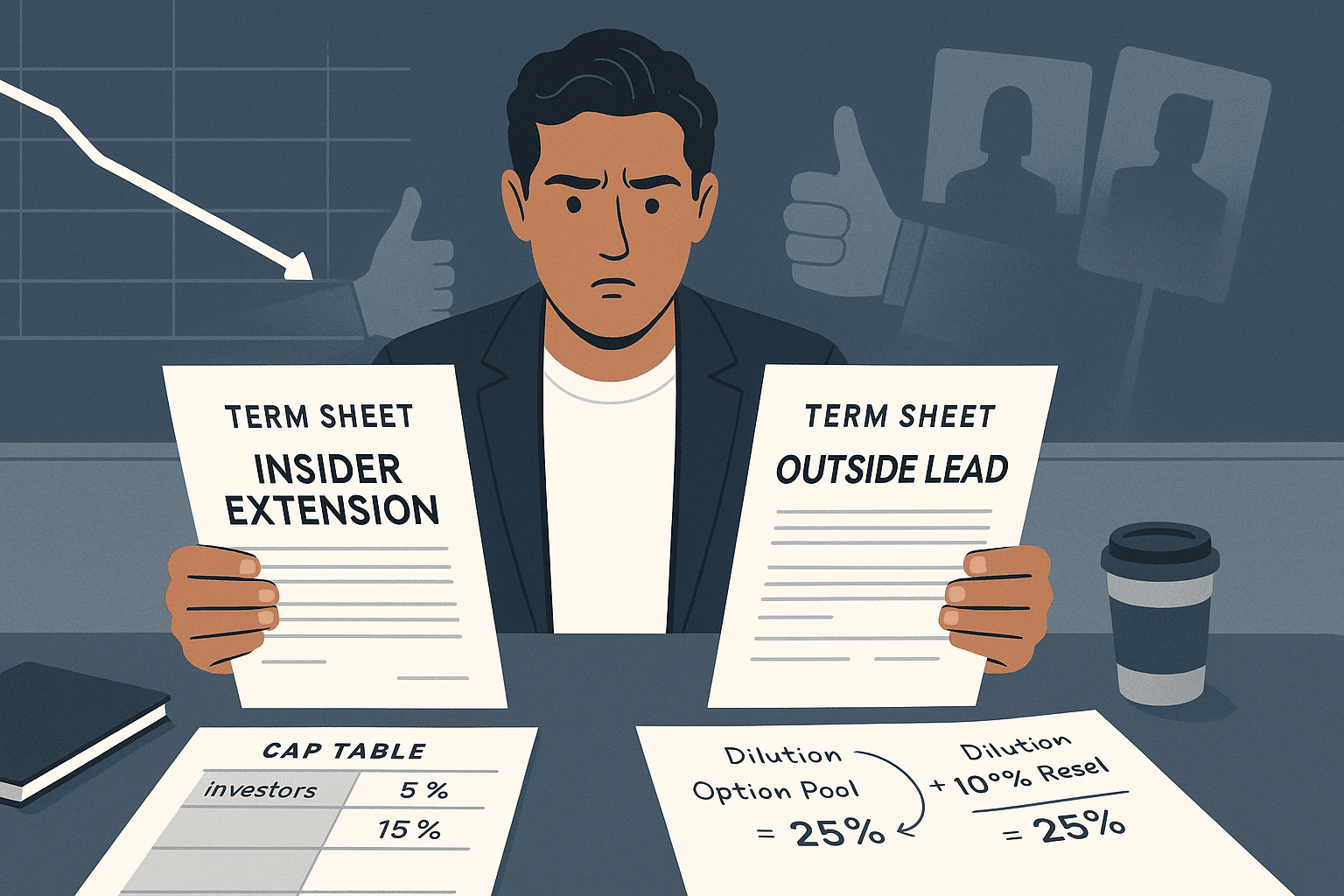
Why founder-friendly term sheets from insiders often lower your outside price, and how new investors read a round led by existing backers.
Their existing seed investor offers to “step up” and lead a $4 million extension at a flat or modestly up price. The partner frames it as conviction: We know the business best. We want to support you. We can move fast. We’ll keep the terms clean and founder-friendly. No new board drama. No months of fundraising churn. No aggressive diligence process. Maybe even no major preference stack expansion, no weird structure, and no hard resets on control.
Founders often hear one message: our insiders believe in us.
Outside investors often hear a different one: if the people with the most information are leading this round, why isn’t the market competing to price it higher?
That gap is the inside lead credibility discount.
It is one of the least discussed, most expensive signaling problems in venture fundraising. And it matters because founders routinely confuse insider support with market validation. They are not the same thing. In many cases, they are opposites.
The paradox is simple: the cleaner and more founder-friendly an insider term sheet looks, the easier it can be for outside VCs to conclude that the price was not truly market-tested. The insider may be acting in good faith. The company may be improving. The terms may genuinely be fair. But because venture is a market built on signaling, optionality, reserve management, and adverse selection, outsider interpretation often overwhelms insider intent.
This article is a contrarian deep dive into why insider-led seed extensions and Series A preempts can reduce your outside price, even when they appear helpful. We will cover when insider leads help, when they hurt, the mechanics behind the credibility discount, and how to structure process, timing, and term sheets so that support from existing investors does not poison the next outside round.
The problem: supportive insider money can weaken price discovery
In venture, valuation is not just a number derived from business quality. It is also an output of process quality.
A startup may believe it is worth a $40 million pre-money because revenue doubled, burn improved, churn is stable, and pipeline is stronger. If three new firms engage, a couple push into partner meetings, and one offers at $40 million, that price has informational content. It says the market broadly examined the asset and at least one fresh buyer was willing to underwrite risk at that level.
Now compare that with a company that raises a $4 million insider extension at the same $40 million pre-money from its seed fund, with no meaningful outside process. On paper, the valuation is the same. In the market, it is not the same.
The outside interpretation is usually harsher than founders expect:
This is why insider-led rounds often create an invisible markdown even when the headline price is flat or up. The market treats them as lower-confidence valuations.
That matters in three concrete ways:
An insider round can buy time. It can also quietly set a lower anchor for everyone else.
Why current founder thinking fails
Most founder advice on insider rounds is too simplistic. It usually takes one of three forms, all incomplete.
1. “Money is money; take the fastest clean check”
This is fine when runway is existential and the company needs survival capital immediately. It is terrible as a general fundraising principle.
All dollars are not equal. The identity of the lead, the presence or absence of competition, and the path by which a valuation was established all affect future financing outcomes. A fast insider check may save three months now and cost 20% to 30% of valuation in the next institutional round.
2. “If insiders know the business best, their lead should be the strongest signal”
This sounds rational. In public markets, informed insider buying can be positive. In venture, the inference is more complicated because insider behavior is constrained by reserves, ownership targets, fund construction, internal marks, follow-on strategy, and reputational signaling.
Outside investors know this. So they do not read insider enthusiasm at face value.
An insider leading a round can mean conviction. It can also mean:
That ambiguity is exactly why credibility gets discounted.
3. “Clean terms eliminate signaling issues”
No. Clean terms solve structural problems, not interpretive ones.
A founder-friendly insider term sheet with standard NVCA docs, no extra control terms, and a flat liquidation preference can still damage outside pricing because the problem is not that the terms are ugly. The problem is that the process failed to generate external validation.
Founders overfocus on legal cleanliness and underfocus on market meaning.
Core insight: the market discounts insider-led prices because insiders are informed but not independent
This is the central idea.
An outside lead is valuable not only because they bring capital, but because they are independent price-setting capital. They do not already own the asset. They are choosing to buy in fresh, under competitive conditions, with fresh underwriting, at a fresh valuation.
An insider is informed, but not independent.
That combination is precisely what creates the credibility discount. Outside VCs reason as follows:
That logic drives five recurring interpretations.
1. Reserve constraints distort insider behavior
Every venture fund has reserve strategy. Even funds that market themselves as “high-conviction supporters” face portfolio construction limits.
Suppose a seed fund manages $200 million. It may have 30 core portfolio companies and a reserve model targeting follow-on only for the top quartile. A partner may love a company and still be unable to write the full Series A lead check because:
Outside VCs know this. So when an insider offers a $3 million or $4 million extension instead of leading a full $10 million institutional round, outsiders ask whether the check size reflects reserve limits, conviction limits, or both.
The problem for founders is that the market often assumes the least flattering interpretation.
If your best-informed investor did not stretch harder, outsiders infer that either:
Neither helps your next price.
2. Insider enthusiasm is weaker than outsider competition
Founders often think, our existing investor is doubling down, so surely that shows strength.
Sometimes. But not as much as two outside firms pushing against each other to win the deal.
Competition does something insider support cannot: it reveals that multiple fresh buyers, starting from zero ownership, each want exposure badly enough to pay up.
Imagine two scenarios.
Scenario A: insider-led extension
Scenario B: outside-led process
Even if the founder chooses the $34 million offer for partner fit, the company now has a real market-clearing range: $34 million to $36 million pre. That range carries credibility.
In Scenario A, the $32 million number is just a statement by someone already exposed. Outsiders may haircut it to $28 million or $30 million because they do not trust the process.
This is the harsh truth: a lower-priced outside term sheet can be more valuable than a higher-priced insider term sheet if it establishes real price discovery.
3. Insider-led rounds trigger adverse selection concerns
Adverse selection is a fancy term for a simple worry: why is this deal available to me now, and on these terms?
When outsiders see an insider preempt or extension, they ask:
None of those questions have to be true for them to suppress valuation.
A common founder mistake is assuming they can explain this away with a narrative like, “We weren’t actively raising, but our insiders wanted to support us.” That line often lands badly with experienced VCs. It can sound like code for, “We wanted money, but not enough people wanted to price us.”
And if outsiders suspect the company was selectively shown to a few investors who passed, the signaling gets worse. At that point, the insider round is not interpreted as conviction. It is interpreted as market-clearing evidence that stronger demand failed to materialize.
4. Insiders are sometimes protecting marks, not setting price
This is uncomfortable but real.
Venture funds report marks. Partners care about portfolio optics. A flat extension at a generous price may be less about what a company would command in a true process and more about avoiding a visible markdown.
Outside investors know this game.
Suppose a company last raised at a $25 million post-money on a seed round. Eighteen months later, growth is good but not great, and the business probably clears externally at $22 million to $26 million pre in a normal process. An insider might propose a $3 million extension at $28 million pre because:
That may be rational for the insider. But to a new Series A investor, the round can look synthetic. If the next process runs and the best external offer is $24 million pre, the founder feels unfairly marked down. The outsider feels they are simply pricing the company where the actual market is.
This is how “supportive” insider pricing creates future pain: it delays the repricing but increases the eventual collision with reality.
5. A supportive insider can accidentally cap upside in negotiation
The moment outsiders know insiders are willing to fund, one key source of founder leverage disappears: financing urgency.
That sounds good. In one sense, it is. You are less desperate.
But there is a catch. If outsiders believe you have a safe internal backstop, they may feel less urgency to move aggressively. Instead of bidding to win, they can wait, watch, and let insiders bridge you while they demand more proof.
This dynamic is especially common at the seed-to-A boundary.
If a firm thinks, “The insiders will keep this company alive for another 6 to 9 months anyway,” that firm can defer risk. Rather than paying $45 million pre today, they may prefer to revisit at $38 million pre later if growth softens, or at $55 million pre only if metrics become undeniable. The existence of insider support creates an option for them. Founders rarely charge outsiders for that option.
When insider leads actually help
None of this means insider-led rounds are bad. Some are exactly right.
They help most in five situations.
1. The company is too early for efficient outside price discovery
If you are pre-product-market fit, with limited revenue and major product risk, an insider extension can be the least bad option. The market range would be wide anyway, and spending four months trying to optimize valuation may be foolish.
In this case, time and simplicity may matter more than signaling purity.
2. The insider is clearly overqualified relative to company stage
If a truly elite existing investor with strong brand value leads an extension and has a visible history of concentrated follow-on behavior, the signaling damage can be smaller. Brand does not eliminate the discount, but it can soften it.
A top-tier firm saying, “We are leading again because we think this is a category leader,” carries more weight than a less established seed fund doing the same.
3. The round is explicitly framed as a bridge to a near-term milestone
Bridges work best when they are short, crisp, and milestone-specific.
Example:
That structure tells outsiders this is not a synthetic substitute for price discovery. It is a tactical financing to reach a clearly underwritable milestone.
4. The insider round is paired with credible outside engagement
If you can truthfully say, “We had multiple inbound conversations, chose not to run a full process because the insider offered speed, and plan to open a broader round after the next milestone,” the damage is lower than if the company appears unable to attract interest at all.
5. The company would otherwise raise from a weak new lead
A bad outside lead can be worse than a good insider bridge. If your only new term sheet comes from a low-value investor demanding heavy structure, broad control terms, or punitive economics, taking insider money may preserve strategic flexibility even if it modestly hurts future pricing.
The point is not “always choose outside.” The point is “understand what signal you are sending and price the tradeoff consciously.”
When insider leads create the credibility discount
The credibility discount is strongest when several conditions stack together:
That last point is the killer.
If you know you will need outside capital soon, do not assume an insider-priced stopgap is neutral. It often becomes the reference point outsiders interrogate hardest.
Cap table math: why a “friendly” insider round can cost more than it looks
Let’s model a company before an insider extension.
Starting cap table
Assume the company raised seed at a $20 million post-money. Eighteen months later, it raises a $4 million insider extension at a $32 million pre-money.
Immediate dilution from the extension
New post-money = $36 million
New investor ownership from new money = $4M / $36M = 11.1%
Assuming the seed lead takes the whole round, the post-round cap table is roughly:
Combined seed lead ownership = 24.4%
The founder may think: Not bad. Clean round. We got capital. Price stepped up from seed.
Now fast forward 9 months. Metrics improve, but not enough to erase signaling concerns. Outside Series A investors haircut the insider price and offer $40 million pre for a $10 million round.
Series A after credibility discount
Pre-money = $40 million
Raise = $10 million
Post-money = $50 million
Series A investor owns 20.0%
After dilution, founders + employees go from 62.2% to 49.8%.
Now compare to a counterfactual where the company had run a real process earlier and raised that same $4 million from an outside lead at a slightly lower but more credible $30 million pre, then later was able to raise Series A at $50 million pre because the market trusted the price discovery.
Counterfactual path
First round: $4 million at $30 million pre
Post-money = $34 million
New investor owns 11.8%
Founders + employees drop from 70.0% to about 61.8%.
Then Series A: $10 million at $50 million pre
Post-money = $60 million
Series A investor owns 16.7%
Founders + employees drop from 61.8% to 51.5%.
Difference
Friendly insider route: founders + employees after A = 49.8%
Outside price discovery route: founders + employees after A = 51.5%
That 1.7 percentage point difference may not sound massive, but on a $500 million exit, it equals $8.5 million of stakeholder value. And this example assumes only a moderate Series A haircut. In real cases, the gap can be much larger if the insider extension creates a stalled narrative or forces an option-pool expansion at the next round.
The core lesson: optimizing for a slightly higher insider extension price today can produce a worse ownership outcome than accepting a more market-credible path.
Term sheet comparison: founder-friendly insider vs. credible outside lead
Here is a simplified comparison.
Option 1: insider extension
Option 2: outside-led round
Most founders instinctively choose Option 1 because the headline valuation is higher, governance is lighter, and process pain is lower.
But if Option 2 creates genuine price discovery, brings a new advocate, and establishes institutional validation, it may be economically superior over the next 24 months.
This is not always true. A bad board seat is expensive. A punitive option pool shuffle can wipe out valuation gains. But founders should stop evaluating insider sheets solely on present-round friendliness. The correct question is:
Which option maximizes my next round’s credibility-adjusted price?
That is the real economic variable.
How outside VCs actually read insider-led rounds
Let’s be blunt about the internal partner-meeting dialogue.
When a company says, “Our insiders are willing to lead,” outside investors often hear one of four subtexts:
Only the first interpretation is benign. The other three produce discount pressure.
Now add a few common facts:
This pattern does not scream, “Pay up now.” It screams, “Wait for more proof.” And if outsiders decide to wait, the insider lead stops being a vote of confidence and becomes a reason no one had to move.
Negotiation scenario: how founders accidentally anchor lower
Imagine a SaaS company with:
The seed lead offers:
The founder then opens a light Series A process and tells outside firms, “We already have a strong insider-led term sheet, but we wanted to meet a few potential partners.”
This sounds powerful. It often is not.
Why? Because the message to outsiders is:
Outside firms now have every incentive to be selective. One may pass. One may say they need another quarter of data. One may offer $34 million pre with more diligence conditions, implicitly treating the insider price as non-binding theater.
The founder is shocked: How can they offer below a clean insider term sheet?
Because the insider term sheet was not viewed as independent price discovery.
Worse, once outsiders sense the company is unlikely to reject insider funding, the threat of walking away loses force. Your backstop protected survival but weakened competitive tension.
How to structure insider rounds so they do less damage
If you need insider money, you need insider money. The answer is not moral purity. It is process design.
Here is how founders preserve more credibility.
1. Be honest about the financing type
Do not call a bridge a Series A if it is really a bridge.
If the round exists to fund a narrow milestone before a broader raise, say so clearly. Markets punish ambiguity more than they punish tactical financing.
Better framing:
Worse framing:
The second framing invites skepticism unless the company was actually flooded with external demand.
2. Keep the bridge sized to the milestone, not to comfort
Large insider bridges create doubt. Small, purposeful bridges create narrative coherence.
If you need 6 months to hit a pricing inflection milestone, raise 6 to 8 months of capital, not 15. An oversized insider extension often looks like a hidden substitute for a real round.
For example:
The bigger the internal check, the stronger the outsider question: if this company was ready, why didn’t someone new lead it?
3. Avoid vanity pricing
A modestly lower but defensible insider price is often better than an inflated flat-or-up number that the market will ignore later.
If you know the company is in a transitional period, do not let insiders “help” by stretching price beyond what a credible outside process would likely bear. That merely sets up a future collision.
It is better to preserve trust than to preserve optics.
4. Negotiate explicit process freedom
Founders should ensure the insider term sheet does not impair the next outside raise. Negotiate for:
One of the easiest ways to poison your next round is to let an insider load the term sheet with rights that effectively tell future investors: you will not truly control this syndicate.
5. Get alignment on external messaging
Your insider and you must tell the same story.
If the insider tells the market, “We’re excited to keep supporting the company as it scales toward a full A next year,” while the founder says, “This was a preemptive A-style lead,” those mixed signals create confusion. Confusion becomes discount.
Agree in advance on:
6. Run enough market contact to preserve tension
You do not always need a full roadshow. But you often need enough external contact to avoid looking unmarketable.
That can mean:
The goal is not to fake demand. It is to avoid a total information vacuum in which the insider round becomes the only valuation evidence anyone sees.
What founders should negotiate in insider term sheets
This is where founders can materially reduce future damage.
1. Milestone-based use of proceeds language
Even if not legally binding, the financing memo and board materials should clearly connect the round to objective milestones.
Example:
That narrative helps future investors understand why price discovery was deferred.
2. No blocking rights on future lead selection
Do not give insiders rights that make future outside leads feel they are joining a controlled cap table.
Watch for:
3. Sensible information rights for prospective investors
If the company plans to raise from new money soon, ensure there is no term sheet language that limits your ability to share diligence materials broadly and efficiently with future firms.
4. Option pool planning now, not later
If the insider bridge avoids a pool refresh but everyone knows hiring will require one before Series A, founders should model that now. Otherwise the next outside lead may demand a large pre-money pool top-up on top of a credibility discount.
Example:
On a $40 million pre, that pool expansion alone effectively shifts $2.8 million of value from existing holders before the new money even lands.
A founder who accepted a “friendly” insider bridge partly because it deferred this issue may find the deferred cost larger than expected.
5. Clear pro rata boundaries
Pro rata is normal. Super pro rata can be dangerous if it crowds out new lead economics.
If your insider wants the right to buy 2x or 3x their pro rata in the next round, ask how that looks to a new lead trying to build ownership. Often it makes the deal less attractive or forces awkward allocation fights.
6. No MFN spillover traps if using SAFEs or side letters
If there are prior SAFEs, side letters, or extension documents, founders need counsel to check whether new insider terms accidentally trigger broader rights or economics across the stack. A “simple” insider round that creates documentation noise can become a diligence headache that outsiders discount.
A practical framework: should you take the insider lead?
Ask these six questions.
1. Am I buying time to hit a real pricing inflection, or just avoiding a market test?
If the answer is the latter, the round probably delays pain rather than creating value.
2. Will I need outside money within 9 to 12 months?
If yes, then process credibility today matters much more than headline friendliness.
3. Is the insider check sized by conviction, reserve limits, or optics?
You may not get a perfect answer, but ask directly. If the investor cannot lead the full next round, understand why.
4. What would a realistic outside process likely yield today?
Do not use best-case comps. Use a sober range. If the insider price is well above what the market likely pays, treat the spread as dangerous, not flattering.
5. Does this term sheet preserve future competitive tension?
If it chills new investors structurally or psychologically, the hidden cost may exceed the legal simplicity.
6. What ownership outcome does each path produce after the next round?
Model at least three cases:
Do the math before you romanticize support.
The founder’s counterintuitive takeaway
The best insider investors are often genuinely trying to help. This is not a story about bad faith. It is a story about market interpretation.
Supportive insiders can still lower your outside price because outsiders do not just ask, who believes? They ask, who believes without prior exposure, under competitive conditions, and with no hidden incentive to defend the asset?
That is the standard for credible price discovery.
If you remember one line, make it this:
An insider term sheet is capital, but not always validation.
Sometimes it is exactly the right capital. But if you are heading toward a round that needs new institutional money, you must manage not just dilution and docs, but signal quality.
Founder-friendly terms can be expensive when they substitute for independence.
A clean insider lead can save your runway. It can also quietly teach the market that your last valuation was an accommodation, not a competition.
That is the inside lead credibility discount. And if you do not account for it, you may discover too late that the most supportive investor at the table also set the anchor that everyone else used against you.
Takeaways
RaiseSimpli Team
Author