Intercreditor Blind Spots: Debt That Hobbles Equity
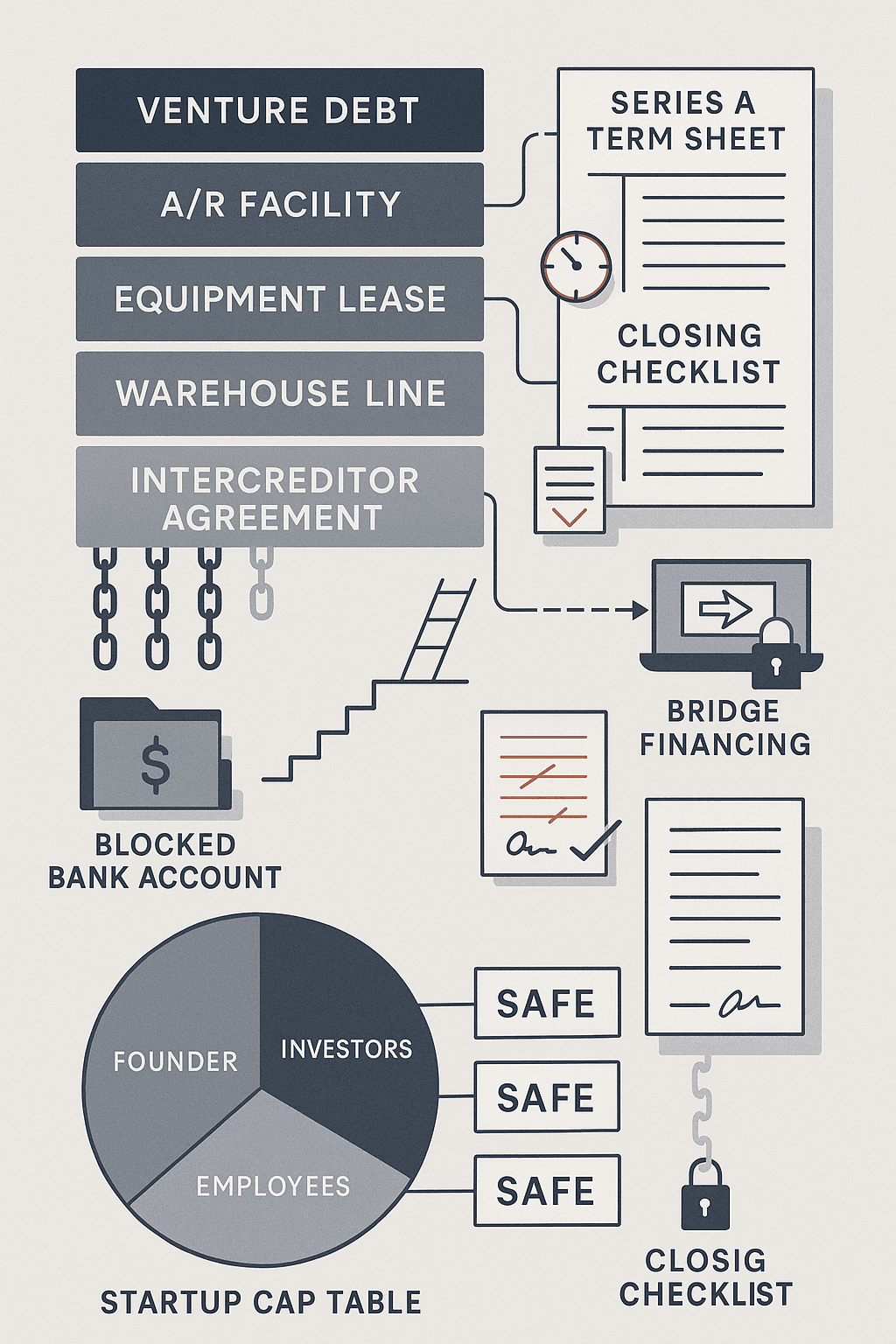
How venture debt, AR facilities, and subordination terms can handcuff your next equity round, and what to negotiate in the intercreditor deal.
On paper, none of this looks fatal. Debt principal is manageable. Interest is annoying but tolerable. Warrant coverage is modest. There is no obvious covenant tripwire. The board still thinks in the usual startup shorthand: debt extended runway, equity will refinance optionality, and the next lead investor will mostly focus on growth, gross margin, burn multiple, and valuation.
Then the Series A lead shows up and starts asking the questions founders usually do not.
Who controls the deposit accounts?
Which lender has first-priority liens on cash, receivables, IP, inventory, and proceeds?
Can new money prime existing lenders, even temporarily?
Who has cure rights if there is a default triggered by the round itself?
How many consents are required to close a bridge SAFE or convert insider notes?
If the company needs emergency capital before signing definitive equity docs, can the board actually take that money without violating negative pledge language or blocked-account mechanics?
That is where the intercreditor blind spot shows up.
Most founders model debt as a balance-sheet problem: principal, interest, amortization, runway impact, dilution from warrants. Sophisticated equity investors model it as a control problem: who sits above the cap table with the practical ability to slow, condition, tax, or veto financing outcomes.
The uncomfortable truth is that intercreditor agreements often matter more to your next round than the debt amount itself. Not because they always blow up financings. Usually they do something more subtle: they create delay, sequencing risk, hidden seniority, and negotiation leverage for people who are not writing your next equity check.
That changes valuation, closing certainty, and who pays to clean up the mess.
The problem founders underestimate
Founders usually understand the headline economics of debt:
What they often do not underwrite is the architecture tying multiple creditors together. Once you have more than one secured or quasi-secured financing source, the key question is no longer just "how much do we owe?" It is "who has rights against what, in what order, under what conditions, and with whose consent?"
That architecture lives in:
Series A and B leads care because these agreements can directly affect:
In other words, intercreditor terms are not legal footnotes. They are part of the company’s control stack.
Why current approaches fail
1. Founders treat debt sources as separate products, not an integrated rights package
A venture debt line is negotiated with one team. An AR facility gets added later by the finance function. Equipment financing arrives opportunistically. Warehouse debt comes in when inventory complexity rises. Each deal is justified in isolation.
That is exactly how companies sleepwalk into inconsistent lien scopes and cross-default structures.
One lender says it only cares about receivables, but the definition of collateral also sweeps proceeds, deposit accounts, and books and records. Another lender says it only wants equipment, but insists on broad default remedies and landlord access rights. The venture lender says IP is excluded from immediate foreclosure but remains part of collateral for most other purposes. Nobody steps back to ask what the stack looks like as a whole when a new equity round needs to move fast.
2. Boards fixate on dilution minimization and ignore financing friction
Many startup boards congratulate themselves for extending runway with “non-dilutive” capital. But non-dilutive is not the same as non-controlling.
An extra 18 months of runway financed through overlapping senior claims can be far more expensive than 8% additional dilution if it causes:
A clean cap table with messy creditor control is not actually clean.
3. Company counsel often paper the docs correctly but the business team never operationalizes the constraints
The legal terms are usually sitting there in plain English. Standstills. cure rights. anti-layering language. blocked-account triggers. field exam rights. release conditions.
The issue is not that the documents are unknowable. The issue is that founders and even some CFOs never convert them into a financing playbook. They do not model what happens if:
In venture fundraising, timing is not a cosmetic issue. A 10-day delay can kill momentum, reset diligence, or trigger adverse updates.
4. Equity investors underwrite around risk founders have not priced
Good Series A/B leads know debt docs can create practical veto points. So they respond rationally. They either:
Founders often misread this as investor conservatism. It is not. It is a pricing response to hidden complexity.
The core insight: the real control architecture sits above the cap table
Cap tables tell you who owns the company. Intercreditor arrangements tell you who can slow the company down when it needs financing the most.
That distinction matters because venture financings happen under time pressure. In that environment, the party that can withhold consent, control cash movement, or force sequencing changes has leverage even without owning equity.
The practical hierarchy often looks like this:
Notice what is missing from that list: debt principal.
A $2 million facility with hard blocked-account control and broad consent rights can be more disruptive to a financing than a $6 million line that is operationally flexible and contractually subordinated.
That is why sophisticated investors do not ask only “how much debt is outstanding?” They ask “what permissions architecture governs this company?”
The debt products that quietly create intercreditor complexity
Venture debt
Classic venture debt often comes with a blanket lien on substantially all assets, sometimes with negotiated exceptions around IP foreclosure mechanics. The lender may market itself as founder-friendly, but the control package still usually includes:
Even before another lender enters the picture, venture debt has already created a baseline control perimeter around your future financing options.
AR facilities and factoring lines
Founders often think AR facilities are self-liquidating and operational. Sometimes they are. But they can also be invasive.
AR lenders care intensely about cash conversion. That means they often negotiate:
When equity investors diligence this, they do not just see a working capital tool. They see a lender with direct influence over cash flow plumbing.
Equipment lessors and purchase-money financers
Equipment financing seems narrow because collateral is specific. Yet these arrangements can still matter if they include:
In a distressed or rushed financing, even a “small” lessor can become one more signature, one more payoff letter, one more release condition.
Warehouse facilities and inventory-backed lines
Consumer, health, fintech, and commerce startups often add warehouse or inventory-backed debt before their equity stack has matured. These facilities can be highly structured, with:
If your next investor has to understand not only the parent company but also the debt waterfall at a subsidiary or special-purpose vehicle, your round just got harder.
The specific intercreditor terms that create trouble
1. Lien priority across cash, receivables, inventory, IP, and proceeds
This is the headline issue, but most teams still simplify it too much.
It is not enough to know that one lender is “first on AR” and another is “first on everything else.” You need to know how proceeds are defined and traced. If receivable collections hit a deposit account that another lender controls, priority can become operationally more important than doctrinally neat.
Example:
On a whiteboard, this looks manageable. In practice, if customer cash lands in the operating account and a trigger event occurs during a fundraising process, the AR lender may gain practical dominion over liquidity before the equity round closes.
2. Standstill periods
Standstills are often sold as stabilizers: they stop junior creditors from taking immediate enforcement action. True. But they also shape who can negotiate during a crisis and for how long.
A junior creditor subject to a 180-day standstill may be unable to act while the senior lender controls the process. That can matter when a new equity investor wants everyone aligned quickly. If the senior lender will not consent to a bridge or partial release, and the junior lender cannot force movement either, the company sits in limbo.
Standstills reduce chaos. They also concentrate leverage.
3. Blocked-account control and cash dominion
This is one of the most underappreciated fundraising risks.
Founders think default means acceleration. Often the immediate consequence is simpler and more dangerous: control of cash moves.
A blocked-account trigger can allow a lender to direct collections into repayment or freeze discretionary movement. During a financing process, that can:
If a lead investor is considering a $15 million Series A but learns that, upon a borrowing-base shortfall, the AR lender can dominate cash collections in 24 hours, that investor is going to re-underwrite downside and process risk immediately.
4. Cure rights
Cure rights determine who gets the chance to fix defaults and preserve positions. This sounds technical. It is actually deeply economic.
Suppose an insider bridge investor wants to put in $1 million via SAFE to keep the company alive until the priced round closes. If existing debt docs restrict junior financing or any financing secured by the same collateral, and if a senior lender has cure or approval rights, then the bridge may require consent.
That means the lender can bargain over:
n- partial paydown
The bridge investor thinks they are rescuing the company. The senior lender knows they are rescuing the lender’s position too, and may price that accordingly.
5. Consent thresholds and amendment mechanics
The language that kills closings is often not “no.” It is “yes, but we need internal credit approval, outside counsel signoff, revised payoff language, and unanimous lender consent.”
In multi-lender structures, small drafting choices matter:
Fundraising timetables do not tolerate ambiguous consent mechanics. A week of document traffic can become a month.
A practical scenario: how a manageable debt stack becomes a Series A problem
Let’s model a realistic company.
Company profile
Debt stack
- Principal outstanding: $4.0 million
- Interest-only for 12 months, then amortization
- Warrant coverage: 0.75% of fully diluted equity
- Blanket lien on substantially all assets
- Negative pledge and restricted debt basket
- Maximum line: $3.0 million
- Borrowing base: 85% of eligible receivables
- Current draw: $1.6 million
- First lien on receivables and proceeds
- Lockbox arrangement with springing blocked-account control on default
- Principal outstanding: $600,000
- Purchase-money lien on lab equipment
- Cross-default to senior debt above $250,000
What the founder thinks
Total debt is $6.2 million. The company is raising a $15 million Series A at a $45 million pre-money valuation. New money will provide 24+ months of runway. Debt can either stay in place or be partly paid down. Since enterprise investors like efficient balance sheets, the founder expects the debt to be viewed as disciplined capital use.
What the Series A lead sees
The lead underwrites a different set of facts.
First, the AR facility currently advances 85% of $2.2 million of receivables, implying a theoretical base of $1.87 million. Current draw is $1.6 million, so cushion is only $270,000 before reserves or ineligibility adjustments. If one large customer ages out or disputes an invoice, the company could hit a borrowing-base deficiency during fundraising.
Second, if that deficiency triggers blocked-account control, then customer collections may be swept or tightly controlled precisely when the company needs flexibility.
Third, the venture debt lender has a blanket lien and consent rights over additional indebtedness and certain lien releases. If the new round wants the AR facility reduced, resized, or subordinated differently, amendments are likely required.
Fourth, the equipment lender has cross-default language. A default under either senior line may put the equipment debt into default too, creating another consent and payoff workstream.
Fifth, the $2 million of SAFEs are not debt, but if insiders want to bridge pre-close with additional SAFE money, the debt docs may still constrain use of proceeds, lien grants, or structurally senior rescue capital.
Now imagine the company gets a term sheet but needs six weeks to close. During that period:
At this exact moment, insiders offer a $750,000 bridge SAFE.
Can the company just take it?
Maybe. Maybe not. It depends on debt docs and intercreditor mechanics. If proceeds must flow through controlled accounts, if lenders require notice or consent, or if the bridge indirectly props up collateral while lenders tighten enforcement positions, the company may need waivers before the bridge solves anything.
That is the trap. The debt stack looked affordable. The control stack was fragile.
How hidden seniority changes equity economics
Even if the round closes, intercreditor complexity can shift economics in ways founders underappreciate.
Example 1: valuation retrade due to execution risk
Assume the Series A lead initially offers:
During legal diligence, investor counsel identifies that all existing lenders must consent to:
The lead now views the close as uncertain and proposes either:
At $45 million pre and $15 million raise, new investors own 25.0% post.
At $39 million pre and $15 million raise, new investors own 27.8% post.
That 2.8-point difference is not caused by growth deterioration. It is the price of financing friction.
Example 2: forced use of proceeds to clean up debt
Suppose the lead insists that, at closing:
Now the advertised $15 million raise only delivers:
If the company’s board modeled runway based on the full $15 million, they materially overstated the financing impact.
Example 3: hidden seniority accepted by new equity
Sometimes investors do not force cleanup. They simply accept existing lender seniority and price around it.
Assume the company closes the $15 million Series A but leaves:
The new preferred stock may be economically junior in any downside scenario to a creditor stack with broad enforcement rights and quick access to liquid collateral.
That means the equity investor is not just buying growth. They are buying behind a control structure that can shape future financing options. If they tolerate that, they will demand compensation somewhere else: price, governance, liquidation preferences, or board control.
The term-sheet interactions founders miss
Debt docs and equity term sheets interact more than most teams realize.
Pay-to-play and bridge expectations
If a lead investor expects insiders to support the company through signing and closing, but insider bridges require lender consent or cash-flow restrictions make proceeds hard to use, then the practical enforceability of investor support weakens.
Use of proceeds clauses
A lead may specify that proceeds fund growth, hiring, or product. Existing lenders may effectively require debt reduction first. If that mismatch is not surfaced early, the term sheet overstates strategic flexibility.
Liquidation preference and downside framing
A 1x non-participating preferred sounds straightforward until there is a meaningful secured debt layer sitting ahead of the preference. Investors will underwrite enterprise value net of debt enforcement realities, not simplistic preference stack diagrams.
Closing conditions
Leads increasingly include debt-specific conditions such as:
If founders discover these conditions late, the round may effectively be contingent on third-party creditor cooperation that has not yet been negotiated.
Red flags in diligence
If you are preparing for a priced round, these are the intercreditor red flags sophisticated investors and their counsel will spot quickly.
Cash-control red flags
Priority red flags
Amendment and consent red flags
Default architecture red flags
Equity interaction red flags
What to negotiate before signing debt docs
The best cleanup strategy is not needing cleanup.
Founders have more leverage before they sign debt documents than after performance softens or a round clock starts ticking. Use it.
1. Narrow collateral definitions aggressively
If the lender says it is underwriting receivables, do not casually grant broad rights over all proceeds, deposit accounts, general intangibles, and books and records beyond what is necessary. Product-specific debt should stay product-specific where possible.
2. Carve out equity financing flexibility
Negotiate clear baskets permitting:
Do not rely on “market practice” or verbal comfort. Put the flexibility in the documents.
3. Limit blocked-account triggers
Springing control should be tied to objective and material events, not broad lender discretion. Push for:
4. Simplify amendment thresholds
Seek majority-lender rather than unanimous consent where possible. At a minimum, define clearly which matters require all-lender approval and which can be handled administratively.
In startup financings, process risk is pricing risk.
5. Pre-negotiate release mechanics
If the business plan includes a priced round in 9 to 18 months, define in advance how liens get released or resized upon a qualified financing. You want template payoff letter language, notice mechanics, and turnaround expectations before the company is under deadline.
6. Watch cross-default thresholds
A $50,000 or $100,000 cross-default threshold can turn a minor operational disagreement into a capital-structure event. Push thresholds up and narrow what counts as a triggering default.
7. Avoid anti-layering traps
Some debt docs prohibit any debt structurally or contractually senior, or any secured rescue capital, without broad consent. That may sound reasonable at signing. It is dangerous if the company later needs a fast bridge before a priced round.
Cleanup strategies before a priced round
If the docs are already signed, the goal is not panic. It is preparation.
Build an intercreditor map
Before you launch fundraising, create a one-page matrix covering:
Most startups cannot answer these questions quickly. Investors notice.
Run a closing simulation
Model what happens if you sign a term sheet tomorrow and need to close in 30 to 45 days. List every third-party action required:
n- UCC termination filings
Then assign owners and realistic timelines. If one lender historically takes 10 business days for routine approvals, your legal close plan should reflect that reality.
Fix account structure early
If operating cash and collateral cash are mixed, clean that up before diligence. Investors hate discovering that ordinary equity proceeds may pass through creditor-controlled plumbing.
Renegotiate while performance is stable
Lenders are more flexible when the company is current, metrics are intact, and no financing emergency exists. If you know a round is coming, seek amendments early:
Budget the real payoff cost
Do not model only principal. Include:
A debt payoff that is 8% more expensive than expected can materially change round sizing.
Align lead investor expectations upfront
If debt cleanup will consume 20% to 30% of proceeds, tell prospective leads early. The right investor may still engage. The wrong investor will use late discovery as retrade leverage.
A negotiation scenario founders should study
Suppose your company has:
Investor counsel requires all liens released except a reduced $2 million revolver post-close.
The venture lender says yes, but only if:
The AR lender says yes, but only if:
Insiders want to fund the $1 million bridge immediately because payroll is tight. Debt docs allow junior unsecured debt only up to $500,000 without consent.
Here is the founder’s real menu of options:
- Pros: fastest path if investor agrees
- Cons: more dilution, more proceeds diverted to cleanup
- Pros: removes uncertainty for lead
- Cons: may require showing your hand early
- Pros: aligns new money with closing path
- Cons: gives lead more leverage on valuation or structure
- First $500,000 under existing basket, second $500,000 after lender consent
- Pros: buys time
- Cons: still leaves approval risk, may trigger investor concern
- Pros: potentially cleaner long-term structure
- Cons: operationally difficult under deadline, expensive legal process
The wrong move is pretending this is purely a legal cleanup exercise. It is a valuation and control negotiation.
If the company waits until definitive financing documents are circulating, every party knows the equity round is mission-critical. That weakens the company’s negotiating leverage materially.
The contrarian takeaway
Founders love to debate whether venture debt is good or bad. That debate is too shallow.
Debt is neither inherently smart nor inherently reckless. The real question is whether the rights architecture around that debt preserves financing agility.
A company with more debt but cleaner intercreditor mechanics can be easier to finance than a company with less debt and a tangled consent stack.
That is the contrarian point many boards miss: the biggest cost of debt is often not interest or warrants. It is the hidden option value you give away on your next capital raise.
And option value is exactly what growth-stage equity investors are paying for.
What founders and investors should do now
For founders
For investors
For boards
The next time someone says a credit line is just a runway extender, push back.
It is also a set of senior rights, account controls, release conditions, and consent gates that may shape who can fund your company later, on what timeline, and at what price.
That architecture sits quietly above the cap table until the moment you need a round done fast.
Then it becomes very loud.
RaiseSimpli Team
Author