Reverse IPO Ratchet: Late-Stage Terms Punish Exits
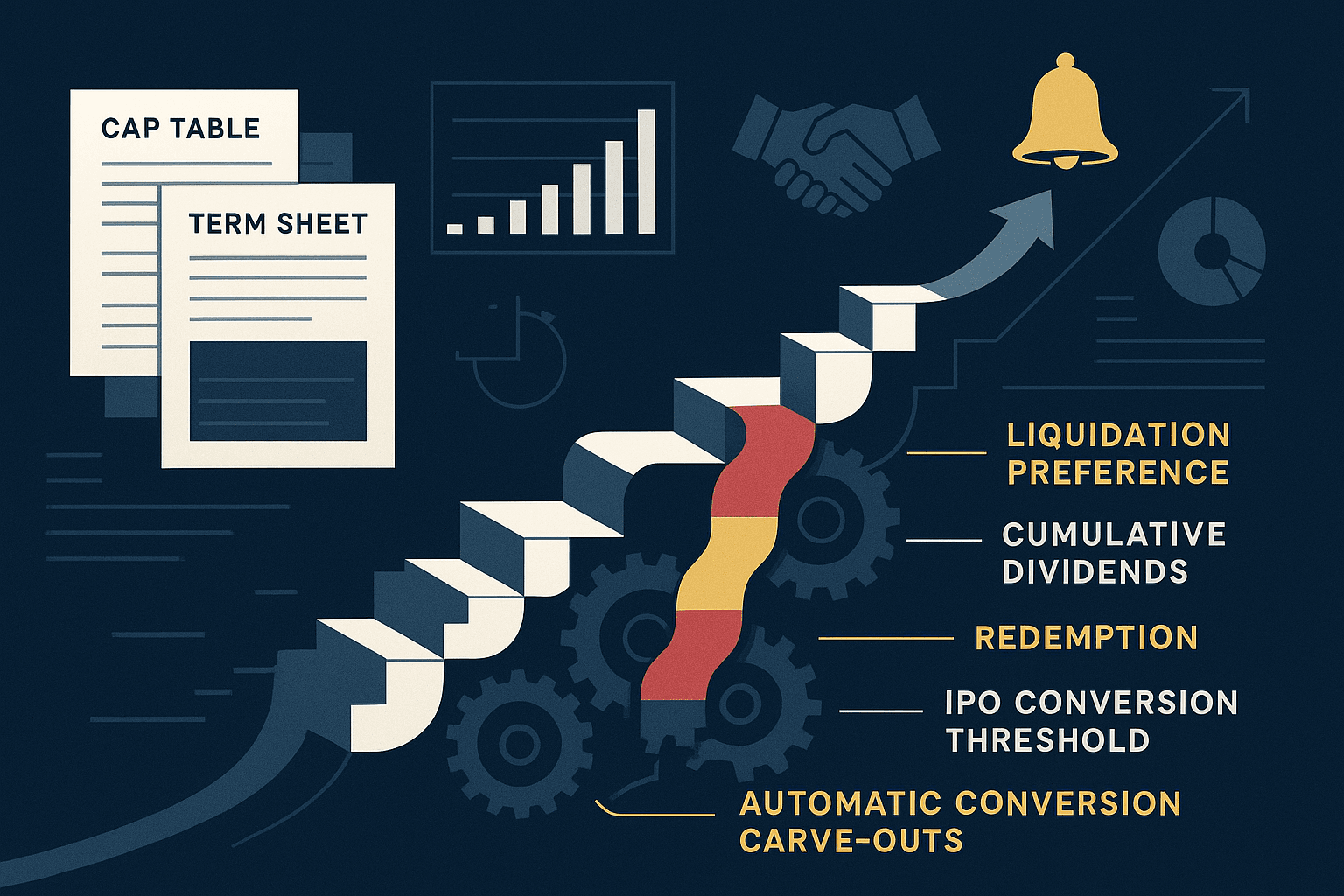
How late-stage preferred terms can punish strong exits that land below the headline price, and what to review before you accept them.
Three years later, the business sells for $1.1 billion in cash after a competitive process. On TechCrunch terms, this looks like a win. The company sold for more than $1 billion. The headline still sounds elite. But the founder’s common stock payout is far worse than expected. Employee option holders are disoriented. Some late-stage preferred investors do fine, or better than fine, while the people who built the company realize the “paper step-up” created a hidden exit tax.
That is the trap.
Most founders understand downside protection in the abstract. They know preferred stock may carry liquidation preferences, dividends, anti-dilution, redemption rights, and conversion mechanics. What many do not fully internalize is that some late-stage terms do not merely protect investors in bad outcomes. They actively distort medium-good and even objectively strong outcomes. They can punish a perfectly healthy M&A sale or a sub-target IPO that would otherwise be a rational, value-maximizing exit.
This is what I mean by the “IPO ratchet in reverse.” In a classic ratchet, investors get protected when the company underperforms on pricing in a future financing. In the reverse version, the company may have built real enterprise value, but if the exit lands below a specific threshold embedded in the preferred terms, the economics snap against common holders. The business can perform well in an absolute sense and still produce a surprisingly bad distribution because the financing documents were designed around a narrow definition of success.
The danger zone typically appears in crossover-led or public-market-influenced late-stage rounds: rounds priced aggressively, justified by IPO comps, and negotiated in periods when boards care more about minimizing dilution on paper than about preserving flexibility across a range of exits. The valuation gets discussed endlessly. The legal plumbing gets waved through as “market,” especially when management is told, with some truth, that these terms only matter if the IPO does not happen the way everyone expects.
That last phrase is exactly the problem.
The problem: premium valuations often come bundled with hidden exit tripwires
At late stage, founders and boards are often solving a very specific near-term problem: extend runway to profitability or to IPO readiness while preserving the strongest possible valuation mark. The psychology changes from early-stage fundraising. At Seed or Series A, people still expect rough edges and structural protection is relatively simple. At Series D, E, or crossover rounds, there is a temptation to optimize for optics:
What gets lost is that a high nominal price can be paired with terms that reshape the exit waterfall in ugly ways. These terms are often not framed as aggressive. They are framed as prudent late-stage protections for investors writing large checks at lofty prices.
Here are the usual culprits:
Individually, each term can be explained away. Together, they can create a capital structure that behaves normally in a home-run IPO and abnormally everywhere else.
That is the key asymmetry. The term sheet is not merely saying, “If things go badly, investors get protection.” It is saying, “If the exact type of premium liquidity event we underwrote does not materialize, the distribution shifts sharply away from common.”
Why current approaches fail
Boards usually review late-stage terms through the wrong lens.
1. They focus on dilution, not on the exit waterfall across scenarios
A board sees two term sheets:
Many boards instinctively prefer Offer B because the dilution looks lower at signing. But that is a static financing view. The company does not realize value at financing. It realizes value at exit. If you do not model the waterfall at $800 million, $1.0 billion, $1.2 billion, $1.5 billion, and $2.0 billion outcomes, you are negotiating half-blind.
2. They assume “we’ll definitely IPO” neutralizes the term risk
This is the classic frothy-market mistake. Late-stage rounds often happen when public comps are generous and crossover capital is abundant. Management starts believing the next step is almost mechanically an IPO. Under that assumption, conversion thresholds, redemption rights, and cumulative dividends feel theoretical.
But IPO windows close. Revenue multiples compress. Growth slows from 90% to 45%. Public investors demand profitability. Suddenly the company can still be very good and still fail to clear the exact IPO price or market cap threshold embedded in the charter.
Then the “theoretical” terms become live.
3. They confuse valuation validation with value realization
A $1.5 billion post-money round is not an exit. It is one investor’s negotiated purchase of a specific security with bespoke rights. Common shareholders do not own that security. Employees definitely do not. Treating the preferred round price as if it automatically re-prices common is one of the most persistent errors in venture-backed companies.
4. Lawyers flag the terms, but boards often do not force economic modeling
Company counsel may explain the mechanics. Investor counsel certainly understands them. But unless someone converts those words into dollars under realistic exit scenarios, the board conversation remains abstract.
“1.5x preference plus accrued dividends unless converted” sounds manageable.
“Series E takes $486 million off the top in a $1.1 billion sale before common sees a dollar” focuses the mind.
5. Management teams underestimate how these terms reshape future M&A negotiations
An acquirer does not care what the cap table was supposed to mean emotionally. They care about the merger consideration required to get board and stockholder approval. If the preferred stack creates a giant dead zone where founders and employees get little, that can change the willingness of management to support a deal, the price floor demanded by investors, and the probability the process falls apart.
In other words, these terms do not just affect payout after a deal is signed. They affect whether the deal gets done at all.
Core insight: late-stage preferred can function like an upside filter, not just downside insurance
The contrarian point is simple: some preferred structures quietly convert a broad range of good exits into economically mediocre outcomes for common, while preserving or enhancing returns for the newest money.
That is different from standard venture risk allocation.
A plain 1x non-participating preferred is relatively clean. Investors can either take their money back or convert into common and share pro rata. In many outcomes, investor and founder incentives reconverge because everyone benefits from pushing value higher.
But once you add multiple preferences, accruing dividends, IPO qualification thresholds, and carve-outs that prevent automatic conversion in non-ideal exits, you create a wedge. That wedge can persist far above the company’s historical invested capital. The latest round may have been marketed as confidence in the company’s inevitable IPO. Economically, it may behave more like a structured instrument with a preferred return and a narrow conversion gate.
The practical result is that the headline valuation becomes a poor predictor of what founders and employees actually receive in a sale or soft IPO.
Let’s walk through how the mechanics work.
Mechanic #1: IPO price-based automatic conversion thresholds
A standard preferred stock setup often provides for automatic conversion into common upon a “qualified IPO,” usually defined by a minimum gross proceeds amount and sometimes a minimum per-share IPO price. The benign version uses thresholds meant only to distinguish a real public offering from a technical listing.
The aggressive late-stage version uses a threshold that effectively says: if the IPO is not priced at or above a level that validates this round, preferred does not automatically convert.
That matters because if preferred stays outstanding or has election rights in a sub-threshold IPO, investor economics can remain structurally senior or become negotiable in a way common holders hate.
Example: conversion threshold distorts a solid IPO
Assume:
Now assume the charter says Series E automatically converts only in an IPO priced at $18.00/share or higher.
The market softens. The company can go public, but the book builds only at $14.00/share.
Without the threshold, everyone converts and the cap table behaves like common. At $14.00/share, the implied equity value is:
That is below the Series E markup case, but still a substantial company.
If Series E automatically converted, its stake would be worth:
That is slightly below cost, but within normal market outcomes.
But if the threshold blocks conversion, Series E may retain preferred rights, negotiate additional protections, demand a structure change, or force a recap conversation before the IPO proceeds. Even if the company technically can list, the financing terms can create frictions around accounting, governance, exchange requirements, or pre-IPO cleanup.
In practice, what happens is not always literal non-conversion surviving forever in the public company. More often, the threshold gives investors leverage to extract concessions because management cannot access the public market cleanly on the planned terms.
The reverse ratchet effect is that a perfectly credible IPO at $14.00 is treated as a disappointment severe enough to reopen economics.
Mechanic #2: automatic conversion carve-outs in acquisitions and non-qualified exits
Some charters define automatic conversion narrowly and leave room for preferred to retain class treatment in mergers, de-SPAC-like transactions, tender offers, or other liquidity events that are not textbook qualified IPOs.
That sounds technical. It is not. It is the heart of many ugly outcomes.
If preferred does not automatically convert in an acquisition where the per-share common value would otherwise be decent, investors can choose the preference stack instead of pro rata common treatment. Founders then discover that the acquisition price needed to make everyone “whole” is much higher than the board’s mental model.
Mechanic #3: multiple liquidation preferences
A 1x liquidation preference means the investor gets back its invested capital before common, unless conversion yields more.
A 1.5x or 2x preference means the investor gets back 150% or 200% of invested capital before common, again unless conversion is better.
This is not market-standard in classic venture rounds, but it appears more frequently when private markets become euphoric and investors want downside insulation against overpaying. The dangerous thing is that “downside” may extend into what founders would call a successful exit.
Example: 1.5x preference changes a billion-dollar sale
Assume this cap table before exit:
Now assume Series E has:
Series E preference amount:
Now the company gets an all-cash acquisition offer for $1.1 billion.
If Series E converted into common, it would own:
Obviously it will not convert. It will take the preference: $450 million.
That leaves:
for everyone else, subject to other preferences higher in the stack.
If the board had mentally treated the $1.8 billion round as a rough indication that a $1.1 billion sale would still be pretty good for common, this is where the error shows up. The latest investors are not sharing proportionately in the downshift from $1.8 billion paper value to $1.1 billion exit value. Common is absorbing much more of it.
Compare with plain 1x non-participating
Under a 1x preference, Series E would take:
leaving:
for the rest.
That extra $150 million transfer from common to Series E is not a small drafting detail. It can mean the difference between employees getting meaningful payouts and getting almost nothing after exercise costs and taxes.
Mechanic #4: cumulative dividends silently compound the preference stack
Cumulative dividends are one of the most under-modeled late-stage terms because they often do not require cash payment while the company remains private. They simply accrue.
Founders hear “8% cumulative dividend” and translate it emotionally as “something similar to interest, but probably not decisive.” Sometimes it is decisive.
Example: accrued dividends make the preference much fatter
Take the prior Series E terms and add:
Series E invested: $300 million
Accrued dividends:
If the 1.5x preference is defined on original purchase price and dividends accrue on top, Series E may be entitled to:
In a $1.1 billion sale, now only $554 million remains for everyone else before accounting for earlier series preferences.
That is how a nominally strong exit starts feeling terrible to common.
And remember: this is a single late-stage series. Many companies also have earlier preferred rounds with their own rights, though those are often simpler. Once multiple layers interact, the common pool can get squeezed much harder than anyone expects from the headline enterprise value.
Mechanic #5: redemption rights create pre-exit leverage
Redemption rights usually kick in after a set number of years, often at investor election or under board-dependent procedures. Founders often dismiss them because Delaware law and solvency limitations make immediate enforcement complicated.
That is too casual.
Redemption rights matter less as a blunt collection tool and more as a strategic pressure point. If a company misses the IPO path and the clock runs, investors can use redemption rights to force the board into exploring liquidity, accepting structured secondary solutions, refinancing the preferred, or negotiating deals from a weaker position.
A company that could otherwise have waited 12–18 months for better M&A conditions may no longer have that flexibility.
That timing pressure tends to help the senior security.
Negotiation scenario: redemption compresses M&A options
Imagine the company above reaches year 5 after the crossover round. Growth has slowed, but the business is still attractive. The company could likely sell for between $950 million and $1.2 billion depending on process quality and timing.
Series E now has redemption rights over its $300 million investment plus accrued dividends. It knows management wants to avoid the reputational damage of a forced process. It also knows the board may not be willing to raise a flat or down round to reset the balance sheet.
As a result, Series E can push for an immediate sale even if waiting might create a better outcome for common. Since its own preference stack already protects much of its return, it is less exposed to the difference between, say, a $1.0 billion and a $1.15 billion sale than common is.
That is the incentive distortion. Senior capital wants certainty. Common needs price. The term sheet quietly aligned those interests in opposite directions.
Mechanic #6: automatic conversion carve-outs and board-approved equivalents can recreate participation economics
You do not always need formal participating preferred for investors to get participation-like outcomes. Merger consideration provisions, separate class votes, or negotiated treatment in a recapitalization can produce similar effects if preferred holders retain leverage because conversion does not happen automatically in the relevant exit.
This matters especially in stock deals, mixed consideration deals, and IPO-adjacent transactions where securities design can be revised as part of closing.
Founders often learn too late that what looked like “non-participating preferred” in a narrow sense still gave investors a menu of superior outcomes if the exact clean conversion event never arrived.
Full cap table math: how a “good” exit becomes mediocre for common
Let’s build a more realistic waterfall.
Capitalization
Assume the company has raised over time:
Fully diluted ownership on an as-converted basis at exit:
Total: 100%
Assume Series E exit occurs 4 years after closing. Dividends accrued = $96 million as above.
Preference stack amounts:
Total aggregate preference if all take preference:
Scenario 1: $900 million acquisition
Who converts?
Waterfall:
- Common: 45%
- Series A converted: 8%
- Series B converted: 15%
- Total participating percentage base = 68%
Distribute remaining $234 million pro rata among this converted pool:
Look at that outcome carefully. A $900 million sale of a venture-backed business with a last round valuation far above that level still delivers only $154.85 million to the entire founder and employee common pool.
If employee options and RSUs are a large component of that common, the founder’s personal proceeds may be far lower than outsiders imagine.
Scenario 2: $1.1 billion acquisition
Series values on conversion:
Waterfall:
Distribution:
Again, a $1.1 billion acquisition sounds outstanding in press release terms. But common gets $311.63 million, not the $495 million it would have received if everyone simply shared pro rata at 45% of total value.
The gap is:
That is the hidden exit tax.
Scenario 3: $1.8 billion IPO at $15.43/share equivalent
At this value, Series E still may not automatically convert if the charter requires an IPO price of $18/share. This is the subtlety founders miss. Enterprise value can be large and still fail the per-share threshold depending on share count and pricing mechanics.
Economically, if it did convert, Series E’s stake would be worth:
That is still below its preference-plus-dividends of $546 million. So if the IPO structure or charter carve-outs let Series E preserve leverage, the company may need a charter amendment, side deal, or repricing of expectations to complete the offering.
This is how “good but not validating enough” public outcomes get punished.
Scenario 4: $2.8 billion IPO
Series E conversion value:
Now conversion finally beats the preference stack. The distortion disappears, because the exit is large enough to overwhelm the senior features.
That is exactly why these terms are dangerous. They are easy to ignore when management believes the company is headed for a clear home run. The terms do not matter in the top decile outcome. They matter in the broad middle where many real exits occur.
How these terms emerge in crossover-led rounds
Crossover investors are not irrational. They are solving a portfolio construction problem.
When they invest privately at late stage, they often compare the opportunity not to a Series A, but to public equities and IPO allocations. They want:
In hot markets, founders hear the flattering version of this: “We can pay a premium because we really believe in the public story.”
The unflattering version is: “We will pay a premium only if the legal terms preserve strong outcomes for us when the public story breaks imperfectly.”
That is not evil. It is sophisticated investing. But boards should understand that crossover-led preferred can act less like classic venture common-risk capital and more like a bespoke structured equity instrument.
Why boards misread these terms during frothy financings
Three recurring reasons:
Markup addiction
Existing investors and sometimes independent directors become attached to the signaling value of a large step-up round. A premium valuation validates prior marks and reduces visible dilution. This creates subconscious pressure to treat legal protections as secondary.
Base-rate neglect
Boards model the bullish case in detail and the medium case superficially. They spend hours debating whether the IPO happens at $4 billion or $6 billion and almost no time on what happens at a $1.0–$1.5 billion sale or a modestly priced IPO that clears liquidity but not the threshold.
Misaligned advice incentives
Not every participant in a financing process is equally motivated to highlight the downside of a premium-priced round. New investors want the deal. Existing investors want the mark. Management wants the headline. Lawyers explain but do not decide. Unless someone explicitly owns scenario modeling for common, no one fully carries that brief.
How these terms reshape M&A years later
When the company eventually explores a sale, the late-stage financing documents reappear with force.
1. They create a price floor for investor support
If Series E needs roughly $546 million before conversion makes sense, and earlier investors have their own preferences or expected returns, the board may discover that a transaction below a certain level is politically or legally difficult even if it is rational for the enterprise.
2. They weaken management’s motivation in the dead zone
Suppose management’s common payout barely changes between a $950 million and $1.1 billion sale because most incremental proceeds go to the preferred overhang. Founders may resist running a grueling process for an outcome that does little for the team. That can reduce competitive tension and lower final price.
3. They complicate acquirer negotiations
Acquirers sense cap table stress. If they know the company has a difficult preferred stack, they may infer that the board needs a deal more than it can admit. They may also exploit internal divisions between preferred and common constituencies.
4. They increase the chance of side deals
Management carve-out pools, retention bonuses, and transaction bonuses become more common when the board realizes a sale otherwise leaves employees underwater. Sometimes these are necessary. But they are also evidence that the original capital structure failed to preserve aligned incentives.
What founders should model before accepting a premium valuation with hidden tripwires
This is the practical part. Before taking a high-priced late-stage round with bespoke terms, founders should insist on explicit scenario analysis.
Build a real exit waterfall, not a cap table snapshot
Model at least these cases:
For each case, show dollars to:
Ask five term-sheet questions directly
If the answer to any of these cannot be reduced to a simple table, the structure is too complex to wave through casually.
Compare term sheets on effective economics, not just nominal valuation
A lower-priced round with clean 1x non-participating preferred may produce better founder and employee outcomes across a wide range of realistic exits than a premium round with hidden structure.
For example:
Deal B may look superior on day one. But if the likely three-year exit range is actually $1.0–$2.0 billion, Deal A could leave common materially better off in most scenarios.
That is the right comparison.
Negotiate the hidden terms, not just the price
If the investor insists on protection, founders can often improve the structure materially by focusing on specific terms:
Even partial improvements matter because they reduce the size of the dead zone where strong exits underpay common.
A blunt view on board responsibility
Boards that approve premium late-stage rounds without scenario-level waterfall modeling are not being sophisticated. They are outsourcing judgment to a headline price.
That is especially dangerous when the round is sold internally as “minimizing dilution.” Minimizing dilution in a security that sits beneath a growing preferred overhang is not necessarily protecting common. In some cases it is the opposite. The board accepted less visible dilution in exchange for more severe contingent subordination later.
Put differently: if you raise at a premium valuation by issuing a security that takes hundreds of millions off the top in any merely good exit, you did not eliminate dilution. You deferred and disguised it.
Takeaways
First, late-stage preferred terms can punish upside, not just protect downside. The most dangerous structures are those that only behave benignly in a narrow home-run IPO path.
Second, headline valuation is a weak proxy for founder and employee outcomes. The security design matters more than the press release.
Third, IPO price-based conversion thresholds, cumulative dividends, multiple liquidation preferences, redemption rights, and automatic conversion carve-outs often combine into a structured-equity package that creates a dead zone for common in medium-good exits.
Fourth, crossover-led rounds are where these tripwires most often appear, because investors are underwriting to public-market validation while protecting themselves against a less-than-perfect version of that story.
Fifth, these terms do not just affect distributions after exit. They reshape incentives before exit, distort M&A negotiations, and can reduce strategic flexibility when the company most needs it.
Finally, founders should stop asking only, “What is the valuation?” and start asking, “What happens at $900 million, $1.1 billion, $1.5 billion, and a below-target IPO?” If the answer is unclear, the round is more expensive than it looks.
That is the real lesson of the IPO ratchet in reverse. The trap is not that investors protected themselves against failure. The trap is that boards accepted terms that redefine success so narrowly that everyone who built the company can lose in outcomes the outside world still calls a win.
RaiseSimpli Team
Author