MFN Cleanup: Series A Leads Forcing SAFE Waivers
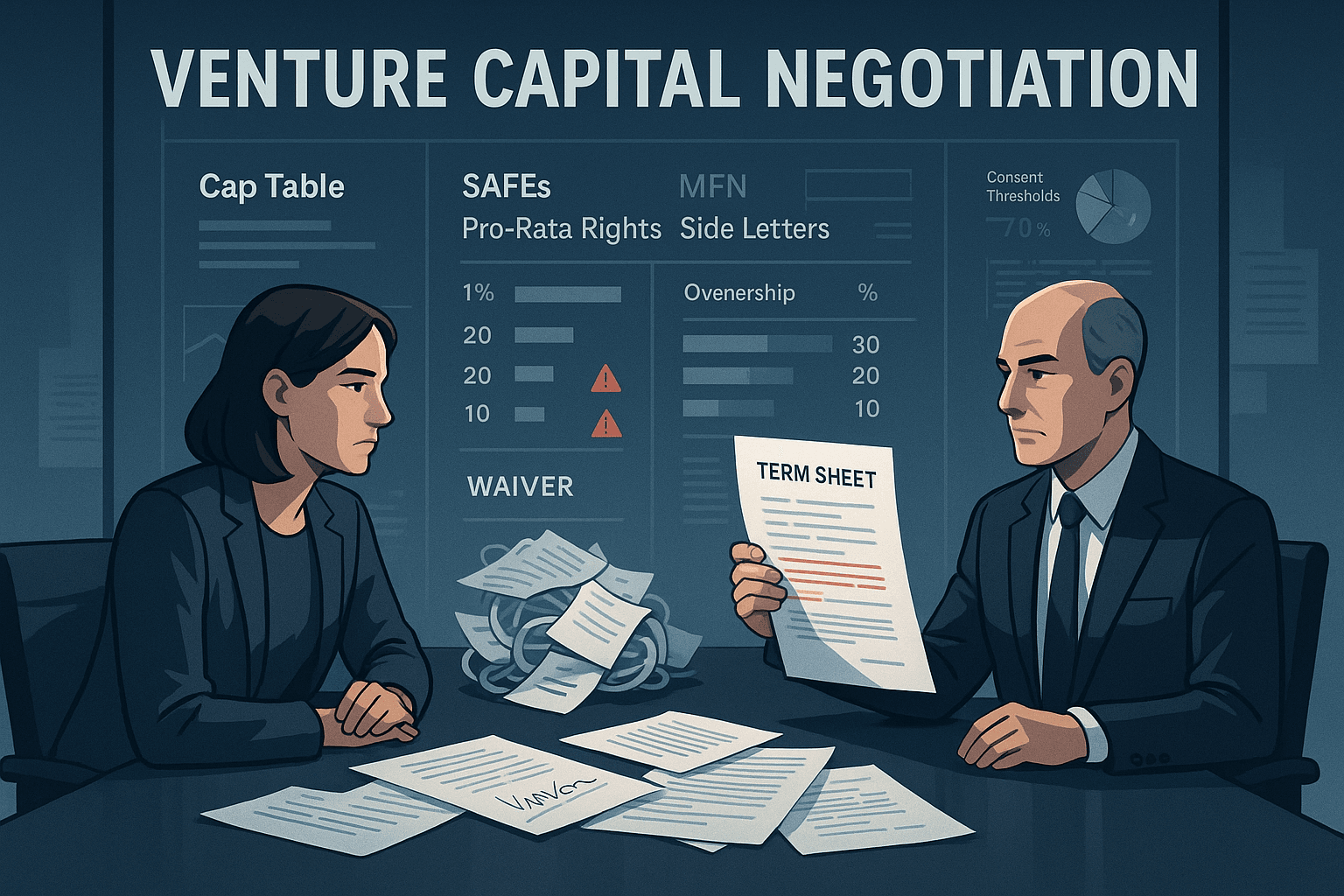
How Series A leads force SAFE holders to waive MFN rights before they price the round, and how to prepare your investors and your leverage.
This is the fundraising dynamic many founders discover too late. They assume messy SAFE stacks merely reduce valuation or create extra legal fees. Often the bigger problem is leverage. A serious Series A lead can weaponize the threat of walking away to force a full MFN and pro-rata cleanup before signing. The lead does not need to prove that every side-letter right is economically devastating. They only need to show that the stack is uncertain, that post-closing disputes are possible, and that they have other deals to do. Once that happens, founders are no longer negotiating only with the lead. They are negotiating with every historical SAFE holder whose consent, waiver, or silence may matter.
That is the trap. And it feels like blackmail because, functionally, it is leverage extracted at the exact moment the founder can least afford delay.
The real scenario: the round that gets repriced by the cleanup
Take a company raising a $12 million Series A at a proposed $36 million pre-money valuation. Before the round, the company has:
The lead likes the company and verbally indicates willingness to lead at $36 million pre. Then counsel does the diligence review.
Here is what they find:
The lead’s lawyer says what experienced lead investors often say in cleaner language: if this round closes without waivers, those SAFE investors may assert rights in the financing documents, in allocation, or after closing. The company could face delayed closing, claims of unequal treatment, or demands for extra shares. The lead does not want to inherit that fight.
So the lead reframes the process:
The founder hears “administrative cleanup.” The lead means “we now control timing and potentially price.”
That distinction is everything.
The problem is not messy documents. It is concentrated timing leverage.
Founders often underweight how fundraising leverage shifts over time.
Before a lead is engaged, old SAFE holders have limited tactical leverage because there is no immediate event to block. They may complain, posture, or ask questions, but there is no live transaction whose urgency they can exploit.
Once a lead investor is ready to move, everything changes. The company now has:
At that exact moment, every obscure right in the SAFE stack acquires leverage far greater than its face value.
A tiny angel with a $100,000 SAFE and a sloppily drafted side letter might have zero economic significance in the cap table. But if their consent is required, or plausibly arguable as required, they can become a gating item on a $12 million round. The issue is not whether they deserve the leverage. The issue is that transaction sequencing gives it to them.
This is why “MFN cleanup blackmail” is the right phrase. The lead is not necessarily acting irrationally or unfairly. In many cases, the lead is doing exactly what a disciplined investor should do: refuse to price avoidable legal ambiguity. But from the founder’s perspective, the result is the same. A party with signing leverage conditions progress on clearing rights that should have been rationalized much earlier.
Why current founder approaches fail
Most founders make one of four mistakes.
1. They assume standard SAFE documents are self-cleaning
They are not.
Even if the core SAFE forms are standard, side letters and email promises are where problems breed. Rights around MFN, pro-rata, information access, and participation in the next round are frequently modified outside the four corners of the base instrument. The ugliness is often not in the SAFE itself. It is in the accreted exceptions.
2. They think small investors cannot matter
Wrong in financing mechanics.
A right held by a small investor can matter more than a large investor’s economics if that right creates uncertainty about who must consent, who gets allocation, or who can later claim parity. Transaction leverage is not proportional to check size.
3. They defer cleanup because “we’ll handle it at the Series A”
That is exactly when cleanup is most expensive.
The cost is not just legal fees. It is negotiating posture. If a founder asks for waivers six months before a financing, investors may grant them with little drama. If the founder asks after telling investors a top-tier lead will walk without signatures, investors immediately understand they have leverage.
4. They disclose rights reactively instead of strategically
Founders often let the lead discover issues through counsel instead of surfacing them in an organized way. That makes the company look sloppy, weak on process, and potentially incomplete in disclosure. Leads price uncertainty harshly.
The core insight: the future Series A negotiation starts when you issue the seed SAFE
The contrarian point is simple: founders should stop treating seed SAFEs as isolated fundraising instruments and start treating them as pre-Series A governance architecture.
Every MFN clause, every side-letter pro-rata grant, every amendment mechanic, and every ambiguity around consent thresholds is a future negotiation chip. If you do not design those chips in advance, someone else will cash them in when the priced round appears.
The right question at seed is not just: can we get this money in quickly?
The right question is: when a new lead investor demands certainty, can we deliver it without asking twenty fragmented investors for bespoke waivers under time pressure?
That leads to three principles.
How waiver consents actually get organized
Founders who have never done this imagine a simple DocuSign process. In reality, waiver cleanup is a miniature political campaign.
Step 1: rights inventory
Counsel creates a matrix covering every SAFE, side letter, note, and written promise. Typical columns include:
If this matrix does not exist, the company is negotiating blind.
Step 2: classify rights by risk
Not every cleanup point matters equally. Counsel and the lead usually sort rights into buckets:
This classification matters because founders often over-negotiate minor points while missing the one right that actually scares the lead.
Step 3: identify consent mechanics
Here the pain begins. You need to know whether cleanup requires:
Many founders discover too late that there is no efficient collective mechanism. If ten side letters were drafted separately, you may need ten separate signatures.
Step 4: map likely holdouts
This is not cynical. It is practical.
Some investors sign immediately. Some want a call. Some need investment committee approval. Some are no longer active. Some have principal-agent issues because the original partner left. Some are emotionally attached to “rights” they barely understand. Some view a waiver request during a hot Series A as an invitation to ask for something.
Step 5: sequence outreach
The best cleanup campaigns do not start with the likely holdouts. They start by accumulating momentum.
Founders and counsel often first contact:
Once a majority of credible investors agree, holdouts become easier to isolate socially and economically.
Step 6: choose the ask carefully
The waiver request itself matters.
A broad request saying “waive all rights” invites suspicion. A targeted request saying “confirm that your MFN and pro-rata rights will not apply to the Series A and will not entitle you to additional securities, allocation, or side-letter treatment in connection with this financing” is more likely to get done.
Precision reduces paranoia.
Who becomes a holdout
In practice, holdouts are rarely the investors founders expect.
The tiny angel with a lawyer friend
This investor wrote a small check, feels overlooked, and now gets a document saying their rights need to disappear for a major round to happen. They may not want economics. They may want recognition, explanations, or ego satisfaction. That can still slow you down.
The micro-fund that marketed founder-friendliness but needs signaling wins
Some small funds use pro-rata and side-letter rights to preserve the appearance of access and discipline to their LPs. Waiving rights without visible consideration can feel like conceding that they negotiated a paper tiger.
The investor with the broadest ambiguous drafting
Paradoxically, weak drafting can create stronger negotiating leverage because ambiguity is expensive. If a side letter vaguely references matching future investor “rights and preferences,” the lead may insist on a waiver even if the investor would probably lose in a litigation merits contest. Nobody wants a financing priced around litigation theory.
The orphaned institutional check
A fund that invested two years ago may now have a departed partner, a disorganized back office, or internal attention elsewhere. They are not hostile. They are just operationally slow. Slowness can kill timing as effectively as hostility.
The investor who already feels diluted out
If an investor believes the company has not kept them close, they may use the waiver process to reopen broader grievances: update quality, access, governance, or perceived favoritism toward new money.
Why small side-letter rights suddenly gain outsized leverage
Because priced rounds are built on certainty, not just economics.
Suppose an investor with a $150,000 SAFE has side-letter pro-rata rights to buy their “proportionate share” of the next round. In an ordinary context, maybe that means a trivial allocation. But now the Series A lead wants to purchase $10 million of a $12 million round, leaving $2 million for insiders and strategic allocations. If multiple side-letter investors assert broad pro-rata rights, the company may have over-promised that $2 million several times over.
Example:
Now assume four SAFE investors claim pro-rata rights based on fully diluted ownership after conversion:
Total asserted rights: $1.25 million
That may still seem manageable, but the lead may object for two reasons:
Now layer MFN on top. If Investor E has an MFN broad enough to elect side-letter terms granted to Investor A, E may attempt to import A’s pro-rata right. Even if E’s argument is weak, the possibility alone is enough to create diligence concern.
This is where tiny rights become large. Not because they are economically huge in isolation, but because they interact nonlinearly in a constrained allocation and documentation environment.
The cap table math: how cleanup pressure can move price
Founders often think waiver cleanup is separate from valuation. It is not.
Assume the company has 10.0 million common shares outstanding pre-financing and $5.5 million of post-money SAFEs converting in the Series A. For simplicity, assume the SAFEs convert into 1.964 million shares in aggregate based on their terms and the Series A price framework. Pre-money capitalization for pricing becomes roughly 11.964 million shares before creation or expansion of an option pool.
At a $36 million pre-money valuation, price per share is approximately:
$36,000,000 / 11.964 million = $3.01 per share
If the Series A is $12 million, investors buy about:
$12,000,000 / $3.01 = 3.987 million preferred shares
Post-financing shares become:
Lead taking $10 million gets about 3.322 million shares, or roughly 20.8% post.
Now suppose cleanup is incomplete, and the lead says one of two things:
At $32 million pre with the same 11.964 million share base, price per share drops to:
$32,000,000 / 11.964 million = $2.67 per share
The $12 million round now buys:
$12,000,000 / $2.67 = 4.494 million shares
Total post becomes:
11.964 + 4.494 = 16.458 million shares
Founder/common holders are diluted materially more. The difference is not abstract. It is the cost of entering a priced round with unresolved rights ambiguity.
If founders own 6.5 million of the 10.0 million common shares pre-SAFE, then:
At $36 million pre:
At $32 million pre:
That 1.2 percentage point drop may look modest, but on future outcomes it is meaningful. On a $500 million exit, that is roughly $6 million of value before tax. And that is before considering any extra option pool expansion or side concessions granted to obtain waivers.
Cleanup failure is not a paperwork issue. It is dilution.
Term sheet comparisons: how leads operationalize the threat
Here are three stylized term sheet positions a lead might take.
Term Sheet A: clean cap table
This is the founder-friendly scenario. Certainty is already present.
Term Sheet B: conditional cleanup
This looks okay on price, but it transfers execution risk onto the company. If waivers stall, the lead can sit back while clock pressure mounts.
Term Sheet C: cleanup discount
This is where founders end up when the lead believes cleanup is painful and the company lacks alternatives.
The key point: the lead does not need to explicitly say “waive rights or we lower price.” The structure of the term sheet can do it silently.
Negotiation scenarios with real leverage dynamics
Scenario 1: the founder asks for waivers after announcing the lead
This is the worst sequence.
The founder emails legacy SAFE investors: “Great news, we have a lead for the Series A. Their counsel needs everyone to waive MFN/pro-rata rights for the financing. Please sign attached.”
What investors hear:
Predictable result: delay, questions, side requests.
Scenario 2: the company socializes cleanup before the process starts
Three to six months before launching the raise, the founder and counsel review the stack, identify problem rights, and quietly approach investors with a fairness narrative:
Result: much lower leverage for holdouts because there is no imminent transaction to exploit.
Scenario 3: a holdout asks for consideration
An investor with a $250,000 SAFE says they will waive MFN only if granted super pro-rata in the Series A or increased information rights.
Founders often panic and negotiate one-off concessions. Usually a mistake.
Why? Because one side concession can trigger parity claims under other MFNs, or at minimum encourage copycat behavior. Better approaches include:
Not every squeaky investor needs to be paid.
Scenario 4: the lead offers to help “if the company handles it”
This is common. The lead does not want to directly negotiate with legacy holders because that can create liability, optics, and process complications. So the founder is left to do the political work while the lead retains veto power over the result.
Founders should recognize this for what it is: outsourced execution under asymmetrical pressure. If the lead makes cleanup a condition, the founder should ask for specificity:
Ambiguity helps the lead. Specificity helps the company manage the process.
How to pre-negotiate amendment mechanics so this trap never forms
The highest-value work happens before problems surface.
1. Use consistent instrument forms
Do not mix multiple SAFE generations and ad hoc side terms unless absolutely necessary. Every variant is future diligence burden.
2. Limit side letters to a narrow menu
If you must grant side rights, standardize them. Build a finite menu with defined language for:
Randomly customized side letters create an amendment nightmare.
3. Narrow MFN clauses upfront
Broad MFNs are cleanup fuel. At minimum, founders should push for exclusions from MFN coverage for:
The narrower the MFN, the lower the future ambiguity.
4. Draft pro-rata rights with practical limits
If granting pro-rata rights, define:
Vague “right to participate in the next financing” language is an invitation to conflict.
5. Build omnibus amendment or waiver mechanisms
This is the biggest practical fix.
Where legally and commercially feasible, structure rights so they can be amended or waived by a defined threshold such as:
The exact threshold depends on counsel, market norms, and instrument design. But the principle is universal: avoid unanimous bespoke consent if you can.
6. Include explicit future financing carveouts
Founders should consider language clarifying that certain side rights do not constrain the company’s ability to negotiate allocation, governance, or terms in a future institutional equity financing led by a new investor. You cannot always get broad carveouts, but even partial clarity helps.
Disclosure strategy: tell the story before diligence weaponizes it
Disclosure is not just about completeness. It is about framing.
If the company knows its SAFE stack includes rights complexity, the founder should prepare a concise memo for prospective leads before legal diligence turns adversarial. That memo should include:
This does two things.
First, it makes the founder look in control.
Second, it prevents the lead from being the first party to define the issue. Once lead counsel labels your stack “messy,” you are reacting inside their frame.
A better frame is: we identified three legacy inconsistencies, two are already resolved, one requires a standard waiver that our investors have supported in principle.
That is manageable. “Your documents are a mess” is not.
What founders should do now if the stack is already messy
If you already have a complicated SAFE stack, the answer is not despair. It is disciplined preemption.
Immediate action plan
If you are already in the Series A process
The blunt takeaway
Series A leads do not merely discount messy SAFE stacks. The best ones convert mess into leverage.
They know founders under time pressure will do almost anything to keep a real priced round alive. They know old investors become fragmented counterparties. They know ambiguous MFN and pro-rata rights are hard to underwrite and easy to fear. So they force cleanup before they commit on price or before they close. Sometimes that is prudent underwriting. Sometimes it is opportunistic pressure. Usually it is both.
Founders should stop moralizing about whether this is fair and start designing around it.
If you issue SAFEs and side letters without thinking about future amendment mechanics, consent thresholds, and financing carveouts, you are effectively writing options for future counterparties to extract value from your urgency. The value may come as lower price, larger option pools, delayed closing, broader conditions, or bespoke concessions to holdouts. But it will come.
The founders who avoid this trap do not have perfect documents. They have controlled variance.
They keep rights standardized. They narrow MFN scope. They cabin pro-rata promises. They create collective amendment pathways. They review the stack before a lead investor does. And they disclose issues in a way that shows command rather than surprise.
That is the real contrarian lesson. The future Series A is negotiated long before the term sheet. It is negotiated in every “small exception” you grant when you are trying to close fast seed money.
If you do not clean up those exceptions on your own timeline, a Series A lead will eventually offer to clean them up on theirs. And their timeline is where your leverage disappears.
RaiseSimpli Team
Author