NDR Lock-In: No Further Diligence Requests Clauses
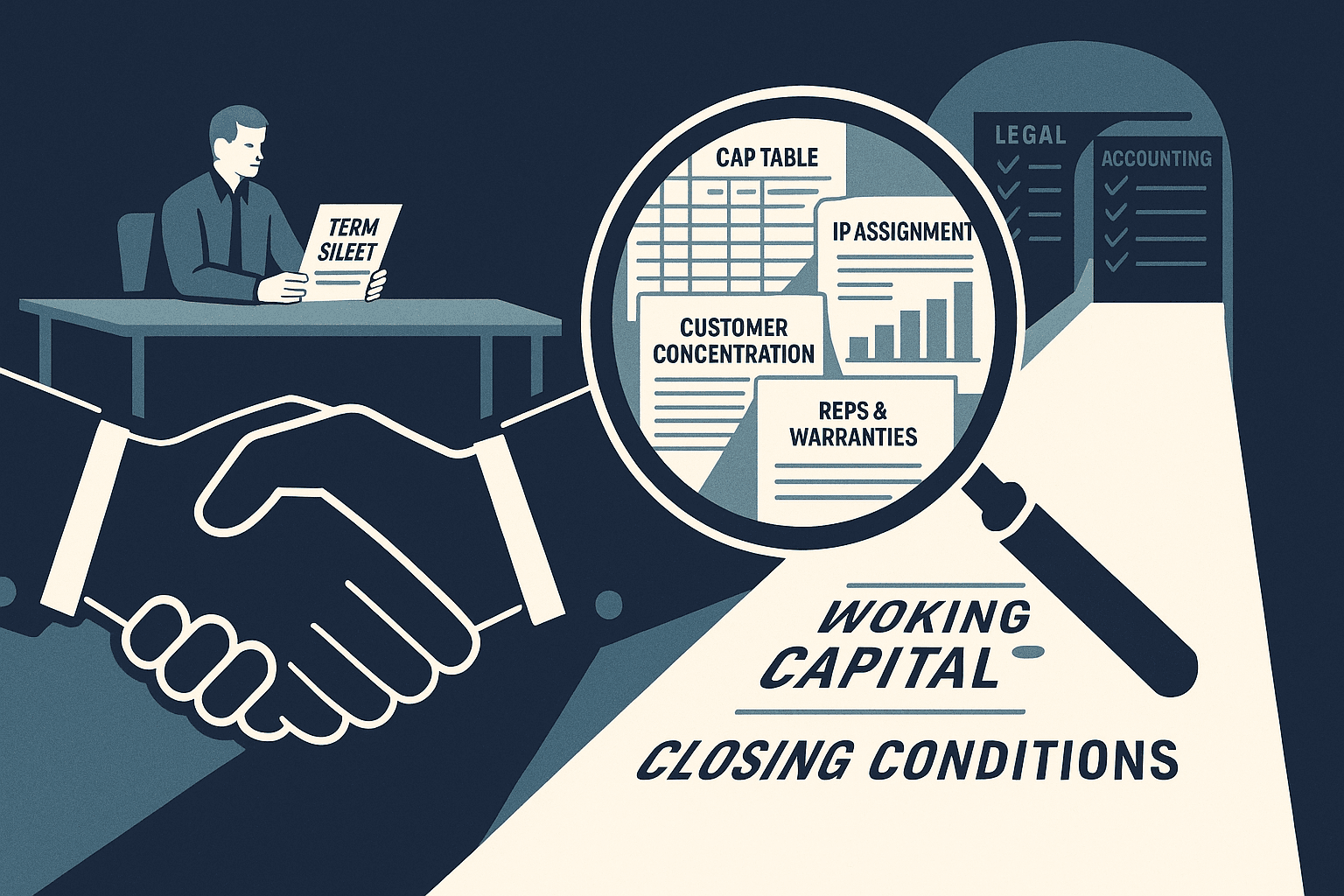
How no further diligence requests clauses can shift leverage to VCs during confirmatory diligence, and what founders should negotiate.
The partner says the firm is in. Valuation is set. Board is aligned. The term sheet looks clean. The exclusivity clause is only 30 days. There is even language that sounds founder-friendly: “Investor has no present expectation of requesting further material diligence beyond confirmatory diligence customary for a financing of this type.” Sometimes it is phrased more aggressively: “No further diligence requests other than customary confirmatory diligence.”
Founders read that line as comfort. They should often read it as a warning.
Because what looks like a promise to stop digging is usually the opposite. It is a mechanism for shifting real underwriting from before the term sheet to after it, when the investor has exclusivity, information rights, counsel engaged, accountants engaged, and a signed headline valuation that the founder now feels psychologically committed to preserving.
This is the NDR lock-in trap: the investor appears to cap diligence requests, but in practice preserves broad room to reopen risk through “confirmatory” legal, financial, tax, IP, compliance, cyber, employment, and customer review. The investor may never technically change price. It often does not need to. It can get the same economic result through structure, conditions, reserves, indemnity-like protections in side letters, expanded protective provisions, pay-to-play mechanics, tranche discussions, option pool sizing, milestone expectations, or simply a threat to delay closing until the company accepts more investor-friendly paper.
The trap works because most founders focus on valuation and ownership, while experienced investors understand that leverage often migrates into process: diligence scope, closing conditions, document discretion, counsel comments, and the right to decide when concerns are “satisfactorily resolved.”
If you want deal certainty, you cannot stop at the term sheet headline. You need to underwrite the underwriting.
The problem is not diligence itself. It is deferred underwriting under exclusivity.
There is nothing inherently wrong with confirmatory diligence. Investors should confirm legal ownership, capitalization, tax posture, employment compliance, data room completeness, key contracts, and the absence of fraud. A serious lead investor has fiduciary and reputational reasons to verify the company before wiring money.
The problem is when the term sheet suggests diligence is substantially done, but the investor has actually done only enough work to get comfortable offering a price subject to broad post-signing optionality.
That optionality matters because a signed term sheet changes the negotiating environment in at least six ways:
This is why NDR-style language is so often misleading. It implies finality while preserving broad interpretive room around what counts as confirmatory, what counts as customary, and who decides whether an issue is material.
Why current founder approaches fail
Most founders mishandle this in three ways.
1. They treat “no further diligence requests” as a real limitation
It usually is not. The clause rarely says the investor waives legal, accounting, tax, cyber, IP, or regulatory review. It usually preserves some variant of:
That is broad enough to drive a truck through. If investor counsel can ask for it, and anything can be framed as necessary to confirm a representation, the investor has not really limited diligence.
2. They negotiate economics but not process
Founders often spend hours debating liquidation preference language, pro rata scope, board observer rights, or option pool treatment. Then they leave diligence process almost entirely open-ended.
That is backwards in any environment where the investor wants a post-signing option.
A 1x non-participating preference is easy to understand. A closing condition requiring “completion of confirmatory diligence satisfactory to Investor in its sole discretion” is where hidden leverage lives.
3. They believe “price is fixed” means renegotiation risk is low
Investors do not need to change the stated price per share to improve economics.
Suppose the term sheet says:
A founder thinks the debate is over. But after signing, the investor may insist on one or more of the following due to issues found in “confirmatory” diligence:
Each may leave the nominal valuation untouched. Each can still shift value materially.
The core insight: “Confirmatory diligence” is often not confirming; it is the real underwriting phase
In many venture deals, the investor does enough pre-term-sheet work to price upside and enough downside to avoid embarrassment. It does not necessarily do enough work to fully price execution, legal hygiene, concentration risk, data rights, employment exposure, or accounting quality.
That deeper work is expensive and time-consuming. More importantly, it is strategically better done after exclusivity. Once the founder is locked in, every unresolved issue can be turned into a closing condition or a reason to delay.
So the right way to read founder-friendly NDR language is not: “They are done with diligence.”
It is: “They want credit for being done with diligence while retaining freedom to treat unresolved items as closing leverage.”
That is why the most dangerous phrases in a term sheet are usually the soft ones:
Every one of those phrases invites retrospective risk-pricing.
How leverage quietly migrates after signing
Let’s make this concrete.
Scenario 1: Reps and warranties become a renegotiation surface
Assume a Series A lead offers:
The founder signs. During legal diligence, investor counsel discovers:
None of these may justify repricing in a hot market. But they justify paper changes.
Investor counsel now pushes for:
n- a bringdown certificate at closing
The investor has not changed the valuation. But the founder is now burning weeks and counsel fees cleaning up issues that should have been underwritten before signing if they were truly gating concerns.
Scenario 2: Working capital and runway assumptions become a hidden economics reset
This is more common in growth rounds and late seed/Series A financings than founders realize.
Suppose the company has:
The founder models post-close cash of roughly:
After signing, accounting diligence reveals:
Now the investor does not need to cut the pre-money to get compensated. It can say:
If the company closes later than expected and cash falls to $1.6 million, the investor can insist on a bridge from insiders, a reduced round size, or tighter controls. Again: same headline valuation, lower founder flexibility, higher investor leverage.
Scenario 3: Customer concentration becomes process leverage
Imagine a B2B SaaS company with $4 million ARR where one customer contributes $1.1 million, or 27.5% of ARR. The term sheet comes quickly because growth looks strong. The investor has seen the top-line summary but not the underlying MSA, renewal history, implementation dependency, or concentration by end-user division.
Post-signing diligence reveals:
The investor may not formally reprice. Instead it can require:
This is renegotiation in everything but name.
Term sheet language that should make founders stop
The language to watch is not just exclusivity. It is the combination of exclusivity with open-ended diligence and subjective closing conditions.
Here are examples.
Dangerous exclusivity/no-shop language
Founder-unfriendly version:
> For 45 days following execution of this term sheet, the Company shall not, and shall cause its representatives not to, solicit, initiate, encourage, discuss, or accept any proposal relating to any equity or debt financing, sale, merger, recapitalization, or similar transaction. The Company shall immediately cease all discussions with other prospective investors.
This is broad but common. The problem gets worse when paired with soft diligence language.
Dangerous NDR-style diligence language
Looks founder-friendly, often is not:
> Investor has completed its principal business diligence and does not presently anticipate requesting further material diligence, other than customary confirmatory legal, financial, tax, technical, and commercial diligence.
What is “principal”? What is “material”? What is “customary”? This commits to almost nothing.
Dangerous closing-condition language
This is where the trap closes:
> Closing shall be subject to completion of confirmatory diligence by Investor and its advisors with results satisfactory to Investor in its sole discretion, including legal, financial, tax, accounting, technical, IP, cybersecurity, regulatory, and commercial diligence, and to negotiation of definitive agreements in form and substance satisfactory to Investor and its counsel.
This effectively means the investor owns the clock.
“No material adverse findings” language
> Closing is conditioned on no facts or circumstances having been identified that, individually or in the aggregate, would reasonably be expected to have a material adverse effect on the Company’s business, prospects, assets, liabilities, operations, capitalization, or valuation.
This is too broad for an equity financing term sheet. “Prospects” and “valuation” in particular invite subjective hindsight.
Better language: time-box, define, objectify
Founders do not need to ban confirmatory diligence. They need to constrain it.
Better NDR framing
> Investor acknowledges that its investment decision has been made based on diligence completed through the date hereof. Any post-signing diligence shall be limited to confirmatory review of the materials identified on Schedule A and customary third-party legal and accounting verification, and shall not include broad-based business re-underwriting absent discovery of a specifically identified material inconsistency with information previously provided.
This does three useful things:
Better closing-condition language
> Closing shall be subject to Investor’s completion, within 15 business days after execution, of confirmatory legal and financial diligence limited to the items listed on Schedule A, provided that any objections must be raised in writing with reasonable specificity during such period. Diligence shall be deemed complete absent written notice of a material deficiency that renders a representation in the definitive documents materially inaccurate or identifies a legal impediment to closing that cannot reasonably be cured prior to closing.
This is much stronger because it creates:
Better counsel/accounting review language
> Investor counsel and accounting advisors may request only such additional documents as are reasonably necessary to verify the accuracy in all material respects of information previously provided or to prepare definitive documents customary for a financing of this type.
This narrows the excuse that counsel can ask for anything simply because counsel wants it.
Better “new issues” language
> If post-signing diligence reveals a previously undisclosed material fact inconsistent with the Company’s written disclosures provided before signing, Investor may request additional diligence reasonably related to such inconsistency.
That is a fair compromise. If the company hid something, the investor gets room. If not, the investor does not get a free-ranging second look.
What objective diligence completion standards actually look like
Most founders never ask what “diligence complete” means operationally. They should.
A good standard is not “investor is satisfied.” It is a checklist plus an objection threshold.
Example objective standard
Confirmatory diligence is complete when all of the following have occurred:
That framework matters because it stops the “rolling diligence” problem where new requests appear every three days from a different advisor with no end point.
Practical examples with cap table math and economic impact
Let’s quantify how post-signing leverage can hurt founders even when price appears unchanged.
Example A: Option pool top-up disguised as cleanup
Pre-term-sheet cap table, fully diluted:
Lead proposes:
Now in confirmatory diligence, the investor says the hiring plan is unrealistic without a 10% unissued post-close pool. They insist the pool be created pre-money.
Required post-close pool target = 10% of post-close shares.
Let x = new pool shares added pre-close.
Then x / (12,500,000 + x) = 10%
x = 1,388,889 shares approximately.
New pre-money FD shares = 11,388,889
New price per share = $32 million / 11,388,889 = about $2.81
Investor shares = $8 million / $2.81 = about 2,847,222
Post-close shares = 14,236,111
Investor ownership stays about 20.0%, but founder and common dilution increases materially.
Founders go from 6,000,000 / 12,500,000 = 48.0% in the original model
to 6,000,000 / 14,236,111 = 42.1%
That is nearly six points of ownership lost without changing the stated pre-money valuation.
If the investor used confirmatory diligence to justify this as “necessary staffing capacity,” the headline valuation masked a real economic reset.
Example B: Delayed close plus minimum cash turns into insider bridge leverage
Assume:
Founder expects closing cash:
$1.8 million - $0.4 million + $5 million - $0.2 million fees = $6.2 million
But confirmatory diligence stretches to 75 days. Cash before close becomes roughly:
$1.8 million - ($400,000 × 2.5) = $800,000
Investor then points to a closing condition requiring at least $1.25 million cash at close. The company is short $450,000. The investor suggests existing insiders bridge the gap with a convertible note or SAFE.
Even if friendly, that bridge may come with:
Again, no price change on the lead’s round. Real leverage shifted anyway.
Example C: Customer-risk covenant changes control economics
Suppose the company closes a Series A:
Post-signing, confirmatory diligence surfaces concentration risk. The investor keeps price but asks for enhanced protective provisions:
Those are not ownership changes, but they alter operational control. Control has economic value. A founder who gave up competitive tension during exclusivity may accept these because they seem “non-economic.” They are economic.
Negotiation scenarios: what founders should say
Scenario: Investor says confirmatory diligence must remain broad because their counsel requires it
Bad founder response:
“Understood, we want to be cooperative.”
Better response:
“We’re happy to support customary confirmatory diligence. The issue is not whether your counsel reviews materials; it’s whether the term sheet leaves diligence scope and timing entirely open-ended while we’re in exclusivity. Let’s define the materials list, set a written comments deadline, and limit additional requests to verification of prior disclosures or specific inconsistencies.”
That reframes the issue as process fairness, not defensiveness.
Scenario: Investor refuses objective completion standards
Investor line:
“We can’t agree to deemed completion because diligence always evolves.”
Better founder response:
“If diligence is still evolving materially, then we should not be in full exclusivity yet. We can either narrow exclusivity until the core work is done, or agree that only previously undisclosed material inconsistencies reopen scope after the initial period.”
This is the right pressure point. Either the investor has underwritten enough to lock the company, or it has not.
Scenario: Investor finds a real issue and wants broad rights
Suppose there is a legitimate contractor IP gap.
Better founder response:
“We agree this needs to be cured. Let’s make the closing condition specific to signed assignment agreements from the identified individuals or alternative evidence reasonably satisfactory to both sides. We don’t think that justifies a general reopener across all IP reps, new indemnity constructs, or a broad satisfaction condition.”
Specific issue, specific cure. Do not let one problem become a general option.
Specific language founders can propose
Below is a practical package. Not every investor will accept all of it, but founders should at least ask.
1. Narrow exclusivity to matched seriousness
> During the 20-day period following execution, the Company shall negotiate exclusively with Investor regarding the proposed financing; provided that such exclusivity shall terminate automatically if Investor has not delivered an initial consolidated diligence request list within 3 business days and a consolidated written issues list within 12 business days.
This creates urgency and punishes drift.
2. Limit diligence scope by schedule
> Confirmatory diligence shall be limited to the matters and document categories listed on Schedule A, together with customary follow-up requests reasonably necessary to verify the same.
3. Require a single issues list
> Investor shall use commercially reasonable efforts to coordinate requests among its internal team, counsel, and advisors and to provide a consolidated list of diligence issues rather than serial requests.
Not perfect, but useful.
4. Define what permits delay or termination
> Investor may decline to close solely if post-signing diligence identifies: (i) a material inaccuracy in the Company’s written disclosures delivered before signing, (ii) a legal impediment to the financing, or (iii) an uncured issue that would cause a fundamental representation in the definitive agreements to be materially untrue at closing.
That is far better than “satisfactory in investor’s sole discretion.”
5. Tie definitive-doc discretion to the term sheet
> Definitive agreements shall be based on NVCA forms and otherwise consistent with the economic and control terms expressly set forth herein, with deviations limited to customary provisions for a financing of this type not inconsistent in any material respect with this term sheet.
This helps stop post-signing control grabs disguised as documentation detail.
Closing-condition language to watch in definitive docs too
The trap does not end at the term sheet. Founders should review the stock purchase agreement, investors’ rights agreement, voting agreement, right of first refusal/co-sale agreement, and disclosure schedules for covert leverage migration.
Watch for:
A common move is to keep the charter market-standard while loading risk allocation into schedules, covenants, certificates, and side commitments. Founders who only compare the high-level NVCA package miss where leverage actually landed.
How founders preserve deal certainty without giving away a free option
There is a workable middle ground between “no diligence after signing” and “investor can keep digging until comfort arrives.”
The middle ground has five parts.
1. Finish more real diligence before exclusivity starts
Ask directly:
If the answers are vague, assume the term sheet is earlier than it looks.
2. Use phased exclusivity if needed
Instead of 30–45 days of total lock-up, use a shorter initial exclusivity period tied to delivery of a diligence list and major workstreams, with extension only if the investor is moving on schedule.
Example:
This is underrated. Exclusivity should be earned.
3. Define “confirmatory” in writing
If you do nothing else, do this. A term sheet that uses confirmatory diligence without defining it is an invitation to re-underwrite.
4. Keep alternative financing paths warm where permitted
Even under a no-shop, founders can often preserve relationships without active solicitation. Existing investors, venture debt providers, or strategic partners may remain relevant if the process slips. Do not theatrically announce the round as done until money is truly committed.
5. Track every post-signing ask against the term sheet
When a new request comes in, ask:
That discipline prevents drift from “confirmatory” into “discretionary.”
A term-sheet comparison: weak vs strong founder position
Weak founder version
This gives the investor a near-free option for 30 days.
Stronger founder version
That is not anti-investor. It is pro-certainty.
The contrarian bottom line
Founders are taught to fear obvious investor control terms and obvious valuation cuts. They should also fear polite language that sounds founder-friendly while preserving process optionality.
“No further diligence requests” is often one of those phrases.
In practice, many NDR-style clauses do not prevent more diligence. They legitimize a shift in where leverage gets exercised. The investor gets to say, “We are not re-trading price. We are just completing confirmatory diligence.” Meanwhile the real bargaining happens in reps, schedules, cash conditions, pool sizing, cleanup covenants, and timing.
The right founder response is not outrage. It is precision.
If an investor truly has conviction, it should be willing to say what remains, ask for it quickly, and be specific about what would stop the deal. If it cannot do that, then the company should not grant broad exclusivity under the illusion that underwriting is done.
A good term sheet is not just a valuation with logos on it. It is a map of where leverage will live between signing and closing.
If you do not define confirmatory diligence, the investor will.
And if the investor defines it after you stop talking to everyone else, you did not get certainty. You sold an option.
RaiseSimpli Team
Author