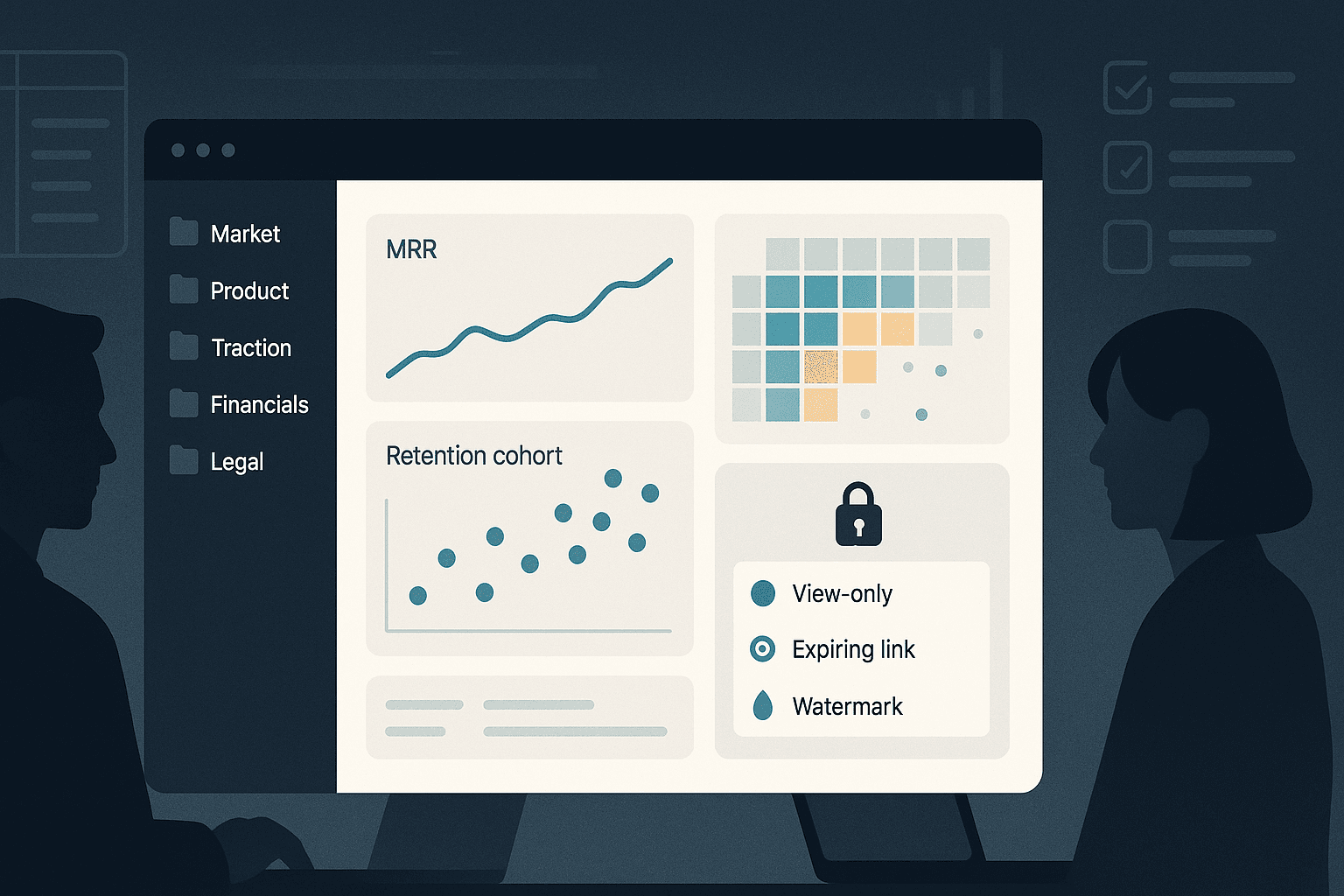
How to run a VC raise without a pitch deck by leading with a data room, what to include, and how to keep investors engaged without slides.
The contrarian premise: fundraising without a pitch deck
Pitch decks are the default interface between founders and investors. They’re also often the lowest-fidelity representation of what investors actually underwrite: traction, velocity, distribution advantage, product truth, unit economics, and team execution. A deck is an abstraction layer; a data room is the source material.
A “no-deck” raise flips the sequence:
This approach can produce a higher-signal process: fewer meetings, faster conviction, and less performative storytelling. Done poorly, it triggers the opposite reaction: “What are they hiding?” or “They don’t understand fundraising.”
This playbook explains when the data room–first strategy works, how to structure it, how to control the narrative without a deck, and how to avoid the red flags that make investors assume weakness.
---
When “no-deck” works (and when it doesn’t)
It tends to work best when:
- Investors will happily skip slides if the product is clearly working and the numbers reconcile.
- Usage-based SaaS, PLG, marketplaces with strong liquidity metrics, B2B with clear pipeline stages, businesses where there’s an objective scoreboard.
- Many top-tier firms claim to be data-driven; fewer actually are. The best signal is how quickly they ask for raw metrics and customer calls.
- If you’re pre-product or pre-revenue and selling mostly vision (deep tech R&D, biotech, frontier hardware), the deck often is the product.
It usually doesn’t work when:
- At that stage, investors underwrite founder-market fit, insight, and approach. A deck/memo can communicate these faster than a folder tree.
- New market creation, complex regulatory dynamics, or non-obvious business models often need a narrative arc.
- A data room doesn’t remove weaknesses; it surfaces them. If you’re not ready to frame the story around the weak spots, it backfires.
Practical rule: If a strong investor can reach an informed “yes/no/maybe” in 30–45 minutes by reading your memo and scanning your dashboard screenshots, you can run a data room–first raise. If they need a long live explanation just to understand what you do, you probably still need a deck.
---
Why the deck persists (and what replaces its functions)
A pitch deck is not merely a slideshow. It serves several functions:
A data room–first raise must replace these functions explicitly:
You’re not eliminating storytelling. You’re moving it from slides to structure, annotations, and sequencing.
---
The core idea: treat your data room like a product
Investors experience your company through your artifacts. If the data room feels like a messy Dropbox, they’ll infer your operating system is messy too. If it feels like a well-designed product, opinionated, consistent, and updated, they’ll infer strong execution.
A good data room is:
Think of it as a self-serve diligence funnel.
---
The “No-Deck” fundraising stack
A practical stack that works well:
This mirrors how many later-stage rounds already work: investors skim a memo, dive into metrics, then use meetings for edge cases and decision-making.
If you want an external reference point, this resembles the memo-driven culture popularized in other contexts (e.g., Amazon’s narrative memos), but adapted to venture workflows.
---
How to control the narrative without slides
The main fear founders have is: “If I drop a data room link, investors will get lost and focus on the wrong things.” That fear is valid.
The answer is guided navigation:
1) Start with an “Investor Start Here” page
This is the landing doc inside the data room. It should include:
2) Use a memo with explicit claims and citations
Write your memo like a research paper:
This prevents investors from cherry-picking a random chart and forming the wrong conclusion.
3) Annotate metrics to pre-empt misreads
Every dashboard screenshot or exported chart should include a short “How to read this” note:
Investors are used to messy data. What they punish is unexplained mess.
---
The canonical data room structure (opinionated)
Below is a folder structure that works for most SaaS/usage-based/marketplace companies. Adjust, but keep the spirit: few top-level folders, clear naming, minimal nesting.
`/00_Start_Here`
`/01_Company`
`/02_Product`
`/03_Market_And_Competition`
`/04_Traction_And_Metrics`
`/05_Financials`
`/06_Customers`
`/07_Legal_And_Cap_Table`
`/08_Diligence_QA`
This structure makes it easy for investors to follow the thread: start → understand → verify → stress-test.
---
Metrics: what to include (and how to avoid self-inflicted wounds)
A data room–first raise lives or dies by metrics hygiene. The goal is not “perfect metrics.” The goal is defensible metrics.
Principles
- What counts as “active”? What is “churn”? Are you using logo churn, revenue churn, gross vs net retention?
- If the memo says $400k MRR and the P&L implies $320k, you’ve created a credibility tax.
- A single month can be noise. Investors underwrite slope.
- By cohort, channel, plan tier, geography, or enterprise vs SMB.
What most investors expect in a growth-stage SaaS raise
For PLG/consumer-style funnels:
For marketplaces:
The “investor trust” charts
These are the charts that, when clean, reduce perceived risk dramatically:
Common metric mistakes that create red flags
If you want to be aggressive, be aggressive in your ambition, not in your definitions.
---
Documents: what matters most (and what’s usually bloat)
A good data room is not exhaustive. Early in a process, too much documentation can signal insecurity or lack of focus.
High-leverage documents
Low-leverage documents (early)
Heuristic: If a document doesn’t help an investor answer one of these questions, it’s probably bloat:
---
The memo: your deck replacement (suggested outline)
Aim for 2–6 pages. Dense, but readable. Use charts sparingly; link out to the data room for depth.
1) Executive summary
2) The problem and why now
3) The solution and differentiation
4) Traction and proof
5) Go-to-market
6) Economics and scale
7) The ask
Including risks feels counterintuitive, but it’s a credibility accelerant. Many investors will do this work anyway; you may as well frame it.
---
Running the process: how to sequence a data room–first raise
A clean process prevents “random walk diligence,” where investors wander through folders and emerge with scattered questions.
Step 1: Prep (1–2 weeks)
Step 2: Launch with a tight first touch
Your outbound/inbound follow-up should include:
You don’t want to spray a data room link broadly. Treat it as a second-step artifact.
Step 3: The “walkthrough call”
Instead of a pitch, run a guided diligence call:
The goal is to tell them where to look, not to show them everything.
Step 4: Weekly updates
Send a weekly investor update during the raise:
Consistency signals operational maturity.
Step 5: Partner meeting and close
By the time you’re in partner meeting, the data room should have already done the heavy lifting. The meeting becomes about:
---
Permissions, leakage, and information hazards
A fear with data rooms is leakage: screenshots forwarded, sensitive metrics shared, competitors learning too much.
You can mitigate without crippling usability.
Recommended permission tiers
Practical controls
Note: sophisticated investors will not be offended by staged access. They expect it.
---
Red flags specific to “no-deck” raises (and how to avoid them)
Red flag 1: “They’re dodging narrative clarity.”
Symptom: Lots of data, no crisp explanation of what the company is and why it wins.
Fix: Put the narrative in the memo and “Start Here.” The data room is evidence, not a substitute for clarity.
Red flag 2: “Metrics are present but undefined.”
Symptom: Charts without definitions, filters, or timeframes.
Fix: Add a metric dictionary and annotate charts. If you use terms like “active,” define them precisely.
Red flag 3: “The room is too curated.”
Symptom: Only flattering charts, no underlying reconciliation, no churn breakdown.
Fix: Include at least one honest page on churn drivers and what you’re doing about them. Investors can smell omission.
Red flag 4: “Numbers don’t match across docs.”
Symptom: MRR in memo differs from finance sheet; customer count differs from CRM export.
Fix: One source of truth and a “last updated” stamp. Reconcile before sending.
Red flag 5: “They’re sharing sensitive legal docs too early.”
Symptom: Full cap table, IP assignments, contracts in the first link.
Fix: Stage legal materials. Over-sharing can look naive and creates unnecessary risk.
---
How to answer investor questions without getting dragged into chaos
A data room–first raise can create a flood of questions. That’s good, if you manage it.
Use a single Q&A log
Track:
This creates compounding leverage: when the third investor asks the same question, you send a link, not a fresh essay.
Publish “canonical answers” back into the room
If you answer something important (e.g., churn spike explanation), add a short note to `/08_Diligence_QA` with supporting charts. You’re building an evolving “truth set.”
Maintain a tempo
Speed matters because fundraising is competitive and attention is scarce.
---
The subtle advantage: you reveal your operating system
Investors don’t just invest in outcomes; they invest in how you get outcomes. A high-quality data room shows:
In other words, the room is an implicit demonstration of execution.
This aligns with a broader shift in venture toward proof and velocity: particularly in environments where capital is more selective and diligence is more rigorous than the 2020–2021 era.
---
The strongest argument against “no-deck” (and how to address it)
The best criticism is practical: investors have workflows built around decks. Partners forward decks to Monday meetings. Associates summarize decks in internal notes. A data room link is harder to circulate.
You can address this without building a full deck by providing:
Call this the Investor Packet. It’s not a deck; it’s a diligence starter kit.
This meets investors where they are while keeping your operating model data-room-first.
---
Suggested “Key Metrics Snapshot” template
One page, consistent every week. Example sections:
Investors love this because it reduces cognitive load and makes internal sharing easy.
---
What to cite (and how) in a data room–first narrative
The request for “references” in a fundraising article is tricky: the most meaningful references are often private (your internal metrics). But you can still cite credible external anchors for market claims and methodology.
Market and category references (examples)
Metric methodology references (examples)
Important: Don’t treat benchmarks as truth; treat them as context. Your job is to show your trajectory and why it’s improving.
---
A candid checklist before you attempt this
Before you run a no-deck process, confirm:
If you can’t check these boxes, you may still be able to raise, but the no-deck tactic will amplify the rough edges rather than hide them.
---
Closing view: the “no-deck” raise as a filter
A data room–first raise is not a hack to avoid storytelling. It’s a commitment to high-integrity evidence and operational clarity.
It can be a powerful filter:
But it also sets a higher bar for you. When you lead with the source material, you don’t get to hide behind slide craft.
If your numbers are real, your product has pull, and your team operates with discipline, skipping the deck can feel like a flex, the quiet kind that serious investors respect.
If your story is still forming, or your instrumentation is immature, a deck isn’t the enemy. It’s scaffolding. Build the scaffolding first, then graduate to the data room as your primary interface.
RaiseSimpli Team
Author