Participation Wash: Hidden Participating Preferred
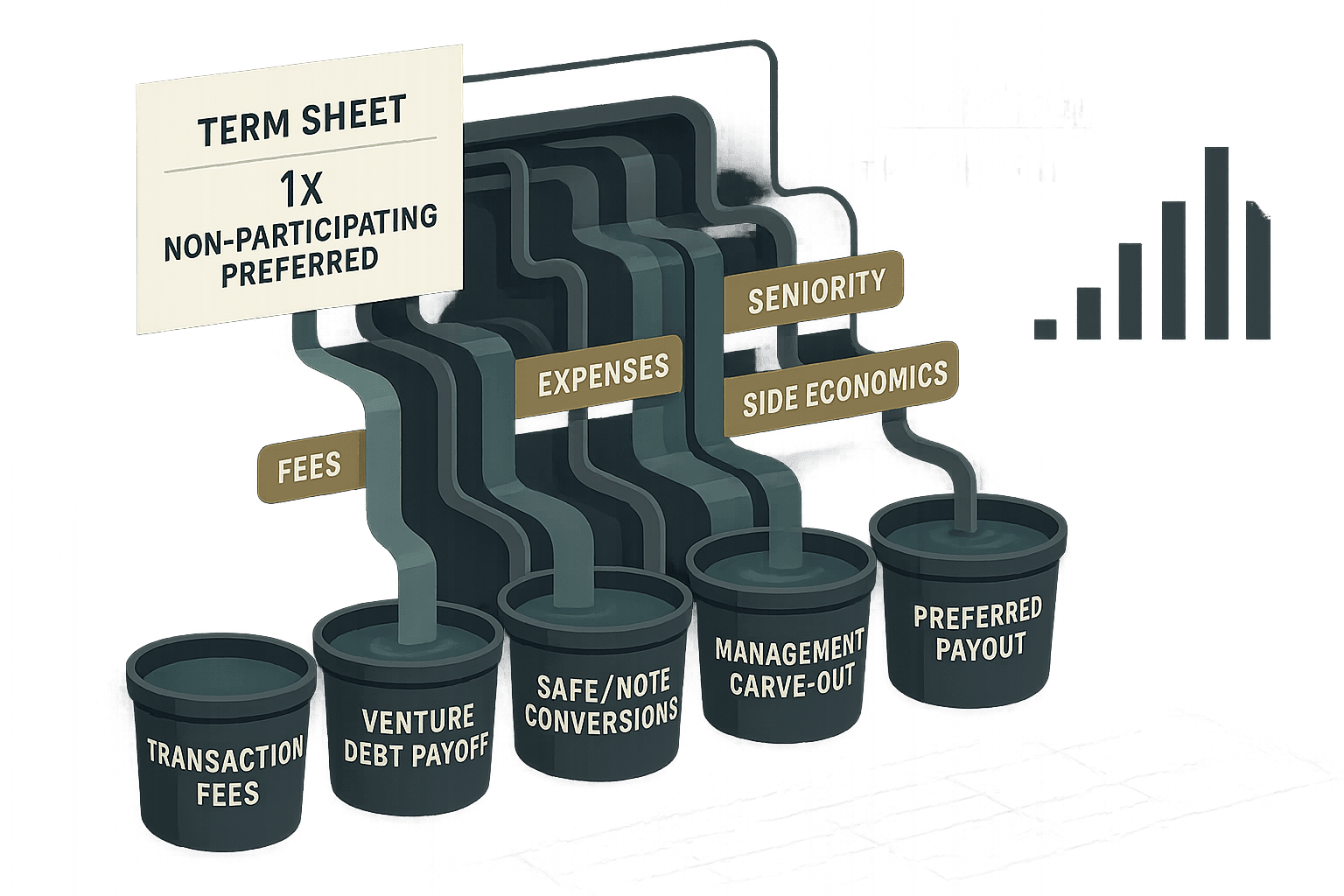
How 1x non-participating preferred can turn participating through side economics, fees, and exit waterfalls, and how to check for it.
The company has raised a $12 million Series A and a $20 million Series B, both on 1x non-participating preferred. No nasty participating preferred. No multiple liquidation preference. No full-ratchet anti-dilution disaster. On paper, this is the kind of cap table lawyers, seed investors, and founders point to as “clean.”
Then the draft closing waterfall shows up.
First, $3.2 million of banker, legal, and transaction bonuses come off the top. Then $8.5 million of venture debt gets repaid, including end-of-term charges and prepayment penalties. Then $4 million goes into escrow. Then a management carve-out pays selected executives before broad common sees anything. Then the SAFEs and notes convert in a way that increases the effective overhang. Then optionholders discover the spread economics on exercise cost and tax withholding matter. Then the preferred holders decide whether to take preference or convert based on a fully diluted denominator the founders never modeled correctly.
The result: the round that was supposed to be founder-friendly behaves a lot like participating preferred. Not because the charter says so. Because the exit waterfall does.
That is the participation wash trap.
It matters because founders routinely negotiate the visible term, 1x non-participating, and ignore the invisible economics that determine who actually gets paid in a sale. Investors do this too, although the best funds absolutely model the side economics. Buyers, boards, debt providers, and management teams each look at distribution mechanics through different lenses. If you only focus on the headline liquidation preference language, you can end up with a “clean” financing that produces a very dirty acquisition outcome.
The contrarian point is simple: participation is not just a charter term. It is an economic outcome. A preferred stack can behave as though it participates whenever side payments, senior obligations, selective carve-outs, or conversion mechanics shift value away from common before the nominally non-participating holders make their election.
This article breaks down how that happens, where the hidden seniority lives, how term sheets and financing documents create it, and what to negotiate now if you want the eventual acquisition waterfall to reflect the story you think you are telling today.
The problem founders miss: the waterfall is not the term sheet
Founders are taught to care about valuation, dilution, board control, pro rata, liquidation preference, and maybe anti-dilution if the round gets tense. That is fine as far as it goes. But acquisition outcomes are governed by a different machine:
By the time a company exits, the clean elegance of “1x non-participating preferred” is only one variable in a much messier stack.
This is why sophisticated investors model outcomes across multiple exit values even in seemingly simple rounds. They do not just ask, “What is the preference?” They ask:
Founders often discover too late that these are the questions that matter.
Why the current founder playbook fails
The standard founder playbook says: avoid participating preferred, keep liquidation preference at 1x, minimize special rights, and you are probably fine. That advice is directionally correct and still incomplete.
It fails for five reasons.
1. It treats liquidation preference as the whole story
Liquidation preference determines one election in one part of the waterfall. It does not determine debt payoff, fees, escrows, retention pools, or the treatment of convertibles and options.
If $15 million to $20 million of value comes off the top before the equity pool is even divided, then whether preferred is formally participating matters less than founders assume.
2. It ignores hidden seniority
Not everything senior to common is labeled “senior.” Venture debt, unpaid dividends if they exist, transaction expenses, tax distributions, employee bonus plans triggered by change of control, and management carve-outs all function as prior claims on sale proceeds.
Some are economically unavoidable. Many are negotiable. Most are under-modeled.
3. It assumes everyone bears costs pro rata
They often do not.
A management carve-out may be paid only to selected management. An investor fee reimbursement may effectively burden all stockholders. A debt payoff hits everyone before equity. An option exercise spread or net-exercise mechanic may shift outcomes among common holders. A SAFE conversion cap can create a larger ownership claim than founders intuitively expect. These asymmetries are where participation wash lives.
4. It relies on simplistic cap table snapshots
A cap table prepared for fundraising is not an exit waterfall. Fundraising cap tables tend to emphasize fully diluted ownership percentages. Exit waterfalls need security-by-security logic, order of operations, treatment of transaction costs, debt, escrows, unallocated option pools, warrants, notes, SAFEs, and multiple payout scenarios.
If your board package does not include a dynamic exit waterfall model, you are not actually governing the economic reality of the company.
5. It confuses legal non-participation with economic non-participation
A legally non-participating preferred share can still produce outcomes that mimic participation if holders get their money back effectively after common has already been diluted by side economics or stripped by top-of-waterfall charges.
That is not semantic. It is the check people take home.
Core insight: side economics can recreate participation without saying so
Classic participating preferred means the investor gets its liquidation preference first and then also shares pro rata in the remaining proceeds as though converted.
Participation wash is subtler. It happens when the effective economic sequence is:
The preferred has not legally double-dipped in the charter. But through side economics and sequencing, common effectively funded a first dip and then shared the remainder on a diminished base.
To see why, you need to stop looking at liquidation preference in isolation and start looking at distribution elasticity: who is protected when the exit value moves down, and who absorbs the first losses when friction enters the system.
In many exits, common absorbs nearly all friction first.
A baseline example: the clean round founders think they have
Assume this capitalization before exit:
Total invested capital in preferred: $32 million.
Assume both preferred series are 1x non-participating and pari passu for simplicity. No dividends.
At a $60 million cash sale with no other complications, the election is easy to model.
If all preferred take preference, they split $32 million, leaving $28 million to common and options.
If all preferred convert, they split the full $60 million according to ownership:
Series A is indifferent at $60 million: $12 million on preference or conversion.
Series B prefers preference: $20 million on preference versus $18 million on conversion.
In practice, if series vote separately, Series B takes preference and Series A may convert or take preference depending on exact documents and series-by-series economics. But the broad founder intuition is that common still gets meaningful value.
That is the headline story.
Now let’s make it realistic.
Example 1: fees and debt quietly wash participation into the deal
Same cap table. Same $60 million headline sale price. Add:
Total off-the-top deductions before equity distribution: $15.7 million.
Net distributable proceeds at closing: $44.3 million.
Already the “$60 million exit” is not a $60 million equity event. It is a $44.3 million immediate distribution event plus a contingent $4.0 million escrow release later, assuming no claims.
Now re-run the election.
If Series A and B both take preference, they receive their 1x invested capital, or $32 million total, from the $44.3 million currently distributable pool. That leaves $12.3 million for common and options.
If everyone converts, they split $44.3 million by ownership:
Now both Series A and Series B take preference. Why?
Look at what happened economically. In the clean headline case, common plus options got $30 million if everyone converted, and still $28 million under a broad preference scenario. In the friction-heavy real case, common plus options get only $12.3 million at closing.
Preferred did not legally participate. But common effectively absorbed the entire $15.7 million friction stack before preferred made its election. That is participation wash.
The preferred holders are protected down to their 1x money back while everyone junior funds the mess.
Example 2: management carve-outs mimic a side class senior to common
Now add a management incentive plan triggered by sale. This is common in soft landings and in deals where the board wants to retain key executives through closing.
Suppose the board approves a carve-out that pays:
Total carve-out: $4.0 million.
Assume this comes off the top after debt and transaction fees but before general equity distribution.
Use the prior example’s $44.3 million distributable proceeds before carve-out. After the management carve-out, only $40.3 million remains for broad equity waterfall.
Preferred still takes $32 million in preference. Common plus options now split just $8.3 million.
This is where founders get blindsided by governance reality.
If the carve-out goes mostly to executives who are also founders, some founders may personally do fine while the broader common class gets crushed. If it goes to a narrow management group, non-management common and optionholders may be wiped out almost entirely. Either way, value moved through a side channel that sat economically senior to equity.
Investors often defend this by saying the carve-out was necessary to get the deal done or retain management. Sometimes that is true. But economically, it means a nominally non-participating preferred stack preserved its downside protection while selected insiders received a side payment before junior equity shared in proceeds.
Again: not legal participation, but very similar effect.
Example 3: venture debt is not neutral just because everyone agreed to it
Founders often treat venture debt as “cheap non-dilutive capital.” Sometimes it is. In exit modeling, it is senior cash-out capital with sharp edges.
Suppose your company raised:
The debt includes:
At exit for $45 million, debt payoff may be closer to $9.2 million than $8 million after fees and accrued interest. Add $2 million of transaction expenses and you are down to $33.8 million before the equity waterfall. If preferred has $25 million of 1x non-participating preference, common is fighting over $8.8 million before considering warrant dilution and escrow.
Here is the practical point: debt compresses the range in which conversion makes sense for preferred.
Without debt, a Series B investor might convert above, say, $55 million enterprise value. With debt and fees, the same investor may still take preference at a headline $65 million sale because the actual distributable equity value is much lower.
Founders negotiate non-participating preferred as though the conversion crossover is fixed. It is not. Debt moves it materially.
Example 4: stacked SAFEs and notes create hidden seniority through dilution timing
SAFEs and notes are often described as simple bridge instruments. In sale scenarios, they can create ugly distribution dynamics depending on whether they convert, get cashed out, or choose the better of multiple outcomes.
Assume before the Series A, the company issued:
At a later sale, these instruments may have rights to receive either:
Suppose the fully diluted common value implied by conversion is favorable. The SAFEs and notes convert into a meaningful percentage right before the sale, increasing the common-equivalent denominator and reducing founder ownership more than expected.
If preferred still elects preference, common and converted bridge holders share what is left after preference. That means the bridge stack diluted common on the residual while preferred remained insulated at 1x.
For example, say post-conversion the ownership shifts from:
to:
At a sale where preferred takes preference, that 10% SAFE/note overhang comes entirely from the junior side of the cap table distribution, not from the preferred’s 1x return. Founders often think of SAFEs as “future dilution.” At exit, they are often present subordination against whatever residual remains after senior claims.
This is especially painful if instrument language lets holders choose the more favorable of cash-out value or conversion economics while founders assumed a simpler outcome.
Example 5: escrows and earnouts are not shared pain unless documents say so
One of the most misunderstood parts of acquisition economics is escrow treatment.
Suppose a $70 million acquisition includes:
If your charter or merger allocation schedule provides that escrow is allocated pro rata as though distributed at closing, then everyone bears the escrow proportionately. Fine.
But deals often become more complex in practice:
Imagine $60 million cash at close, but with $12 million of debt/fees and $32 million of preferred preference. Common sees only $16 million of apparent residual at closing before escrow treatment. If another $10 million is contingent in escrow or earnout and likely realized only by continuing management or only after claims, the founder who thought they sold for $70 million may be living economically inside a sub-$50 million certainty outcome.
Preferred may not get formal participation. But the structure can preserve preferred certainty while pushing execution and claim risk into the junior layers.
That is a form of participation wash through risk allocation rather than pure dollar sequencing.
How term sheets and financing docs create hidden seniority
The hidden seniority rarely lives in one place. It is distributed across documents. Founders need to know where to look.
Charter
This is where liquidation preference, dividend rights, seniority, pari passu treatment, and conversion mechanics live. Founders look here first, which is correct, but insufficient.
Watch for:
Venture debt documents
This is often the most underappreciated source of effective seniority.
Watch for:
SAFE and note instruments
Hidden economic variance is rampant here.
Watch for:
Option plan and change-of-control plans
These shape who gets paid and when.
Watch for:
Investor rights and side letters
Sometimes fee reimbursement, observer rights, consent rights, or bespoke economics hide here.
Watch for:
Merger agreement
This is where all the theory becomes money.
Watch for:
A term sheet comparison founders should actually run
Consider two Series B term sheets.
Term Sheet A: “Founder-friendly” headline
Term Sheet B: “Slightly tougher” headline
Most founders will reflexively choose Term Sheet A because non-participating sounds cleaner than participating.
That can be wrong.
If Term Sheet A leads to later venture debt, broad board discretion on sale bonuses, stacked SAFE cleanup with sloppy drafting, and uncapped transaction friction, the real exit outcomes in the $40 million to $100 million range may be worse for common than under Term Sheet B, where the headline preference is technically participating but other side channels are constrained.
The point is not that participating preferred is good. It usually is not. The point is that founders should compare modeled exit distributions, not just redline stigma.
Run at least these scenarios before signing:
If you do not run these scenarios, you are negotiating vibes, not economics.
Negotiation scenarios: what founders should push now
Here is where to be opinionated. Founders should stop congratulating themselves for getting “plain vanilla 1x non-participating” if the rest of the stack remains open season.
1. Put hard caps and governance on transaction expenses
Negotiate:
Why it matters: every uncapped dollar off the top increases the chance preferred takes preference instead of converting.
2. Restrict debt capacity and model payoff economics
Negotiate:
Why it matters: debt is not just a financing choice. It is an exit-waterfall term.
3. Require class-sensitive approval for management carve-outs
Negotiate:
Why it matters: management carve-outs can create a shadow senior security class.
4. Clean up SAFEs and notes early
Negotiate or implement:
Why it matters: convertibles create exit surprises when everyone is tired, rushed, and lawyered up.
5. Clarify escrow and earnout allocation now, not during the deal
Negotiate in financing docs where possible or set policy expectations through board approvals:
Why it matters: risk allocation can mimic seniority even when cash allocation looks neutral.
6. Demand a real exit waterfall model at every board meeting after Series A
This should not be optional.
The model should include:
Why it matters: if the board has not seen the waterfall, the board is making strategic financing decisions blind.
A worked comparison: same headline term, very different dirty outcomes
Let’s compare two companies, both with identical preferred terms:
Both companies sell for a headline $75 million.
Company Clean
Net immediate distributable proceeds: $70 million.
If preferred converts, it gets 45% of $70 million = $31.5 million.
If preferred takes preference, it gets $30 million.
So preferred converts. Common + options get $38.5 million at close, plus their pro rata share of escrow later.
Company Dirty
Net distributable proceeds at close before equity: $51.5 million.
After carve-out and escrow constraints, effective immediate pool for broad equity is even tighter.
Preferred compares:
Preferred takes preference.
Residual for common, options, and converted SAFEs: $21.5 million before considering the dilution impact of the SAFE conversion among the junior group.
If the junior pool is now:
Then founders/common do not get anywhere close to the headline intuition from Company Clean. On a nominally only 15% lower distributable pool, common may experience a much steeper value collapse because preferred stayed protected while junior dilution and side payments compounded.
This is the essence of the trap: the downside is not shared linearly.
What boards and investors model differently from founders
The better funds do not merely ask whether a term is market. They model where the conversion crossover sits under realistic friction.
They know that:
Founders tend to model point estimates. Investors model breakpoints.
That is why a board investor may be relaxed about giving you “clean” 1x non-participating preferred while simultaneously supporting debt, SAFE bridge financing, broad expense flexibility, and retention pools. They may sincerely believe the round is clean. They may also understand that in any middling exit, their capital remains well protected.
This is not automatically bad faith. But it is often asymmetrical understanding.
The practical founder checklist
Before your next round, ask these questions in writing:
If management or the board cannot answer these crisply, you have an economic governance problem.
The bottom line
The startup world overweights visible terms and underweights payout plumbing.
“1x non-participating preferred” is still better than overtly participating preferred in most cases. But founders should stop treating it as a magic shield. In a real acquisition, the money does not flow from headline purchase price directly into a neat pro rata chart. It flows through fees, debt, escrows, convertibles, carve-outs, taxes, exercise mechanics, and document-defined priorities.
That is where supposedly clean preferred can start acting a lot like participating preferred.
The right takeaway is not paranoia. It is discipline.
Negotiate the waterfall, not just the label. Cap the friction. Constrain hidden seniority. Standardize convertible treatment. Govern debt tightly. Force the board to look at actual distribution scenarios.
Because a clean round is not the one with the nicest preference headline.
It is the one where the exit waterfall still looks clean when the buyer’s funds-flow memo finally arrives.
RaiseSimpli Team
Author