Pre-Money SAFE Mix-Ups: Ownership Surprises at Series A
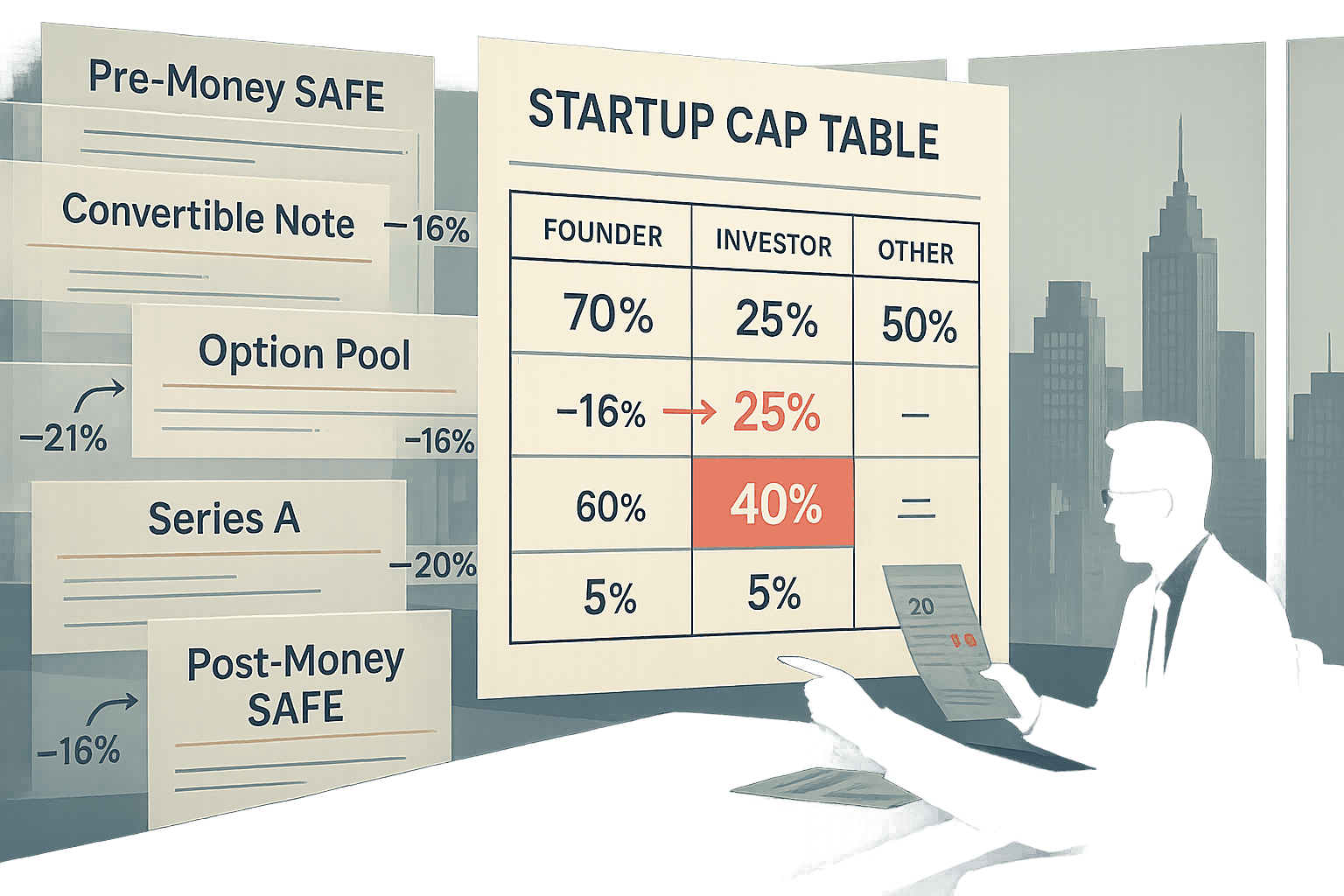
How mixed SAFE generations break ownership expectations at Series A, and how to model pre-money and post-money SAFEs together.
Then the closing cap table arrives.
The founders thought they would own 46%. They own 41.8%. The employee pool is larger than expected. One SAFE holder gets materially better economics than another investor who wrote the same check size six months later. The lead investor says nothing improper happened: the documents worked exactly as drafted. Company counsel says the models were directionally right but depended on assumptions about company capitalization. The CFO discovers that the “fully diluted” number used in one spreadsheet was not the one the SAFE actually references. Everyone is unhappy, and no one is technically wrong.
This is the pre-money SAFE mirage.
It happens when companies raise over multiple instrument generations, legacy YC-style pre-money SAFEs, newer post-money SAFEs, convertible notes, MFN side letters, pro rata side deals, custom amendments, and then try to price a Series A as if all conversion instruments behave the same way. They do not. They allocate dilution differently, define capitalization differently, and can quietly move economics between founders, employees, and investors in ways that remain invisible until the priced round forces every formula to reconcile.
The dangerous part is not that these documents are complicated. The dangerous part is that most startup teams think they are simpler than they are.
The problem: the cap table people think they own is often not the cap table that actually converts
Most founders carry around an intuitive ownership model:
That mental model is good enough when a company has one financing instrument type, one standard set of definitions, and no side letters. It breaks when you stack instruments that were created in different fundraising eras.
The core reason is simple: pre-money SAFEs and post-money SAFEs are not just different pricing wrappers. They are different dilution allocation systems.
A pre-money SAFE generally converts based on a company capitalization definition that often excludes some or all other SAFEs from the denominator used to determine its conversion price. Translation: multiple pre-money SAFEs can each be modeled as if they are not diluting one another in the way founders expect. The resulting dilution lands disproportionately on common holders and, depending on the drafting, the option pool.
A post-money SAFE was designed to fix this uncertainty for the investor. Its promise is more explicit: the investor can know, at signing, roughly what percentage of the company their SAFE buys on a post-money basis, subject to the defined capitalization mechanics. Translation: the founder’s dilution is more predictable per SAFE, but the company can paint itself into a corner if too many post-money SAFEs are issued before a priced round.
Then add notes. Notes bring their own machinery:
Then add side letters:
At that point, there is no such thing as “the SAFE conversion.” There are many conversions, each document-specific, all interacting at once.
Why current approaches fail
1. Founders rely on summary percentages instead of document-level math
Founders often track SAFEs in a simple table:
This is useful for fundraising history. It is not a conversion model.
A real conversion model needs at least:
If your model ignores those definitions, it is not conservative. It is fiction.
2. Counsel often checks legal correctness, not ownership intuition
Lawyers draft and review financing documents. Many do not build dynamic scenario models. That is not a criticism; it is role clarity.
The legal question is often: “Does this instrument operate according to its terms?”
The founder’s economic question is different: “If all of these instruments operate according to their terms at a Series A with a pool increase and a lead target ownership, what do I and my team actually own?”
Those are related questions, but they are not the same question.
A startup can have perfect documentation and still be surprised by the economics.
3. Spreadsheet models usually import the wrong denominator
The most common spreadsheet failure is denominator contamination.
A model will use one fully diluted share count for everything:
That is not how most instruments work.
Different documents reference different capitalization definitions at different moments in time. Some include the option pool reserve. Some include only outstanding options, not unissued reserve. Some exclude other convertibles. Some include shares issuable upon conversion of certain other instruments but not others. Some calculations happen before the Series A price is set; others depend on it.
If your model has one denominator, your answer is probably wrong.
4. Mixed SAFE generations create false comparability between investors
Two investors can each invest $1 million on an “$8 million cap,” yet receive meaningfully different outcomes depending on whether one used a pre-money SAFE and the other used a post-money SAFE, and depending on the size of the total convertible stack by the time of the Series A.
Founders frequently explain these instruments to later investors as if they are comparable. They are not.
The post-money SAFE makes the investor’s ownership more fixed relative to later SAFE issuance. The pre-money SAFE leaves more uncertainty and can push dilution back toward common in less obvious ways.
If you treat them as economically interchangeable, the reconciliation pain shows up later.
5. Option pool planning is usually done too late and with the wrong assumptions
Series A term sheets often require a pool increase sized to support 18–24 months of hiring. Leads typically want that increase counted in the pre-money capitalization, meaning the dilution is borne by existing holders, not the new investor.
Now combine that with mixed convertibles.
Founders often plan hiring based on their expected post-A ownership and a rough future option pool percentage. But if the convertibles interact differently than expected, the company may need a larger pre-closing pool refresh than modeled, and that extra dilution lands on the same people already absorbing SAFE conversion slippage.
This is how a modest modeling error becomes a material morale event.
The core insight: mixed instrument stacks do not just change price, they change who bears dilution, when, and against which denominator
Most founders think of conversion instruments as affecting valuation. That is incomplete.
The real issue is dilution routing.
Every financing instrument answers, explicitly or implicitly, three questions:
When all instruments answer those questions differently, “headline terms” stop being reliable.
A founder can survive a lower price. A founder gets blindsided when dilution is routed differently than expected.
Let’s make this concrete.
Scenario 1: the clean-looking stack that is not clean
Assume before any conversion:
Now the company has raised:
The company is negotiating a Series A lead on:
Founders often try to estimate this quickly:
That estimate is not serious enough.
Step 1: estimate the Series A price per share before convertible complexity
Suppose the lead insists that the pre-money includes a refreshed option pool to 15% post-close. Already, this means the pool increase is not a side issue; it changes the price per share because it changes the pre-money capitalization denominator.
Let’s first simplify and ignore convertibles just to see the pricing tension.
If existing pre-financing shares are 8,000,000 and new investor puts in $10,000,000 at a $30,000,000 pre, a naive share price would be:
That would give the Series A investor:
But if the investor also requires a larger option pool created pre-closing, the denominator increases, the price per share falls, and the investor gets more shares for the same money.
Suppose to reach a 15% post-close unissued pool, the company must add 1,200,000 shares to reserve pre-closing. Then pre-money shares become 9,200,000 for pricing purposes, and the Series A share price becomes:
Now the new investor gets:
Same headline valuation. Very different dilution.
That alone matters. But now add convertibles.
Step 2: note conversion does not equal SAFE conversion
The note has a 20% discount and a $14M cap. We compare the discount price to the cap price.
Using the pool-adjusted Series A price of about $3.2609:
Now cap price depends on the note’s capitalization definition. If we crudely use 9,200,000 shares as denominator:
The cap price is better for the note investor.
Now include accrued interest:
Shares on conversion at cap price:
So far, straightforward. But this depends heavily on whether the note’s denominator includes the entire pool increase, all SAFEs, only certain options, etc. A different denominator can materially change these shares.
Step 3: pre-money SAFE math distorts in ways founders routinely underappreciate
Take SAFE 1: $1.5M pre-money SAFE at $9M cap.
If its company capitalization excludes other SAFEs but includes the option pool reserve, then using 9,200,000 shares for illustration:
SAFE 2: $1.0M pre-money SAFE at $12M cap:
Again, these look easy. But the issue is not just the share count. The issue is that each pre-money SAFE’s pricing mechanics may not force the SAFE holders to dilute one another in the intuitive way founders expect from a post-money framework.
Said bluntly: if founders issued several pre-money SAFEs over time, each investor may have been sold using a narrative that implied a cleaner ownership picture than the conversion math ultimately delivers.
Step 4: the post-money SAFE behaves differently from the beginning
SAFE 3 is $2.0M post-money SAFE at a $16M cap.
The intuitive math is ownership-based:
That is the point of the post-money SAFE form: the investor can estimate a fixed company ownership percentage attributable to that SAFE on a defined post-money basis.
But 12.5% of what exactly, and when relative to other conversions?
That depends on the form’s capitalization definition and sequencing, but the investor’s economics are much more insulated from later SAFE issuance than a pre-money SAFE holder’s economics would be.
This means when pre-money and post-money SAFEs coexist, they are not simply taking turns converting at different prices. They are using different systems for allocating the pain.
Step 5: combine everything and the founder surprise appears
Let’s create an approximate combined share count using the simplified math above:
Pre-financing shares after pool increase:
Convertible additions:
To approximate SAFE 3, let X be total shares after all convertibles but before Series A new money. If SAFE 3 owns 12.5% of X, and all other shares total:
Then:
Then the Series A investor, at $30M pre on a denominator that may itself depend on exactly which shares are included, gets about 33.33% of the pre-money share count for $10M on $30M pre, implying roughly:
Post-closing approximate total:
Founder ownership:
That is far below the “around 50%” instinct many founders start with.
And this is still simplified. Real documents can move this result several points in either direction.
Scenario 2: how mixed instruments distort employee pool planning
Now assume the company had budgeted compensation based on the founders owning 42% post-A and an unissued pool of 10%. That was the board’s planning case.
But the actual conversion audit shows:
This changes operating reality.
Suppose the hiring plan for the next 24 months requires:
That is 10.25% expected usage without much buffer.
If the company enters the round thinking 10% unissued is adequate, the lead will almost certainly force a larger pool. And because pool increases are usually priced pre-money, that extra dilution comes out of the old holders, not the lead.
Now imagine the lead says: “Given your hiring plan and your overhang, we need 18% unissued at close, not 15%.”
That may sound like a small term-sheet tweak. It is not.
If adding the extra 3% pool requires another 700,000–900,000 shares pre-close depending on the denominator, that dilutes founders, employees, and convertibles immediately. It can also lower the effective Series A price per share in the model and increase the new investor’s share count.
This is why mixed convertibles and pool planning cannot be modeled separately.
Scenario 3: where lead investors exploit confusion
Most institutional leads are not trying to trick founders. But they are very willing to price uncertainty in their favor.
Here is the common negotiation move:
“Your convertible stack is messy. We can’t be sure how the pre-money translates because several SAFEs and notes have inconsistent capitalization definitions and side letters. To compensate for execution risk and conversion ambiguity, we need either a lower pre-money valuation or a larger option pool at closing.”
That is not always bad faith. Sometimes the stack is genuinely messy. But when founders have not done the work, the investor controls the narrative.
Example negotiation
Founder expectation:
Lead’s conversion counsel finds:
Lead responds:
Notice what happened. The investor used cap table confusion to reframe both valuation and pool size.
Could the founder fight this? Yes, if the founder already had a rigorous conversion audit and alternative structures ready.
Without that, the founder is arguing vibes against math.
Where counsel and spreadsheets miss the interaction
Legal review often happens instrument by instrument
Each SAFE may look reasonable on its own. Each note amendment may look minor on its own. A side letter granting MFN or pro rata rights may look harmless on its own.
The problem emerges only when all documents are stacked and run through a priced equity round with:
No single document is “broken.” The stack is.
Spreadsheet owners tend to hard-code assumptions from the last round discussion
A finance lead will often update the cap table model incrementally. One tab from six months ago assumes all SAFEs convert at cap price. Another assumes the pool increase is 10%. A third tab ignores one side letter because it was signed after the model was built. Then those outputs flow into board materials.
The model becomes path-dependent. It reflects the history of assumptions, not the current legal reality.
The biggest hidden error: sequencing
Conversion math depends on sequence.
Questions that matter:
If your model does not specify sequence explicitly, it is not an audit model.
A practical pre-Series A conversion audit
Founders should run this process before circulating a Series A deck broadly, not after receiving a lead term sheet.
Step 1: create an instrument register, not just a financing summary
For every SAFE, note, and amendment, capture:
If this is not in one place, you are not ready.
Step 2: normalize capitalization definitions side by side
This is where most surprises are found.
Build a matrix with each instrument on one axis and the following components on the other:
Mark whether each component is included, excluded, or ambiguous.
Ambiguity is not a footnote. Ambiguity is negotiation leverage for the next investor.
Step 3: model at least three financing scenarios
Do not build one “base case.” Build:
For each case, output:
This decomposition matters. It lets you see where dilution is actually coming from.
Step 4: test sequence sensitivity
Run the model with explicit alternatives where legally plausible:
If results move by more than 0.5–1.0 percentage points for founders, that issue deserves legal resolution before the round.
Step 5: reconcile the model to legal documents with counsel in one session
Do not send spreadsheets back and forth asynchronously for weeks. Put finance, founder, and counsel on one call and reconcile line by line:
Your goal is not to create a pretty model. Your goal is to eliminate exploitable uncertainty.
Step 6: pre-negotiate fixes where possible
If you discover genuine mess, you may be able to clean it up before the Series A:
Investors often accept cleanup amendments if the alternative is financing friction.
What founders should ask before accepting any bridge instrument
To avoid future mirages, founders should ask five blunt questions every time they issue a new convertible:
If nobody in the room can answer those questions with numbers, do not sign on the strength of “standard docs.”
Standard does not mean simple when multiple standards coexist.
A term sheet comparison founders should actually care about
Founders obsess over pre-money valuation. They should spend more time on these terms when convertibles are outstanding.
Term Sheet A
Term Sheet B
n- $10M raise
Many founders pick A because the headline valuation is higher.
That can be wrong.
Suppose under A the extra pre-money pool top-up and uncleaned conversions leave founders at 38.2%.
Suppose under B the lower headline price is partly offset by shared pool dilution and cleanup amendments, leaving founders at 39.4%.
B is the better economic deal for common, even though the pre-money is lower.
This is not theoretical. In messy stacks, denominator terms routinely matter more than one or two turns of valuation optics.
The opinionated bottom line
If you have mixed pre-money SAFEs, post-money SAFEs, notes, and side letters outstanding, you do not have a cap table. You have a set of legal claims waiting to be resolved by a priced round.
Until you run a real conversion audit, your ownership expectations are provisional.
The pre-money SAFE mirage is especially dangerous because it flatters founders during the seed years. Pre-money SAFEs can make fundraising feel cheap and fast when issued incrementally. Post-money SAFEs can make each new check feel legible on its own. Notes can bridge awkward moments without repricing the company. Side letters can patch investor requests one at a time.
But stacks formed this way accumulate hidden interaction effects.
Then Series A arrives and does what priced rounds always do: it forces all your stories to become arithmetic.
At that point, the company that understands its arithmetic keeps negotiating leverage. The company that does not gets told what its own cap table means.
That is avoidable.
What to do now
Before you pitch Series A investors, do four things:
Founders do not lose leverage because cap table math is complicated. They lose leverage because they discover the complication after the other side has already used it in negotiation.
Run the audit early. If your stack is cleaner than expected, great, you gain confidence. If it is messier than expected, even better, you still have time to fix it before confusion becomes a discount.
That is the real lesson here: the biggest Series A dilution shock is rarely the round itself. It is the gap between the ownership cap table you have been carrying in your head and the one your documents have been building behind your back.
RaiseSimpli Team
Author