No-Liquidity VC Deals: SAFE Side Letters and ROFRs
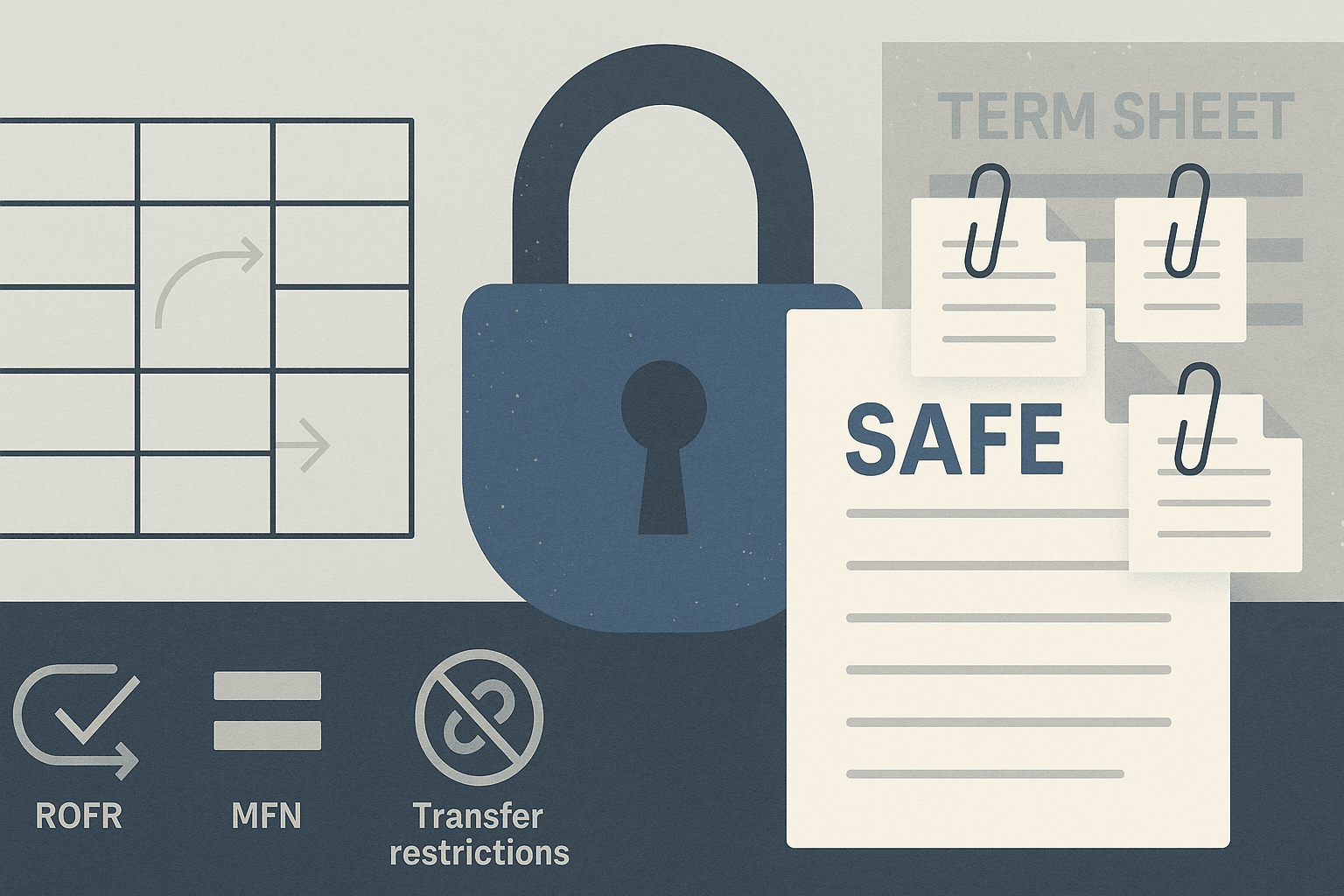
Why SAFE side letters and ROFRs are replacing term sheets in some early-stage deals, and how they give investors control without a priced round.
The new normal: control without a priced round
There’s a quiet shift happening in early-stage venture financing, and it’s easy to miss because it rarely shows up in headline numbers or market reports.
The classic story of venture funding, term sheet → priced preferred round → board seat → pro rata rights → clear governance, is being replaced, especially at pre-seed and seed, by something more ambiguous: SAFEs plus side letters, bundled with ROFRs, transfer restrictions, MFN clauses, and a handful of bespoke “add-ons” that collectively give investors many of the protections and ownership lock-in of a priced round, without actually pricing the round.
Founders often interpret this as “lighter weight” financing. Some investors pitch it as “founder-friendly,” “faster,” or “standard.” In practice, these “no-liquidity” deals can create a different kind of friction: not the overt friction of negotiation at a priced round, but the creeping friction of hidden governance and liquidity constraints that can make later financings harder, constrain employee liquidity, and shift leverage to early investors when it matters most.
This article is opinionated: these structures are not inherently bad, but they are often used in ways that are asymmetric: protecting investors while quietly reducing founder optionality. The right response isn’t panic. It’s literacy and negotiation.
What “no-liquidity” deals really mean
The phrase “no-liquidity VC deals” isn’t a formal legal category. It’s a descriptive shorthand for a pattern:
The “no-liquidity” label comes from the reality that these instruments often delay the moment when anyone has clean, transferable shares, while still enabling investors to control or constrain transfers and future issuance.
Why it’s happening now
Several forces have converged:
To be clear: many of these investor concerns are legitimate. The issue is how they are implemented, often off the cap table’s “main stage” where founders are used to negotiating.
SAFEs were designed to be simple. Side letters make them complex.
A SAFE (Simple Agreement for Future Equity) was designed to reduce negotiation overhead by deferring valuation and many preferred stock terms until a priced equity financing.
Key point: a SAFE is not equity today. It’s a contract right to receive equity in the future upon specified triggers.
The simplicity breaks down when investors add side letters or “SAFE add-ons” that effectively recreate priced-round features:
The result is a hybrid instrument: a SAFE with term-sheet gravity.
The key tools: what investors are adding (and why)
Below are the most common “quiet” terms, what they do, and why investors want them.
1) Side letters: the stealth term sheet
A side letter is a separate agreement between the company and an investor that grants rights not contained in the base SAFE.
Common side-letter rights include:
Why investors like them:
Why founders should care:
Reference: YC SAFE forms and commentary (for baseline SAFE concept and typical triggers): https://www.ycombinator.com/documents
2) MFN clauses: the term that negotiates itself
An MFN (most favored nation) clause typically gives the investor the right to upgrade their SAFE terms if the company later issues SAFEs with more favorable terms.
MFNs can be limited (e.g., only economic terms like valuation cap/discount) or broad (including side-letter rights).
Investor rationale:
Founder risk:
A founder-friendly framing is: MFN is not evil, but it should be narrow, time-bound, and clear about scope.
3) ROFRs (Right of First Refusal): controlling the secondary market
A ROFR gives a party (often the company, sometimes the investors) the right to purchase shares before they are sold to a third party.
ROFRs are extremely common in venture-backed companies, especially in stock purchase agreements and investor rights agreements in priced rounds.
The twist in “no-liquidity” SAFE deals is that ROFR-like provisions show up earlier via:
Investor rationale:
Founder/employee risk:
Reference: NVCA model legal documents (illustrative baseline of ROFR/co-sale constructs in priced rounds): https://nvca.org/model-legal-documents/
4) Transfer restrictions: a blunt instrument
Transfer restrictions can include:
Some restrictions are reasonable, particularly to preserve securities law compliance and cap table hygiene. The problem is when they are drafted to make any secondary practically impossible.
The subtle dynamic: restrictions rarely matter until they matter. When an employee wants to sell a small portion to cover AMT or a founder wants to reduce concentration risk, the paperwork suddenly becomes a leverage point for investors.
5) Pro rata rights via side letters: ownership lock-in without pricing
In priced rounds, pro rata rights are typically granted to “major investors” (definition varies) and documented in the investor rights agreement.
In SAFE rounds, pro rata often appears as:
Investor rationale:
Founder risk:
There’s a real balancing act here. Many founders want to reward early believers with pro rata. But it should be managed intentionally, not scattered across side letters.
6) Consent rights without preferred stock: governance creep
Some side letters include consent rights like:
In a priced round, these show up as protective provisions for preferred stockholders. In SAFE world, adding them early can create a situation where non-stockholders (SAFE holders) have veto power-like influence.
Whether that’s enforceable depends on drafting and state law, but practically, companies comply because they don’t want litigation or reputational damage in a tight capital market.
Why investors prefer these structures over term sheets
It’s tempting to say investors do this because they’re “sneaky.” The more accurate explanation is structural:
From the investor seat, it’s rational. From the founder seat, it can create hidden costs.
The founder cost: not dilution, friction and leverage
Founders tend to focus on valuation caps and dilution. In “no-liquidity” SAFE deals, the biggest costs often show up elsewhere:
1) Cap table complexity becomes a Series A tax
A Series A lead will diligence:
n- Every side letter
The more bespoke paperwork, the more time and legal cost. Worse, it can introduce “deal risk” if the lead investor demands cleanup.
2) Liquidity constraints can hurt hiring and retention
Senior hires increasingly ask about:
If early investors have strong ROFRs or consent rights that effectively block secondary, you may be less competitive in talent markets.
3) The “shadow priced round” problem
When enough side-letter rights accumulate, you’ve recreated a priced-round governance structure, without the clarity of a priced round.
That ambiguity creates leverage points:
A priced round forces everyone to negotiate at once. Side-letter creep forces founders to renegotiate continuously.
4) Misalignment on the path to pricing
If early investors are comfortable sitting on SAFEs with control-ish rights, they may have less urgency to price a round. Founders might want the clarity and signaling of priced equity; investors might prefer indefinite optionality.
Multiple perspectives: when these terms are reasonable
It’s important to acknowledge the legitimate reasons these clauses exist.
Scenario A: Founder wants speed and minimal distraction
A pre-seed company may rationally accept a SAFE with light side-letter info rights to close quickly and build.
Scenario B: Investor is concentrated and needs basic protections
An angel writing a meaningful check may reasonably ask for:
Scenario C: The company is enabling secondary too early
If a company starts allowing broad secondary sales at seed stage, it can create adverse selection (people who know most sell first) and cap table bloat. Some ROFR and transfer discipline can be healthy.
Scenario D: Regulatory and compliance constraints
Certain transfer restrictions are sensible for securities compliance and to avoid accidental public-market-like behavior.
The critique is not “never agree.” It’s don’t accept a priced-round governance package smuggled into a SAFE without understanding the consequences.
What founders can negotiate (before it’s too late)
If you only remember one thing: the best time to negotiate these rights is before the SAFE is signed. After money is in, leverage changes.
Here are practical negotiation points that preserve founder flexibility without being unreasonable.
1) Standardize your SAFE docs
If possible:
If an investor wants special rights, try to:
This is partly legal hygiene, partly fundraising signaling: clean docs build confidence.
2) Narrow MFN scope
Founder-friendly MFN guardrails:
MFN is often where “small” concessions become future traps.
3) Put pro rata on rails
If you grant pro rata via side letter:
Pro rata is valuable. Don’t give it away accidentally or infinitely.
4) Clarify secondary and transfer rules explicitly
Instead of vague consent rights, propose a policy-like structure:
The goal is to avoid a world where every secondary is a bespoke negotiation.
5) Avoid consent rights that mimic protective provisions
If an investor asks for veto-like rights while still on a SAFE, consider pushback:
If they insist, narrow the scope and add:
6) Add sunsets to side-letter rights
One of the cleanest solutions: rights that expire.
Examples:
Sunsets prevent “permanent seed terms.”
7) Use check-size tiers instead of one-off favors
A common founder mistake is granting bespoke rights to win a single investor.
Instead:
This reduces resentment among investors and reduces future legal entropy.
8) Be careful with “future promises”
Some side letters include commitments like:
These can become enforceable obligations or at least strong leverage points. If you must agree, ensure terms are:
Red flags that you’re recreating a term sheet (badly)
Not all side letters are problematic. But founders should slow down when they see:
If you’re stacking enough of these, you should ask: why not just price a seed round?
Why term sheets are coming back, in a different way
There’s an irony here: the more SAFEs get loaded with side-letter terms, the more the market drifts back toward term-sheet complexity, just distributed across many documents.
A priced seed round has costs (time, legal fees, negotiation), but it also has benefits:
In some cases, the “founder-friendly” option is actually to price the round earlier, because it forces clarity and prevents perpetual convertibles with creeping controls.
Practical advice for founders running a SAFE round
Here’s a pragmatic playbook if you’re raising on SAFEs and want to avoid the worst “no-liquidity” outcomes.
Step 1: Decide your philosophy on secondary early
Write down internally:
If you don’t decide, your earliest investors will decide for you through restrictions.
Step 2: Build a rights matrix
Create a simple table:
This is invaluable for later diligence and helps you spot inconsistencies.
Step 3: Prefer one “clean” side letter template
Draft one side letter template with counsel and stick to it. Deviations should be rare and deliberate.
Step 4: Make the next lead’s life easy
Ask: If I were a Series A lead, would I hate this cap table?
If the answer is yes, you will eventually pay for it, either in legal cleanup, lost time, or reduced leverage.
What investors should do (if they want to be good partners)
The best investors can still protect themselves without creating cap table landmines.
Constructive investor behaviors:
Investors who take the opposite approach may win more rights early, but they can also poison later rounds if new leads view the structure as messy or coercive.
Legal and market references (for further reading)
(As always: these are educational references, not legal advice.)
The bottom line
SAFEs are not the problem. Side letters are not the problem. ROFRs and transfer restrictions are not the problem.
The problem is the unpriced, indefinite, rights-heavy financing stack: a set of documents that delays valuation and liquidity while steadily importing control features, creating a cap table that is constrained but not clean.
If you’re a founder, the correct posture is neither paranoia nor passivity. It’s to treat every “small” add-on as part of an emerging governance system. Negotiate for:
Do that, and you can keep the speed benefits of SAFEs without waking up a year later to discover you effectively signed a term sheet, one clause at a time.
RaiseSimpli Team
Author