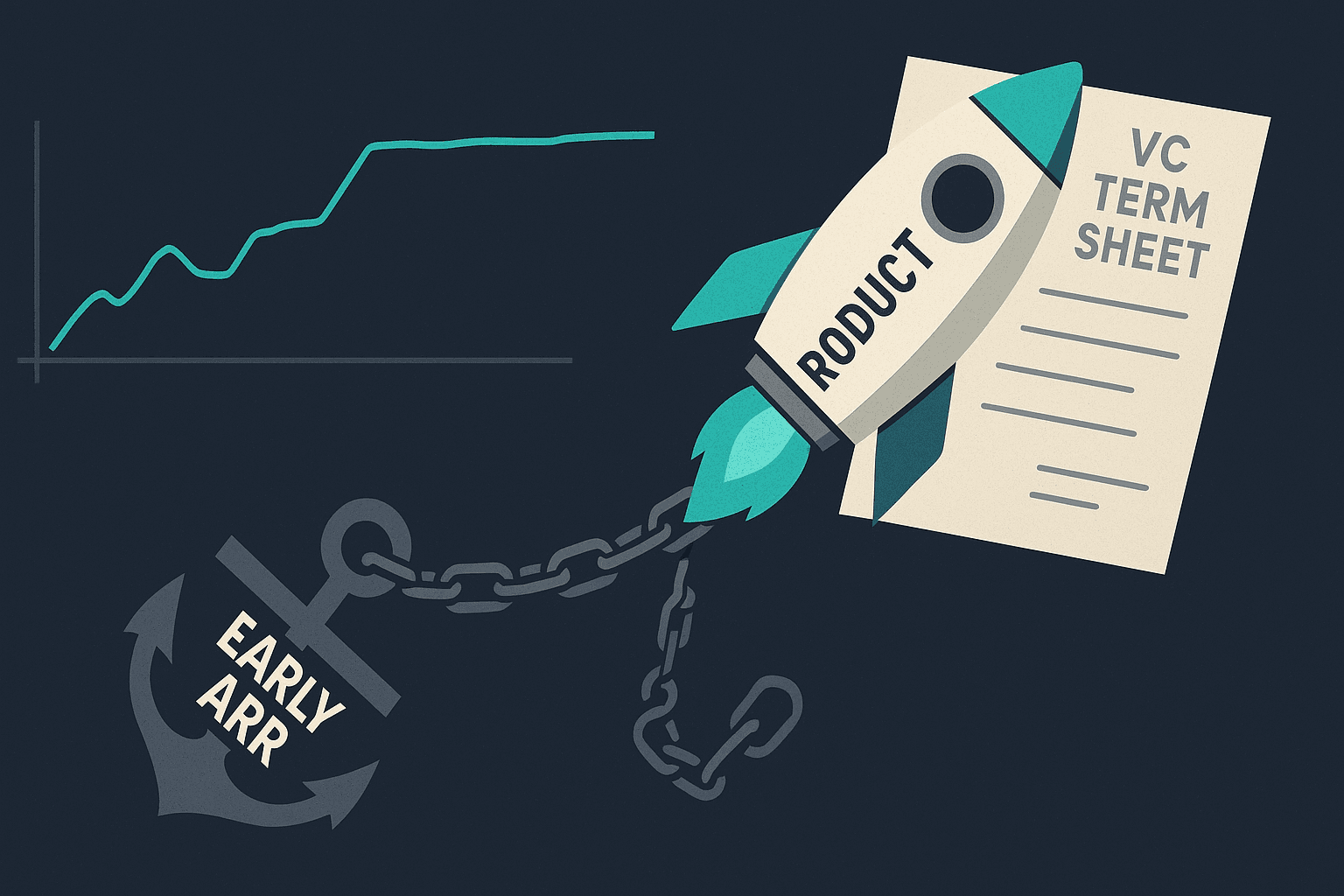
When early ARR works against you in the next VC round, why investors read it differently than founders expect, and how to avoid the trap.
The uncomfortable idea
In early-stage software, revenue is supposed to be the proof. Proof that someone cares. Proof that your product works. Proof that you’re building a business, not a science project.
And yet: there is a real, repeatable failure mode where monetizing too early, or optimizing too hard for early ARR, makes your next VC round harder, not easier.
This isn’t an argument against charging. It’s an argument against letting early revenue become the organizing principle of your company before you have validated the right market, the right product, and the right growth loop.
In a venture context, early ARR can:
The twist is that all of this can happen even when you did something “good”: got customers to pay.
This article lays out the mechanics of the revenue-first trap, where it’s most common, what sophisticated investors actually look for at Series A/B, and how to time pricing, metrics, and narrative so revenue amplifies your story rather than suffocating it.
---
What “revenue-first” really means (and why it’s tempting)
“Revenue-first” is not simply “we charge money.” It’s when revenue becomes the primary success metric before the company has validated the inputs that drive sustainable growth.
A revenue-first posture often shows up as:
It’s tempting because it works, initially.
But the venture question at Series A/B is not “can you make some revenue?”
It’s closer to:
> Can this become a very large company on a predictable growth path, with strong retention, efficient acquisition, and a scalable go-to-market model?
Early ARR can either clarify that answer, or obscure it.
---
The valuation anchor: how small ARR can cap your next round
Valuations are storytelling with math constraints. At Series A/B, many investors triangulate value from a blend of:
When you raise with no revenue, you’re often valued on potential and early usage. When you raise with some revenue, you invite revenue multiples, even if your revenue is too small or too noisy to deserve that framing.
The multiple trap
If you show up to a Series A with $300k ARR growing 10% MoM, you might hope investors underwrite the growth curve. But many will subconsciously compare you to “A-stage SaaS” comps: maybe 10–20× ARR in a normal market, higher in frothy cycles, lower in risk-off ones.
Even a generous 20× on $300k is $6M. Investors won’t literally price you at $6M if you have other strengths, but the number becomes an anchor. You now have to argue your way out of your own ARR.
If instead you had framed yourself as pre-revenue but with, say, 200k weekly active developers and a clear activation-to-retention curve, the valuation discussion might center around market dominance potential.
This is not theory, it’s behavioral finance applied to fundraising.
Revenue quality matters more than revenue existence
Investors are not impressed by ARR that is:
In fact, low-quality early ARR can be worse than none because it creates a diligence trail that raises questions.
---
The PMF signal distortion: monetization can hide the truth
One of the hardest jobs in an early startup is figuring out whether you have PMF. Not vibes, evidence.
Strong PMF typically shows up as:
The revenue-first trap can distort these signals in multiple ways.
1) Paid customers are not always retained customers
If you can close early deals through founder hustle, relationships, or heavy discounting, you can accumulate ARR while your retention quietly fails.
Retention is the truth serum. Many investors view net revenue retention (NRR) and gross revenue retention (GRR) as the clearest indicators of whether your product is becoming a habit or a line item.
Even at Series A, sophisticated investors care more about early retention than polished ARR.
References for deeper context:
2) Pricing can select for the wrong users
Charging too early can bias your user base toward:
Meanwhile, the users who would have spread your product, developers, analysts, operators, designers, may churn before adoption because the pricing gate prevents the natural “try → love → expand” loop.
This is one reason developer tools often use generous free tiers and usage-based expansion: the goal is to let the product prove itself before procurement gets involved.
3) Early sales motion can freeze your product into the wrong shape
If your earliest revenue comes from a handful of enterprise customers, you may end up:
This is a subtle form of product debt: features that are expensive to maintain and hard to unwind.
A classic framing here is to separate:
Revenue-first teams often over-invest in the second category because it pays now.
---
The investor mismatch: you start signaling the wrong kind of company
Investors pattern-match. The metrics and motion you bring to the table signal what kind of business you are.
If you monetize early via bespoke enterprise contracts, the company starts to look like:
That can be a great business, just not always a great venture business unless it’s paired with strong expansion, high margins, and a repeatable sales engine.
Who you attract (and repel)
Early ARR can pull you toward investors who prioritize capital efficiency and near-term revenue predictability. Again, not bad. But if your ambition is a high-growth Series A/B path, you need investors who believe you can:
If your early story is “we can sell $25k pilots by customizing onboarding,” many top-tier Series A firms will worry they’re funding a consultancy-in-disguise.
This doesn’t mean you are one. It means your signals look like one.
---
The operational tax: monetization introduces friction and slows learning
Charging money is not just adding Stripe.
The moment you monetize, you invite:
Each of these adds overhead, and, more importantly, slows the feedback loop that matters most pre-PMF: ship → observe → learn → iterate.
There’s a reason many iconic startups delayed monetization or kept it simple early:
This is not to claim “they didn’t charge.” It’s that their primary goal was compounding usage, not maximizing early ARR.
---
Counterpoint: early revenue can be a superpower
The revenue-first trap is real, but it’s not universal. Early revenue can be an advantage when it is:
In some categories, charging early is almost required:
Also, bootstrapped or capital-efficient companies can use early revenue to avoid dilution and raise later on better terms.
So the point isn’t “don’t monetize.” It’s:
> Monetize in a way that increases signal quality and preserves growth optionality.
---
Where the trap is most common (patterns to watch)
1) Developer tools and bottoms-up products
If your natural distribution is bottom-up adoption, premature paywalls can kill the loop:
Many successful dev tools instead monetize via:
Reference: OpenView’s writing on product-led growth (PLG) and expansion loops has repeatedly emphasized letting adoption lead revenue.
2) Founders with strong sales backgrounds
Sales-strong founders can close deals before the product is truly ready. That’s a skill, and also a risk.
They may generate impressive early ARR that is mostly a function of:
If the product isn’t self-proving, the business may struggle to scale past founder-led sales.
3) Markets with ambiguous ICP early on
If you don’t yet know who your best customer is, revenue can mislead you. The first people to pay are not always the most scalable segment, they’re often the most desperate.
Desperation buys. But it can also demand customization.
---
How VCs actually evaluate Series A/B readiness (beyond ARR)
ARR matters, but investors increasingly underwrite around a few core questions.
Series A: “Is there a repeatable wedge?”
Common emphases:
Series B: “Is this a scaling machine?”
Common emphases:
If your early ARR comes with high services load, weak expansion, and messy cohorts, you may hit a Series B wall even if top-line looks decent.
References:
---
The tactical playbook: monetize without falling into the trap
1) Decide what you’re optimizing for by stage
A simple stage-appropriate optimization stack:
If you’re early, ask:
2) Use pricing to learn, not to extract
Early pricing should answer questions:
Tactics:
A useful mental model: your early pricing is an instrument panel, not a cash register.
Reference: Monetizing Innovation (Madhavan Ramanujam & Georg Tacke) for value-based pricing and avoiding feature-based price confusion.
3) Keep your “ARR story” clean: quality over quantity
If you do have ARR, make it legible:
Investors fear messy revenue because it increases diligence risk.
4) Protect the product loop from enterprise gravity
Enterprise customers can be great, later. Early on, they can capture your roadmap.
Guardrails:
If you can’t say “no,” you don’t have a product roadmap, you have a queue.
5) Instrument usage before you instrument invoices
Your best defense against the revenue-first trap is having usage truth.
At minimum, track:
When you later monetize, you can prove that pricing sits on top of real adoption.
6) Choose a value metric that scales with success
Bad early pricing often comes from picking a value metric that doesn’t scale:
Good value metrics:
Usage-based pricing is not a panacea, but it can align incentives when the product’s value scales with activity.
Reference: Kyle Poyar (formerly OpenView) has popularized practical frameworks around PLG and usage-based monetization.
7) Time fundraising narrative to the company you’re becoming
Fundraising is narrative plus evidence.
If you’re early and monetizing lightly, your story might be:
If you’re later with meaningful ARR:
What doesn’t work well:
---
How to handle the common objection: “But VCs want revenue”
Yes, and no.
VCs want evidence that the business can become very large. Revenue is one form of evidence. But revenue that is:
can weaken the argument.
A more accurate statement is:
> VCs want proof of scalability.
Sometimes the strongest proof is revenue. Other times it’s retention, network effects, rapid adoption, or a distribution wedge.
If you’re pre-Series A and your revenue is early, consider leading with:
Then show revenue as the natural outcome.
---
Red flags that you’re already in the trap
Use this checklist. If several are true, your next round may be harder than it should be:
These are all solvable, but they require acknowledging the problem.
---
A practical strategy: the “dual-track” approach
One way to avoid the trap is to run two tracks explicitly:
Track A: Adoption and PMF validation
Track B: Monetization learning
The key is governance: Track B must not be allowed to distort Track A.
This structure is especially effective for PLG or developer-first products where the adoption loop is the moat.
---
When to deliberately choose “revenue-first” (and how to do it safely)
Sometimes revenue-first is rational:
If you choose this route, do it with safeguards:
You want to look like a company temporarily using services to accelerate learning, not a company permanently selling bespoke work.
A useful reference point is the classic VC view that services can be acceptable early if they are a bridge to product scale, a theme discussed widely in startup literature and by many operators, though often without a single canonical source.
---
The narrative reset: how to recover if early ARR is hurting you
If you suspect you’re stuck in the trap, you can reset without burning the company down.
Step 1: Re-segment customers by success, not by revenue
Identify the customers who:
That segment is your real ICP candidate, even if it’s not your largest revenue today.
Step 2: Rebuild your metrics deck
For fundraising and internal clarity, emphasize:
Then show ARR as the outcome of those.
Step 3: Fix pricing leaks and discount culture
Discounting is sometimes necessary, but chronic discounting teaches the org that list price is fictional.
Step 4: Stop selling custom work as product
If a feature is truly custom, price it as custom.
This improves:
Step 5: Tell a coherent “before and after” story
Investors accept pivots and resets when they’re rational.
A strong narrative sounds like:
That is far more investable than pretending early ARR is already PMF.
---
What to include in a Series A/B deck to avoid ARR anchoring
If you’re worried that small ARR will cap valuation discussions, structure the deck to lead with the right evidence.
Consider:
If revenue is small, don’t hide it, contextualize it.
The goal is to make ARR a supporting actor, not the protagonist.
---
The core principle
Rushing to monetize is rarely fatal because you charged money. It’s fatal because monetization can:
The antidote is not “delay revenue indefinitely.”
It’s to treat revenue as a consequence of compounding product value, and to time pricing, packaging, and contracts so they increase learning and strengthen your future fundraising story.
If you’re building a venture-scale company, the best early monetization strategy is the one that preserves the thing VCs ultimately pay for:
> credible evidence that growth will compound.
---
References and further reading
RaiseSimpli Team
Author