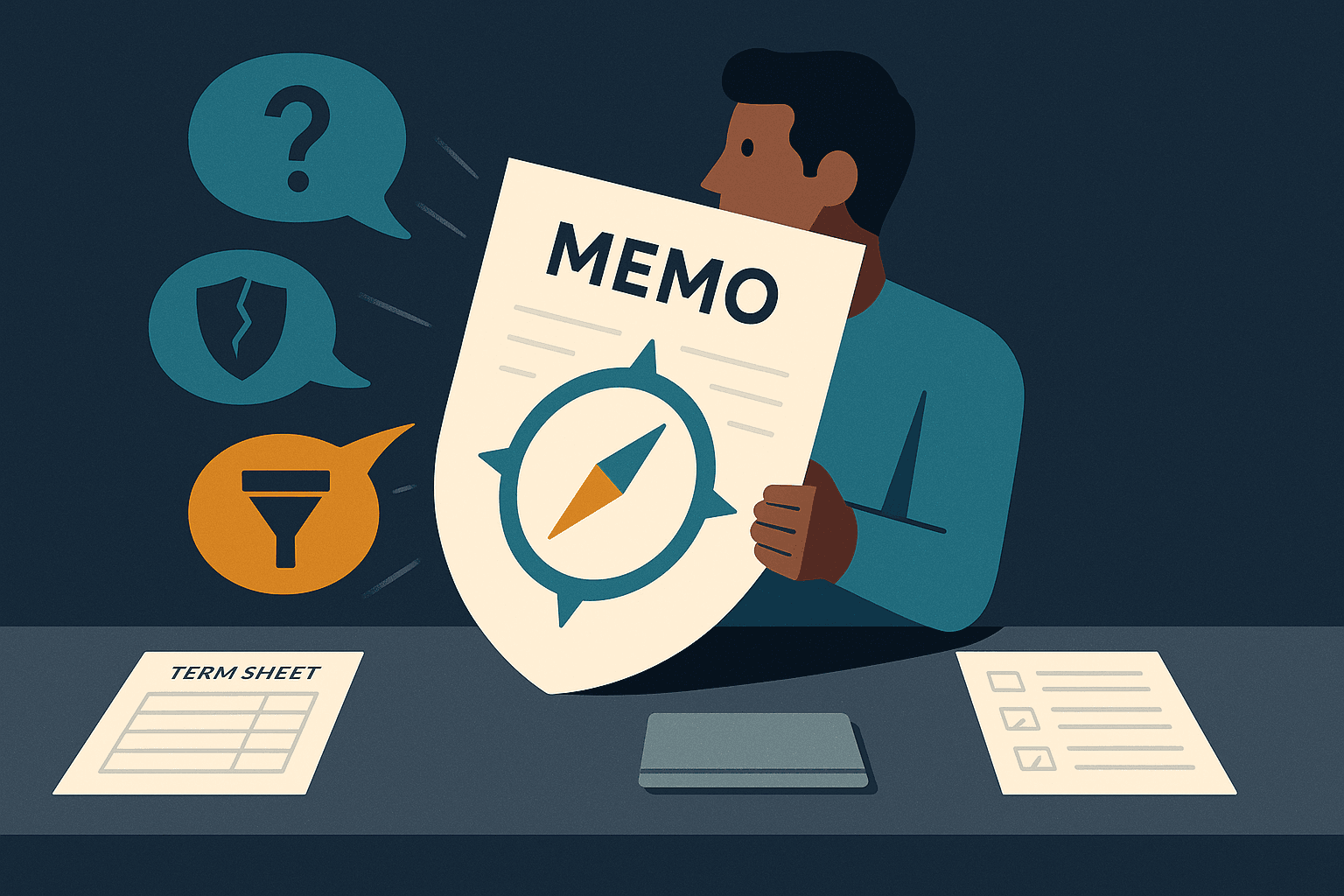
How a Right to Win memo helps you address investor doubts early and control the fundraising narrative in ways a pitch deck alone cannot.
Why a “Right to Win” memo exists (and why decks don’t solve this)
Most fundraising advice focuses on the pitch deck: tell a crisp story, show traction, demonstrate market size, and articulate the product. That’s necessary, but it’s not sufficient.
Investors don’t only ask “Is this interesting?” They ask, often implicitly:
A deck is optimized for excitement and recall. It is not optimized for skepticism management. In fact, decks often make skepticism worse by:
The result is predictable: after a good meeting, the investor goes to their internal decision process (partner meeting / IC / memo-writing), and the doubts that weren’t pre-empted become the reasons to pass.
A one-page “Right to Win” memo is designed to interrupt that dynamic. It is a deliberately structured, high-signal document that answers the hardest questions before they’re asked, so the investor’s internal narrative becomes:
> “They’ve seen the risks clearly, they have a plan, and they’re already executing against it.”
If you do this well, two things happen:
This is not a replacement for a deck or data room. It’s the missing bridge between “compelling story” and “investable belief.”
What investors are actually doing: reducing downside narratives
Venture investing is often described as upside hunting. Operationally, though, early-stage decision-making is frequently about eliminating downside narratives that could embarrass the firm or fail IC.
Typical internal objections sound like:
Your goal is not to “argue” investors out of skepticism. Your goal is to make the skeptical story less plausible than your story: using clear reasoning, specific evidence, and explicit tradeoffs.
A good Right to Win memo does three things:
The one-page constraint is the feature, not the bug
One page forces discipline:
This matches how partners actually operate. In many firms, an internal champion has to summarize the deal in a few minutes (sometimes less). If you give them a tight one-pager that already handles the major objections, you are effectively writing the first draft of the partner narrative.
This is similar in spirit to Amazon’s famous memo culture (narratives over slides) where structured writing reveals gaps in thinking and improves decision quality ([Amazon writing culture overview](https://www.inc.com/justin-bariso/jeff-bezos-amazon-6-page-memo-writing.html)). You don’t need a six-page memo for fundraising, but you do need the same rigor.
When to use it in a fundraising process
Use the Right to Win memo when you have:
Practical timing:
Do not send it as a cold outbound attachment. Cold outreach needs fast curiosity; the memo is for converting curiosity into commitment.
The Right to Win memo: a practical one-page framework
Below is a structure that fits on one page if written tightly (roughly 600–900 words).
1) One-sentence claim: “We have a right to win because…”
This is not a slogan. It should be falsifiable.
Template:
> “We have a right to win in [market] because [unique capability / wedge] gives us [distribution or product advantage] that compounds into [durable position].”
Example (illustrative):
> “We have a right to win in SMB financial automation because our embedded workflow + bank data graph turns reconciliation into a default behavior inside existing tools, creating switching costs and a data advantage that improve accuracy and reduce fraud over time.”
This sets a clear thesis: wedge → compounding advantage → defensibility.
2) The top 3 investor doubts (stated bluntly)
Name the doubts the way a skeptical partner would.
Example section header:
> “The skeptical view (and why it’s reasonable):”
Then list three bullets, typically aligned to:
Be fair. If you strawman, you lose credibility.
3) Rebuttal by proof, not by assertion
For each doubt, provide:
A tight format looks like:
Doubt → What’s true → Proof → Next verification
#### A) Market skepticism
Common investor questions:
What good looks like in the memo:
Evidence investors respect:
References to ground your framing:
#### B) Moat fragility
Investors often say “moat” but mean “why won’t this be competed away?”
In software, defensibility tends to come from compounding advantages, not static features. The memo should make compounding explicit.
Common defensibility vectors:
A useful mental model is to describe the flywheel: action → data/learning → product improvement → more adoption.
Be careful with weak moat claims:
This aligns with broader commentary that ML/AI advantage often decays without data/network effects and iteration velocity (see analysis in industry writing like Benedict Evans’ essays on platforms and aggregation dynamics: https://www.ben-evans.com/).
#### C) Go-to-market risk
GTM is where most early-stage companies die, not because the product is bad, but because distribution is misunderstood.
The memo should answer:
Avoid generic claims like “We’ll do content marketing” or “We’ll hire AEs.” Instead, specify a repeatable engine.
Examples of credible GTM de-risking proofs:
Good GTM memos often mirror the discipline in modern startup metrics thinking (activation, retention cohorts, net revenue retention for B2B) as popularized in open resources like a16z’s operational content (https://a16z.com/).
4) The “earned secrets” section (the most underused)
Add 2–3 bullets titled something like:
> “What we know that isn’t obvious from the outside:”
This is where you include the specific insight you earned by building or selling:
This section is powerful because it signals non-consensus understanding, which is what VCs are paid to find.
5) The milestones that convert belief into certainty
End with 3–5 milestones over 90–180 days that, if hit, should make the round obvious.
These should be:
Examples:
This gives investors a diligence map and tells them what “progress” means.
A complete one-page template (copy/paste)
Use this structure and keep it tight.
---
Right to Win Memo
Core claim (1 sentence):
The skeptical view (3 bullets):
1) Market skepticism:
2) Moat skepticism:
3) GTM skepticism:
What we know that isn’t obvious (earned secrets):
Milestones that would make this inevitable (next 90–180 days):
---
How to write it so it actually works
Write like a partner, not like marketing
A Right to Win memo is not brand copy. It should feel like a clear internal document.
Tactics:
Don’t “win” every point; choose your tradeoffs
Investors are suspicious of perfection. If you claim:
…you sound inexperienced or dishonest.
Instead, be explicit:
Tradeoffs are how strategy shows up on paper.
Use “pre-mortems” to find the real doubts
Before writing, run a pre-mortem: imagine the company failed in 24 months. Ask:
Then turn those into the “skeptical view” bullets.
This technique is well-supported in decision-making literature as a way to surface risks and reduce overconfidence (Gary Klein’s work on pre-mortems is widely cited; overview: https://en.wikipedia.org/wiki/Pre-mortem).
The three big skepticism categories, deeper guidance and examples
1) Market skepticism: timing beats size
A common founder mistake is to respond to market skepticism with bigger TAM slides. But timing skepticism isn’t a sizing problem; it’s a willingness-to-pay now problem.
Investors want to know:
Good memo move: highlight a forcing function.
Examples of forcing functions:
If you can connect your product to a forcing function, you shorten the “market education” fear.
2) Moat skepticism: articulate the compounding loop
Most “moat” discussions fail because they list assets, not dynamics.
Instead of:
Write:
That is a defendable loop.
Also address platform risk directly:
Investors know platform dependency is real; acknowledging it and showing contingency planning is a credibility multiplier.
Related reading on competitive strategy and “what is defensibility” can be anchored in classics like Porter’s competitive forces (overview: https://en.wikipedia.org/wiki/Porter%27s_five_forces) and modern platform analysis (Benedict Evans).
3) GTM skepticism: show the motion, not the hope
GTM is often where founders overgeneralize. “We’ll sell to enterprises” is not a plan.
A strong memo specifies:
Also include a statement about what makes CAC improve over time.
If CAC does not improve, you need either:
This is why many investors look for evidence of retention and expansion even earlier than founders expect.
Controlling the narrative without sounding defensive
There’s a fine line: pre-empting doubts can sound defensive if you overdo it.
Rules of thumb:
Your goal is to communicate: “We are not surprised by reality.”
How this memo shortens diligence (mechanically)
Investors do diligence to answer:
A Right to Win memo speeds this up by:
It also helps your champion internally: they can paste your points into their IC memo.
Common failure modes (and how to avoid them)
Failure mode 1: The memo is just a second deck
If it reads like marketing copy, you lose the point. Make it analytical.
Failure mode 2: Vague defensibility claims
“Network effects” without specifying who the network is and what value increases with scale is worse than saying nothing.
Failure mode 3: Confusing activity with proof
“100 meetings” is activity. Proof is conversion, retention, paid willingness, and references who sound like they’d be upset if you disappeared.
Failure mode 4: Overpromising milestones
If you miss your own milestones, the memo becomes an artifact of unreliability. Choose milestones you can hit.
Advanced move: write two versions (external + internal)
If you have a strong lead investor or advisor, ask them for permission to write:
Some firms will effectively build this themselves; offering a structured version can accelerate the partnership.
A final opinionated take: founders who name risks early raise faster
Founders often worry that acknowledging risk will scare investors. In practice, sophisticated investors already see the risks; what they’re evaluating is whether you see them.
The Right to Win memo is a signal of:
It doesn’t replace traction. But it can:
If you can fit your right to win on one page, and make it read like it came from someone who has actually sold and built in the real world, you will control more of the narrative than the market will.
RaiseSimpli Team
Author