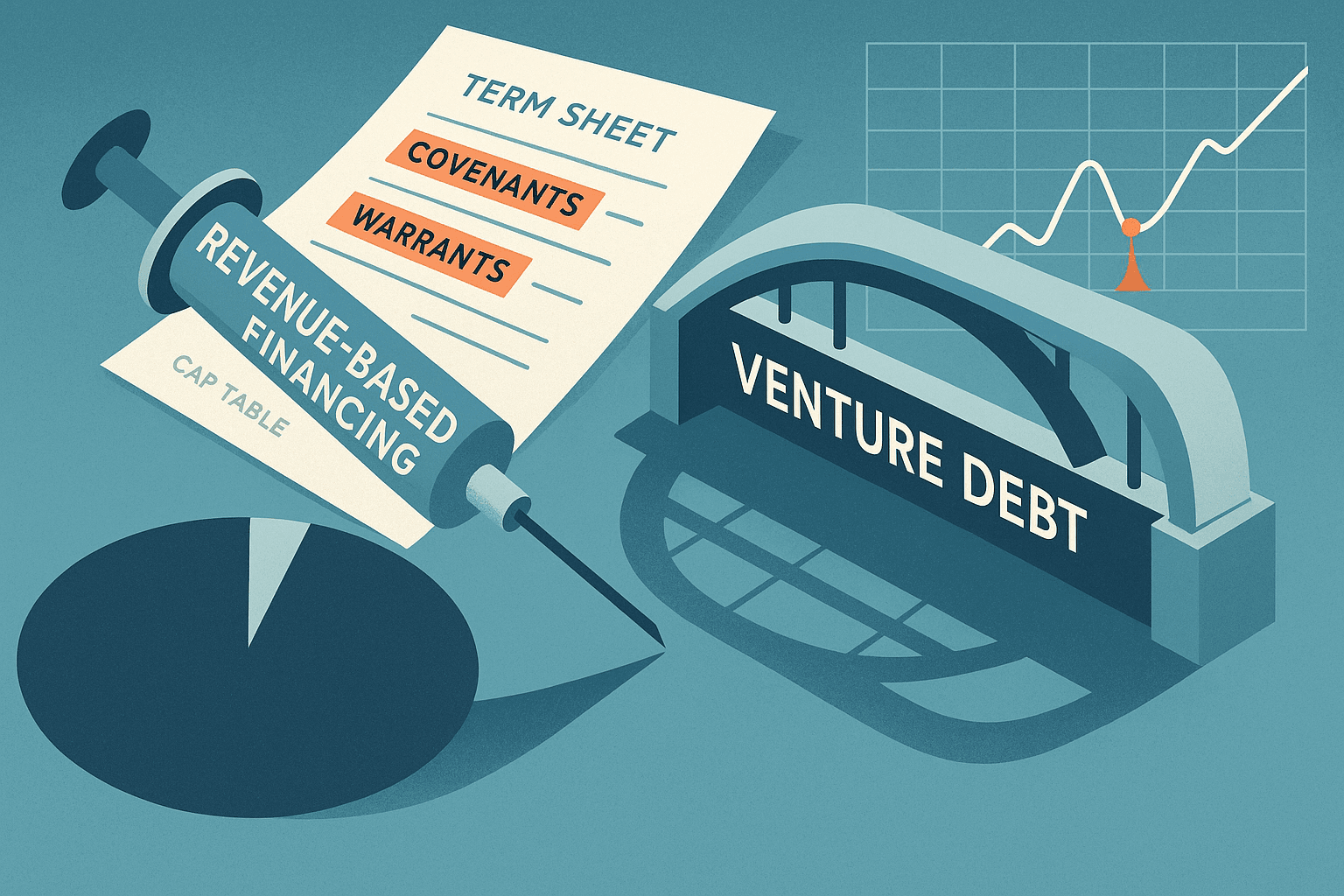
How revenue-based financing and venture debt can quietly behave like equity, and what founders should check before calling the money non-dilutive.
The “non-dilutive” pitch and why founders keep buying it
“Non-dilutive capital” has become one of the most effective phrases in startup finance marketing. It lands because it speaks to a real founder fear: selling too much of the company too early, especially when the valuation feels unfair or the market is down.
But the label is doing too much work.
Revenue-based financing (RBF), venture debt, and various hybrid instruments can be genuinely useful, sometimes better than a priced equity round. Yet many deals marketed as non-dilutive end up behaving like equity in practice. They do so through:
The problem isn’t that these tools exist. The problem is the mismatch between how they’re described and how they behave under stress.
This article unpacks how “non-dilutive VC” works, where the bodies are buried, and how to negotiate from a position of clarity, without moral panic. You’ll also get a decision framework for when RBF or venture debt can truly beat a priced round.
> Disclosure-style note: This is educational and general; treat it as a starting point and involve competent counsel for any financing. Many of the specific structures vary by jurisdiction and lender.
---
A quick taxonomy: what people mean by “non-dilutive”
Revenue-based financing (RBF)
RBF typically advances cash in exchange for a fixed return (e.g., 1.2–2.0x principal) repaid as a percentage of revenue until the cap is met. Variants include:
RBF is often positioned as “equity-free.” But it can still dilute outcomes by siphoning cash and limiting strategic options.
Venture debt
Venture debt is a term loan (sometimes with a revolving facility) issued to venture-backed companies, usually with:
It’s usually “less dilutive” than equity in the narrow cap-table sense, but the warrants, covenants, and default rights can shift power and economics in equity-like ways.
Hybrids: “non-dilutive VC”
Some funds (and increasingly, platform lenders) blur the lines, offering:
These products can be legitimate. But they’re often underwritten with a VC mindset: asymmetric upside, strong downside protection.
---
First principles: what “dilution” really is
Founders often use “dilution” to mean percentage ownership dilution.
Investors often care about value capture: how much of the enterprise value ends up in their pocket vs yours.
“Non-dilutive” products may preserve your percentage while reducing your optionality and ultimate payout. In other words:
The right comparison isn’t “equity dilution vs no dilution.” It’s:
> Total cost of capital + constraints + probability of downside scenarios vs equity cost and governance.
This is why sophisticated founders model distributions, not point estimates.
---
How “non-dilutive” becomes equity-like: the mechanisms
1) Warrants: the obvious “quiet dilution”
Venture debt commonly includes warrants (e.g., 0.25–2.0% coverage, sometimes more depending on risk, stage, and market). Warrants are literally an equity claim. They are dilutive in the ordinary cap-table sense.
Warrant terms to scrutinize:
Even if warrant coverage is small, the signaling and precedent can matter: later lenders may demand similar or better terms.
Reference: Venture debt warrant structures are widely discussed in practitioner guides and lender primers; see Silicon Valley Bank’s historical materials and other venture debt lender resources for typical ranges and concepts (SVB’s specific materials remain cited across the industry, though availability varies after their collapse and asset sales).
2) Covenants that function like board control
Covenants are often treated as “technical.” In reality, they can become a governance layer that sits above the board in moments of stress.
Common covenants and what they imply:
In an equity round, governance is explicit: board seats, protective provisions, veto rights. In “non-dilutive” instruments, governance often arrives through the back door, triggered by covenant breaches.
When you breach (or get close), your lender can effectively:
That’s equity-like influence without equity-like accountability.
3) Default triggers and “gotcha” clauses
Default is where debt turns into control.
Beyond “non-payment,” watch for:
Debt is binary: you’re fine until you’re not. And when you’re not, the creditor’s remedies can overwhelm the cap table’s theoretical ownership.
4) Effective liquidation preference via seniority and security
Equity investors get liquidation preferences. Lenders get seniority and security interests.
In practical waterfall terms, senior secured debt often sits above everyone else.
If the company sells early for a modest amount, debt can capture most proceeds, leaving common equity with little even if ownership percentages look “undiluted.”
This is one of the main ways debt becomes equity-like: it changes the exit distribution.
5) Revenue skims that tax growth (RBF’s signature trap)
RBF’s defining feature, repayment as a percentage of revenue, sounds aligned: “Pay more when you make more.”
But it can become a growth tax:
The founder isn’t diluted on paper, but the enterprise value can be diluted by under-investment.
This is especially acute for:
6) Minimums, floors, and “catch-up” provisions
Some RBF deals include:
These convert RBF from flexible to rigid, i.e., it starts to look like amortizing debt while still costing like quasi-equity.
7) Refinancing pressure and “stacking” dynamics
A subtle equity-like effect is when non-dilutive capital forces a priced round later, on the lender’s timeline.
Examples:
If the instrument causes you to raise equity under duress, it effectively acts like a structured path to dilution, just delayed and often worse.
---
Why this trend accelerated: incentives and market structure
The VC slowdown and “anti-dilution sentiment”
In down markets, founders resist flat/down rounds. Investors resist paying up. Non-dilutive products fill the gap.
Lenders discovered VC-style returns without VC-style mark-to-market pain
Hybrid funds can combine:
That can be compelling versus pure equity, especially if fundraising markets are choppy.
SaaS metrics made underwriting feel deterministic
The rise of SaaS dashboards (MRR, NRR, churn, CAC payback) encouraged the belief that you can “underwrite growth” like credit.
Sometimes you can. Often you can’t, particularly when growth is driven by product transitions, pricing experiments, new segments, or platform risk.
Reference: The broader debate about whether ARR behaves like collateral appears frequently in fintech and SaaS finance writing; see discussions around recurring revenue lending and the evolution of venture lending in industry publications like a16z, TechCrunch, and practitioner blogs from lenders and CFO advisors.
---
Red flags: when “non-dilutive” is likely to bite you
Here are practical red flags that suggest you’re buying disguised equity (or worse: equity economics with debt remedies).
Red flag 1: The provider avoids showing an IRR or total cost of capital
If the pitch is “Only X% of revenue,” demand:
If they won’t model it with you, they may be relying on confusion.
Red flag 2: Broad MAC clauses and subjective default triggers
If the lender can declare default based on vague “adverse change” language, you don’t have a contract, you have a relationship contingent on their mood and portfolio.
Red flag 3: Warrant coverage that’s “small” but paired with heavy fees
Sometimes the trick is to say: “Warrants are tiny.”
Then layer:
The all-in cost can rival equity while retaining creditor control.
Red flag 4: Restrictions that block future fundraising flexibility
Watch for covenants that:
These can trap you into a narrow set of outcomes.
Red flag 5: Short maturity with “extension conditioned on equity raise”
That’s often not a loan; it’s a timed pressure device.
Red flag 6: Security interests that include IP in a way that scares acquirers
A blanket lien is common; but the details matter. If the lender’s remedies create uncertainty around IP transfer, you can lose deals.
Red flag 7: RBF on a company that is not yet efficient
If your CAC payback is long or your unit economics are still moving, RBF can freeze your ability to invest through the ugly middle.
---
Negotiation levers: how to make these instruments genuinely founder-friendly
You usually can’t remove risk protections entirely, but you can shape them so the instrument behaves like financing rather than control.
1) Narrow the default language
2) Build in cure rights and flexibility
3) Cap fees and simplify the economic stack
Push for:
If warrants exist, keep them modest and avoid aggressive cashless exercise provisions.
4) Align amortization to cash generation
For venture debt:
For RBF:
5) Protect fundraising and M&A optionality
6) Get reporting requirements to a reasonable place
Monthly reporting is normal. Unrealistic timelines and excessive metrics can become a constant default risk.
7) Use competitive tension
The market now has many lenders and RBF providers. Even two term sheets can materially improve terms.
---
When “non-dilutive” can beat a priced round (yes, sometimes it’s the right move)
Despite all the critique above: there are cases where venture debt or RBF is decisively better than equity.
Case A: You have predictable cash flows and clear ROI on capital
If you can deploy $1 and reliably get $3 back on a timeline that matches repayment, non-dilutive tools can be excellent.
Typical examples:
Case B: You’re bridging to a near-term value inflection
Venture debt works best as a bridge when:
In this scenario, giving up 1–2% in warrants might be cheaper than selling 15–25% in an equity round at a depressed valuation.
Case C: You want to avoid signaling issues of a down round
If raising equity now would create a negative signal (flat/down) and you’re confident you can grow out of it, a modest debt facility can buy time.
Be careful: this only works if the debt doesn’t create a future forced raise.
Case D: You have a “default alive” plan
If you can reach breakeven without more equity, RBF can be an alternative to chasing venture outcomes.
In that case, the question becomes: are you willing to trade some upside for control and long-term independence?
This is often rational for founders building durable, profitable businesses rather than hypergrowth rockets.
---
When you should strongly prefer equity
1) Your business needs heavy reinvestment to win
If the winner is the company that invests the most effectively (sales, R&D, network effects), revenue skims can be strategically fatal.
2) Your metrics are still volatile
If you’re pre-product-market fit, experimenting with pricing, or dependent on a platform partner, adding fixed obligations is usually a mistake.
3) You need freedom to pivot
Debt covenants and repayment schedules punish pivots. Equity is more forgiving because risk is shared.
4) You are already in a fragile liquidity position
If you’re raising “non-dilutive” money because you are desperate, you are likely accepting terms that behave like control instruments.
In distress, equity may be expensive, but it’s often the only capital that can actually absorb uncertainty without triggering default dynamics.
---
A practical modeling approach: compare outcome distributions, not slogans
If you want to be intellectually honest about “non-dilutive,” model these three scenarios:
Then compare:
A simple but revealing exercise: compute the implied “equity equivalent” cost.
Example intuition:
This is not perfect, but it forces the right question: what are you really paying?
---
The governance paradox: “non-dilutive” often means “less aligned”
Equity investors win when the company wins. Their downside is their investment.
Lenders win when they get repaid, often regardless of whether the company becomes great. Their downside protection can motivate behavior that is rational for them and destructive for you.
That doesn’t make lenders bad actors. It means incentives differ.
If you take on debt-like obligations, you should expect debt-like behavior:
Equity can be expensive, but it is often more aligned with venture uncertainty.
---
The middle ground: founder-friendly structures that are “honestly non-dilutive”
Some structures can preserve the spirit of non-dilution while avoiding the worst traps:
The most founder-friendly non-dilutive capital is boring.
If the product feels flashy, it may be because the economics are complex enough to hide the true cost.
---
Due diligence checklist: questions to ask before you sign
Economic
Control / Covenants
Legal / Security
Operational
Strategic
---
So is “non-dilutive VC” a lie?
Not always. But it’s frequently an overstatement that exploits a narrow definition of dilution.
A more accurate framing is:
The right stance for founders is neither cynicism nor gullibility. It’s precision.
If you can model the downside, negotiate the covenants, and size the facility conservatively, these instruments can be powerful tools, especially when equity is overpriced (for you) or mis-timed.
If you can’t, “non-dilutive” capital can become the worst of both worlds: equity-like cost with debt-like consequences.
---
References and further reading
Because many of the most important details live in term sheets rather than academic papers, the best references are often practitioner sources. Useful starting points:
If you want, I can also provide a downloadable one-page checklist you can use to compare two term sheets (RBF vs venture debt vs equity) and a simple spreadsheet model structure.
RaiseSimpli Team
Author