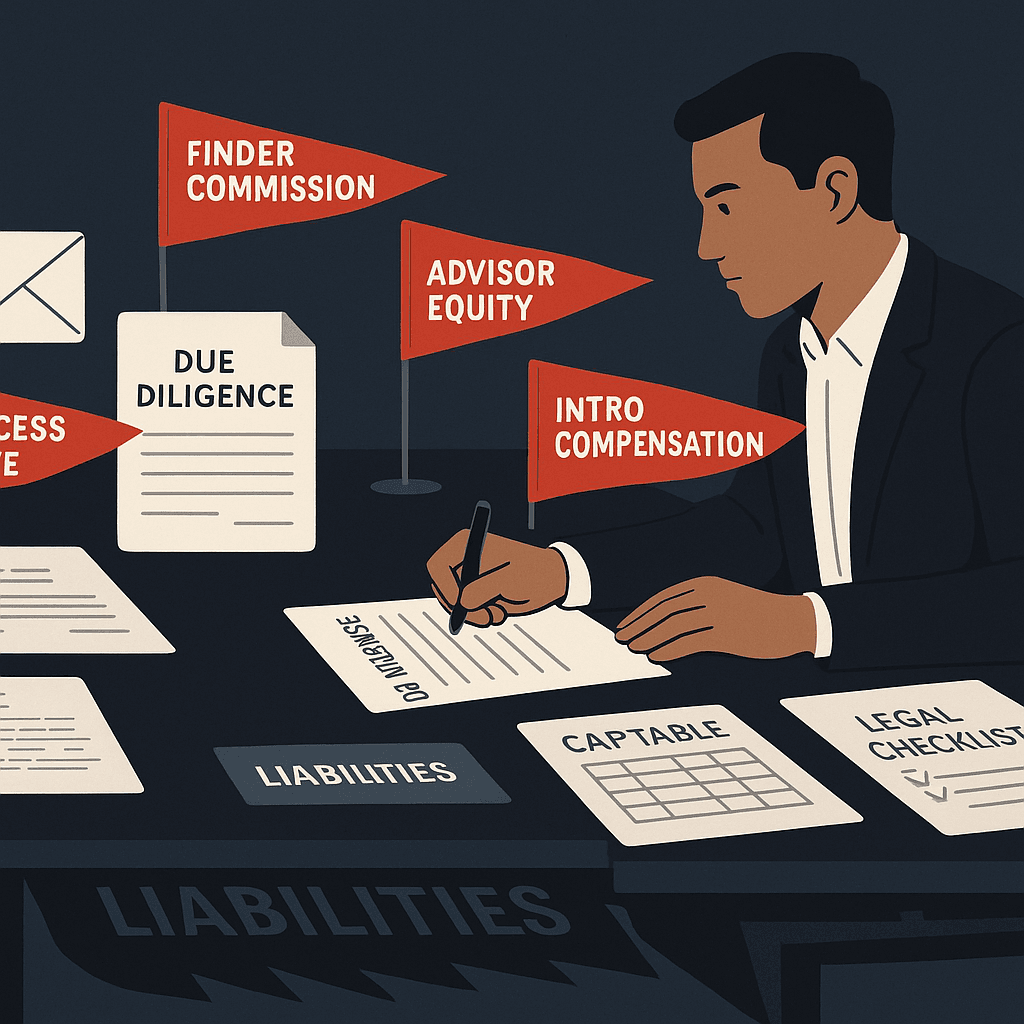
How hidden banker, broker, and finder compensation claims can derail a VC round, and how to clear them before investors start diligence.
No board approval. No formal engagement letter. No invoice. No one remembered it.
But now the lead investor’s counsel is asking three ugly questions:
What looked like a harmless side arrangement has become a financing problem. Not because the fee itself is necessarily large, but because the liability sits off cap table, outside the standard financing model, and inside the legal risk perimeter of the round.
This is the “SAF audit trap”: not a Simple Agreement for Future Equity, but a Simple Agreement for Future Fees, the loose, half-documented, founder-made promise to pay someone if money comes in. It may be a banker success fee, a finder commission, an advisor carry promise, a percentage of proceeds for introductions, or even a vague “we’ll take care of you at close” written in email or text. Founders rarely model it. Company counsel often doesn’t see it until diligence. Investors absolutely care once they do.
And when it surfaces late, it can do three things fast: delay closing, reduce price, or force an indemnity and escrow package that makes the round far more painful than it should have been.
The real problem is not the invoice, it’s underwriting unknown compensation liability
Founders often misunderstand what scares VCs here. They assume investors are just trying to avoid paying someone else’s fee. That is part of it, but the bigger issue is underwriting uncertainty.
A clean venture round requires investors and their counsel to get comfortable with several representations:
A contingent compensation claim attacks all of those at once.
If someone claims they were promised 5% of funds raised, that is not just a payable. It may be:
The round math might still work. The legal certainty often does not.
That is why hidden compensation arrangements regularly become closing conditions. Not because venture lawyers love process. Because they are paid to remove tail risk before money wires.
Why current founder behavior creates this mess
Most of these problems are self-inflicted, and they follow predictable patterns.
1. Founders treat fundraising help as informal until it becomes expensive
A former executive offers to make introductions. A startup advisor says she knows “all the right seed funds.” A boutique banker volunteers to “help position the story.” A friend of the CEO wants a percentage if his network leads to a close. No one wants to spend legal budget papering exploratory help, so the arrangement starts in text messages and vague emails.
The founder’s mental model is simple: no money raised, no problem.
That is exactly backward.
Contingent compensation is where the problem begins. Once payment is tied to capital raised, especially as a percentage of proceeds, you have created a rights question that will be tested at the exact moment the company can least afford ambiguity: closing.
2. Founders underestimate how broad “in connection with the financing” can become
The company may think a claimant only introduced one angel 18 months ago. The claimant thinks they “opened the round,” “created momentum,” or “brought the lead through the network.” A banker who touched a process months ago may argue the current financing is a continuation of that mandate.
In disputes over success fees, causation is always stretched after the fact.
If a company raises $8 million and someone claims 4%, the argument is not over whether they sent an email. It is over whether they were the procuring cause of the financing, whether the financing falls within the tail period, and whether side discussions converted into an engagement.
3. Founders confuse enforceability with investability
A founder’s favorite line is: “It’s probably not enforceable.”
Maybe. But VCs do not need a court judgment to care.
If there is a non-trivial chance of a claim, the round gets burdened anyway. Investors and counsel think in expected downside, not founder optimism. A weak claim can still:
A legally uncertain liability can still be a very real financing liability.
4. Founders ignore broker-dealer risk because “everyone does intros”
This is where things get more serious.
A person who merely introduces founders to investors as a one-off favor is one thing. A person who regularly solicits investors, negotiates terms, receives transaction-based compensation, or is “in the business” of raising capital for others can look a lot more like a broker. That matters because investors, company counsel, and sometimes auditors do not want unregistered broker issues contaminating a financing.
I am not giving legal advice here, and broker-dealer analysis is fact-specific. But as a practical financing matter, these facts make diligence go red fast:
Once those facts are in the record, investors do not just ask, “How much is owed?” They ask, “What legal exposure comes with it, and who is standing behind the risk?”
Why investors and counsel care so much about unregistered broker and finder issues
From the founder side, this often feels like overreaction. It isn’t.
Venture investors underwrite risk in layers. Price is one layer. Legal cleanliness is another. Hidden compensation claims break the assumption that the company has controlled the perimeter of the financing.
Here is how investor counsel typically sees the issue.
First concern: undisclosed liabilities
Suppose a company is raising a $10 million Series A at a $30 million pre-money valuation. If there is a 5% success fee claim, the nominal liability is $500,000. If cash at close after legal fees is only $8.9 million, that fee represents 5.6% of net proceeds. If the company had 11 months runway in the model, that could compress to 10.3 months or less depending on burn.
That is not immaterial. It changes use-of-proceeds credibility.
Second concern: claim priority and payment timing
If the claimant expects payment at close, the financing may not close without either:
Every one of those creates drafting, negotiation, and timing problems.
Third concern: securities law contamination
Again, the legal analysis depends on facts and counsel. But investor lawyers know that transaction-based compensation to unregistered persons involved in securities placements can create avoidable legal questions. They do not want post-closing allegations that the financing involved improper intermediation, especially if emails show the company knew about it.
Even if ultimate risk is low, no one wants to paper around a record that looks careless.
Fourth concern: side-door economics
VCs care deeply about where financing proceeds go. A hidden fee is effectively off-term-sheet economics. If a founder negotiates a $30 million pre but forgot a $500,000 contingent payment, the economic reality is worse than the priced round suggests.
Investors may respond by saying, in substance: if net proceeds are lower, valuation should be lower too.
That is how a fee dispute becomes a price chip.
How harmless email promises become term sheet problems
Most founder-generated fee problems fall into four buckets.
1. Unpaid banker success fees
This is the cleanest category conceptually and often the largest in dollars.
A company hires or loosely engages a banker, placement agent, or fundraising consultant. The stated or implied deal is some mix of:
The banker helps for a period, the process pauses, the relationship fades, and the company later closes a round with one or more overlapping investors. No one resolves the fee entitlement on the way out.
Then diligence asks for all engagement letters and arrangements relating to capital raising.
If the old banker has a 12-month tail and introduced three firms now in the syndicate, the company may face a six-figure claim whether or not the current CEO thinks the banker “really earned it.”
#### Example with numbers
The company budgeted $175,000 for financing legal and D&O updates. It did not budget another $480,000 in cash plus possibly warrant coverage. If monthly burn is $700,000, that surprise fee is almost three extra weeks of runway gone immediately.
A lead investor can fairly ask: if the company failed to disclose nearly half a million dollars of financing-related liability, what else is loose?
2. Informal finder arrangements
This is the most common early-stage trap.
A founder promises a person “2% of anything that comes in from your intros” or “$25,000 if your investor closes” or “0.5% advisory equity when this round gets done.” These arrangements are often made before institutional money, when the company is desperate and the founder sees no downside to conditional promises.
They become dangerous because they are usually undocumented, imprecisely scoped, and legally messy.
Questions immediately arise:
Because nothing was drafted carefully, every ambiguity turns into cost.
#### Example with numbers
A startup raises a $3.5 million seed round. Eighteen months earlier, the founder emailed an industry contact: “If any of your VCs come in, we can do 3% cash at close.” The contact introduced one angel scout, who later introduced the eventual lead fund partner. The contact now claims the lead originated from his network and demands 3% of the full round: $105,000.
Maybe the company thinks the fair amount is zero. Maybe outside counsel thinks litigation risk is modest. But if closing is in nine days and the lead’s counsel wants a release before funding, the practical value of “we would probably win later” is limited.
The company may settle for $40,000 to $75,000 just to get the round done.
That money is not coming from nowhere. It is coming from founder dilution indirectly, because the company either raises less net cash than expected or needs a larger round than planned.
3. Advisor carry promises and “shadow economics”
Some founders promise advisors a cut of financing economics that never makes it into the cap table formally. It may be phrased as:
These promises feel softer because they are often future-looking and not reduced to signed documents. But once diligence questionnaires ask for all side letters, oral promises, and compensation arrangements related to financing, they become hard to ignore.
If promised equity was not board-approved, not priced, or not reserved in the option pool, then the cleanup itself can become a governance issue.
#### Example with cap table math
Assume before financing:
New Series A:
Now imagine an advisor claims the CEO promised “1% of the round” in equity for fundraising help. What does that mean?
Founders rarely define it. It could mean:
That range, 40,000 to 160,000 shares, is too wide to dismiss. At the Series A price, the implied value ranges from $80,000 to $320,000. If the board never approved it, the option pool may need expansion, which may shift dilution into pre-closing negotiation.
A “small” advisor promise can therefore reopen the cap table.
4. Intro-based compensation hidden in side channels
The most toxic cases are not formal contracts. They are fragments:
Founders think these are too casual to matter. Diligence treats them as discoverable facts.
If the company’s document production later reveals an email saying, “Will honor 2% if your fund comes in,” the issue is now alive whether anyone wants it or not.
Why this resurfaces specifically during VC diligence
Because venture financings institutionalize memory.
Before a priced round, startups operate on oral understandings, speed, and selective recordkeeping. Diligence forces the company to convert fuzzy history into representations backed by signatures.
Typical diligence requests include:
Then the financing documents add reps such as: no broker, finder, or investment banker is entitled to any brokerage, finder’s, or other fee or commission in connection with the transactions based on arrangements made by the company, except as disclosed.
That rep forces a decision. Either disclose and solve the issue, or sign into risk.
Good company counsel will not let you bluff through it if they know the facts. Good investor counsel will not ignore it once they suspect it exists.
How these issues change the economics of a round
Founders should understand that contingent fee disputes do not just create legal work. They alter financing outcomes.
Here are the three most common economic consequences.
1. Direct reduction of net proceeds
If a disputed banker or finder is paid at close, the company simply receives less usable cash.
#### Example
If the budget and milestone plan assumed $8.78 million net, the company is short $315,000 immediately. At a $500,000 monthly burn, that is 19 days of runway.
2. Valuation pressure through retrading
Investors may say: we underwrote a clean $9 million round; if proceeds are effectively lower or legal risk is higher, price must move.
Suppose:
A late-stage fee claim of $450,000 appears. The investor may respond in one of three ways:
If pre-money drops from $27 million to $25.5 million while the raise stays $9 million:
That 1.09 percentage point shift sounds small. On founder economics, it is not. If founders collectively own 55% pre-close on a fully diluted basis, that retrade can cost them hundreds of thousands to millions in future value depending on exit outcomes.
3. Escrows, holdbacks, and indemnity drag
Even where valuation stays intact, investors may insist on mechanical protections.
Example structure:
That package may preserve headline valuation but still weakens the company materially. The holdback reduces immediate liquidity. The indemnity creates founder-specific exposure. Future board discussions now have a live legacy problem on the agenda.
Term sheet and closing scenarios founders actually see
The hidden compensation issue usually migrates into financing documents in one of five ways.
Scenario 1: Specific disclosure, mandatory payoff at closing
Best case if the amount is clear.
The company discloses that X adviser is owed $60,000 under a written consulting agreement. Closing condition requires a payoff letter and release, and payment is made from proceeds.
This is painful but manageable.
Scenario 2: Disclosure plus escrow
Used when the amount or entitlement is disputed but investors still want to close.
The company and lead agree to reserve enough to neutralize tail risk.
#### Example
This protects investors but starves the company of cash.
Scenario 3: Founder indemnity for undisclosed arrangements
This happens when investors suspect the company’s records are incomplete or management credibility is dented.
The lead may say: we will close, but any pre-closing broker/finder claim not listed on the schedules is the founders’ problem, not the company’s.
Founders hate this, and they should. It converts process sloppiness into personal financial exposure.
Scenario 4: Price chip in term sheet revision
If the issue appears before definitive docs are too far advanced, the investor may simply reduce valuation or increase round size requirements.
Founders often call this bad faith. Sometimes it is. Sometimes it is rational repricing of newly discovered risk.
Scenario 5: Full stop until cleanup
If there are signs of serious unregistered broker activity, multiple claimants, contradictory records, or threatened litigation, the lead may freeze the process until outside counsel resolves it.
This is the nightmare version because time kills optionality. Existing investors sense weakness. New investors see diligence smoke. The company starts making concessions just to keep momentum alive.
What founders should do before a round, not during one
The right time to solve contingent compensation is before you circulate a deck for the institutional round.
Here is the practical cleanup process.
1. Run a compensation liability audit specifically for fundraising help
Do not ask only for signed contracts. Ask for facts.
Review:
Interview the CEO, any co-founders, finance lead, chief of staff, and anyone who participated in investor outreach. The goal is not legal perfection. It is to identify every person who might plausibly say, “I am owed something if you close.”
2. Build a claimant matrix
For each person, capture:
This turns anecdote into decision-making.
#### Simple example
| Claimant | Evidence | Claimed economics | Introduced capital | Risk level | Estimated exposure |
|---|---|---:|---:|---|---:|
| Banker A | Signed engagement | 5% + warrants, 12-mo tail | $4.0M | High | $200k–$260k |
| Advisor B | Email thread | 0.5% equity “on close” | unclear | Medium | $30k–$150k |
| Contact C | Texts | 2% cash on intros | $1.5M disputed | Medium/High | $0–$30k |
| Former exec D | Oral only | “take care of me” | none clear | Low | $0–$10k |
Now management and counsel can prioritize.
3. Separate legal enforceability from financing materiality
Some claims are weak legally but dangerous practically. Others are strong legally but small enough to settle cheaply. Founders need both analyses.
Ask outside counsel two different questions:
Those are not the same inquiry.
4. Negotiate clean releases early
If a claimant could plausibly interfere with a round, silence is not your friend.
Get to one of four endpoints before term sheets arrive:
What matters is documented finality.
A mediocre settlement today is often cheaper than a financing delay later.
5. Avoid “creative” fixes that preserve ambiguity
Founders often try to finesse the issue by saying things like:
These are terrible instincts. They extend the tail, create fresh evidence, and make the eventual dispute worse.
If the company owes compensation, document and resolve it. If it does not, get that position documented too.
6. Clean up governance for any equity component
If any advisor or consultant was promised equity, make sure:
Unapproved equity promises are exactly the kind of side liability sophisticated investors hate.
How to negotiate when a claim appears mid-round
Sometimes founders discover the issue too late. If that is where you are, the goal is containment.
Step 1: Control the factual record
Do not speculate in email with investors or counsel. Assemble the documents, timeline, and actual economic exposure. Distinguish between:
The cleaner the internal chronology, the easier it is for counsel to propose a solution.
Step 2: Show that management is handling it, not hiding it
Investors are more forgiving of messy legacy facts than of evasive founders.
A good update sounds like this: we identified two historical compensation arrangements tied to fundraising introductions; one has been settled and released; the second is disputed, estimated exposure is $0 to $75,000, and company counsel is negotiating a no-fault release before closing.
A bad update sounds like this: someone random may be asking for something but we don’t think it matters.
Step 3: Offer a concrete path to closing
Investors hate open-ended problems. Give them options.
For example:
When founders present a controlled plan, the issue is less likely to metastasize into valuation retrade.
Step 4: Protect against overbroad investor remedies
Investors will often ask for the maximum package first: broad indemnity, large escrow, and sweeping disclosure language. Push for proportionality.
If the realistic exposure is $40,000, a $300,000 escrow is not proportionate. If one claimant is fully released, do not accept a representation that implies an unresolved universe of unknown claims unless there truly is one.
The more precise the cleanup, the narrower the remedy can be.
The red flags that make counsel and VCs assume the worst
If any of these are present, expect aggressive diligence:
That last one is the killer. Credibility damage is often worse than the underlying fee.
A practical founder checklist before launching a round
Run this like diligence on yourself.
The core insight: off-cap-table fundraising promises are financing debt, not relationship debt
Founders often treat these obligations as social obligations to be sorted out later. That is the wrong category.
A contingent payment promise tied to raising money is effectively financing debt. It sits outside the cap table but directly affects proceeds, legal representations, and closing certainty. The round is not clean until that debt is either extinguished, quantified, or ring-fenced in a way investors can underwrite.
That is why the “SAF” trap is so dangerous. It feels smaller than equity because it is off cap table. In reality, it can be more disruptive than a cap table issue because it combines economics, legal risk, disclosure burden, and time pressure.
A messy option grant can usually be fixed with board paper and math. A hidden finder claim can infect the entire closing.
Final takeaways
The blunt version: if someone outside the cap table expects to get paid when money comes in, that is not an afterthought. It is part of your financing architecture whether you modeled it or not.
Treat it that way before your next round, or your investors will do it for you at the worst possible time.
RaiseSimpli Team
Author