SAFE Cap Arbitrage: Legacy Math Meets New Money
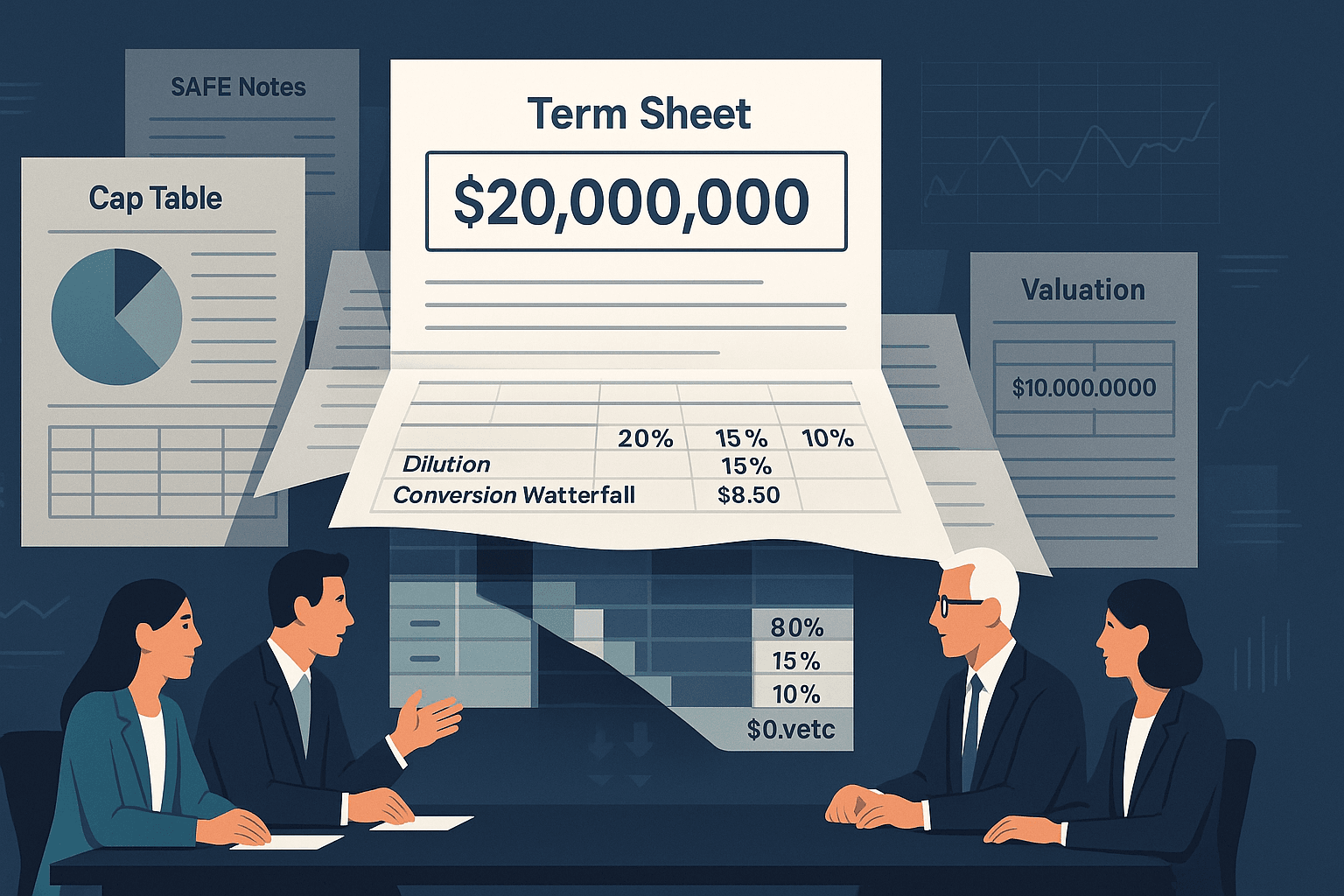
How new investors exploit legacy SAFE math to demand better economics than your headline valuation suggests, and how to model it first.
Then the markup comes back.
The lead says the round still works, but only if the option pool is increased before the financing, the MFN SAFE holders are cleaned up, the discount SAFE conversion is clarified, and the company acknowledges that the legacy SAFEs convert into a much larger chunk of the business than management’s model implied. The investor is not, technically, cutting the headline valuation. They still say “$24 million pre.” But they want ownership protections and structural adjustments that make their actual economics look more like they invested at $20 million, or worse.
This is the SAFE cap arbitrage trap.
It happens when a company accumulates multiple SAFEs across different dates, caps, discounts, and side-letter rights, then raises a priced round where the new money investor realizes the legacy instruments create multiple effective entry prices. The lead is not focused on your marketing line about valuation. The lead is focused on fully diluted ownership, conversion sequencing, and post-close economics. If the old SAFEs are about to convert at very favorable prices, the new investor will use that math to argue that they deserve better economics too.
That argument can show up as a bigger option pool, a lower price per share definition, a pre-money ownership target, a requirement to amend certain SAFEs, a tranche structure, or a flat reduction in valuation once the spreadsheet is forced into the open.
Founders often experience this as bait and switch. Investors experience it as basic arithmetic.
The uncomfortable truth is that both sides are usually reacting to the same mistake: treating the headline valuation as the economic truth when the cap table mechanics say otherwise.
The real problem: your cap table may contain several prices, not one
In a simple equity financing, people talk as if there is one price. There is a pre-money valuation, a share price, and a clean issuance to the new investor.
That is not how a company with stacked SAFEs behaves.
Once you have:
you no longer have one financing price. You have a system of interlocking prices.
Some investors are effectively buying common-equivalent ownership at a low cap set 12 or 18 months ago. Some are converting off a discount to the preferred round price. Some may receive whichever is better. Some may be excluded from the denominator used for one calculation but included for another.
When the new lead underwrites the round, they do not ask, “What valuation did we agree?”
They ask:
This is why founders can be “right” that the term sheet says $24 million pre-money and still be “wrong” about the economics of the deal.
Why current founder approaches fail
Most founders make one of four mistakes.
1. They model SAFEs as a rough dilution estimate instead of legal conversion mechanics
A founder will say something like, “The SAFEs are about 15% dilution.” That is not a model. That is a placeholder.
Actual dilution depends on:
A 15% hand-wave can become 22% in the definitive math very quickly.
2. They anchor on pre-money valuation instead of investor ownership
Sophisticated investors reverse engineer ownership. If a lead wants 16.7% post-close for a $4 million check, they care whether the denominator after all conversions and pool changes gives them 16.7%, not whether someone verbally says “$24 million pre.”
If the denominator gets larger because SAFEs convert more favorably than expected, the lead’s ownership drops. They will seek to repair that through price or structure.
3. They assume all SAFEs are founder-friendly because they were sold without board fights
SAFEs feel easy when they are issued. The negotiation is light, the docs are short, and the company avoids setting a priced round too early.
But easy issuance often means delayed complexity, not avoided complexity.
Every low cap you sold to get the round done is a future price wedge in the next financing. Every side letter you barely noticed is a future term-sheet issue. Every MFN promise is a possible renegotiation right embedded in your cap table.
4. They disclose the cap table too late or too loosely
If the lead discovers the actual conversion outcomes during diligence rather than in your first serious model, you lose credibility immediately. Worse, you give the investor leverage to say the round economics were misunderstood.
Once that happens, everything reopens.
The core insight: new money optimizes for effective price per fully diluted share, not your headline valuation
This is the central point founders miss.
A new lead investor does not care that everyone can repeat the same pre-money number in the press release. The lead cares about the effective price they are paying per share of the enterprise on the cap table that will actually exist.
If legacy SAFEs convert as though they bought into a $10 million company, while the lead is investing at a stated $24 million pre, the lead may conclude:
At that point, the lead is not attacking your valuation for sport. They are repricing risk through another mechanism.
That is SAFE cap arbitrage in practice: the lead exploits the mismatch between headline valuation and actual conversion economics to justify better terms for themselves.
A concrete example: the attractive seed round that is not actually attractive
Let’s build a realistic case.
Starting cap table before the priced round
Assume the company has:
Current fully diluted common-equivalent baseline before SAFEs: 9,000,000 shares.
Now add legacy SAFEs:
Total SAFE cash: $4,000,000.
The company now signs a seed term sheet:
The founder’s naive view is simple: “We raise $4 million into a $24 million pre, so post-money is $28 million. Investor gets 14.3%. SAFEs convert somehow. We’ll all be diluted a bit.”
That is exactly how people walk into trouble.
Step 1: legacy SAFEs create effective prices far below the round price
To simplify, assume the priced round share price before SAFE effects would imply $24 million divided by a company capitalization denominator negotiated in the financing.
But each SAFE has its own effective conversion logic.
For post-money cap SAFEs, a rough ownership intuition is easier than for old pre-money SAFEs: the investor bought the right to convert as if their money purchased a slice of the company at that cap, subject to the SAFE form mechanics.
Approximate ownership from the post-money cap SAFEs
Combined, those three SAFEs alone are economically pointing toward roughly 23.33% of the company before accounting for exact sequencing and the discount SAFE.
That should already change how you think.
The founder thought the new investor buying 14.3% at a $24 million pre was the main event. In fact, the legacy SAFE stack may be consuming substantially more ownership than the new money.
The discount SAFE problem
SAFE C converts at 80% of the preferred round price. If the new round price per share is, say, $2.40, SAFE C converts at $1.92.
If the preferred investor buys 1,666,667 shares for $4 million at $2.40 per share, the discount SAFE converts into 520,833 shares for its $1 million.
That is not as dramatic as a low cap SAFE, but it still enlarges the denominator and pushes down the new investor’s actual ownership.
Step 2: the option pool increase becomes the hidden concession vehicle
Now assume the lead says the company needs a 15% post-money unissued option pool to hire a VP Sales, Head of Product, and two senior engineers.
Currently there are 1,000,000 option shares, but perhaps most are granted, leaving only 300,000 available. The lead insists the pool be topped up before closing.
This is where economics move without “changing valuation.”
If the option pool increase is carved out of the pre-money, founders and existing holders absorb it. Depending on the SAFE documents and capitalization definitions, SAFE holders may or may not share fully in this dilution. New investors often structure the ask so the burden falls mostly on founders and common.
A round that was marketed as $24 million pre can effectively become much cheaper for the lead if they force:
This is not cosmetic. It can shift several points of ownership.
A worked cap table illustration
Let’s put rough numbers on it. Assume for illustration:
At that price:
Now approximate the post-money cap SAFEs by backing into share counts using the pre-round common baseline:
This simplified set yields:
Total post-close shares before pool top-up effects: 13,302,083
Post-close ownership:
That 11.28% should be a shock.
The founder sold the round internally as a $4 million financing at a $24 million pre. In simple no-SAFE math, the investor would expect around 14.29% post. In the actual cap table, the investor gets 11.28%.
A sophisticated lead will not accept that quietly.
What the lead does next
The lead now has three ways to respond.
Response 1: explicit valuation cut
The cleanest move is to say the round must be repriced. Instead of $24 million pre, maybe it is $19 million pre or $20 million pre so the investor gets back to the target ownership.
Founders hate this because it is visible.
Response 2: keep headline price, demand structural concessions
This is more common because it sounds friendlier while achieving similar economics.
The lead may say:
Each of these shifts economics or control without technically touching the headline valuation.
Response 3: use the SAFE stack to divide founders and insiders
If some SAFEs are especially founder-friendly to renegotiate or were issued to small angels, the lead may say:
“We are not asking you to cut valuation. We are asking you to clean up legacy paper that no institutional investor can underwrite as-is.”
This pressures founders to go back to early supporters and request cap increases, discount removals, MFN waivers, or conversion amendments. Sometimes that is appropriate. Sometimes it is simply a way for the new lead to force legacy money to bear the cost of preserving the lead’s target economics.
The term sheet comparison founders should actually run
Here are two seed term sheets that look similar in a summary email but are not remotely equivalent.
Term Sheet A: “Friendly headline”
Term Sheet B: “Lower price, cleaner mechanics”
Many founders automatically prefer Term Sheet A because the valuation is higher by $2.5 million.
That is often wrong.
If Term Sheet A forces a pool increase of, say, 1,300,000 new option shares before closing, while Term Sheet B does not, founder common may end up in a similar or worse place under A. Meanwhile the lead under A may get nearly the same effective ownership as under the lower-priced B.
The right comparison is not pre-money valuation. It is:
If you are not comparing term sheets that way, you are negotiating the wrong variable.
Sequencing is where the hidden economics live
Conversion sequencing sounds technical, which is why it is dangerous. Small drafting choices determine who gets diluted by whom.
Questions that matter:
The lead’s counsel will work these issues line by line because every denominator definition has economic consequences.
Founders often delegate this to company counsel and treat it as implementation. That is a mistake. Implementation is where price gets rewritten.
A negotiation scenario: how investors reopen economics without saying “retrade”
Imagine this exchange.
Founder: “We agreed $24 million pre. Why are we talking about ownership again?”
Lead: “Because after modeling the SAFE conversions and pool refresh, our $4 million buys only 11.5% of the business. That is below our underwriting threshold.”
Founder: “But the valuation is fixed.”
Lead: “The headline valuation is fixed. The actual dilution was not accurately represented. We’re happy to keep the headline number if the pool is handled differently and the $10 million cap SAFE holders agree to amend. Otherwise we need to adjust economics.”
That is not irrational. It is exactly how institutional investors behave when the denominator changes.
The founder’s strongest response is not outrage. It is a better model.
For example:
If you cannot produce those scenarios yourself, the investor’s spreadsheet becomes the truth by default.
When legacy SAFE investors really are getting “too good” a deal
Founders do not like hearing this, but sometimes the lead is right.
If you sold a large amount of capital on very low post-money caps, then delayed the priced round while company momentum improved, those SAFE holders may indeed be converting at economics that are disproportionately favorable relative to the new round.
Example:
That is a real economic mismatch.
Founders should stop moralizing about it and decide what objective they want:
You usually cannot maximize all five.
How founders should model this before taking any term sheet seriously
At minimum, build a financing model with these tabs:
1. Instrument inventory
For each SAFE:
2. Share count definitions
Maintain separate denominators for:
Do not collapse these into one number.
3. Scenario engine
Run at least these scenarios:
4. Ownership outputs
For each scenario, show:
5. Sensitivity table
Show how a 0.5% change in investor target ownership translates into pre-money valuation changes. This helps you negotiate with precision.
If the lead says they need 13.5% instead of 11.8%, you should know exactly whether that means a valuation move from $24 million to $21.7 million, a smaller pool top-up, or an amendment to one specific SAFE.
Practical renegotiation strategies before the lead uses the math against you
Strategy 1: clean up outlier SAFEs before the financing process
If one or two old SAFEs are driving most of the distortion, approach those holders early.
Possible amendment asks:
Most early angels will be more flexible before a lead investor makes them the obstacle.
Strategy 2: sell on post-close ownership transparency, not valuation theater
When you engage leads, provide a clean cap table model showing exact outcomes under your proposed financing assumptions.
This does two things:
If the investor wants to change economics, they must argue with disclosed math rather than reveal hidden math.
Strategy 3: negotiate pool sizing as an operating plan, not a finance abstraction
Do not accept “15% post” because it is market. Ask:
A lead asking for a 15% pool may only have a 9% operational need. The extra 6% is economics, not hiring realism.
Strategy 4: translate every ask into effective valuation impact
If the investor insists the price is unchanged but wants a larger pool, more aggressive capitalization definitions, or SAFE amendments, quantify the equivalent valuation shift.
For example:
That 3.2-point loss might be economically similar to cutting the pre-money by several million dollars. Say that explicitly.
It changes the negotiation from rhetoric to math.
Strategy 5: use selective side letters instead of global repricing where possible
If the lead truly needs a minimum ownership threshold, it may be cleaner to offer:
These are not free. But they may be less damaging than rewriting the whole financing around a denominator fight.
What investors are really signaling when they focus on SAFE math
Founders often hear this as opportunism. Sometimes it is. But usually it signals one of three things.
1. The investor has a hard ownership model
Many funds need a minimum percentage at entry to make portfolio construction work. If your SAFE stack pushes them below that threshold, they will fix it somehow or walk.
2. The investor is worried about downstream dilution
If too much of the company is already spoken for by founders, employees, and legacy SAFEs, the Series A may require another painful reset. Seed leads know this. They underwrite not just your next 12 months but your next cap table conflict.
3. The investor sees governance weakness in financial sloppiness
A messy SAFE stack suggests the company raised reactively, without a coherent financing plan. Some investors read that as a governance and planning signal, not just a math issue.
That is why transparency matters. A messy cap table is survivable. Surprise is not.
A founder checklist before signing any priced round term sheet
Before accepting a term sheet, answer these questions in writing:
If your answer to any of these is “we’ll sort it out in docs,” you are not done negotiating.
The blunt takeaway
The SAFE cap arbitrage trap exists because founders talk in valuations while investors negotiate in ownership.
If your company has multiple legacy SAFEs, you do not have a single clean round price. You have a set of embedded economic claims that may convert at dramatically different effective prices. Any serious new investor will find those differences, model them, and use them.
Sometimes they will use them to cut valuation openly. More often they will keep the attractive headline number and demand better economics somewhere less visible: option pool sizing, capitalization definitions, conversion sequencing, side-letter cleanup, or control rights.
The defense is not indignation. It is preparation.
Model every instrument precisely. Disclose the math early. Compare term sheets on founder ownership and effective price, not branding value. Renegotiate distortionary SAFEs before a lead investor weaponizes them. And treat definitive document sequencing as core economics, not legal plumbing.
Because once new money shows you that your $24 million pre actually behaves like $20 million in the cap table, the market will not care which number was in the email. The only number that matters is the ownership everyone ends up with after the conversion dust settles.
RaiseSimpli Team
Author