SAFE Side Letters: How Standard Clauses Shift Control
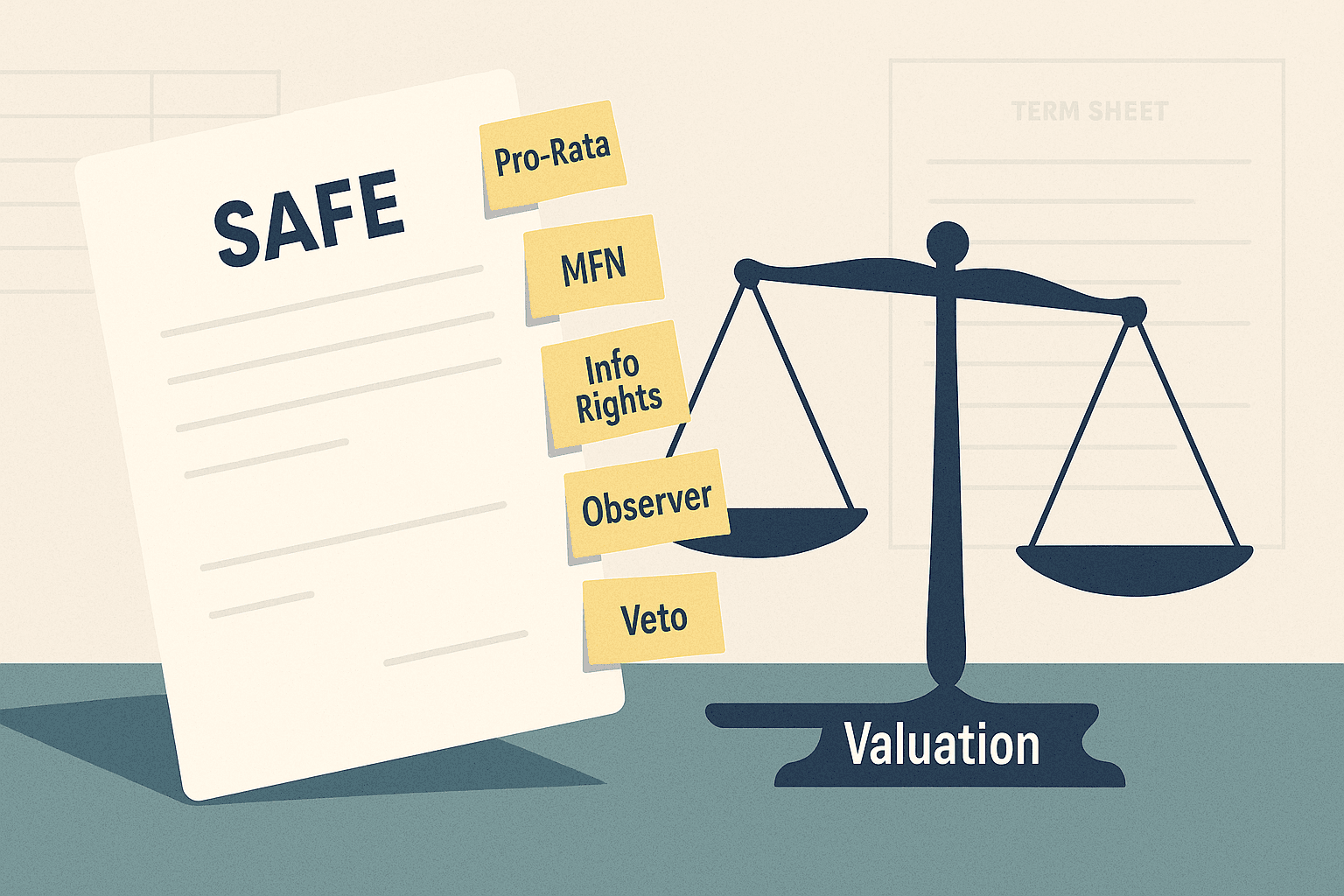
How standard-looking investor clauses in SAFE side letters can change your valuation and control, and what to negotiate before you agree.
The hidden deal inside your SAFE
SAFEs are marketed as founder-friendly, fast, and “standard.” That’s often true for the base instrument, especially the YC post-money SAFE templates, because they’re short, familiar, and mostly about economics at the next priced round.
But many SAFEs are not just the SAFE. They come with a side letter: a separate agreement that grants rights not written into the SAFE itself. Side letters frequently show up in pre-seed and seed rounds, especially when:
Side letters are where “standard” can become quietly non-standard.
A clause that sounds harmless, “pro-rata,” “MFN,” “information rights,” “board observer”, can materially change:
This article breaks down the most common SAFE side-letter clauses, how they impact economics and control, and a practical checklist for negotiating them.
> Important note: This is not legal advice. Use this to ask better questions and to recognize where a “small ask” is actually a leverage point. Always review with qualified counsel.
---
Quick refresher: what a SAFE does, and doesn’t, do
A SAFE (Simple Agreement for Future Equity) is a contract that typically converts into equity at a later priced round (or sometimes on change of control), usually with:
Notably, a SAFE generally does not grant the holder:
That absence is part of why SAFEs are fast.
So when a side letter adds any of those features, you’re effectively stapling parts of a priced-round governance package onto what is supposed to be a lightweight instrument.
Reference: Y Combinator’s SAFE templates and explanations provide the baseline market expectation for “standard” SAFE terms, especially in the US (YC SAFE documentation: https://www.ycombinator.com/documents/).
---
Why side letters are so powerful (and so easy to underestimate)
Side letters exploit three dynamics:
Founders often focus on the headline SAFE economics (cap, discount) because those are explicit.
Side-letter economics are usually implicit.
---
Term 1: Pro-rata rights, not just “allocation,” but future pricing pressure
What it is
A pro-rata right gives an investor the ability to purchase enough securities in a future equity financing to maintain their ownership percentage.
In side letters, this is typically framed as:
Sometimes it’s limited to the next priced round; sometimes it applies to multiple rounds.
Why investors ask for it
Pro-rata is rational:
How it changes your economics
Pro-rata rights don’t directly change the SAFE conversion math, but they change the supply and demand of your next round.
In a tight, high-demand Series A, allocation is scarce. You want the ability to:
If multiple early investors have pro-rata rights, you have less flexibility. That can create pricing pressure in two common ways:
How it changes your control
Pro-rata is not formally a veto, but it can behave like one:
Negotiation reality: pro-rata is not all-or-nothing
Founders can often shape pro-rata into something reasonable:
Reference: Pro-rata rights are standard in priced rounds and often discussed in venture financings. NVCA model documents show how participation rights are commonly structured in preferred stock financings (NVCA: https://nvca.org/model-legal-documents/).
---
Term 2: MFN (Most-Favored Nation), the clause that can silently rewrite your round
What it is
An MFN clause promises that if you give any later investor more favorable terms, the MFN holder can adopt those terms.
In SAFE land, MFN is sometimes:
Why investors ask for it
Investors ask for MFN when:
This is especially common when the investor believes the founder is “still price-discovering.”
How it changes your economics
MFN can create a retroactive repricing mechanism.
Example:
That can materially increase dilution at conversion.
But the bigger trap is that MFN can apply to more than cap/discount. Depending on drafting, “more favorable terms” may include:
So one “concession” to close a late investor can cascade across earlier investors.
How it changes your control
MFN changes how you negotiate with everyone later:
This can lead to a brittle fundraising process where you either:
Reasonable limitations that reduce MFN blast radius
If an investor insists on MFN, founders can narrow it:
Reference: YC’s MFN SAFE illustrates the concept and tradeoffs (YC documents: https://www.ycombinator.com/documents/).
---
Term 3: Information rights, the “small ask” that changes your operating cadence
What it is
Information rights typically require the company to provide periodic financial and business updates, and sometimes inspection rights.
Common asks include:
Why investors ask for it
Two reasons:
For engaged angels, information rights can also be a proxy for “I want to help.”
How it changes your economics
Information rights don’t change dilution directly. But they can change fundraising leverage and company trajectory, which changes economics.
Those costs matter at pre-seed.
How it changes your control
This is where information rights are underrated:
Also: information rights create leakage risk. Even well-intentioned investors talk. Some sit on multiple competitor boards. “Confidential” is not always practically confidential.
Negotiation moves that preserve sanity
Reference: NVCA documents and typical preferred stock financings include investor information rights as a standard protective feature (NVCA: https://nvca.org/model-legal-documents/). For early-stage norms, many law firms summarize standard “information rights” packages in seed/Series A.
---
Term 4: Board observer rights, governance without fiduciary duty
What it is
A board observer right allows an investor (or their representative) to attend board meetings and receive board materials, sometimes with exceptions for conflicts.
Why investors ask for it
Investors like observer rights because they:
How it changes your economics
Again, not direct dilution, but indirect effects are real:
A board with heavy observer presence tends to become more formal earlier. That can be positive (discipline) or negative (speed tax).
How it changes your control
Observer rights can be a stealth control mechanism:
Also, observers increase conflict management overhead:
Negotiation terms to consider
Reference: Board rights and observer provisions are common in preferred financings; many venture law primers discuss the typical structure and confidentiality carve-outs (NVCA model documents are a baseline: https://nvca.org/model-legal-documents/).
---
Term 5: Vetoes / protective provisions, the biggest red flag on a SAFE
What it is
“Veto” is informal; the legal form is usually a consent right: the company cannot take certain actions without investor approval.
In priced rounds, protective provisions are negotiated as part of the preferred stock terms. On a SAFE, they’re not standard, so if they show up via side letter, pay close attention.
Common veto areas:
Why investors ask for it
Some investors, especially those used to priced rounds, dislike the idea of having zero control while meaningful capital is at risk. They may argue:
Occasionally, they’re trying to prevent being crammed down or structurally subordinated.
How it changes your economics
Veto rights can change economics by changing what financings are possible.
If an investor can block:
…they can force you toward financing paths that are worse for founders/common.
Even if they never exercise the veto, the existence of the right changes bargaining dynamics in a crisis, exactly when you have the least leverage.
How it changes your control
This is the most direct control impact.
A SAFE with veto rights starts to look like preferred stock without paying for preferred stock. The investor gets governance protections early, before a priced round sets the full set of rules and fiduciary architecture.
Side-letter vetoes also create structural problems:
When (if ever) vetoes might be reasonable
There are cases where limited consent rights can be acceptable, for example:
But even then, founders should prefer that governance lives in a priced round where terms are standardized, disclosed, and integrated into one set of corporate documents.
If you must accept some consent rights, narrow them aggressively
Reference: Protective provisions are a standard component of NVCA preferred stock financings, typically requiring approval of a class or series of preferred stock (NVCA: https://nvca.org/model-legal-documents/). Their presence in SAFE side letters is a departure from the “simple” norm.
---
The second-order effects founders miss
Side letters don’t just add isolated rights; they create system effects.
1) Side letters complicate your next lead’s diligence
A good Series A lead will ask:
If the answer is “yes, lots,” they will worry about:
This can slow down or even kill a deal.
2) They create fairness and signaling problems
If Investor A has pro-rata and Investor B doesn’t, you may have to explain why. That can:
3) They increase administrative overhead permanently
Someone has to track:
At 10–20 SAFE holders, “small” differences become operational debt.
---
Multiple perspectives: founders vs. investors (and when each is right)
The investor-friendly case for side letters
Side letters can be a pragmatic compromise:
In this framing, side letters are customization without rewriting the base document.
The founder-friendly critique
The problem is not customization; it’s asymmetry.
In a priced round:
In SAFE rounds with side letters:
That last point matters: if an investor wants priced-round-like rights, founders should consider whether they should be paying priced-round-like terms (or leading a round) rather than attaching governance to an uncapped or lightly capped SAFE.
---
A founder’s negotiation checklist (practical and slightly opinionated)
Use this before signing any SAFE side letter.
Step 1: Inventory and classify every requested right
Create a table with columns:
If you can’t summarize a clause in one sentence, it’s too vague.
Step 2: Ask “Does this right change my future financing leverage?”
A useful heuristic:
If it changes leverage, price it or narrow it.
Step 3: Put hard limits on pro-rata
Recommended defaults (adjust to your round):
Step 4: Treat MFN like a loaded weapon
If MFN is unavoidable:
Also: be careful about granting MFN to many investors. One MFN is manageable; ten is a governance-by-accident system.
Step 5: Standardize information rights via a single investor update policy
Decide what you can commit to operationally:
Then bake that into all side letters (or none). Avoid bespoke reporting.
Step 6: Board observer rights should be rare at pre-seed
If you’re pre-seed and don’t yet have a functioning board cadence, observer rights can force premature formalization.
If you grant them:
Step 7: Avoid vetoes on SAFEs whenever possible
If an investor asks for veto rights on a SAFE, respond with one of these moves:
Your goal: prevent a future situation where one early check can block survival financing.
Step 8: Watch transferability and affiliate definitions
Side-letter rights should not be freely transferable to unknown parties.
Step 9: Ensure consistency with your charter and future documents
Side-letter promises can conflict with:
Your counsel should confirm there’s no latent conflict.
Step 10: Model the cap table impact of likely scenarios
Do simple scenario modeling:
Then ask:
Even rough modeling clarifies what you’re actually signing.
---
What to do if you already signed side letters
If you’ve already granted side-letter rights, you still have options.
---
A concrete “red/yellow/green” rubric
Green (usually fine)
Yellow (often okay but needs careful drafting)
Red (avoid unless you are effectively doing a priced round)
---
Closing view: “Standard” is not a synonym for “safe”
The core SAFE is often straightforward. The side letter is where complexity and leverage creep in.
The founder mistake is not agreeing to any investor rights, it’s agreeing to rights that:
The investor mistake is also common: treating side-letter asks as low-cost because they don’t change the cap. In practice, governance and allocation rights are often more valuable than a small movement in valuation cap.
If you adopt one rule:
> If a side-letter term would be “major” in a priced round, it is major on a SAFE too, except now it’s harder to see and harder to unwind.
---
References (starting points)
(Additional jurisdiction-specific treatment of fiduciary duties, observer rights, and enforceability of side letters varies; consult counsel for your specific situation.)
RaiseSimpli Team
Author