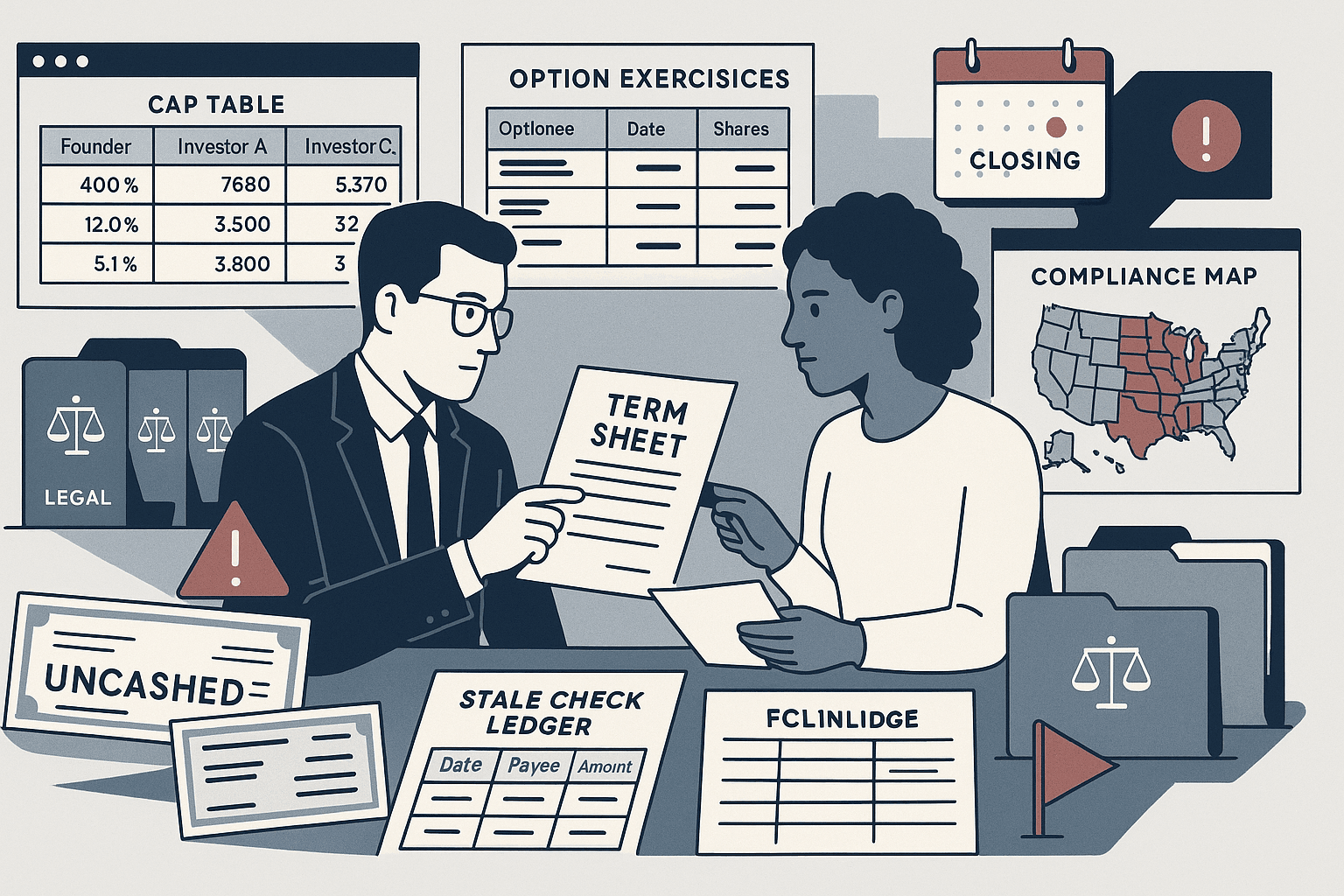
How unclaimed founder and employee equity liabilities can derail Series A diligence, and what escheatment cleanup to do before you raise.
Then diligence counsel asks a question almost nobody treats as a financing issue until it becomes one: show us all outstanding equity-related payment obligations, including repurchase proceeds, option exercise funds held but not timely processed, final-pay settlements connected to equity withholding or net exercises, and any unclaimed-property analyses by state.
That is the moment a surprising number of otherwise fundable companies discover a hidden discount already embedded in their round. Not a formal line item on the term sheet. Not a banker-style quality-of-earnings adjustment. A quieter, more corrosive thing: legal cleanup cost, time delay, indemnity friction, and investor skepticism translated into pricing pressure and closing conditions.
Call it the “Series A escheatment discount.”
It is not really about escheatment in the abstract. It is about whether your company has unresolved liabilities tied to founder and employee equity that can survive payroll cycles, survive departures, survive stock plan administration changes, and then reappear during financing diligence as evidence that the company’s internal controls are weaker than management claims. That matters because Series A investors are not just buying growth. They are buying the reliability of the cap table, the enforceability of equity issuances, and the absence of ugly legal surprises that can force post-close cleanup.
Most founders have a rough mental model of unclaimed property law as a “big company problem.” Dormant gift cards. Vendor checks. Old payroll. Delaware audit horror stories. What they miss is that startup equity administration creates its own unclaimed-property surface area. It is messy, decentralized, and highly sensitive to personnel turnover.
The recurring trouble spots are boring enough to be ignored and dangerous enough to matter:
Any one item may be small. The pattern is what kills confidence. A $1,842 uncashed repurchase check is not about the money. It is about what the missed check implies: Did the company track departures correctly? Was the repurchase valid under the stock restriction agreement? Did the board approve it? Was the share count updated? Was tax treatment correct? If the payee’s last known address was in California, New York, or Texas, was the item reportable under that state’s unclaimed property regime? If the company is Delaware-incorporated and has no complete address records, does Delaware become the fallback state for escheatment purposes?
That chain of questions is why this issue escapes the neat silo of “admin.” It becomes a financing issue because it bleeds directly into three investor concerns: cap table integrity, legal compliance, and management credibility.
The problem is not the absolute liability. It is the conversion of sloppy equity administration into financing leverage.
Series A diligence is designed to test whether a startup that has been operating informally can now withstand institutional scrutiny. Equity is the obvious pressure point because errors there are nonlinear. A bookkeeping mistake in software subscriptions is annoying. A bookkeeping mistake tied to founder shares, options, repurchases, or securities law compliance can call ownership records into question.
Unclaimed-property exposure turns small administrative misses into broader diligence problems for four reasons.
1. It suggests the company may not know what it owes, to whom, and in what state.
Investors do not need the liability to be large to care. They need enough evidence that liability identification is incomplete. Once diligence counsel sees one uncashed repurchase check or one unresolved exercise wire, they stop assuming the issue is isolated.
Then the request list expands:
A two-hour cleanup becomes a two-week diligence thread because nobody has a single owner for the data.
2. It creates uncertainty around whether the cap table was updated correctly.
If the company purported to repurchase 100,000 unvested shares from a departed employee at the lower of cost or fair market value, but the repurchase check was never cashed and no follow-up occurred, what exactly happened?
There are at least four possibilities:
That ambiguity is poison in a financing where lead investors need comfort on outstanding shares, option pool sizing, and fully diluted ownership.
3. It raises the specter of state enforcement and historical lookback.
Most startups have never done a formal unclaimed-property review. That does not mean they have no exposure. It means they have no documented position. For investors, lack of a position is itself a risk.
Unclaimed property rules vary by state and property type, but the pattern is familiar: after a dormancy period, property owed to an owner may need to be reported and remitted to the relevant state, typically based first on the owner’s last known address and second on the company’s state of incorporation if address data is missing or the owner’s state does not escheat that property type.
For venture-backed startups, Delaware incorporation often matters because Delaware is aggressive, sophisticated, and a common fallback jurisdiction when records are incomplete. Investors and their counsel know this. They also know that poor historical records can make a state estimate liability using extrapolation methods in an audit context. You do not need to be under audit for that dynamic to affect diligence. The mere possibility changes the legal risk discussion.
4. It signals weak internal controls right before investors are wiring institutional money.
A company asking for $12 million in primary capital while being unable to explain a backlog of unresolved equity-related liabilities is making the wrong impression. The lead is not just underwriting the business model. It is underwriting whether the finance and legal functions can handle board governance, 409A processes, investor rights, and future M&A diligence.
In practice, that means the same issue can appear in two places at once:
That is the real “discount.”
Why current founder approaches fail
Most founders do not ignore this risk because they are reckless. They ignore it because the default startup operating model practically guarantees blind spots.
“Our law firm handled equity.”
No, it probably handled the documents. That is not the same thing as owning the lifecycle of payment obligations arising from those documents.
Outside counsel drafts the restricted stock purchase agreement, the exercise forms, the stock plan, and perhaps the repurchase notices. But who confirms a repurchase check was delivered, remained valid, was reissued if stale, and was tracked for unclaimed-property purposes three years later? Usually nobody. Or a controller who joined after the event. Or an HR generalist without securities context.
“Our cap table software should have this.”
Cap table systems are useful, but they are not magical. Many companies run the legal record in one system, payroll in another, accounts payable in another, banking outside both, and old founder-era records in email PDFs. If your Carta ledger says shares were repurchased, but the bank never cleared the check, you do not have a solved problem. You have a software entry and a legal question.
“The amounts are too small to matter.”
This is the most common and most expensive mistake. Small liabilities become material when they indicate process failure.
Imagine a company with these unresolved items:
Aggregate exposure: $70,000.
No Series A lead cares about $70,000 in isolation on a $10 million round. But if that $70,000 reveals poor records across four years of equity events, legal cleanup can cost more than the liability itself. Counsel may spend $25,000 to $60,000 sorting the issue. Closing may slip 2 to 4 weeks. Founders may spend precious negotiation capital on indemnity or special conditions instead of board composition or option pool treatment.
“We’ll fix it after the financing.”
Investors hate open-ended promises on cap table and compliance issues. A customer contract can often be papered post-close. Equity ownership defects cannot always be. If there is uncertainty around who owns what, who was owed what, or whether historical state obligations were triggered, the lead investor will want at least a bounded cleanup plan before wiring funds.
That usually means one of three bad outcomes:
The core insight: escheatment exposure is rarely priced directly, but it is routinely priced indirectly.
Founders often ask the wrong question: “How much is the escheatment liability?”
The more relevant question is: “How will investors convert uncertainty about equity-related liabilities into round economics and terms?”
That conversion usually happens through four mechanisms.
Mechanism 1: legal cleanup demands
The cleanest investor response is to force the company to fix the issue before close. That can include:
This sounds manageable until you map the founder hours. A CFO or controller may lose 30 to 60 hours. The CEO gets dragged into founder stock history. Counsel runs point on states, repurchase mechanics, and backup documentation. Recruiting and fundraising momentum suffer.
If your financing is competitive, investors may tolerate that. If your process is soft, they may use it as evidence that your internal systems are not ready for premium pricing.
Mechanism 2: timing delays that weaken leverage
Diligence delays are not neutral. Time affects fundraising leverage.
Suppose the company enters a Series A process with 7 months of runway and two interested leads. Management expects to sign a term sheet in week 3 and close in week 7. During diligence, one lead identifies unresolved equity liabilities and demands a cleanup workstream. Closing slips by 4 weeks.
Now runway is effectively 6 months by signing and 5 months by close. The second lead, seeing delay and legal noise, drifts. Existing investors become more influential because they are the backstop. The original lead becomes less price-sensitive in the founder’s favor.
Nothing about the escheatment issue changed the company’s ARR. It changed the company’s negotiating posture.
That is how administrative defects become valuation defects.
Mechanism 3: indemnity friction and disclosure schedule pain
In priced financings, investors usually get reps and warranties around capitalization, authority, compliance, and litigation. If diligence uncovers unresolved unclaimed-property risk, counsel may push for:
Founders often underestimate how much this matters psychologically. A broad “we may have some stale checks” disclosure sounds harmless. To investor counsel, it is an invitation to ask what else is missing. To the lead partner, it is a reason to be less flexible on other asks.
Mechanism 4: valuation pressure hidden in ordinary term sheet debates
Nobody writes “escheatment discount: -$2 million pre” on the term sheet. Instead, the discount shows up in more familiar fights:
In other words, the issue rarely gets priced as a legal reserve. It gets priced as skepticism.
A realistic Series A scenario with numbers
Take a SaaS startup raising a $12 million Series A.
Pre-round cap table
Assume the company has:
Fully diluted pre-money shares before any pool top-up: 10,500,000.
Lead investor initially offers:
Post-money fully diluted shares: 14,700,000.
Investor ownership post-close: 4.2 million / 14.7 million = 28.6%.
So far, standard.
Diligence issue discovered
Investor counsel finds:
Aggregate known cash exposure: $120,950.
Again: the absolute number is trivial relative to the round. But legal uncertainty is not.
Company counsel estimates:
How the lead investor reacts
The lead does not usually say, “We need a $120,950 reserve.” Instead it reframes the conversation:
That sounds like a standard market adjustment. It is not. It is a disguised diligence discount.
Valuation impact math
At $28 million pre with the same 10.5 million pre-money share count:
Compare to the original offer:
That 1.4 percentage-point swing is meaningful.
At the founder level, if founders owned 6,000,000 / 10,500,000 = 57.14% pre-round, then:
That is an 82 basis point drop in founder ownership from a diligence issue that had only about $121,000 of visible cash exposure.
At the implied economic level, a $2 million lower pre-money valuation is more than 16x the identified liability.
That is the series A escheatment discount in action.
How option pool top-ups amplify the damage
The cleaner way investors extract protection is often through the option pool rather than an explicit valuation cut.
Suppose instead of moving the pre-money down, the lead insists on increasing the unissued option pool from 1,000,000 shares to 1,800,000 shares pre-close, arguing that the company needs to hire a controller, senior people ops, and legal/compliance support because internal processes are immature.
That adds 800,000 shares to the pre-money denominator.
Revised fully diluted pre-money shares: 11,300,000.
If the headline pre-money stays at $30 million:
The investor can say, truthfully, that ownership is “basically the same.” But founders absorb the extra dilution from the pool increase.
Founder post-close ownership becomes:
Versus 40.82% in the original clean deal.
That is almost 2.9 percentage points of founder dilution created not by business underperformance, but by a diligence narrative that the company needs more operational infrastructure because prior controls were weak.
If you are a founder, that is the key lesson: process defects do not only hit you through explicit price cuts. They hit you through denominator engineering.
Term sheet comparison: clean company vs. escheatment-friction company
Here is what this can look like in practice.
Term Sheet A: clean diligence
Term Sheet B: escheatment-friction company
The differences seem incremental. They are not.
Assume pre-money share count was originally 10.5 million and pool top-up adds 500,000 shares to 11.0 million.
At $28.5 million pre:
Founder post-close ownership:
Compare that with 40.82% in the clean deal. The difference is 2.44 percentage points. For a company that may later exit for $500 million, that dilution difference is worth roughly $12.2 million to founders in aggregate. And it started with a legal-compliance issue whose direct liability may have been well under $200,000.
This is why sophisticated founders should stop treating escheatment and unclaimed equity liabilities as back-office trivia.
The negotiation scenario founders misplay
When investors raise this issue, many founders default to one of two bad responses.
Bad response 1: minimizing the issue
“The total exposure is tiny. This is immaterial.”
That argument fails because investor counsel is not focused on materiality in the GAAP sense. They are focused on uncertainty, records, and precedent. If you sound dismissive, you worsen the credibility problem.
Bad response 2: conceding broad indemnity too quickly
Founders sometimes offer a sweeping indemnity to make the issue go away. That is usually unnecessary and can create future pain, especially if the definition of covered losses is vague or if the issue ties back to founder stock history.
A better negotiation posture is:
Investors price uncertainty aggressively. They price bounded problems much more rationally.
What a proper equity-liability audit looks like before the round
Founders should run this audit 60 to 90 days before launching a Series A process, ideally led by finance with outside counsel oversight.
The goal is not perfection. The goal is to convert ambiguous risk into a documented, controlled narrative.
Step 1: build the equity cash-obligation ledger
Create a master schedule of every cash obligation related to equity or equity-adjacent employment settlements since formation or at least since the earliest practical record date. Include:
For each item, capture:
This alone surfaces most of the problem.
Step 2: reconcile legal records to banking and payroll records
Do not trust any single source.
Match:
Your aim is to answer the question investors will ask: for each equity event, did legal intent, accounting treatment, and cash movement actually line up?
Step 3: classify issues into three buckets
Bucket A: resolved and documented. No action needed beyond organization.
Bucket B: known liability with straightforward remediation. For example, reissue a stale repurchase payment, obtain updated address, document owner outreach, and evaluate reporting timing.
Bucket C: legal ambiguity affecting ownership or state compliance. These are the items that need counsel attention before the room opens.
Founders should want the number of Bucket C items to be close to zero before circulating diligence.
Step 4: prepare a state-exposure memo
You do not need a 100-page treatise. You need a concise memo that answers:
This memo changes the dynamic in diligence. Instead of counsel discovering you have no view, you show up with a view.
Step 5: fix address records now
Incomplete address records are gasoline on a Delaware problem. If you can validate former employee and service-provider addresses, do it before diligence. Better owner-location data can materially improve your analysis and limit fallback assumptions.
Step 6: ratify and paper over gray areas
Where historical approvals, notices, or settlement mechanics were sloppy but economically uncontroversial, work with counsel on ratifications or confirmatory documents now. The purpose is not cosmetic. It is to reduce the chance that a tiny unpaid amount becomes an ownership dispute.
A practical remediation example
Assume your audit finds the following:
Total known exposure: $67,100.
Without preparation, investor counsel may assume the unknown exposure is much larger than the known exposure.
With preparation, you can present:
Now the issue is no longer “the company has cap table/compliance sloppiness.” It is “the company found and managed a finite administrative issue.”
That distinction is worth real money.
How founders should answer the diligence question
If asked about unclaimed property or unresolved equity liabilities, the wrong answer is “not applicable.” The better answer is short and controlled:
“We conducted an equity-liability audit covering repurchase proceeds, exercise funds, payroll-linked equity settlements, and other equity-related cash obligations. We identified specific legacy items, quantified them, reconciled the stock ledger and banking records, and prepared a remediation plan with counsel. The amounts are not material to the financing, and we do not believe any item creates a cap table ownership defect. We have included the schedule, board actions, and legal analysis in the data room.”
That is how adults talk in diligence.
What investors are really testing
A contrarian point: the best investors are not using this issue to play gotcha. They are testing whether management can identify and contain non-obvious legal-financial risk.
Series A is the transition from improvisation to institution-building. If your company cannot explain what happened to stale repurchase checks, former employee equity settlements, or rejected exercise funds, investors infer you may also be weak on other invisible control points:
That inference may be unfair in a narrow sense. It is still how financing markets work.
The founder takeaway
The “Series A escheatment discount” is not a formal accounting reserve. It is the accumulated price of being forced to negotiate from a position of uncertainty when investors discover unresolved equity-linked liabilities.
The direct dollars are usually not the main problem. The main problem is the story those dollars tell.
If stale option exercises, uncashed repurchase checks, forgotten final-pay equity settlements, or missing address records exist in your company, do not wait for lead counsel to discover them in diligence. Run the audit first. Quantify the issue. Reconcile the records. Fix what can be fixed. Paper what needs papering. Prepare the legal memo.
A founder who walks into Series A with a controlled explanation may still deal with cleanup. A founder who walks in surprised will almost certainly pay for that surprise through time, terms, or valuation.
And in venture, the quiet discounts are often the most expensive ones.
RaiseSimpli Team
Author