Shadow PMPM: AI Revenue Quality and Your VC Round
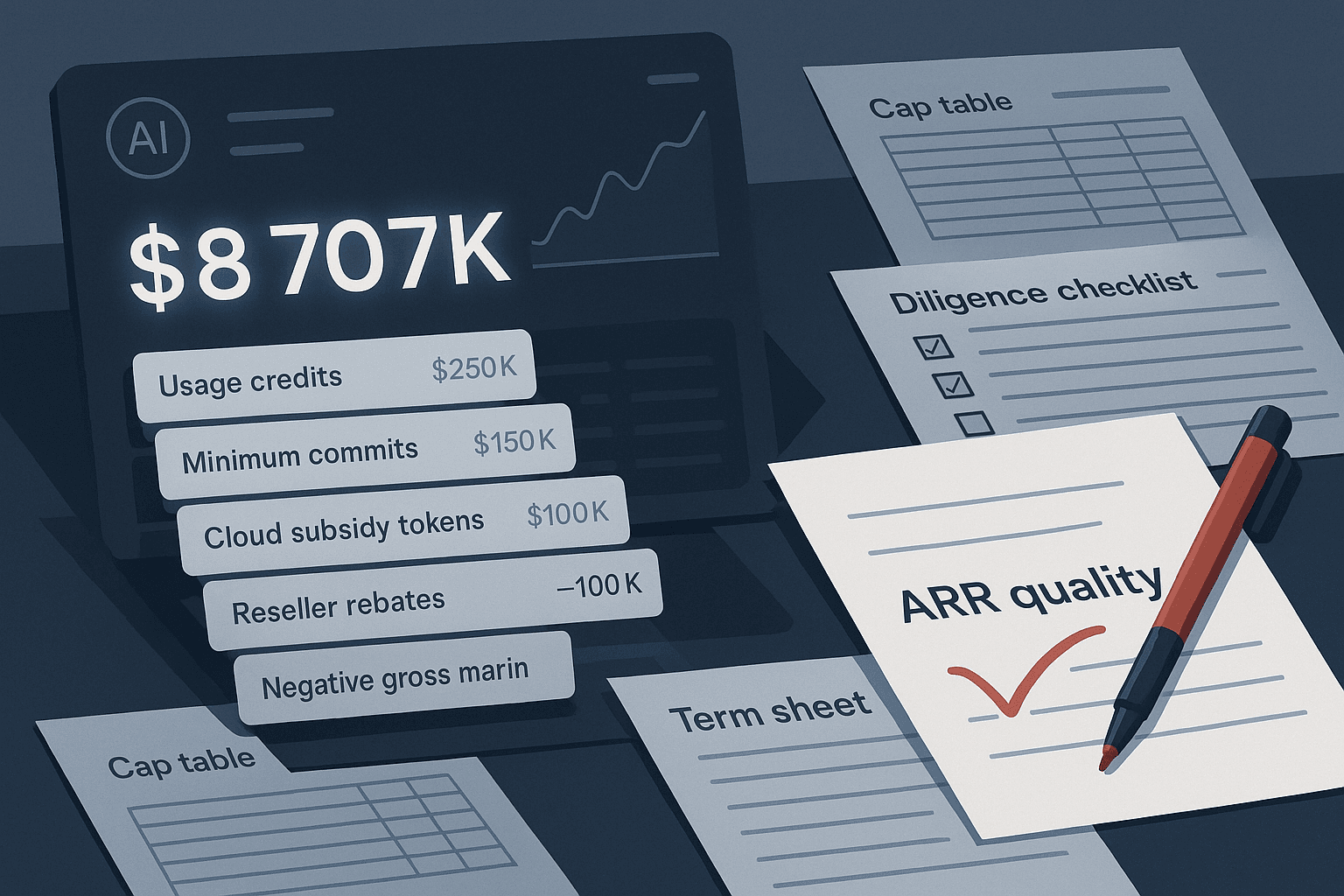
How usage credits, minimum commits, and co-sell subsidies can inflate AI revenue quality, and how VCs test it before pricing your round.
ARR has climbed from $400,000 to $3.2 million in 14 months. Net dollar retention appears above 140%. Logos are recognizable. Pipeline is deep. The deck shows strong expansion within customers as usage scales. Management frames pricing as a smart hybrid model: platform fee plus consumption. Investors lean in.
Then diligence starts.
One customer’s expansion was mostly a one-time minimum commit tied to a budget cycle that is unlikely to reset at the same level. Another account’s usage looked healthy only because the startup effectively subsidized inference through cloud credits and waived overages during implementation. A channel-driven deal booked at full contract value relied on reseller marketing development funds and co-sell rebates that masked the true customer willingness to pay. Several customers signed six-figure annual contracts, but actual product pull was far lower than the booked run rate. Gross margin looked acceptable in the board deck only because credits sat below the line economically, not because the model was truly efficient.
By the second partner meeting, the debate is no longer whether the company is growing. It is whether the revenue is real.
That is the trap.
In healthcare SaaS, investors used to worry about “shadow PMPM” economics: nominal per-member-per-month revenue looked solid, but actual collected and durable revenue was lower once implementation concessions, services dependence, incentive offsets, and payer behavior were understood. In AI, the same pattern is emerging under a different set of disguises. The surface metric is ARR. The hidden issue is revenue quality.
For many AI startups, reported ARR is being quietly inflated by four forces:
None of these are inherently fraudulent. Some are good commercial tactics. Many are rational in the early market-building phase. But if you are heading into a VC round, especially in a market where investors have become deeply skeptical of AI infrastructure economics, these items are not neutral. They are valuation-sensitive adjustments.
And here is the uncomfortable truth: revenue-quality adjustments often hurt valuation more than slower growth.
A company growing 80% with clean, durable, high-margin revenue can command a better outcome than a company growing 130% on revenue that investors believe will unwind, reprice, or compress at renewal. Growth gets attention. Revenue quality sets the multiple.
The problem: headline ARR is becoming a weak proxy for economic truth
Traditional SaaS investors built pattern recognition around a relatively simple premise: subscription ARR was a decent shorthand for future revenue, with some variation driven by churn, expansion, and margin profile. AI breaks that shortcut.
Why? Because AI pricing often mixes subscription, minimum commitments, usage, implementation periods, model costs, cloud credits, and strategic distribution incentives into one contract. The booked annualized number may look neat. The underlying economics usually are not.
A standard AI customer arrangement might include:
Management annualizes this into $420,000 of ARR and tells a credible-sounding expansion story.
A good investor asks a different set of questions:
Those questions frequently produce a second metric behind ARR: diligence-adjusted ARR.
VCs may not always formalize it with that exact label, but they absolutely do the math.
Why current approaches fail
Most founders know investors care about quality of revenue. The problem is that they still present AI revenue using software-era heuristics that obscure the risk.
Failure mode 1: Treating all contracted ARR as economically equal
A $500,000 annual contract with demonstrated monthly usage, healthy gross margin, and multi-team workflow dependency is not the same as a $500,000 annual contract driven by an end-of-year innovation budget plus a minimum commit no one has yet consumed.
In the deck, they often appear identical.
They should not.
Contracted ARR matters. But in AI, contracted ARR without usage normalization is often just a legally documented hypothesis.
Failure mode 2: Ignoring the subsidy stack
AI startups frequently benefit from a hidden subsidy stack:
Again, none of this is illegitimate. The mistake is presenting the resulting revenue as if it emerged from unsubsidized market demand at steady-state unit economics.
A startup with 68% “gross margin” while consuming significant cloud credits may actually have a normalized gross margin of 42%. That difference does not merely affect operational planning. It changes how an investor thinks about future burn, pricing power, and defensibility.
Failure mode 3: Confusing onboarding usage with durable usage
Early customer ramps often produce noisy behavior. Teams try many use cases, test prompts aggressively, and let business units experiment under a broad budget umbrella. This can create a flattering 60- or 90-day run rate that does not reflect embedded workflow value.
Founders annualize that run rate.
Investors discount it because they have seen this movie before: experimentation looks like expansion until the customer finance team asks what actually shipped into production.
Failure mode 4: Hiding margin problems inside “strategic pricing”
There is a difference between intentionally underpricing to win a category and failing to understand serving cost under real usage patterns.
If your gross margin depends on future model cost declines, architecture improvements you have not yet implemented, or vendor pricing concessions that are not contractually secured, then your current revenue is lower quality than you think.
VCs are not just buying revenue. They are buying the belief that revenue compounds.
Revenue that becomes less profitable as usage scales is not compounding. It is accumulating liability.
The core insight: investors recast AI ARR into durable, unsubsidized, normalized revenue
The single biggest misunderstanding founders have is thinking diligence is about verifying booked revenue. It is not. It is about recasting booked revenue into a forward-looking quality-adjusted base from which valuation can be anchored.
In other words, investors ask: What portion of current ARR would still exist, at acceptable gross margin, after temporary supports disappear?
That is the “real ARR” discussion, even if no one uses that phrase out loud.
The recast usually happens across three dimensions:
1. Revenue durability adjustment
This haircut applies to revenue supported by:
2. Margin normalization adjustment
This recasts gross margin by removing:
n- Temporary vendor discounts
3. Valuation multiple adjustment
Even if headline ARR remains intact, weak quality can compress the revenue multiple. Investors may still finance the company, but they pay for it as if a chunk of revenue is non-recurring, low-margin, or likely to be repriced.
This is why quality issues can hurt more than growth slowdowns.
A company at $5 million ARR growing 120% might expect, say, a 12x forward multiple in a favorable market if revenue is clean. If diligence suggests only $3.5 million of ARR is durable and normalized gross margin is 45% instead of the presented 68%, the investor may shift to valuing the business at 6x–8x on adjusted revenue. The enterprise value impact is brutal.
A practical framework for finding shadow PMPM in AI revenue
Founders should stop defending headline ARR as if every dollar deserves equal treatment. Build your own recast before investors do it for you.
Use a four-bucket framework.
Bucket 1: Credit-adjusted net revenue
Start with GAAP or management revenue, then isolate any economic support that made that revenue look better than it really is.
Examples include:
This bucket answers: What did the customer truly pay, and what did it truly cost us, absent temporary support?
Bucket 2: Minimum-commit realism
For each customer with a minimum commit, compare:
This bucket answers: How much of booked ARR reflects real workflow dependence versus anticipated future adoption?
Bucket 3: Subsidy dependence
Map all third-party commercial support associated with deals:
This bucket answers: Would the contract have closed at this value without someone else helping finance demand or delivery?
Bucket 4: Margin truth
Normalize serving costs under realistic usage and no temporary vendor relief.
This means modeling:
This bucket answers: If the customer actually gets value and scales usage, do unit economics improve or deteriorate?
Example 1: how $4.8 million of ARR becomes $2.9 million of diligence-adjusted ARR
Assume an AI workflow startup presents the following:
At first glance, that is premium.
Now break the revenue down.
Reported customer base
| Customer group | Customers | Booked ARR |
|---|---:|---:|
| Enterprise production deployments | 4 | $1.6M |
| Large annual minimum commits, partial usage | 3 | $1.5M |
| Channel/co-sell assisted deals | 3 | $1.1M |
| Pilot-expanded accounts with launch subsidies | 2 | $0.6M |
| Total | 12 | $4.8M |
Now adjust.
Step 1: minimum-commit realism
The three large commit customers each signed roughly $500,000 annual deals. Actual last-90-day usage implies annualized consumption of only $260,000, $310,000, and $350,000 respectively. One account appears likely to grow into the commit. Two do not.
A reasonable diligence adjustment may be:
Adjusted ARR impact: -$375,000
Step 2: co-sell and reseller subsidy adjustment
The $1.1 million in channel/co-sell ARR includes:
Investors do not usually remove all of this ARR. They do, however, question durability and willingness to pay. A practical recast might haircut 25% of this bucket until renewal evidence exists.
Adjusted ARR impact: -$275,000
Step 3: pilot-launch subsidy adjustment
Two accounts worth $600,000 total include waived overages and discounted usage during the first six months. Presented ARR assumes post-launch price realization that has not yet occurred. Actual customer behavior suggests one account will convert cleanly and the other may settle 40% lower.
Adjusted ARR impact: -$180,000
Step 4: annualization normalization
Across the base, management has annualized a few late-quarter usage spikes from new feature releases. Investors may trim another $120,000 from normalized run rate.
Now adjusted ARR becomes:
But investors may go one step further.
If they conclude that only production-deep, unsubsidized, margin-sound revenue deserves a premium multiple, they may classify just $2.9M–$3.2M as true “core ARR” and treat the remainder as transitional.
That distinction may never appear in the term sheet language. It will absolutely appear in the price.
Example 2: gross margin normalization can be more damaging than ARR haircut
Suppose the company above claims 64% gross margin.
Here is the presented COGS profile on $4.8M revenue:
Looks investable.
Now normalize.
Hidden issue 1: cloud credits masked infrastructure cost
The company used $420,000 of hyperscaler credits during the trailing twelve months. Management treated the resulting lower cash spend as a real margin benefit. Investors treat it as temporary support.
Normalized COGS impact: +$420,000
Hidden issue 2: underpriced enterprise usage
Two large customers are generating inference-heavy workloads at prices set before model costs stabilized. If priced to maintain target contribution margin, each would require ~18% higher effective rates, or the company would absorb another $260,000 annual COGS burden under current usage.
Normalized COGS impact: +$260,000
Hidden issue 3: support burden underallocated
A solutions architect team spent heavy time on prompt tuning, integration debugging, and evaluation setup, but only a fraction sits in COGS. An additional $180,000 should be treated as direct cost for current deployments.
Normalized COGS impact: +$180,000
Normalized COGS becomes:
Normalized gross profit on the same $4.8M revenue is now $2.212M, or 46.1% gross margin.
That is not a cosmetic change. It reclassifies the company.
At 64% gross margin, investors may believe software leverage is emerging.
At 46%, they worry the startup is effectively a services-and-compute wrapper around expensive model calls with fragile pricing power.
That perception change can cut multiple more than the ARR haircut itself.
Example 3: renewal evidence matters more than logo count
Imagine two AI companies each showing $6M ARR.
Company Alpha
Company Beta
Which gets the better Series A valuation?
In a more speculative market, Beta might have won easily.
In a disciplined market, many serious investors prefer Alpha.
Why? Because Alpha’s revenue base is proving it survives contact with renewals. Beta’s growth may be partially a front-loaded monetization artifact.
This is the central point founders miss: the market pays more for evidence that current ARR is the floor than for arguments that current ARR is the ceiling.
How VCs translate revenue-quality risk into term sheet math
Founders often assume diligence concerns result in a pass. More commonly, they result in a lower price, stricter structure, or both.
Here is how that can play out.
Scenario A: clean story, premium pricing
Scenario B: same growth, weaker quality
Same headline ARR. Same top-line growth. Roughly half the valuation.
That is why revenue quality is not an accounting footnote. It is the fulcrum.
Cap table impact: why a revenue-quality haircut compounds founder dilution
Let’s put real numbers on this.
Assume a startup wants to raise $12M.
Case 1: founders price off the story they tell themselves
If the existing fully diluted cap table before the round is:
After the round, roughly:
Case 2: investors reprice after revenue-quality diligence
Post-round ownership becomes approximately:
Now layer in a likely Series A option pool refresh. Suppose investors require the ESOP to be brought back to 15% post-money and the increase comes effectively from pre-money holders.
That pushes founder ownership down further. The founder group can easily move from expecting roughly 50% post-round ownership to landing near 39%–41% depending on the mechanics.
This is the hidden danger. Revenue-quality haircuts do not just sting emotionally. They permanently alter control, future dilution resilience, and negotiating power in later rounds.
Negotiation scenario: the term sheet you receive is not the story you pitched
A common founder mistake is treating revenue-quality pushback as a debate about fairness. It is not. It is a pricing framework conflict.
Consider this simplified negotiation.
Founder position
Investor position
Likely investor offer
Founders usually respond in one of three ways:
Only the third works.
What founders should present before investors apply the haircut themselves
If you run an AI company with any mix of credits, minimum commits, subsidized channels, or usage pricing complexity, your board deck and fundraising materials should include a parallel set of quality metrics.
Do not wait to be asked.
1. Credit-adjusted net revenue
Show a table that reconciles:
The message is simple: we know the difference between reported traction and durable monetization.
2. Commit coverage ratio
For each material account with a minimum commit, present:
Then summarize a portfolio metric such as:
Usage coverage ratio = annualized trailing 180-day usage / contracted minimum ARR
If your top 10 customers have 0.92x coverage, that tells a very different story from 0.41x coverage.
3. Subsidy exposure percentage
Calculate:
Subsidy-exposed ARR / total ARR
Where subsidy-exposed ARR includes contracts materially influenced by co-sell rebates, marketplace incentives, partner-funded implementation, or temporary internal pricing support.
The number does not need to be zero. It needs to be understood and shrinking.
4. Normalized gross margin bridge
Show investors a bridge from reported to normalized gross margin:
Then, critically, show the operational plan to move from 44% to 60%+ with identifiable levers:
If you cannot articulate the bridge, investors will assume margin recovery is aspirational.
5. Renewal cohort evidence
Nothing beats proof.
Segment ARR into:
Then show logo retention, dollar retention, and normalized margin by cohort. If post-renewal cohorts have better usage coverage and margin, that is gold. It demonstrates the business gets healthier with age rather than weaker.
A founder-friendly way to frame the narrative
The best founders do not pretend subsidies and minimum commits do not exist. They explain where they were strategically useful and why the business is de-risking beyond them.
A strong narrative sounds like this:
That is an investable posture.
The opposite posture, insisting all ARR is equally high quality because it is “under contract”, is how founders get repriced.
Term sheet comparison: same company, two diligence outcomes
Here is a simplified comparison.
| Item | Scenario 1: Founder-controlled narrative | Scenario 2: Investor-discovered issues |
|---|---:|---:|
| Headline ARR | $5.5M | $5.5M |
| Management-adjusted ARR disclosed upfront | $4.6M | Not disclosed |
| Investor-adjusted ARR | $4.5M | $3.7M |
| Normalized gross margin | 58% | 45% |
| Pre-money valuation | $36M | $24M |
| Raise amount | $10M | $10M |
| Investor ownership | 21.7% | 29.4% |
| ESOP increase requested | 2% | 5% |
| Board terms | Standard | Tighter governance |
The lesson is not that disclosure magically fixes weak economics. It does not.
The lesson is that if you understand and quantify the issue first, you preserve credibility, narrow the valuation gap, and often avoid the harshest interpretation.
The contrarian takeaway
In AI startup fundraising, the dangerous metric is not low ARR. It is overstated ARR quality.
Investors can forgive slower growth more easily than they forgive revenue they believe is subsidized, mispriced, or non-durable. That is because growth can accelerate. Trust in the revenue base, once broken, is hard to rebuild inside a process.
If your revenue depends materially on credits, inflated minimum commits, channel subsidies, or underpriced inference, do not hide it and do not normalize it away with storytelling. Surface it. Quantify it. Recast it. Then show the path to cleaner economics.
The founders who win strong rounds in this environment are not the ones with the prettiest ARR graph. They are the ones who can answer, with precision:
That is the modern diligence test.
Not whether you can book AI revenue.
Whether that revenue survives daylight.
RaiseSimpli Team
Author