Venture Debt Warrants: Re-Anchoring Your Valuation
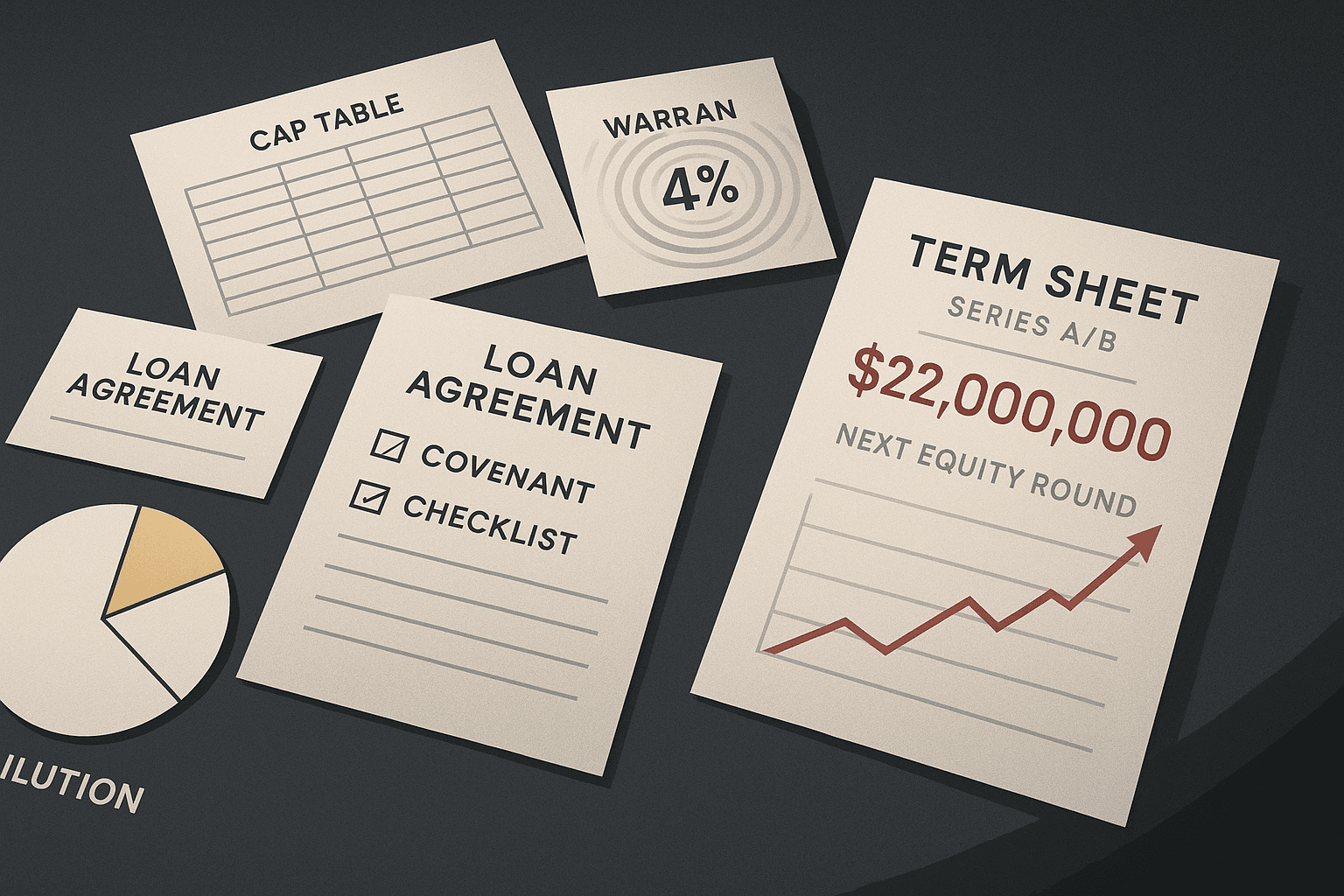
How venture debt warrants can re-anchor your next equity valuation, and what to negotiate in warrant coverage before you take the loan.
Nine months later, the company starts raising a Series A extension. A new lead asks for the debt documents. Then come the questions that matter more than founders expect:
Nothing in the original board memo said the debt would help define the company’s next equity price. But in practice, it often does.
This is the shadow price trap. Venture debt lenders do not need to lead equity rounds to influence valuation. Through warrant coverage, strike-price mechanics, anti-dilution-style adjustments, information rights, and default leverage, they can create an unofficial equity reference point long before the next priced round. That reference point is not always explicit. Sometimes it shows up as a spreadsheet sensitivity. Sometimes it appears in diligence as an annoying clean-up item. Sometimes it becomes a psychological anchor in a lead investor’s head: if sophisticated debt capital effectively underwrote an equity-linked exposure at X, why am I paying 2X without a very strong reason?
Founders call venture debt “non-dilutive” because the immediate dilution is small. Investors call it “expensive equity in disguise” when the debt stack starts shaping future financing options. Both are directionally right. The mistake is thinking dilution is the only cost worth modeling.
The problem: venture debt creates a valuation signal whether you intend it to or not
Most founders evaluate venture debt on four dimensions:
That is incomplete. The fifth dimension is the one that hurts later: what equity price does this debt imply, suggest, or privilege in future negotiations?
That implied price can emerge from several debt-side economics:
The result is a hidden anchor. Not a legally binding valuation cap in the SAFE sense, but a commercially sticky equity benchmark that sits in the background of every financing conversation.
And anchors matter. In negotiation psychology, the first credible number tends to pull subsequent discussion toward it, even if everyone claims to be valuing the company independently. In venture, “credible” does not just mean market-clearing. It means documentable, signed by a sophisticated institution, and embedded in security terms that survive into diligence.
A lead investor reviewing your financing history is not starting from a blank page. They are asking what prior sophisticated counterparties were willing to accept in exchange for risk. If a lender received equity upside on terms that imply a weak or stale price, that term package can color the next round’s framing.
Why current founder playbooks fail
The standard founder playbook around venture debt goes something like this:
That logic breaks for three reasons.
1. Founders underweight how little equity economics can still produce a loud signal
A 0.5% to 1.0% warrant package sounds tiny compared with a 20%+ priced round dilution event. But valuation anchoring is not proportional to dilution. A small package can still embed a precise pricing reference.
If the warrant strike is pegged to the last preferred round price or the “lowest price of the next financing,” the lender has helped create a document trail around what informed capital considers an acceptable entry point. That can be enough to affect the range a future investor defends internally.
2. Companies model dilution statically instead of conditionally
Most cap table models show a simple line item for “debt warrants.” That misses the real issue. The economics often change depending on the next financing structure.
Questions founders fail to model include:
A venture debt package is not one number. It is a set of conditional claims.
3. Equity investors do not analyze debt in isolation
Series A/B leads care about friction. Anything that complicates closing, cap table clarity, security seniority, future option pool planning, or downside outcomes will get priced into the round one way or another.
A messy debt package rarely kills a good company. More often, it narrows the set of clean offers. Investors either:
Founders often think the debt only matters if the lender blocks a deal. In reality, the lender does not need veto power to reduce your negotiating leverage.
The core insight: warrants plus debt controls can manufacture an unofficial equity price
The contrarian view is this: venture debt is not merely debt with a little dilution attached. In many cases it is a hybrid pricing instrument. The lender’s warrant economics, combined with covenant and information rights, can create a shadow equity price that influences the next real one.
There are four ways this happens.
1. Warrant strike mechanics import an equity benchmark into the debt package
The simplest version is a warrant struck at the last preferred share price. Suppose your seed round was done at a $40 million post-money valuation with 10 million fully diluted shares outstanding. Preferred price per share: $4.00.
You later add $6 million of venture debt with 1.0% warrant coverage.
Assume coverage is calculated on a fully diluted basis implied by the debt amount over the last round price:
The founder reaction is usually: 15,000 shares on a 10 million share base is trivial. True. That is about 0.15% of the company on this simplified math.
But that is not the full effect. The warrant tells every future investor that a sophisticated lender was comfortable receiving equity upside at a $4.00 reference point after reviewing the company’s post-seed performance. If you try to raise at $8.00/share nine months later, that prior document can become a subconscious objection unless your metrics improved dramatically.
This gets sharper when the strike is not fixed at the last round, but floats off the next round.
Example: strike tied to the next financing
Suppose the debt warrant gives the lender the right to buy shares at 80% of the price per share in the next qualified equity financing.
Now the lender is not just along for the ride. The debt package has inserted itself directly into next-round pricing. If the Series A lead proposes $5.00/share, the lender gets a $4.00 strike. The economic transfer is bigger than the headline coverage suggests.
Let’s run it:
Intrinsic value at issuance is already positive:
That still sounds small. But the problem is not only the value transfer. The problem is the financing optics: the debt docs now contain a live discount to the next equity round, meaning the “true” marginal price of capital is lower than the lead’s headline price.
Sophisticated Series A investors notice this instantly. They ask: if the company’s debt provider effectively gets in at a lower price through a contractual formula, why is the headline round price the right benchmark for everyone else?
2. MFN-style or anti-dilution-like adjustments create a lower-bound reference price
Traditional venture debt warrants do not always include full anti-dilution protection. But many include narrower adjustment concepts that function similarly in practical fundraising situations.
Typical examples:
This is not always labeled MFN. But it can work like one.
Example: bridge round with side-letter economics
Assume the company raises venture debt in January. The lender warrant is struck at the seed price of $3.00/share. In October, cash burn runs hot and the company raises a $4 million insider bridge.
Headline bridge price: $3.20/share.
But the bridge investors also receive:
If the debt warrant agreement has broad “equivalent economics” language, the lender may argue that the effective price of the bridge is below $3.20 and seek an adjustment. Even if the legal answer is debatable, the practical outcome is bad: now you are negotiating debt economics in parallel with emergency equity fundraising.
That dispute itself becomes a valuation anchor. A future lead investor will ask for the memo resolving how the lender’s effective price was recalculated. Once you have done that math for one constituency, you have taught everyone else how to frame the company’s true financing price.
3. Default covenants can force a shadow repricing at the worst possible time
Founders treat covenants as operational constraints: liquidity thresholds, revenue tests, consent rights, reporting deadlines, negative pledges, IP transfer restrictions. They matter for another reason. A technical or near-technical default right before fundraising gives the lender leverage to extract economics based on a company’s weakest negotiating moment.
That leverage can re-anchor pricing in three ways:
Example: default-driven warrant reset
Suppose a company borrows $10 million with 0.75% coverage and a minimum unrestricted cash covenant of $3 million unless ARR exceeds $12 million. ARR misses plan. Cash falls to $2.6 million just as the company launches a Series B process.
The lender has no desire to own the company. But it does want to protect downside and get paid for flexibility. It offers a waiver package:
This looks manageable in the board packet. In practice, it is poison for pricing discipline.
Why? Because you have now contractually linked debt relief to the next equity round price. The lender’s economics improve if the round prices lower or at least not materially above current expectations. Even if the lender never pushes for a lower price directly, the paper now contains a lower-bound or matching mechanism that future investors will inspect.
The shadow price has become explicit.
4. Information rights turn lenders into pre-round price discovery participants
Most founders accept lender information rights as harmless: monthly financials, compliance certificates, budgets, board-approved operating plans, notices of defaults, material litigation, fundraising updates. But information rights matter because they let lenders build and defend an internal view of equity value long before the market does.
That affects the company in two ways.
First, the lender can use current information to negotiate amendments, draw conditions, or waivers with much tighter pricing awareness than the founder expects.
Second, those same materials often surface in equity diligence. A new lead may ask:
Once a lender has received recurring investor-grade information and negotiated warrant economics around it, their terms can look less like boilerplate debt compensation and more like an informed statement about risk-adjusted equity value.
How the shadow price affects Series A/B lead psychology
This is where founders tend to be naive. Venture investors do not literally copy debt warrant prices into term sheets. That is not how it works. The influence is subtler and often more powerful.
Lead psychology mechanism 1: debt terms suggest where informed outsiders saw asymmetry
A lender taking warrants at a price linked to the last round, or discounted to the next one, signals that an informed third party wanted equity optionality because pure interest return was not enough. A lead investor may read that as evidence that the company’s risk was already too high for clean debt economics.
That does not necessarily reduce valuation one-for-one. But it narrows the set of arguments founders can make for a premium step-up.
Lead psychology mechanism 2: diligence friction gets converted into price discipline
Series A/B leads want clean cap tables and controllable closing risk. If debt documents require warrant interpretation, amendment negotiations, payoff mechanics, subordination review, or consent clean-up, the investor often “pays for the hassle” by lowering price or increasing structure.
A messy debt package may not lead to a reduced pre-money on paper. It may instead show up as:
All of those are valuation impacts by another name.
Lead psychology mechanism 3: the lender’s strike becomes a mental lower bound
If the debt warrant strike is at or below the last round, a future investor may implicitly treat that as a floor for “credible historical pricing.” The company then bears the burden of proving why today’s equity should clear far above that level.
This is especially acute in flat or soft markets. In a euphoric market, investors overlook these anchors. In a disciplined market, they lean on them.
Cap table math: why “small” warrants become larger in financing models
Let’s move from psychology to modeling.
Assume this setup before Series A:
The company seeks to raise $15 million in Series A.
Scenario 1: clean up round at $6.00/share, no debt adjustments
Debt warrant looks immaterial.
Scenario 2: Series A at $3.00/share triggers strike adjustment and top-up economics
Assume the warrant agreement says if equity is sold below strike within 18 months, lender receives the lower strike and enough extra shares to preserve economic equivalence.
Now:
That could mean 31,500+ shares instead of 20,000.
Still not massive, right? Wrong question. The direct dilution is modest. The issue is that every financing model now needs conditional debt tabs, legal assumptions, and amendment scenarios. The lead investor notices uncertainty and starts negotiating against it.
Scenario 3: debt clean-up required as condition to close
Assume the new lead says:
“We will invest $15 million at a $45 million pre, but only if the debt is amended so the lender waives financing-related defaults, fixes the warrant strike with no further adjustments, and confirms no consent right over future equity issuances.”
The lender responds:
Economically, this can easily cost more than a headline 25–50 bps move in valuation. Yet founders rarely compare the alternatives on a unified basis.
Term sheet comparison: same debt principal, very different shadow pricing risk
Consider three venture debt offers for a company that just raised a $12 million seed at a $48 million post.
Offer A: apparently cheap, shadow-price heavy
Offer B: more expensive coupon, cleaner equity interface
Offer C: medium pricing, hidden amendment optionality
Most founders pick Offer A because 0.5% coverage feels cheapest. Many experienced investors would prefer Offer B.
Why? Because Offer B contains more explicit dilution today but less shadow valuation risk tomorrow. A fixed strike and no repricing clauses keep the debt from inserting itself into the next round’s price formation. Offer A, by contrast, is a low-headline-cost instrument that reaches forward into the company’s future valuation.
This is the central contrarian point: the debt package with higher nominal warrant coverage can be economically cheaper than the one with lower coverage if it produces less pricing interference in the next round.
Negotiation scenario: a Series B lead uses debt warrants to push price down
Let’s walk through a realistic negotiation.
Company profile:
The company wants a Series B at $120 million pre-money.
Assume 20 million FD shares pre-round. A $120 million pre implies $6.00/share.
A new lead likes the business but says:
The lead offers:
What is the real difference?
At $6.00/share on 20 million shares, pre-money value is $120 million.
At $5.00/share, pre-money value is $100 million.
New investor shares:
Difference: 666,667 shares, or 3.33% of the company pre-pool effects.
Add a 10% pool refresh pre-money and the founder/common dilution grows further. Now layer in debt amendment sweeteners. A warrant package that originally looked “sub-1%” has helped produce several points of effective ownership shift.
Did the warrant mechanically cause the lower valuation? No. Did it give the lead a credible basis to demand it? Absolutely.
Hidden valuation anchors are strongest in mediocre outcomes, not great ones
The best companies outrun debt terms. If growth inflects, multiple firms compete, and the financing is oversubscribed, lenders do not determine valuation. Markets do.
The trap matters in the middle 60% of outcomes:
In those situations, every piece of prior paper matters. Venture debt can become part of the story investors tell themselves about what the company is really worth and how desperate it may be.
What founders should negotiate upfront
If you are taking venture debt before a major priced round, negotiate not just for cost of capital but for future pricing neutrality.
1. Fix the warrant strike if possible
Best outcome:
Avoid if possible:
A clean fixed strike keeps the debt package from touching your next round economics.
2. Pay more coupon to reduce pricing optionality
This is often the right trade.
If the lender wants compensation, founders should generally prefer:
over
Cash cost is visible and finite. Pricing optionality is path-dependent and tends to become expensive when you are weak.
3. Cap warrant coverage and eliminate top-ups
Negotiate:
If there must be amendment economics, try to confine them to fixed fees rather than new equity-linked instruments.
4. Narrow information rights
Lenders need reporting. They do not need to become shadow equity analysts with unrestricted access.
Aim for:
Push back on:
The more investor-like the lender’s information package becomes, the more their negotiated equity economics look like informed pricing signals.
5. Clean up consent rights around future equity issuances
You want certainty that the next lead can fund without lender theatrics.
Clarify in documents:
Ambiguity invites leverage.
6. Pre-negotiate intercreditor and payoff mechanics
This is underappreciated. Equity diligence gets ugly when no one knows exactly how the lender exits, subordinates, or amends.
Before you need the round, confirm:
A lead investor pays less attention to debt that has a predictable unwind path.
A practical diligence checklist before launching the next round
If you already have venture debt, do not wait for the lead investor to discover the mess. Run your own cleanup process first.
Document review
Pull and summarize:
Cap table modeling
Build three financing cases:
For each, model:
Legal cleanup questions
Ask counsel:
Process discipline
Prepare a one-page memo for new investors that explains:
This does not make the issue disappear. But it prevents investors from assuming the worst.
The founder takeaway: “non-dilutive” is the wrong question
The right question is not whether venture debt is dilutive. Of course it is, at least a little. The right question is whether the debt package imports a future valuation framework into your company before the market gets to price you.
That is the shadow price trap.
A lender with small warrant coverage can still shape your next round if the strike formula references future pricing, if adjustment language captures lower-priced issuances, if default covenants create amendment leverage, or if information rights let the lender negotiate from an investor-grade understanding of your metrics. Once those features exist, the debt is no longer merely extending runway. It is participating in valuation formation.
Founders should stop optimizing for the lowest headline warrant percentage and start optimizing for the cleanest future equity interface.
If forced to choose, take the debt package with:
That package is often cheaper in the only moment that really matters: when a new lead is deciding how much of your company they need to own.
The punchline is blunt. Venture debt does not need to set your valuation formally to influence it materially. The minute your warrant terms, covenants, and lender rights give someone a documented way to infer a “real” equity price, your next round is no longer being negotiated on a clean slate.
That number, explicit or implicit, legal or psychological, is your shadow price. Ignore it, and you may discover too late that your supposedly non-dilutive capital already helped price the company.
RaiseSimpli Team
Author