SPV Allocation Mirage: Distorted Seed Price Discovery
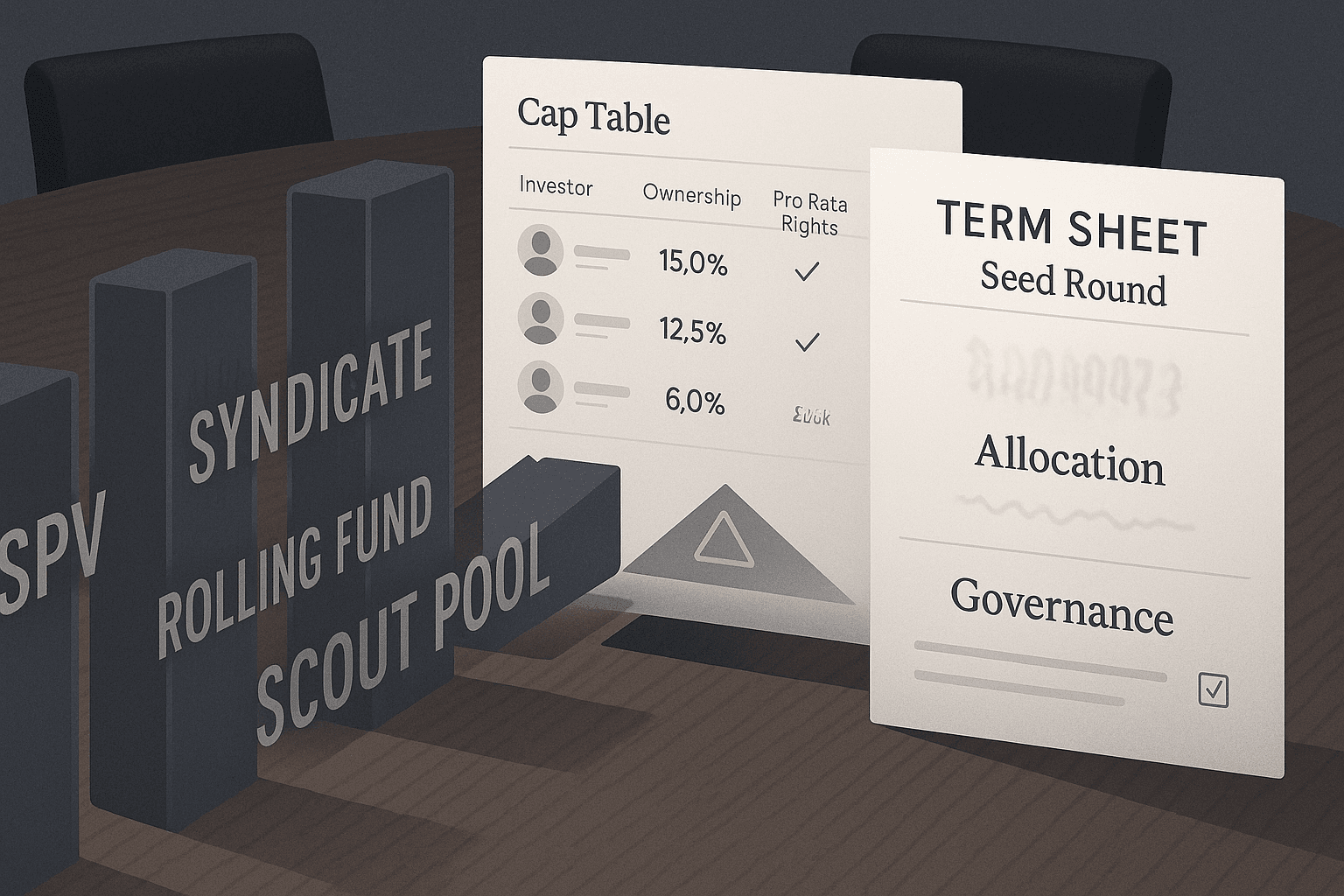
How angel syndicates and rolling vehicles distort price discovery in seed rounds, and how to manage SPV allocation to keep your terms clean.
A known angel syndicate says it can bring $750,000. A rolling vehicle manager wants $500,000. Two micro-funds ask for another $400,000, but both mention they may route part of the check through sidecars depending on LP appetite. On paper, the company looks oversubscribed. The founder starts leaning into scarcity: “We have more demand than room.” The price edges up. A few direct angels rush in.
Six weeks later, the round is still not closed.
The $750,000 syndicate is actually one GP with a $100,000 core check and a best-efforts SPV that still needs backers. The $500,000 rolling vehicle allocation is subject to member opt-in and portfolio construction limits after three other deals in the same month. One of the micro-funds is real money; the other is waiting on its own LP capital call timing. The founder now has 40 names in a data room, three overlapping diligence processes, no single investor with enough actual exposure to lead governance, and a “book” that looked full but was mostly optionality.
This is the SPV allocation mirage trap.
It is not that SPVs, angel syndicates, or rolling vehicles are bad. They are often efficient tools. They widen access, concentrate administrative burden into one line item, and let smaller investors participate in rounds they otherwise could not touch. Many excellent seed financings include SPVs. Many high-quality emerging managers use rolling structures. Some of the best companies ever funded raised early capital through syndicates.
The problem is different: these structures can quietly distort price discovery in seed rounds because they allow investors to signal allocation before they have fully secured capital, before they have full internal commitment, and sometimes before they have done lead-quality underwriting. That gap between signaled demand and committed conviction creates a mirage. Founders see momentum where there is only distribution. Markets see validation where there is only packaging.
In hot markets, this is a nuisance. In normal or cold markets, it can break a round.
The deeper risk is not just a delayed close. It is that SPV-heavy demand can leave the company with weaker sponsor quality, less reliable follow-on support, muddier governance, and a next-round story that looks less robust under scrutiny. The Series A investor who asks, “Who really led the seed?” is often asking a more precise question: “Who had enough direct conviction to own the underwriting decision, board dynamic, and follow-on burden?”
If the answer is “a collection of pooled optionality,” the seed may have looked strong while actually weakening the company’s financing position.
The core problem: pooled capital often signals demand earlier than it delivers commitment
Founders usually think about investors in binary terms: either they are in or they are out. That is how direct funds often behave. A traditional micro-VC with discretionary authority over a fund can decide to invest $500,000, complete diligence, sign docs, wire on schedule, and show up consistently after closing.
SPV-based capital behaves differently because the decision stack is layered.
A direct fund decision usually looks like this:
A syndicated or rolling vehicle decision often looks more like this:
Every extra layer introduces slippage risk.
That slippage matters because founders and other investors frequently count “indicated interest” as if it were committed capital. A syndicate lead says, “I think we can fill $500,000.” The founder hears, “We have $500,000.” Existing angels hear, “The round is coming together.” A prospective lead hears, “There is outside validation.” But until the syndicate has actually filled, documented, and funded, the number is not capital. It is marketing-adjusted possibility.
This subtle distinction distorts price discovery.
Price discovery in seed is already messy. Companies have limited operating history, financial data is thin, and valuation is heavily influenced by momentum, scarcity, comparable rounds, and investor competition. If a founder believes there is more real demand than actually exists, they may set terms too aggressively. If outside investors infer there is a strong market clearing price from pooled indications, they may move faster than their genuine conviction supports. That can temporarily prop up a valuation that the actual direct buyers would not have independently validated.
In other words, pooled optionality can manufacture the appearance of consensus.
Why current founder heuristics fail
Most founders use some version of the wrong filter.
They ask:
Those are not useless questions. They are just not the right ones.
The right questions are:
A round can look strong on the surface while failing every one of these tests.
The most common founder mistake is treating access intermediaries as if they were conviction intermediaries. They are not the same.
An angel syndicate may be great at assembling small checks quickly, but that does not mean it has lead-quality conviction. A rolling fund may have a high-profile manager and excellent content distribution, but that does not mean the manager has concentrated reserves or the ability to support a company through a difficult bridge. A scout-backed SPV may be a useful social proof asset, but social proof is not the same as underwriting depth.
The issue is not prestige. It is economic substance.
Why the usual defenses are too glib
When this issue comes up, three defenses usually appear.
Defense 1: “An SPV is still money”
Sometimes, yes. But timing, certainty, and governance quality matter. A dollar that arrives six weeks late after creating false scarcity is not equivalent to a dollar wired by a direct fund when the round needs to close. A dollar with no follow-on capacity and diffuse accountability is not equivalent to a dollar from a concentrated investor who can help reset strategy, recruit an executive, or defend the company in the next round.
Seed financing is not just fundraising. It is investor selection under uncertainty.
Defense 2: “One SPV line keeps the cap table clean”
Legally, sometimes. Economically, not always.
A clean cap table line can conceal messy investor concentration, fragmented expectations, and governance ambiguity. If 40 people are economically behind one nominee line item, the company may still have to manage 40 opinions through the syndicate lead, especially when things are going wrong. The cap table looks simple. The stakeholder map is not.
And in some cases, multiple syndicates each create their own SPV line, so the company gets neither direct conviction nor line-item simplicity.
Defense 3: “A known syndicate brand attracts future investors”
Only if future investors believe that brand reflects real underwriting quality.
Sophisticated Series A firms know the difference between a direct institutional lead and a distributed allocation assembled by audience reach. They will ask who set terms, who anchored diligence, who owns the board relationship, who has reserves, and whether any investor in the seed had enough basis risk to matter. If the answer is vague, the signal degrades quickly.
The hidden mechanics of the mirage
The SPV allocation mirage usually forms through four mechanisms.
1. Allocation inflation
Managers talk in target allocations, not funded allocations.
A syndicate lead says, “We’re taking $400,000 to $600,000.” That sounds like a commitment range. In reality, it may mean:
Founders then relay the high end of the range to others. This is how perceived momentum exceeds real capital.
2. Diligence outsourcing
Some pooled vehicles rely on borrowed diligence. Not fraudulently, just structurally. They wait for another investor to do the hard work first.
That creates a paradox: they can make the round look more filled before anyone with enough skin in the game has actually decided to lead. Everyone is waiting for someone else’s conviction while the founder interprets the aggregate as conviction.
This weakens the signaling value of the whole book.
3. Temporal mismatch
SPVs and rolling vehicles often move on a slower operational cadence than founders expect.
Subscription windows, LP elections, KYC/AML, docs, capital calls, and admin workflows can add real time. If the company needs to hire, launch inventory, or show cash certainty to a co-lead, those delays are not administrative trivia. They affect execution and negotiating leverage.
4. Concentration opacity
A round with five “investors” can actually be one direct fund, two overlapping syndicates drawing from similar angel networks, one rolling vehicle with highly dispersed exposure, and one operator SPV.
To a future investor, that round may appear diversified. In fact, it may be fragile because no one actor has enough ownership, reserves, or accountability to matter.
A simple model: direct lead capital versus pooled optionality
Assume a startup is raising a $3 million seed at a $12 million pre-money valuation.
Post-money = $15 million.
New investors collectively purchase 20.0% of the company.
Now compare two versions of the same round.
Scenario A: direct-conviction round
Total = $3.0 million
Ownership by new money:
This round has a clear sponsor. One fund has enough exposure to care deeply and enough stake to justify follow-on work. Another fund has meaningful ownership. There is a natural governance spine.
Scenario B: SPV-heavy mirage round
Total after scramble = $3.0 million
At first glance, this seems fine. The company still raised the money.
But look at what actually happened.
The founder spent six extra weeks backfilling a $775,000 shortfall between indicated pooled demand and funded pooled demand. Existing investors had to stretch pro rata. Direct angels were added late, often with less diligence quality. The only investor with real institutional concentration is the $500,000 micro-fund, which owns just 3.33%.
Actual new ownership from the pooled actors:
No one in that group individually owns enough to behave like a true lead. Even if one manager is visible, the economic exposure is spread. The founder may have “many supporters” and no sponsor.
That is a fragile round structure.
The cap table math founders miss
Founders often focus on dilution percentage and ignore investor concentration quality.
That is a mistake because the same 20% dilution can produce very different future financing outcomes.
Take the same $15 million post-money seed.
If one direct lead owns 8.33%, that lead can plausibly defend pro rata in a Series A and may even overinvest to maintain influence. Suppose the company raises a $10 million Series A at a $30 million pre-money valuation.
Series A post-money = $40 million.
The seed lead’s 8.33% stake would require about $3.33 million to fully maintain ownership. Most seed funds will not write that much, but they may reserve enough to take meaningful super pro rata or at least defend part of the position.
Now imagine the largest pooled vehicle in the seed owns 2.00% through an SPV. To maintain its stake at the Series A, it needs about $800,000. That may sound easier, but structurally it is often harder. Why?
Because the SPV may not have reserves. The syndicate manager may need to form a new vehicle, remarket the opportunity, and hope backers opt in again. There is no guarantee the same end investors participate. So the company enters its Series A with “supportive prior investors” who are supportive in theory but procedurally unreliable.
Future investors notice this.
A cap table with concentrated, reserved capital gives comfort. A cap table with distributed seed ownership and unclear follow-on machinery creates financing risk.
The same issue shows up in insider bridges.
Suppose the company misses plan and needs a $1.5 million extension before Series A. In a direct-conviction seed round, the lead and second fund might split $1.0 million and ask angels to fill the rest. In an SPV-heavy round, everyone says they are “supportive,” but few can move quickly. The founder is then forced to reopen external fundraising from weakness.
This is how an apparently successful seed structure can depress the next financing.
How SPV-heavy rounds can lower the true market-clearing price
The irony is brutal: pooled structures can push a seed valuation up in the short term and reduce it later.
Here is the sequence.
So the founder “won” the seed negotiation and lost the financing game.
This happens because price discovery in early-stage markets is not just about this round’s check size. It is also about whether the investor set credibly underwrites the next round narrative.
If your seed investors look like tourists, your next-round buyer will haircut the signal.
Term sheet comparison: direct lead versus syndicated pseudo-lead
Founders should learn to compare economic terms and structural terms separately.
Consider two seed term sheet situations.
Offer 1: direct lead
Offer 2: syndicated pseudo-lead
A founder tempted by Offer 2 sees the higher headline valuation and larger apparent demand. But structurally, Offer 2 may be inferior on almost every variable that matters after signing.
Key questions:
A founder should heavily discount unfilled vehicle capacity. In many cases, $1.5 million from a direct lead at a slightly lower price is much better than a higher-priced “up to” allocation from pooled optionality.
Negotiation scenario: how to separate real money from performative allocation
Suppose a syndicate manager says:
“We’d love to lead with $1 million. I can put in $150,000 personally and I’m confident we can fill the rest through our network.”
The wrong founder response is:
“Great, I’ll mark you down for $1 million and tell others the round is anchored.”
The right founder response is direct:
“Happy to work together. For planning purposes, I can only count discretionary capital as committed. I’ll reserve up to $1 million for you, but I’ll communicate externally that $150,000 is committed and the balance is subject to SPV fill. We’ll set a date after which any unfilled allocation rolls back to the company.”
That one sentence protects price discovery.
You are not insulting the investor. You are clarifying economic reality.
Then negotiate specifics:
This forces the distinction between conviction and distribution.
A practical diligence framework for founders
Before treating any pooled vehicle allocation as real demand, ask the following.
1. What is the manager’s own check?
If the manager is putting in $25,000 and “bringing” $500,000 through others, you are mostly dealing with access, not underwriting. That can still be useful, but do not mistake it for a lead.
2. Is the allocation discretionary or best-efforts?
Can the manager commit the full amount without further LP elections or backer opt-in? If not, what amount is truly discretionary today?
3. What is the expected fill timeline?
Not “we move fast.” Ask for actual process timing:
4. What happens if the vehicle underfills?
Do terms change? Does the investor lose rights? Is there a minimum below which the company would rather replace the allocation with direct capital?
5. Who controls follow-on decisions?
Can the manager form a new SPV for the next round? Do they historically do that? What percentage of prior deals actually received follow-on support from the same backer base?
6. How many look-through investors are there, and do they overlap with others in the round?
Overlapping backers create correlated fragility. Three vehicles may look diversified but actually draw from the same 20 angels.
7. Who speaks for the vehicle when governance gets hard?
Not when things are good. When the company misses plan, needs a bridge, or has founder conflict. One clean nominee line is only helpful if authority is genuinely centralized.
A simple founder scoring system
Use a weighted score out of 100 for each investor source.
Now score three hypothetical investors.
Investor A: direct seed fund
Score:
Investor B: angel syndicate
Score:
Investor C: rolling fund manager
Score:
This does not mean avoid B or C. It means price them correctly in your round construction. They are supplements, not anchors.
How to structure around hidden friction
Founders do not need to reject SPVs. They need to control them.
1. Separate “committed” from “reserved” in your internal round tracker
Only discretionary, signable capital counts as committed.
Everything else is reserved or indicated. Do not use reserved amounts to justify valuation escalation internally. If you mention them externally, label them accurately.
2. Set expiration dates on allocations
If a vehicle wants room, give it a deadline.
Example:
This prevents endless limbo.
3. Tie rights to funded thresholds
Do not hand out governance or information complexity in exchange for hypothetical size.
Example:
4. Prefer one real lead plus SPV supplements
The healthiest structure is often:
The unhealthy structure is a round where no direct investor crosses the threshold of real sponsorship and everyone assumes someone else will.
5. Ask for historical fill data
Managers hate this question because it converts narrative into evidence.
Ask:
If they cannot answer, assume the process is less reliable than advertised.
The governance problem nobody addresses early enough
SPV-heavy rounds often create governance confusion that does not show up until the company is under stress.
A direct lead with 8% to 12% ownership knows it has a reputation, portfolio mark, and fund economics tied to the outcome. That investor may be demanding, but at least accountability is legible.
A dispersed SPV can create weird incentives.
The manager may have enough reputational interest to stay involved but not enough economic exposure to do painful work. End investors may have enough money at risk to care emotionally but no direct control. If the company needs a recap, bridge, founder replacement, or aggressive strategic pivot, who actually decides? Who takes responsibility for telling the hard truth? Who signs consents quickly?
Founders underestimate how important this becomes.
The right seed investor is not just a source of funds. It is a future decision-making counterparty.
If your seed round is made of pooled optionality, your company may discover in a crisis that it has many spectators and few principals.
A warning sign for Series A investors
If you are a founder reading this before your seed, internalize this sentence:
Broad seed participation is not the same as strong seed sponsorship.
Series A firms evaluate this constantly. They look for:
If the round is full of SPVs with no reserves and thin manager checks, the Series A investor may infer that the prior market did not deeply believe, it merely liked the option.
That weakens your negotiating position more than founders realize.
When SPVs are genuinely useful
This article is contrarian, but the point is not “never use SPVs.” The point is “know what they are good for.”
SPVs are useful when:
The trap is using SPVs to substitute for lead-quality conviction.
They are best as amplifiers, not foundations.
What founders should do in the room
When someone presents a large pooled allocation, respond with precision, not gratitude theater.
Say:
“We’re excited to work together. To plan the round responsibly, can you break your allocation into fully discretionary capital, highly probable capital, and best-efforts capital? Also, what is the latest date we should treat the balance as available?”
That single question changes the dynamic.
Serious investors will answer clearly. Promotional allocators will deflect.
Then build the round accordingly.
Do not let anyone else’s marketing calendar dictate your price discovery.
The takeaways
First, a round is not stronger because it has more logos, more names, or more soft-circled dollars. It is stronger when it has more committed conviction.
Second, SPVs, rolling funds, and syndicates often blur the line between indication and commitment. That blur can manufacture the appearance of demand and distort valuation discussions.
Third, the cost is not only delay. It is weaker sponsorship, opaque concentration, unreliable follow-on support, and harder governance when the company needs decisive insiders.
Fourth, founders should discount pooled allocations until they understand how much capital is discretionary today, how fast it can close, who controls governance, and whether there is any credible reserve behavior behind the vehicle.
Fifth, the best seed rounds usually have a clear spine: one real lead or co-lead with meaningful direct ownership, supplemented by pooled vehicles where helpful, not replaced by them.
The seed market rewards momentum, but companies are not built on momentum alone. They are built on counterparties who can decide, wire, support, and show up again when the story gets harder.
That is what real price discovery looks like.
Everything else may just be a mirage.
RaiseSimpli Team
Author