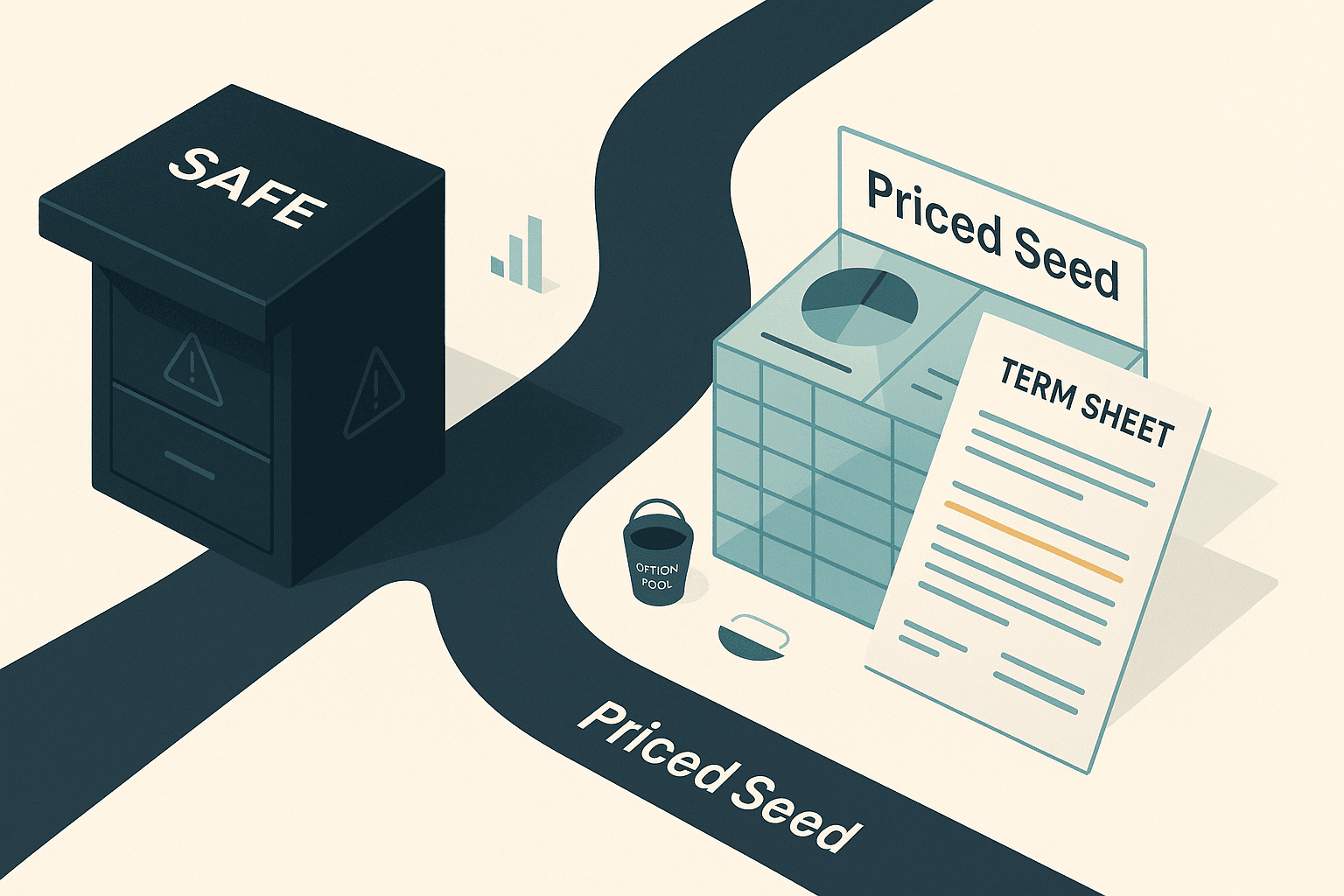
When a priced seed round beats a SAFE, why priced rounds are coming back, and how to negotiate terms that protect your company early.
The priced seed is back (and it’s not nostalgia)
For roughly a decade, the startup fundraising default at seed in the US has been the SAFE (and its close cousin, the convertible note). The pitch was irresistible: fast, cheap, founder-friendly, and a way to avoid “premature valuation debates.”
But in the last couple of years, more founders, and more investors, have been returning to priced seed rounds (i.e., selling preferred stock at a negotiated valuation with a full set of terms).
This isn’t just cyclical fashion. It’s a reaction to a set of structural problems SAFEs create when:
A priced seed round can be better than a SAFE when the goal isn’t merely to “get money in the door,” but to set the company up to raise a clean Series A without getting reset, repriced, or re-termed.
This piece is opinionated: for many strong companies, a well-negotiated priced seed is the most founder-protective instrument: precisely because it forces clarity early, when you still have leverage.
> Key idea: SAFEs feel simple, but they defer complexity. Priced rounds surface complexity now, when you can still negotiate it deliberately.
---
Definitions (to keep us precise)
---
Why priced seeds are returning
1) “Stacked SAFEs” made cap tables unpredictable
Many seed rounds weren’t one SAFE. They were:
By the time you reach a Series A, you don’t have a clean “seed ownership picture.” You have a conversion math event that may surprise founders and new investors.
Series A investors hate uncertainty. Not morally, economically. They price risk. Uncertainty about how much of the company converts, at what effective price, and whether the option pool must be resized before conversion, all increases friction.
2) The “downstream market” started enforcing discipline
When Series A capital is abundant, many SAFEs convert without drama. When it tightens, Series A investors become more sensitive to:
In tighter markets, investors are more likely to require terms that effectively reprice earlier risk, sometimes harshly.
3) Large seed rounds started looking like “mini-Series As”
If you’re raising $4M–$8M at seed, the “we’re too early to price” argument weakens. A priced seed round provides:
4) SAFEs can produce “valuation theater” anyway
A valuation cap is a valuation negotiation, just deferred, and often misunderstood.
Founders often say: “We raised on a SAFE; we didn’t set a valuation.”
In practice, if your SAFE cap is $10M and you sell a lot of it, you effectively set a price. You just postponed the moment when everyone has to confront what that means.
---
The hidden costs of SAFEs (what the template doesn’t tell you)
SAFEs are not “bad.” They are often appropriate. The issue is that founders underestimate three kinds of cost: pricing cost, control cost, and financing cost.
Cost #1: SAFE overhang can poison the Series A
From a Series A investor’s perspective, SAFEs represent a claim on equity that will convert at favorable terms relative to the Series A price.
If the SAFE cap is low, SAFE holders take a meaningful chunk. If the cap is high, SAFE holders may still take more than founders expected, especially when the company raises multiple SAFE tranches.
The Series A investor then asks:
If those answers aren’t crisp, the investor will protect themselves by:
Cost #2: Option pool + SAFE interaction is frequently misunderstood
SAFEs do not, by themselves, define whether an option pool increase happens pre-money or post-money, and the “post-money SAFE” (YC’s 2018 version) can create a false sense of certainty.
Even with post-money SAFEs, you still face real negotiations at priced rounds about:
Option pool math is one of the most common places founders lose meaningful ownership without realizing it.
References:
Cost #3: Governance gets deferred… and then imported at Series A (often with interest)
SAFEs are economically focused. They don’t set a board, voting thresholds, protective provisions, or investor rights.
That means the first time governance becomes “real” is often the Series A, when the investor has more leverage.
A priced seed gives you a chance to set governance before you’re under Series A pressure.
Cost #4: You can get “Series A’d at seed” anyway, just later
Founders sometimes use SAFEs to avoid negotiating terms. Then at the Series A, they face:
If the market is soft, the Series A investor may insist on terms that feel like a penalty for earlier ambiguity.
---
When a priced seed is better than a SAFE
A priced seed round is often preferable when several of the following are true:
1) You have credible valuation anchors
If you can justify valuation via traction, growth, enterprise pipeline, product maturity, or competitive dynamics, pricing now can reduce future renegotiation risk.
2) You’re raising a meaningful seed round (say $2M+)
Once the round is large, “speed and simplicity” are less compelling than cap table clarity.
3) You expect an institutional Series A and want it clean
Institutions like clean stories:
A priced seed can make your Series A process faster, not slower.
4) You want to set governance while you still have leverage
Priced rounds establish:
Done well, these are not “investor wins.” They are company infrastructure that reduces surprises.
5) You want to avoid cap-table “gotchas”
Common SAFE gotchas:
A priced round forces a cleanup.
---
The counterargument: When a SAFE is still the right move
SAFEs remain excellent when:
Also: SAFEs can be founder-friendly if used with restraint:
The mistake is not “raising on a SAFE.” The mistake is treating a SAFE like free money and then being surprised by conversion math.
---
A founder-friendly priced seed term playbook
Below is a practical playbook: the terms that matter most, what “founder-friendly” looks like, and how to negotiate without setting off alarms.
This section assumes a typical US preferred stock seed round using NVCA-style documents, often simplified at seed. Reference: NVCA model legal docs (NVCA).
1) Valuation: pre-money vs post-money (and why it’s not semantics)
Pre-money valuation + new money = post-money. Most term sheets talk in pre-money.
Founders should push for clarity on:
Founder-friendly approach:
2) Option pool math: the quiet transfer of ownership
The option pool is usually increased before the financing (i.e., “pre-money”), which effectively makes founders pay for future hires.
Sometimes that’s reasonable. Often it’s oversized.
What to do:
Founder-friendly target:
Key negotiation language:
This is hard to argue with, and it signals operational maturity.
References:
3) Liquidation preference: keep it simple and standard
At seed, the standard is typically:
Meaning: on a sale, investors get the greater of:
Avoid:
Founder-friendly position:
Reference: NVCA term overviews; broad market commentary from venture law practices.
4) Pro rata rights: good in moderation, dangerous if over-granted
Pro rata gives investors the right to maintain their ownership in future rounds.
It can be founder-friendly because:
But it becomes problematic when:
Founder-friendly approach:
Negotiation framing:
5) Board and control: don’t build a Series A board at seed
Seed boards should be light. Common structures:
Founder-friendly principle: keep founder control while adding functional governance.
Avoid at seed:
Healthy compromise:
6) Protective provisions: focus on the “big decisions”
Protective provisions require preferred approval for certain actions (issuing senior stock, changing charter, selling company, etc.). These are normal.
The founder risk is when the list expands to operational items like:
Founder-friendly approach:
7) Pay-to-play: usually unnecessary at seed
Pay-to-play forces investors to participate in down rounds or lose rights.
This can be useful later in complex financings. At seed, it’s often noise.
Founder-friendly stance:
8) Information rights and inspection rights: fine, with boundaries
Investors will ask for:
Founder-friendly boundaries:
9) Founder vesting (and “reverse vesting”): negotiate like an adult
If founders have not been on standard vesting, investors may require it.
This isn’t inherently hostile. It’s about commitment risk.
Founder-friendly approach:
Market norms vary, but a common middle ground:
10) Participation rights in future SAFEs/notes: eliminate ambiguity
If you previously issued SAFEs, a priced seed should cleanly define:
Founder-friendly approach:
---
How to avoid getting “Series A’d” at seed
“Getting Series A’d at seed” usually means accepting heavy terms, multiple liquidation preferences, participation, aggressive control provisions, or oversized option pools, under the rationale that the investor is taking early risk.
Sometimes risk-based terms are justified. But most of the time, the best seed terms are boring.
Here’s how to keep them boring.
1) Choose a lead who values standardization
The single biggest determinant of seed terms isn’t the docs, it’s the lead.
A good seed lead will:
A problematic lead will:
2) Anchor the negotiation around Series A compatibility
A powerful phrase in seed negotiation:
Most reputable investors agree with this because it protects their own upside too.
3) Treat the option pool as a budget, not a ritual
Bring a hiring plan and equity ranges. Make the pool a consequence of strategy.
This prevents the common move where the investor says:
without tying it to reality.
4) Don’t over-allocate pro rata
If everyone has pro rata, later rounds get cramped, and the lead investor at Series A has less room to build a position.
A crowded pro rata stack can reduce demand, which reduces price.
5) Keep liquidation preferences standard
If an investor pushes for participating preferred at seed, ask directly:
Often the answer is vague. That’s informative.
6) Use counsel who does venture financings weekly
This is not a place to economize. The cost difference between general corporate counsel and a venture-specialized lawyer is often tiny relative to the dilution created by one bad term.
References:
---
Negotiation mechanics: how to actually get a founder-friendly priced seed
Step 1: Create competitive tension, even lightly
A priced seed round is easiest to negotiate when you have:
You don’t need a bidding war. You need enough demand that “standard terms” is the path of least resistance.
Step 2: Ask for a “clean term sheet” explicitly
Request:
Make it easy for the investor to say yes.
Step 3: Redline only what matters
Founders lose goodwill and time by negotiating everything. Focus on:
Everything else is usually second-order at seed.
Step 4: Model dilution scenarios before you sign
Build a cap table model with:
Then simulate Series A:
If your model shows you’ll be unusually diluted by Series A, fix it at seed, usually via pool sizing and pricing clarity.
Step 5: Watch for “most favored nation” and side letter creep
If there are side letters:
MFN clauses can be fine, but they can also create accidental economics.
---
A worked example: SAFE stack vs priced seed
Consider a simplified scenario.
Scenario A: SAFE stack
Depending on the SAFE form and whether there’s a discount, the conversion will yield different effective ownerships. But the key dynamic is:
If the Series A investor also requires a 10–15% option pool refresh pre-money, founders can be hit twice.
Scenario B: priced seed
Now the Series A investor sees:
The company may still face a tough Series A market, but it’s less likely to face a “cleanup discount.”
The takeaway isn’t that $15M is “better” than $8–12M caps. It’s that clarity reduces financing friction, and financing friction reduces price.
---
The most common priced-seed mistakes founders make
1) Letting the option pool float until the last minute.
2) Accepting participating preferred because “it’s just a seed round.”
3) Granting broad veto rights that slow down execution.
4) Over-promising pro rata to small checks and angels.
5) Not cleaning up SAFEs/notes before pricing.
6) Optimizing headline valuation while ignoring economic terms.
Headline valuation is a story. Terms are physics.
---
Practical term positions (a quick checklist)
If you want a seed round that won’t haunt you at Series A, these are reasonable founder-friendly defaults:
Reference baselines:
---
Conclusion: priced seed isn’t “more investor-friendly”, it’s more reality-friendly
The core argument for priced seed rounds isn’t that SAFEs are flawed instruments. It’s that many companies have been using SAFEs outside the conditions where they work best.
If you’re raising a substantial seed, have credible valuation anchors, and care about a clean Series A path, a priced seed round can be more founder-friendly because it:
SAFEs are great when speed matters and uncertainty is high. Priced seed is great when the company is real enough that ambiguity becomes expensive.
If you take one operational lesson from this: model dilution, negotiate the option pool with a hiring plan, and keep seed terms boring enough that Series A investors don’t feel compelled to “fix” them later.
---
References (starting points)
(This article is educational and not legal advice; consult qualified counsel for your specific round.)
RaiseSimpli Team
Author