VC Reference Calls: The Backchannel That Decides
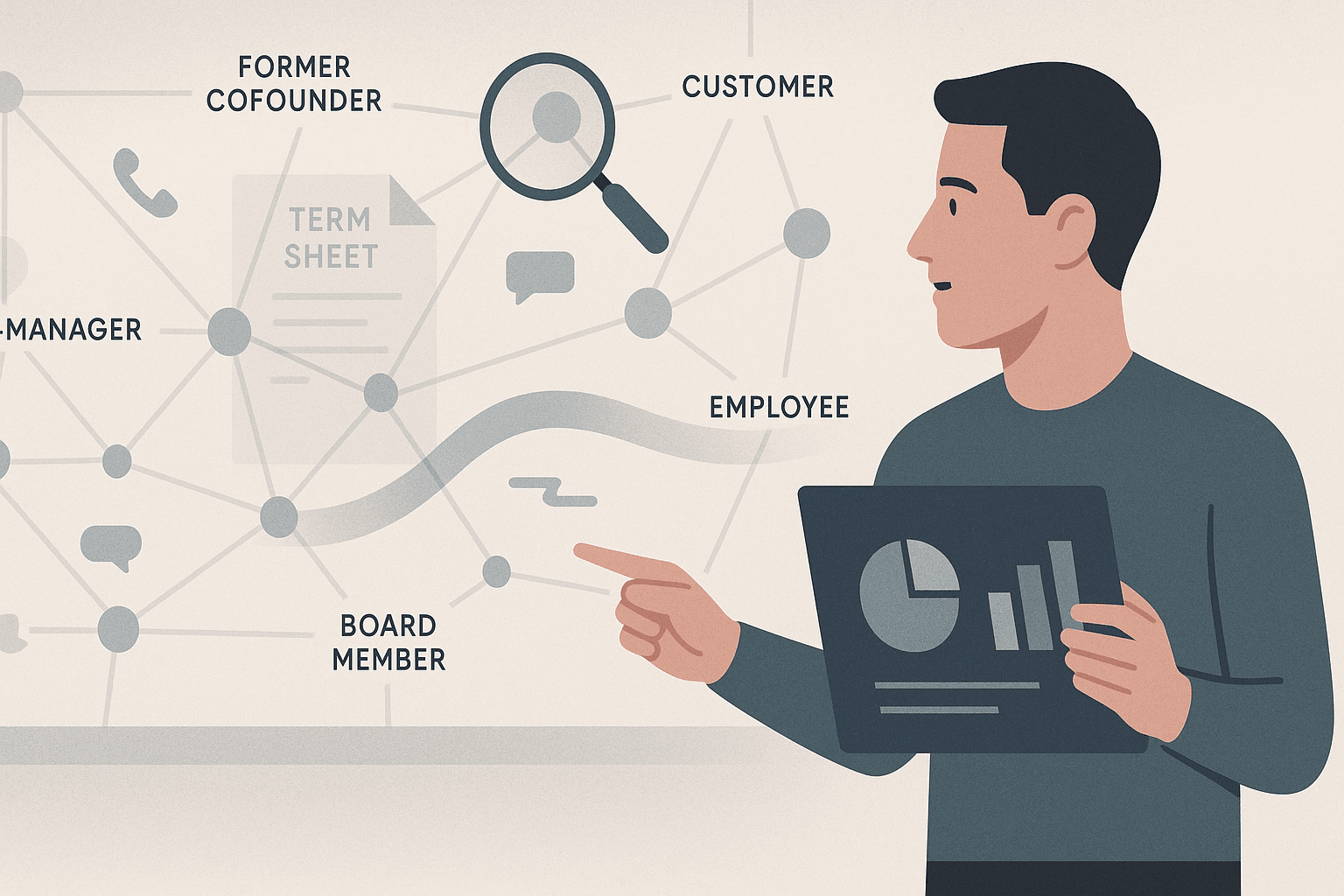
How VC backchannel reference calls often decide your round before you pitch, and how founders can prepare for them ethically and effectively.
The backchannel is the real diligence, often before you meet
Founders commonly imagine fundraising as a sequence: intro → first meeting → partner meeting → diligence → term sheet. In practice, many rounds are effectively decided earlier, in parallel, and sometimes before the first real conversation: through quiet backchannels and reference calls.
This isn’t a conspiracy. It’s an adaptation to a noisy market.
So VCs do what humans do in uncertainty: they ask other humans.
The uncomfortable part: references are not a neutral information-gathering step. They’re an interpretation layer that can tilt a decision long before product metrics or deck polish matter.
This article breaks down:
The goal is not to “game” diligence. The goal is to understand the system, reduce avoidable risk, and keep your narrative coherent without crossing ethical lines.
---
Why investors rely so heavily on backchannels
1) The core product at seed is judgment under uncertainty
At seed and pre-seed, investors cannot underwrite like private equity. Cohort retention might not exist. Revenue may be experimental. The company may be pre-product.
So investors overweight what is available:
Those traits are hard to see in a 45-minute pitch. They’re easier to triangulate via people who have observed you over time.
2) Social proof is a compression algorithm
Investing is an attention market. VCs compete for the best deals, and speed matters. A backchannel is a compression mechanism: a few trusted signals can justify moving fast.
This creates a feedback loop:
Even if the VC believes they are “just gathering context,” their prior gets set.
3) VC incentives push toward reputational risk minimization
A venture fund’s existential risk is not missing one good deal, it’s backing a deal that becomes a high-profile failure for avoidable reasons (fraud, toxicity, lawsuits, founder blowups).
References help answer questions like:
That’s why reference calls disproportionately focus on behavior, not just competence.
4) The backchannel is also about ownership and signaling
Many firms want to know:
Backchannels are as much about market mapping as founder evaluation.
---
How the backchannel actually happens (the mechanics)
VC backchannels are not always formal “reference calls.” They come in layers:
Layer A: passive inbound opinions
This often happens before the VC reaches out or accepts a meeting.
Layer B: opportunistic references
After the first meeting, investors often do fast, casual outreach:
These are sometimes framed as “getting to conviction quickly.”
Layer C: structured reference calls
Later-stage funds and more process-heavy firms will schedule formal references:
Calls become more standardized, sometimes including:
Layer D: shadow references (the one founders fear)
“Backdoor” references aren’t necessarily malicious. They’re a response to selection bias: founder-provided references tend to be curated.
But shadow references can be sloppy:
And yet, these calls can be disproportionately influential.
---
What VCs ask on reference calls (and what they’re really scoring)
The best investors are careful: they ask open-ended questions, seek multiple angles, and discount extreme opinions unless corroborated. Others are more casual and more biased.
Either way, certain question families are common.
1) The “would you work with them again?” question
What they ask:
What they infer:
This is a proxy for:
Note: a lukewarm “yes” is often interpreted as “no.”
2) Strengths framed as edge
What they ask:
What they infer:
Generic praise (“smart,” “hardworking”) is weak signal. Specific praise (“closed a partnership no one thought possible by reframing incentives”) is strong.
3) Weaknesses framed as risk
What they ask:
What they infer:
A critical nuance: VCs aren’t looking for “no weaknesses.” They’re looking for known failure modes and whether the founder compensates.
4) Conflict, stress, and truth-telling
What they ask:
What they infer:
This cluster often decides rounds.
5) Leadership and talent density
What they ask:
What they infer:
The most credible references often come from:
6) Ethics and boundaries
What they ask:
What they infer:
Even a hint of dishonesty can be fatal because it’s hard to price.
---
The uncomfortable truth: references are noisy, biased, and political
Backchannels can be useful while still being flawed. Founders should understand the failure modes.
1) Selection bias and availability bias
A neutral but accurate reference may not return the call; an aggrieved one will.
2) Incentives are messy
References have incentives:
The investor is not just gathering facts; they’re sampling incentives.
3) Pattern matching can become prejudice
VCs sometimes over-index on:
This can amplify bias against:
Founders can’t fix systemic bias alone, but they can prepare for it by ensuring references provide specific evidence rather than vibes.
4) One bad call can outweigh five good ones
Humans are loss-averse; so are investment committees.
In practice:
This is rational from a downside-protection perspective, but it can be unfair when the negative reference is contextually wrong.
5) Backchannel telephone game
A comment like:
mutates into:
then into:
Founders rarely get to see this mutation, but they pay for it.
---
What “ethical preparation” means (and what it doesn’t)
There’s a line between preparation and manipulation.
Ethical preparation is:
Unethical manipulation is:
Also risky (even if not unethical): manufacturing references who can’t speak to the relevant period or role.
Investors can detect overly polished references. They may not call it out, but it reduces credibility.
---
Build your reference set like a portfolio, not a vanity list
A strong reference strategy is coverage + credibility + relevance.
1) Segment by relationship type
Aim for a balanced set:
Different investor concerns map to different reference types.
2) Segment by time slice
If your career has phases (e.g., early engineer → PM → founder), select references from the most relevant phase.
If there’s a known messy period (a blowup, a layoff, a failed startup), do not pretend it doesn’t exist. Instead:
3) Choose “truthful advocates,” not “friends”
The best references are not your closest friends. They are people who:
Measured, evidence-based praise is more persuasive than hype.
4) Don’t overload on brand names
A famous name helps get a call returned. It does not guarantee a good reference.
Investors know that:
Specificity beats prestige.
---
Pre-wire references the right way: a practical system
“Pre-wiring” has a bad reputation because it sounds like spin. Done ethically, it’s just communication hygiene.
Step 1: Ask permission early, not under deadline
A bad pattern:
A better pattern:
This gives people room to decline, and that protects you.
Step 2: Share a short, factual context doc
Send a 1-pager (bullet points) with:
This is not scripting. It’s refreshing memory.
Step 3: Invite constructive critique
Explicitly say:
This does two things:
Step 4: Calibrate them on the stage
A seed investor and a growth investor listen for different things.
Seed: learning rate, speed, founder-market fit, ability to recruit.
Series A: repeatable GTM, management cadence, prioritization, board readiness.
Help references emphasize relevant examples.
Step 5: Create a reference map (internal only)
Maintain a simple table:
You’re not building a propaganda machine. You’re building situational awareness.
---
Handling backdoor references: you can’t control them, but you can shape the surface area
You cannot stop investors from contacting mutual connections. But you can reduce the odds that the first person they reach is the wrong one.
1) Increase the density of accurate information
If the investor’s first three pings reach people who:
…then a random weak negative signal later is less likely to dominate.
2) Seed the network ethically
Before fundraising, invest in professional relationships:
This is not gaming. It’s reputation compounding.
3) Don’t surprise people with your story
Many negative references come from misalignment:
If your narrative has changed, e.g., you left a company and now describe it differently, expect that to come up.
Consistency matters. If you’ve updated your view, say so explicitly:
That reads as maturity, not revisionism.
---
What to do if you have a “red flag” in your past
Some founders do. Most do, in some form: a failed startup, a firing, a public argument, a lawsuit, a messy cofounder split, a product incident, a Twitter moment.
The mistake is to treat these as secrets.
1) Distinguish between “bad outcome” and “bad ethics”
Investors can accept:
They struggle to accept:
If your issue is in the first category, the right framing is lessons + changed behavior.
2) Pre-empt with a clean, brief disclosure
Not a confessional. A factual narrative:
Keep it short. Offer to go deeper if asked.
Why this works: it prevents the backchannel from being the first time they hear it.
3) Bring your own credible counterweight
If you know a particular person might deliver a negative view, you don’t need to attack them. You need credible people who can contextualize.
Example approach:
Then ensure at least one reference from that era can say:
4) Avoid the trap of litigating the past
Founders sometimes try to “win” the story. Investors don’t want courtroom energy. They want risk assessment.
If you sound obsessed with vindication, it can read as unresolved.
Aim for: calm, accountable, specific.
---
What founders get wrong about references (common self-sabotage)
Mistake 1: Only offering executives as references
If all your references are senior leaders, investors may wonder:
A strong set includes people from multiple levels.
Mistake 2: Over-indexing on “niceness”
Investors are not selecting for niceness. They’re selecting for:
A reference who says “they’re very nice” but cannot cite hard outcomes is weak.
Mistake 3: Avoiding anyone who might mention weaknesses
Paradox: references that acknowledge a real weakness (and show how you manage it) are more credible.
Example of a good reference line:
That’s gold. It signals growth.
Mistake 4: Using current employees without care
If you ask current employees to be references, consider power dynamics. It can be coercive unintentionally.
Better alternatives:
If you do involve current employees, make it explicitly opt-in and low pressure.
---
What sophisticated VCs do during reference checks (and why it matters)
Understanding the best-practice investor approach helps you anticipate what good diligence looks like.
1) They triangulate across types
They won’t rely on one persona. They’ll mix:
2) They listen for specificity and calibration
A sophisticated VC discounts:
They weight:
3) They test for integrity through consistency
They compare:
Inconsistency isn’t always bad, people change, but unacknowledged inconsistency is.
4) They know references can be wrong
The best investors treat references as signals, not verdicts.
Still, even good investors can be influenced by:
Founders should plan accordingly.
---
How to protect your narrative without manipulation
“Narrative” sounds like spin. But in diligence, narrative means:
You protect it by making it legible.
1) Write down your own “reference storyline”
Do this before you fundraise:
This isn’t PR. It’s internal clarity.
2) Align your references on facts, not opinions
You don’t need everyone to share an opinion. You need them to share the same factual base.
For example, if you left a company:
People can disagree about who was “right.” Investors mainly care that you’re not distorting reality.
3) Keep your ask clean
When asking someone to be a reference, do not ask for a “positive reference.” Ask:
If they hesitate, don’t use them.
4) Don’t over-manage the channel
Over-instruction creates uncanny valley. Investors can hear it when references sound rehearsed.
Good references feel like:
Not:
---
Practical: a founder’s reference checklist
Use this as a pre-round operating checklist.
Before fundraising (2–6 weeks)
During fundraising
After fundraising
---
Multiple sides: why founders dislike backchannels, and why they persist
The founder critique (often valid)
The investor defense (also valid)
The reality: backchannels persist because they work often enough, and because VCs are judged by outcomes, not process fairness.
Founders therefore have two options:
Only one is rational.
---
What to do when an investor says “we heard something concerning”
This moment determines whether you look like a professional or a risk.
1) Don’t demand names
You can ask generally:
Pushing for the source can look retaliatory.
2) Offer your version with accountability
A strong response:
A weak response:
Even if the reference is unfair, the way you respond is signal.
3) Provide additional triangulation
Offer 1–2 more references who can speak to that domain.
Not as a counterattack, as context.
4) Know when to walk away
If an investor is anchored on a narrative and won’t engage with facts, you may be facing a non-recoverable prior.
Fundraising is partly about fit. Not every “no” is fixable, and chasing an anchored skeptic burns time.
---
References and further reading (selected)
A few credible starting points that touch diligence, references, and behavioral signals (not all focus exclusively on backchannels, but they inform the underlying mechanics):
- Daniel Kahneman, Thinking, Fast and Slow, biases that affect informal judgments.
- Research on structured vs unstructured assessments in hiring (e.g., Schmidt & Hunter meta-analyses on selection methods; while not VC-specific, it explains why informal references are noisy).
If you want VC-specific primary sources, look for partner blog posts describing “how we get conviction” at firms like Sequoia, Benchmark, Accel, Greylock, and a16z; many describe founder assessments and triangulation even when they don’t label it “backchanneling.”
---
The founder’s ethical advantage: be the easiest truth to learn
You can’t stop investors from talking. You can influence whether the story they hear is:
or
The ethical preparation playbook is simple but not easy:
If you do that, the backchannel becomes less threatening. Not because you’ve controlled it, but because you’ve made reality legible.
RaiseSimpli Team
Author