SAFE Stacking: How Layered SAFEs Reprice Your Startup
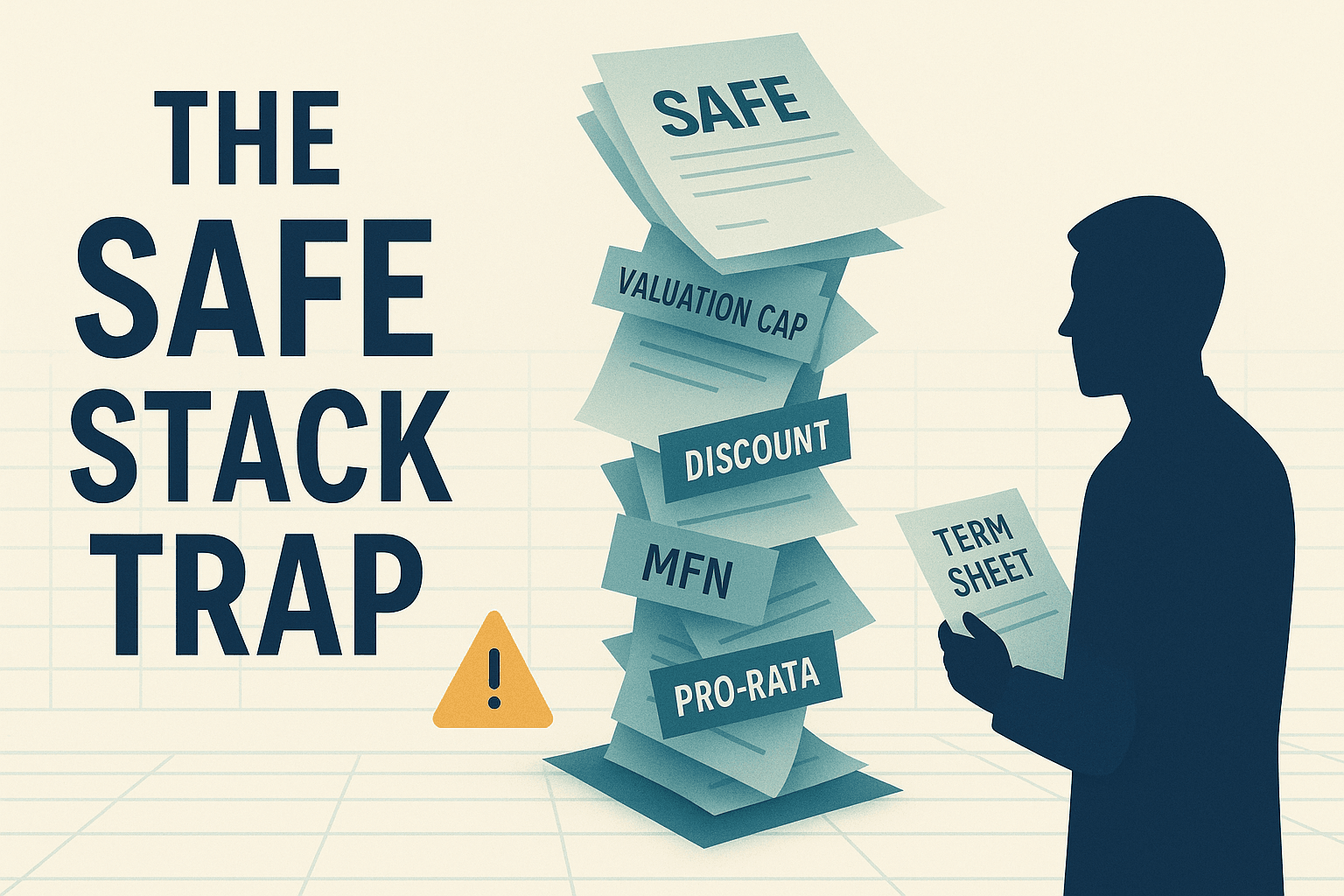
How layering multiple SAFEs can quietly reprice your company and unsettle new investors, and how to keep your cap table clean for the next round.
In practice, many startups don’t raise one SAFE. They raise a stack of them: pre-seed SAFE, then another SAFE, then an MFN SAFE, then a “bridge” SAFE, then a last-minute SAFE to hit runway. Each one feels small and harmless at the moment. Together, they can quietly reprice your company, distort ownership outcomes, and, most importantly, create enough ambiguity that new investors slow down or demand harsher terms.
This article is opinionated: SAFE stacks are often a hidden leverage transfer from founders to early money and a hidden risk transfer from new money to everyone else. They are not inherently bad. But if you don’t model them and manage term complexity, a priced round becomes less a clean financing and more a forensic accounting exercise.
We’ll cover:
> Not legal or tax advice. SAFEs are contracts; details vary (YC pre-money vs post-money, side letters, state law, counsel interpretations). Always run a real model with your lawyer and finance lead.
---
1) The core misconception: “SAFEs delay valuation” (they don’t, they encode it)
Founders often say: “We’re doing SAFEs so we don’t have to set valuation yet.” That’s only half true.
A SAFE round with a valuation cap (and/or discount) absolutely embeds a valuation ceiling for the SAFE investors. And when you stack multiple SAFEs, you’re effectively selling slices of the company at different implied prices.
Two consequences follow:
Pre-money SAFE vs post-money SAFE (why it matters)
YC introduced the post-money SAFE to make dilution more legible for founders and investors: each SAFE’s ownership percentage is more determinable at signing because it’s based on a post-money cap table definition.
The trap: mixing forms (pre-money + post-money, or modified versions) creates ambiguity and negotiation friction, especially if you have multiple rounds and side letters.
Reference: Y Combinator SAFE documents and explanations (YC library)
---
2) Why SAFE stacks spook new investors
Most institutional investors don’t hate SAFEs. They hate uncertainty and unmodelable outcomes.
A stacked SAFE cap table triggers classic diligence questions:
When the answers are messy, a lead investor may:
It’s not personal. It’s a pipeline problem: partners and associates must compare deals quickly. SAFE stacks increase time-to-yes.
---
3) A simple cap-table model: how stacking SAFEs changes outcomes
Let’s build a simplified example. The goal isn’t to be legally perfect for every SAFE form; it’s to show how “small” SAFEs accumulate into large effective dilution and lower implied valuation.
Starting point
SAFE stack
Total SAFEs = $4.0M
New priced round
Now compute approximate conversion.
#### Step 1: Compute Series A price per share (ignoring SAFEs for a moment)
If the company has 10,000,000 shares and a $24M pre-money, then:
#### Step 2: Compute SAFE conversion prices
Each SAFE converts at the lower of cap price or discount price, depending on the specific SAFE and terms. Here we assumed A and B are cap-only; C is discount-only.
#### Step 3: Convert dollars into shares
Total SAFE shares ≈ 3,437,500 shares
So before Series A even issues new shares, the SAFE stack increases the share count from 10,000,000 to 13,437,500 (again, simplified).
#### Step 4: Series A shares
Series A invests $6.0M at $2.40/share =>
Total shares after Series A (ignoring option pool refresh) ≈ 13,437,500 + 2,500,000 = 15,937,500
#### Step 5: Ownership snapshot (ignoring pool refresh)
Already, the SAFE stack is not “a bridge.” It’s a major equity allocation.
Where the repricing happens: effective pre-money
If Series A thinks they’re buying 6M / (24M + 6M) = 20% post-money, they’re wrong in this simplified model, they’re buying ~15.7% because SAFEs converted into a big chunk.
In real negotiations, investors will insist on a structure where their ownership target is met, typically by adjusting:
until the Series A ownership lands where they want.
This is the “quiet repricing”: the headline pre-money may say $24M, but after accounting for the SAFE stack (and pool refresh), the effective price paid by the Series A for the company can resemble a much lower valuation.
Add the option pool refresh (the silent multiplier)
Many term sheets require that the company create/expand an option pool pre-money so that the dilution burden is borne mostly by founders and prior holders, not the new investor.
Suppose Series A requires 10% post-money unallocated option pool. That means after all conversions and the Series A, the pool should be 10% of the company.
In practice, to get there you issue additional option shares, increasing the denominator and diluting everyone except (often) the new money, depending on how it’s negotiated.
This is one reason SAFE stacks feel fine until a priced round: pool math interacts with SAFE conversion and can push founder ownership down sharply.
Reference: Brad Feld / Venture Deals (option pool and pre-money vs post-money dilution mechanics)
---
4) Pro-rata: the promise, the problem, and the stack effect
“Pro-rata” rights (the right to maintain ownership by participating in future rounds) can be reasonable, but they become chaotic in a SAFE stack for three reasons:
A new lead often wants a minimum ownership (e.g., 15–25% for a Series A). If existing SAFEs collectively demand significant pro-rata, you get a hard constraint: either the round gets bigger, the lead’s price/terms change, or some parties waive rights.
The uncomfortable truth
If you sold a lot of SAFEs at low caps and attached pro-rata, you may have sold not just equity, but future allocation control. That control can be more valuable than the equity itself.
New investor reaction: “I’m not leading a round where I can’t get my target stake unless I overfund the company.”
---
5) Red-flag SAFE terms that create outsized damage in a stack
Not all SAFE terms are equal. The following frequently trigger renegotiation or a diligence slowdown.
1) MFN (Most Favored Nation) clauses
MFN clauses allow earlier investors to adopt better terms from later SAFEs. This can blow up your stack because one “friendly” later SAFE (higher discount, lower cap) can retroactively reprice earlier money.
MFN can be reasonable for very early checks, but stacking MFNs is toxic: you can accidentally guarantee the entire stack the best terms you ever offered.
Reference: YC’s MFN SAFE and discussion
2) Mixed SAFE forms and nonstandard definitions of “Company Capitalization”
Conversion price often depends on the definition of the capitalization base: does it include the option pool (granted vs unallocated), converted SAFEs, promised pools, or excluded securities?
If you have multiple SAFEs with different definitions, you can’t produce a single coherent conversion model without bespoke legal interpretation. New investors hate this.
3) Change-of-control payouts that behave like liquidation preferences
Some SAFEs provide cash-out multiples or valuation-based payouts on acquisition before conversion. A small SAFE stack can become a large senior claim in an M&A scenario, surprising founders who thought they were raising equity-like money.
4) Side letters with information rights, pro-rata, or veto-like provisions
SAFEs are supposed to be “simple.” Side letters can make them behave like mini preferred rounds.
If you have 20 SAFE holders each with slightly different side letters, you create:
5) Aggressive discount + low cap combinations
A SAFE with both a low cap and a steep discount effectively grants the investor the best of both worlds. In a stack, it sets a floor for “how cheap” the equity can become.
---
6) Why founders underestimate dilution: the denominator problem
Dilution anxiety often focuses on the headline: “We raised $4M on SAFEs.”
But dilution is about how many shares those dollars buy at conversion, which depends on:
A useful mental model:
> Every SAFE is a promise to issue shares later at a price you’ve partially precommitted to.
Stack enough of those promises and you’ve effectively run multiple priced rounds, just without the transparency and governance that priced rounds usually impose.
---
7) A more realistic framing: SAFE stacks are “priced rounds in disguise”
Here’s the uncomfortable but practical view:
Priced rounds force everyone to face the cap table now. SAFE stacks postpone that reckoning until the moment you least want surprises: when you’re trying to close a lead investor.
This is why many experienced investors say: raise SAFEs early, but don’t let them pile up. At some point, do a priced seed (or at least consolidate).
---
8) How to unwind or convert a SAFE stack before a priced round
If you already have a stack, you’re not doomed. The goal is to reduce uncertainty and align incentives before you’re in a high-pressure closing window.
Strategy A: Run a cap-table “truth model” early (and share it)
Do this before you start the priced round roadshow.
Minimum model outputs:
Tools: Carta, Pulley, and plain spreadsheets can work; the key is correctness and consistency.
New investor signal: when you can produce a clean model fast, you remove a major friction.
Strategy B: Consolidate via a “SAFE roll-up” amendment
If you have many small SAFEs, consider asking holders to amend into a single standardized SAFE (or a small number of standardized SAFEs) with consistent definitions.
Common approaches:
This is basically a mini-recap. It requires trust and clear communication: you’re trading complexity for clarity.
Strategy C: Offer early conversion into a priced seed (preferred) round
If your stack is large enough, a priced seed can be cleaner than yet another SAFE.
Mechanics:
Pros:
Cons:
Reference: Venture Deals (priced rounds mechanics)
Strategy D: Pre-negotiate pro-rata waivers or allocation caps
If pro-rata is going to crowd out a lead, you can negotiate in advance:
This is delicate, but it’s often easier before a lead investor is at the table (when it feels less adversarial).
Strategy E: Convert some SAFEs into equity now (in a small internal round)
Occasionally, companies do an internal priced round (or equity issuance) with existing investors to convert convertibles and establish a clean cap table prior to raising external money.
This can work if:
Strategy F: If the stack is “underwater,” renegotiate honestly
“Underwater” here means: the caps are so low relative to the market you expect that SAFE holders are poised to own a very large chunk, enough to make the next round unattractive.
Options:
The key is to avoid surprises: if you wait until a lead investor forces the issue, SAFE holders may feel cornered.
---
9) A founder-friendly checklist to avoid the SAFE stack trap
Fundraising hygiene
Cap discipline
Signaling
---
10) Multiple sides: when SAFE stacks are rational (and when they’re not)
When stacking SAFEs can be rational
In these cases, SAFEs can be a legitimate tool, especially early.
When stacking SAFEs is usually a mistake
At that point, you’ve built a cap table that behaves like a complex structured product, without the documentation quality that structured products require.
---
11) Practical guidance for the next priced round: how to present your SAFE stack to a lead
If you’re fundraising a priced round with a stack outstanding, don’t hide it. Package it.
Provide:
This doesn’t just reduce diligence time; it demonstrates operational competence.
---
12) Bottom line
A SAFE is not “free money until later.” It’s a priced claim on future equity. Stack enough SAFEs and you silently sell meaningful ownership, often at lower effective prices than you realize, while increasing the complexity and negotiation surface area of your next round.
The best founders treat SAFEs like any other security:
If you do that, SAFEs can remain what they were intended to be: a simple, fast early financing tool, not a cap-table trap.
---
References & further reading
- https://carta.com/learn/
- https://pulley.com/resources
RaiseSimpli Team
Author