SAFE Hidden Clauses: MFN, Pro Rata, Valuation Caps
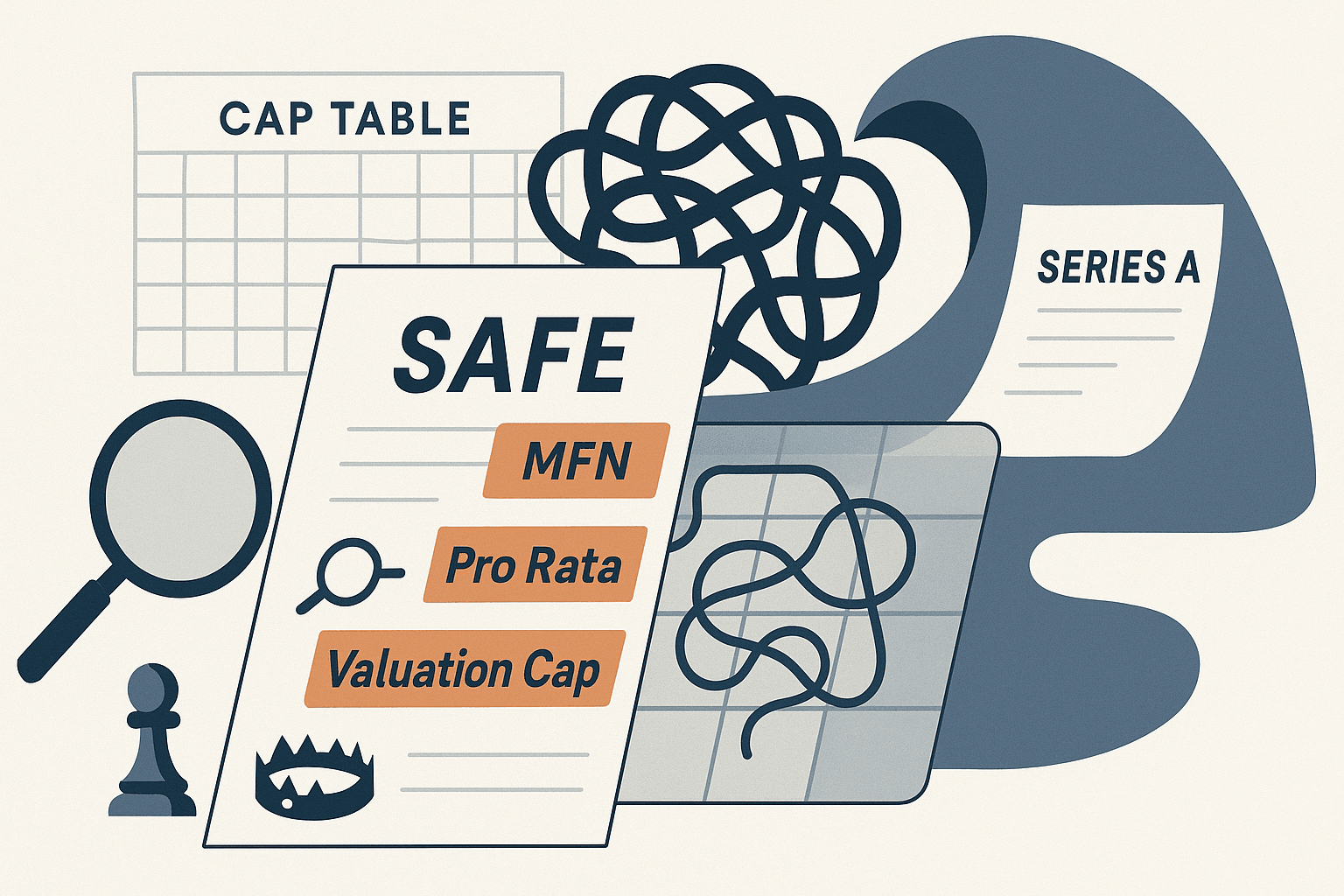
How MFN, pro-rata, and valuation cap clauses in a SAFE can reshape your next round, and which terms to read closely before you sign.
Why this article exists
SAFEs are often sold as “founder-friendly.” Sometimes they are. But they are also quietly powerful instruments that can reshape your next priced round, especially Series A, through clauses that look innocuous in isolation.
The trap isn’t usually a single egregious term. It’s the combination of:
If you’re building a venture-scale company, the economics of your Series A are not just the price and the size. They’re also: who must be let in, who can take more than their share, and what your pre-money actually means once all convertibles become stock.
This guide is opinionated: in my view, most founders under-negotiate SAFE terms because they believe “it’s standard.” Many “standard” SAFE add-ons are standard because founders allow them to be, not because they are required for a healthy seed.
I’ll walk through how the hidden clauses work, how they show up in real documents, what red flags to look for, and alternative structures that sophisticated VCs will accept.
> Important note: This is not legal advice. Use it to sharpen your negotiating posture and to know what questions to ask your counsel.
---
SAFEs 101 (only what you need)
A SAFE (Simple Agreement for Future Equity) is a convertible instrument that typically converts into equity at a future priced round. The most common reference is Y Combinator’s SAFE, which has a few variants:
In a priced round (e.g., Series A), the SAFE converts into preferred stock using a defined conversion mechanism. The conversion price depends on the cap and/or discount and on how the priced round defines its share price.
Key point: a SAFE is not “just a placeholder.” It is a claim on your future equity under rules you set today, often before your leverage is real.
References:
---
The core problem: SAFEs are negotiated as if they’re isolated
In reality, a SAFE is part of a system:
The Series A term sheet has to reconcile all of it into a single capitalization story. And if it can’t, your new lead investor may demand:
Founders often think the only risk is “more dilution.” The subtler risk is that messy convertibles reduce your ability to choose your next investor, and increase the probability of a “structure-heavy” Series A.
---
The SAFE clauses that quietly reshape Series A
1) Valuation caps: the silent price floor (and sometimes, your actual price)
A valuation cap feels simple: it limits the price at which the SAFE converts, giving the investor upside if your Series A is priced higher than the cap.
The hidden effect is that a cap is not just a discount, it is a shadow valuation that can dominate your Series A economics when enough money is capped.
#### How the math becomes governance
Imagine:
If a large portion of the $6M converts at $20M–$35M caps while the Series A is at $80M, the SAFE holders get materially more shares than the Series A price implies.
That has knock-on effects:
In practice, many Series A leads mentally re-price your round after modeling the conversion stack. Your “$80M pre” may behave like “$60M pre” once the cap table settles.
#### Red flags with caps
#### What’s “standard” here?
YC’s post-money SAFE was designed partly to reduce ambiguity by making dilution more legible at signing. But legible doesn’t mean small.
Reference:
---
2) MFN: the retroactive upgrade that founders forget they granted
MFN (Most Favored Nation) provisions allow an investor to upgrade their SAFE if the company later issues another SAFE with “more favorable” terms.
Founders often view MFN as harmless: “If we give someone better terms later, earlier investors shouldn’t be punished.” The problem is how broad “better terms” can be defined, and how MFN interacts with time, urgency, and messy financing.
#### What MFN looks like (example)
You might see language like:
> “If the Company issues any subsequent SAFE or other convertible security with terms more favorable to the investor than this SAFE, the Investor may elect to amend this SAFE to include such more favorable terms.”
On its face, this looks like pricing parity. In reality, it can be:
If you raise a small bridge SAFE under time pressure with a lower cap or additional investor protections, MFN holders can reach back and claim those terms too, multiplying the impact.
#### Why MFN is so dangerous in “small bridge” situations
The most common scenario:
That can turn a $500k “tough but survivable” bridge into a re-pricing of your entire seed stack.
#### MFN isn’t always evil
There’s a reasonable investor argument for MFN:
But the founder-friendly version of that argument is: if you want to reward early risk, don’t give retroactive upgrades, give a cap that reflects early risk. MFN is often a way to get “early cap now” while reserving the right to get “late cap later.”
#### Founder stance
References:
---
3) Pro rata rights: when “fair” becomes crowd-out
Pro rata rights let an investor maintain their ownership percentage in future financings. Many institutional seed investors expect them.
The issue is not pro rata per se, it’s how much, who gets it, and how it aggregates across many SAFE holders.
#### The crowd-out dynamic
Suppose at Series A you want:
If existing investors collectively have pro rata rights that require you to offer them (or reserve) $6M of the round, your new lead may demand a larger total raise to hit their ownership target. That can:
Or it can force you to deny allocation to a new investor you want.
#### SAFE pro rata can be sneakier than priced-round pro rata
In priced rounds, pro rata is typically spelled out in the Investors’ Rights Agreement, often limited to “Major Investors” and subject to thresholds.
With SAFEs, pro rata sometimes appears:
Because SAFEs are fast, founders sign side letters without realizing they’ve created an obligations stack.
#### Red flags
#### Reasonable middle ground (what VCs accept)
References:
---
4) “Company Capitalization” definitions: where dilution hides in plain sight
Many conversion formulas rely on a definition of “Company Capitalization.” Small changes here can materially alter conversion price.
A common investor-friendly move is to define capitalization in a way that includes:
Including a larger pool increases the denominator and can yield more shares to the SAFE holder at conversion, depending on structure.
#### Example of a definitional trap
Language like:
> “Company Capitalization includes all shares of Common Stock issued and outstanding, all shares reserved for issuance under any equity incentive plan, and all shares issuable upon conversion of outstanding securities…”
Founders often don’t appreciate that “shares reserved” means the board can expand the option pool later and inadvertently change conversion outcomes.
#### What you want
This is one place where having counsel who has actually papered many SAFE-to-Series-A conversions matters.
References:
---
5) What counts as an “Equity Financing”: conversion triggers and edge cases
SAFEs typically convert on an “Equity Financing” above a threshold (a “Qualified Financing”). That definition can be gamed.
#### Common edge cases
If the SAFE doesn’t convert when everyone assumes it will, you can end up with:
#### Founder approach
---
6) Liquidity and dissolution treatment: preferences you didn’t mean to grant
SAFEs have provisions governing what happens in a liquidity event (acquisition) or dissolution before conversion.
Depending on the SAFE version, the investor may get:
This can be reasonable. But pay attention to whether SAFE holders are effectively getting a preference-like outcome without having negotiated a priced round.
For founders, the key is consistency across your SAFE stack so that an acquisition doesn’t turn into a multi-class negotiation.
---
The “SAFE stack” problem: how clauses interact
Most painful Series A situations don’t come from one clause; they come from interacting clauses across multiple instruments.
Here’s a pattern that repeatedly creates trouble:
Result: the Series A lead demands either:
Founders interpret this as “Series A investors are predatory.” Sometimes they are. But often it’s just the cap table telling the truth: you already sold a lot of your Series A economics, quietly.
---
Clause-by-clause negotiating: what to push back on (and how)
A. MFN: if you can’t remove it, narrow it
Preferred outcome: no MFN.
If you must accept MFN, narrow it like this:
- pro rata
- information rights
- board/observer rights
- liquidation treatment
- side letters
A reasonable investor can accept: “MFN is about not being disadvantaged within the seed round, not about perpetual retroactive repricing.”
B. Pro rata: keep it for majors, make it expire
Push for:
If a small-check investor insists on pro rata, the honest response is operational: “We can’t manage dozens of pro rata holders and still run an efficient Series A process.”
C. Valuation caps: manage them as a system, not per-check
Cap negotiation isn’t just “what’s fair today.” It’s “what does my cap table look like when $X converts?”
Tactics:
D. Definitions: don’t accept mysterious capitalization language
Ask counsel to model conversion under:
If the definition allows future changes to affect conversion materially, it’s a trap.
E. Side letters: treat them like primary documents
Side letters are where “standard” rights sneak in.
Process discipline:
---
Realistic red flags (what should make you pause)
- If you’re not sure you’ll never raise a bridge, MFN is a loaded gun.
- This can make your Series A allocation impossible.
- It’s often unnecessary; if investors push for it, ask what risk they think they’re underwriting that the cap doesn’t cover.
- Different definitions, different triggers, different liquidity treatment. Cleanup becomes expensive.
- If a term can’t be explained clearly, it’s either poorly drafted or deliberately vague.
- Board observers, vetoes, consent rights: these belong (if at all) in a priced round with a coherent set of documents.
---
Alternative structures VCs will actually accept
1) A priced seed round (when SAFEs are no longer “simple”)
Opinionated take: once your seed stack gets big enough that conversion meaningfully affects Series A pricing, you should strongly consider a priced seed.
Benefits:
Tradeoff:
But if you’re already negotiating MFN, pro rata, and multiple caps, you’ve lost the simplicity anyway.
Reference:
2) SAFE with cap only + separate, standardized pro rata side letter for majors
This is often the cleanest seed structure:
This separates economics (SAFE) from rights (side letter), but in a controlled, consistent way.
3) “Same terms for the whole round” policy (no MFN needed)
Instead of MFN, commit operationally:
If you later raise another round, it’s a new round. This reduces the moral argument for MFN.
4) Convert-to-equity seed extension instead of a punitive bridge SAFE
If you’re close to Series A but need runway, consider:
The goal is to avoid setting a new low cap that triggers MFN repricing.
5) Capped note (rarely better, sometimes worse)
Convertible notes can be fine, but they add:
If you’re trying to reduce Series A fragility, adding maturity walls can backfire. Notes are often more founder-adverse than SAFEs unless carefully managed.
---
A practical checklist before you sign any SAFE
Step 1: Build a conversion model
At minimum model:
If you can’t model it, you can’t negotiate it.
Step 2: Inventory all “rights” granted outside the SAFE
Step 3: Decide your “rights budget”
A useful founder discipline:
Step 4: Standardize your documents
Use one SAFE template per round. Deviations create technical debt.
Step 5: Plan for the bridge now
Even if you don’t expect it, plan for it. The bridge is where most MFN and cap stack disasters are born.
---
The investor perspective (and how to respond intelligently)
Founders negotiate better when they understand why investors ask for these terms.
Why investors ask for MFN
Your response:
Why investors ask for broad pro rata
Your response:
Why investors push for low caps
Your response:
This is not about being combative. It’s about communicating that you understand the second-order effects and you’re managing the company for the long term.
---
Case-style examples: what “poisoned Series A economics” looks like
Example 1: MFN turns a small bridge into a full-seed repricing
Founder expects only $750k to convert cheaply.
But MFN holders elect the $15M cap. Now most of the $3M converts at $15M.
Series A lead models dilution, decides the round can’t clear their ownership target at the founder’s desired price. They demand a lower pre or more money raised.
Root cause: MFN was treated as “fairness,” not as an embedded option.
Example 2: Pro rata stack crowds out the new lead
Lead wants $12M for 20% ownership. The company only wants to raise $12M total.
To satisfy pro rata, either:
Root cause: pro rata rights were granted too broadly with no thresholds.
Example 3: Cap stack makes the headline pre-money meaningless
The “effective” ownership of SAFE holders resembles what they would have received at a much lower pre. The founders feel the Series A “took too much.”
But the Series A didn’t take it, the earlier caps did.
Root cause: founders treated caps as localized discounts, not a priced claim on the cap table.
---
Opinionated guidelines (if you remember nothing else)
---
References and further reading
If you want to go deeper, ask your counsel to walk you through how your specific SAFE language interacts with (a) option pool refresh mechanics and (b) Series A price-per-share definitions. Those are the two most common places where founders discover “hidden” dilution.
---
Closing thought
A SAFE is only “simple” if you keep it simple.
Your goal as a founder isn’t to win every term negotiation; it’s to avoid creating a cap table that forces you into a bad Series A. MFN, broad pro rata, and poorly understood caps don’t just change economics, they change who has leverage when your company finally has real traction.
Treat each SAFE as if it’s already part of your Series A term sheet. Because, functionally, it is.
RaiseSimpli Team
Author