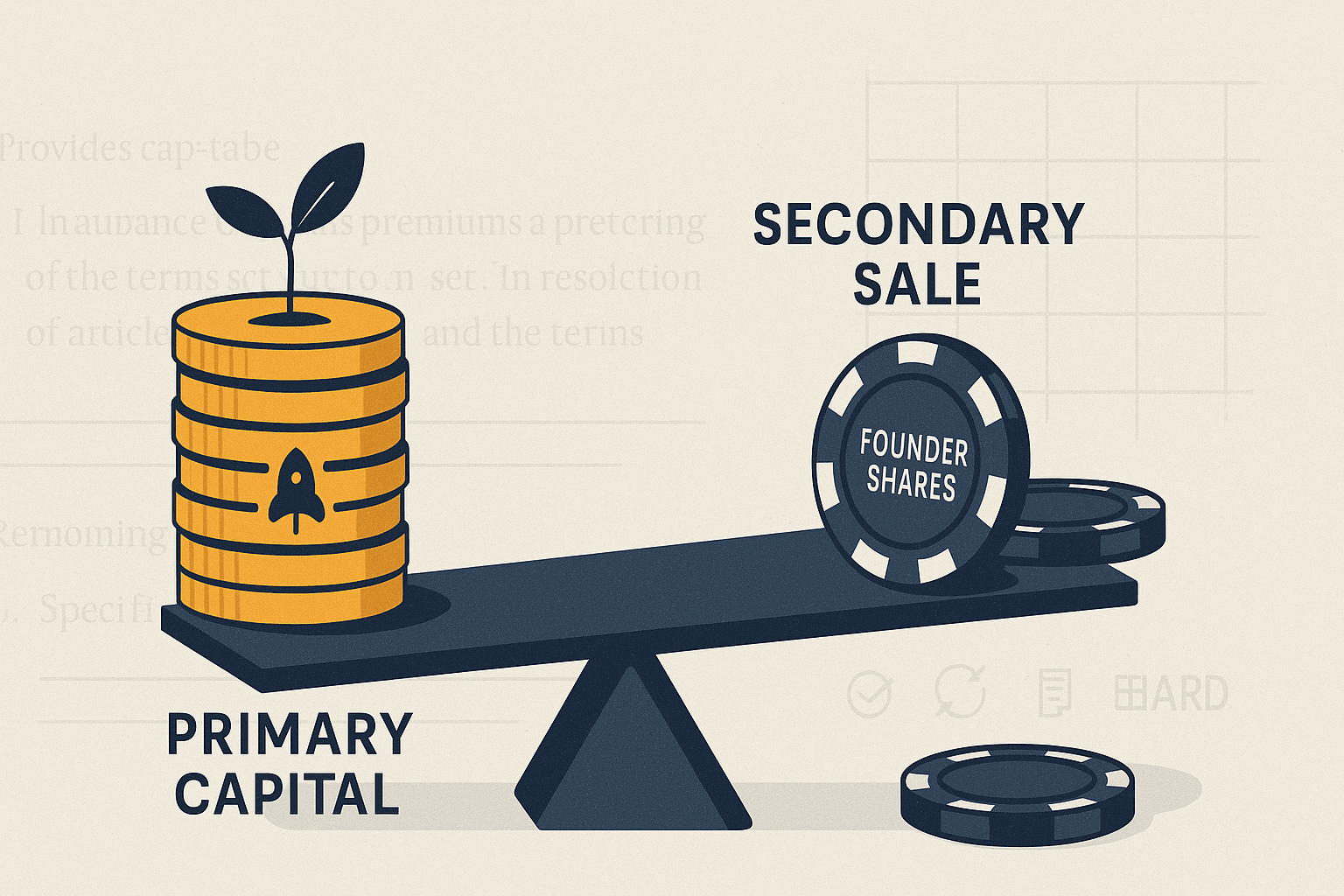
When letting founders sell shares hurts your next VC round, how timing and size change investor reactions, and how to structure the sale.
The problem isn’t that founders sell secondaries, it’s how and when
Founder secondaries (a founder selling some of their personal shares to investors, usually during a financing) are one of the most misunderstood, and most mispriced, moves in startup fundraising. In the best cases, a controlled secondary de-risks the founder, reduces burnout, and aligns incentives for the long slog. In the worst cases, it becomes a signaling event that quietly poisons the next round: growth looks weaker, primary capital looks less needed, and investor conviction looks fragile.
This article is opinionated: most early founder secondaries are bad, and a meaningful fraction of “founder liquidity” is really a substitute for fixing fundamentals (go-to-market efficiency, retention, margin profile, or simply the clarity of the story). But it’s also true that some secondaries, done with discipline, can increase valuation by removing latent risk and strengthening the company’s narrative.
We’ll unpack:
> Note: This is not legal or tax advice. Secondaries have material legal/tax implications and are highly jurisdiction-specific. Consult counsel and a qualified tax advisor.
---
1) What a founder secondary actually is (and why investors care)
A secondary sale is the sale of existing shares from one shareholder (e.g., a founder) to another party (often a new or existing investor). It contrasts with a primary issuance, where the company issues new shares and receives the cash on its balance sheet.
Common variants:
Why investors care is simple:
Investors are not morally opposed to founders having money. They’re opposed to founders selling shares in ways that change incentive structures, create adverse selection, or reveal a weak financing need.
A foundational principle in venture is that value is created by future growth. Anything that implies the future is less compelling, like a founder wanting out, gets scrutinized.
---
2) How VCs underwrite and price secondaries
Secondaries are often “priced” at the same share price as the primary round, but that doesn’t mean VCs think of them as equivalent.
2.1 Primary and secondary are different risk exposures
That’s why many funds have explicit policies limiting secondaries at early stages. Even when permitted, the internal IC memo often treats the secondary tranche as a separate instrument with separate rationale.
2.2 Secondaries are influenced by fund mechanics and constraints
Even if a VC likes the company, they may avoid secondaries because:
2.3 Pricing reality: secondaries often deserve a discount (but founders rarely accept it)
In public markets, liquidity and information reduce spreads. In private markets, secondaries should be discounted because:
In practice, in hot markets, secondaries often clear at or near the last round price. In colder or more selective markets, buyers push for discounts, structure (e.g., preferred-like terms), or simply refuse.
A useful reference point is the existence of dedicated secondary funds and platforms, which often transact at discounts when there’s no competitive process (see coverage from industry analyses by firms like Forge, EquityZen, and secondary-focused funds; also note that private secondary pricing varies significantly by company quality and market cycle).
---
3) The signaling problem: why secondaries can hurt your next VC round
The most important effect of a founder secondary is not dilution. It’s what it implies.
3.1 “If the company is winning, why does the founder need liquidity now?”
This is the default skeptical read. It’s not always fair, but it’s how many investors think, especially when growth is not obviously breakout.
Founders often justify secondaries as “risk reduction.” Investors often hear: “confidence reduction.”
If your metrics are elite, the market forgives liquidity. If your metrics are merely good, secondaries can become the narrative.
3.2 Secondaries can imply weak demand for primary capital
A new lead investor wants to believe:
If a meaningful portion of the “round” is secondary, the next investor may wonder whether you:
In other words, a secondary can be interpreted as a hidden softness signal in the prior round.
3.3 Incentives: the “hunger” question is real
It’s fashionable to dismiss the motivation argument as simplistic. But incentives do matter. A founder with $0 in the bank and a founder with $10M liquid behave differently under stress.
The nuance: the goal isn’t to keep founders desperate. The goal is to keep them committed to the hard path when the easy path (selling the company early, slowing down, avoiding conflict) appears.
A small, controlled secondary can reduce personal stress without dulling ambition. A large secondary can create an option value mismatch: the founder’s downside is protected, so the founder rationally prefers lower-variance outcomes.
3.4 Cap table optics: secondaries can create “too many sellers” vibes
If founders sell, employees often ask to sell. If early angels sell, it can look like smart money is exiting.
Even when that’s not true, the next round investor sees a pattern: selling pressure. They may worry about future tender demands, morale issues, and ongoing cap table complexity.
---
4) When secondaries are especially dangerous
Not all secondaries are equal. Here are patterns that often create downstream pain.
4.1 Early-stage secondaries without breakout traction
At Seed or Series A, the company’s value is mostly future optionality. If a founder sells early, the question becomes: why now?
Unless you have unusually strong pull (e.g., category leadership, explosive growth, exceptional retention), early secondaries can read as premature de-risking.
4.2 Secondaries used to “paper over” valuation disagreements
A classic anti-pattern: a new investor won’t meet the founder’s valuation expectations on primary, so the round is “sweetened” with secondary.
This can clear the round, but it creates a fragile foundation for the next raise:
4.3 Large founder liquidity relative to round size
A rule of thumb many investors apply informally:
There is no universal threshold, but once the secondary becomes a meaningful percentage of the total dollars, scrutiny rises.
4.4 Secondaries in a down round or flat round
If valuation is flat/down and founders take liquidity, the signal is almost impossible to spin positively. The buyer may be fine with it, but the next buyer will assume the company is struggling and founders are hedging.
---
5) The clauses that decide whether your secondary is painless, or a minefield
Many founders treat secondaries as “side deals.” They are not. They sit inside a legal and governance framework that can materially affect future fundraising.
Below are the big ones to understand. Exact terms vary, but these are common across NVCA-style documentation in the US and comparable structures elsewhere.
5.1 ROFR (Right of First Refusal) on share transfers
A ROFR typically allows the company (and sometimes investors) to match any proposed transfer of shares. This matters because:
ROFR is extremely common; it’s also a reasonable control mechanism to keep the cap table clean.
What to watch:
5.2 Co-sale / Tag-along rights
Co-sale rights allow investors to sell alongside a founder if the founder sells shares. If you sell 5% of your holdings, they might be able to sell 5% of theirs.
This is often framed as fairness, if the founder gets liquidity, others should too. But it can complicate secondaries and increase selling pressure.
5.3 Pro-rata rights (and why they show up indirectly)
Pro-rata typically refers to the right of existing investors to participate in future primary financings to maintain ownership.
How it affects secondaries:
The subtle risk: if a round is structured with more secondary and less primary to satisfy ownership goals, the company might end up undercapitalized, making the next round harder.
5.4 Protective provisions / board approval requirements
Some documents require board or preferred shareholder approval for transfers above certain thresholds. Even if not explicit, practically, a meaningful founder secondary is often treated as a board-level discussion because it affects:
5.5 “Secondary restrictions” in the financing documents
It’s increasingly common to see explicit terms like:
If you accept these, understand that they may limit flexibility later.
5.6 Drag-along and transfer restrictions
These don’t directly govern a secondary, but they influence who can buy, how clean the cap table remains, and whether future acquirers/investors view the shareholder base as manageable.
---
6) How secondaries can damage your next round mechanics (not just optics)
The next round investor does not only ask “why did you sell?” They ask “what did it do to the system?”
6.1 Undercapitalization: the silent killer
If the company could have raised $15M primary but instead raised $10M primary + $5M secondary, the company has less runway and fewer shots on goal.
That can force:
And reactive fundraising is where valuation gets compressed.
6.2 Option pool dynamics
Secondary proceeds don’t expand the option pool. Primary often does (or triggers an option pool “top-up”). If you do less primary, you may:
This is one reason some “secondary-heavy” rounds feel worse in hindsight than they looked on day one.
6.3 Ownership and control side effects
If the buyer of the secondary is a new investor, they may end up with meaningful common ownership or convert into preferred via the financing structure. This can:
6.4 Signaling via the data room
Future investors will see the transaction history:
Even if you think it’s private, it will surface in diligence (cap table, stock transfer ledger, investor conversations). The story must hold up.
---
7) The case for founder secondaries (yes, sometimes they’re rational)
A blanket “no secondaries ever” stance is simplistic. There are real situations where a secondary improves the company’s expected outcome.
7.1 Founder risk concentration is extreme
Many founders have:
A modest liquidity event can lower stress, improve decision quality, and reduce the chance the founder takes a bad acquisition out of fear.
This is consistent with the incentive alignment argument: reducing personal fragility can increase willingness to pursue the best long-term outcome.
7.2 “Talent retention” applies to founders too
We accept employee liquidity programs as retention tools (especially later-stage). The same logic can apply to founders when:
7.3 Cleaning up early cap tables
Sometimes the most valuable secondary is not founder liquidity but cap table maintenance:
This can make the company more investable later.
7.4 Controlled secondaries can increase valuation under the right conditions
This sounds counterintuitive, but it happens when the secondary:
In those cases, the next round investor may see a more stable leadership situation and a cleaner forward plan.
---
8) A practical framework: deciding whether to allow founder liquidity
Here’s a decision framework that is more useful than ideology.
Step 1: Are your fundamentals strong enough to “absorb” the signal?
Secondaries are easiest to defend when:
If you’re already close to the line, don’t add narrative risk.
Step 2: Can you fully fund the plan with primary?
If a secondary reduces primary below what you need to hit the next milestone, it’s a bad trade.
A good rule: primary should be sized to win, not to close.
Step 3: How much liquidity is enough to change behavior, not identity?
The goal is not wealth maximization today; it’s risk reduction.
Practical heuristics used in the market (varies widely):
Step 4: Who is buying and what does that imply?
Step 5: Can you message it cleanly to the next round?
Assume future diligence will ask:
If you can’t explain it in two sentences without sounding defensive, you’re setting a trap for later.
---
9) How to structure a “controlled secondary” that doesn’t torpedo fundraising
If you decide to do a secondary, structure matters as much as amount.
9.1 Make it subordinate to a strong primary
A common best practice is:
This avoids the undercapitalization problem and reinforces that the financing is about company growth.
9.2 Cap it explicitly and tie it to milestone maturity
Use clear caps, e.g.:
Avoid open-ended “we’ll see” approaches that invite repeated selling.
9.3 Prefer a single, clean event over drip-selling
Repeated founder sales create an overhang and increase skepticism. A one-time controlled secondary (with board buy-in) is easier to defend.
9.4 Avoid exotic terms that create future confusion
Sometimes buyers propose structures that start to resemble preferred terms (ratchets, guarantees, side letters). These can create a diligence mess later.
Keep it simple. Clean common transfer. Clear approvals.
9.5 Manage information and internal morale
Employees will hear about it. If the founder sells and employees can’t, resentment can build.
Consider whether a broader tender (even small) is appropriate at later stages, or whether you should clearly communicate the rationale (without oversharing).
9.6 Be careful with valuation anchoring
If the secondary is priced at the round price, that anchors “fair value.” If later you raise at a lower price, the optics worsen.
This is another reason secondaries pair best with strong momentum.
---
10) Term sheet negotiation: how secondaries show up in the deal
Secondaries often appear as a line item in the financing summary:
Key negotiation points:
Also watch for side terms that effectively restrict future liquidity beyond what you intend.
For US-style documentation norms, NVCA model legal documents are a useful reference baseline (National Venture Capital Association model docs).
---
11) Common misconceptions (that cause founders to misplay secondaries)
Misconception 1: “Secondary is free, it doesn’t dilute the company.”
It doesn’t dilute the company, but it can:
Misconception 2: “If the investor agrees, it must be fine.”
The investor buying your secondary is not necessarily the investor who will fund your next round. The next round investor may interpret it very differently.
Misconception 3: “Secondaries always mean the founder is less committed.”
Not always. But markets trade on heuristics. Your job is to avoid being misclassified by a heuristic when you’re fundraising.
Misconception 4: “We’ll keep it quiet.”
Assume it will be known in diligence and through networks.
---
12) A concrete way to think about “how much is too much”
There’s no universal formula, but you can reason about it via three ratios:
If you want a simple, defensible posture:
---
13) When you should explicitly say no (even if it’s tempting)
You should refuse founder liquidity when:
This is the “secondary sale trap”: the immediate relief (closing the round, getting personal cash) is outweighed by the probability-weighted damage to the next financing.
---
14) When a secondary can be a power move
A secondary can strengthen the company when it is:
When those conditions hold, founder liquidity can be positioned as governance maturity: the company is building for endurance, not short-term heroics.
---
15) Checklist for founders before agreeing to a secondary
Use this as a pre-signing checklist:
---
Conclusion: secondaries are not a sin, they’re a high-voltage tool
Founder secondaries sit at the intersection of incentives, storytelling, and capitalization strategy. They can be healthy in mature companies with strong momentum. They can also quietly corrode your fundraising trajectory when used too early, too large, or as a substitute for primary capital.
The core idea is simple: your next VC round is not just a function of today’s valuation, it’s a function of perceived momentum and clean incentives. A founder secondary is a strong signal to the market. If you can’t control the signal, don’t send it.
If you can control it, small, disciplined, subordinate to primary, and backed by undeniable execution, it can remove fragility and increase the probability of building something enduring.
---
References and further reading
- Forge Global research/market commentary: https://forgeglobal.com/
- EquityZen market insights: https://equityzen.com/blog/
- Kaplan & Strömberg, venture contracting/governance research (various papers; one gateway page): https://www.nber.org/people/steven_kaplan
(These references provide background on terms, mechanics, and market behavior; specific outcomes depend heavily on company quality and market cycle.)
RaiseSimpli Team
Author