Founder Secondaries at Seed and Series A: Risks
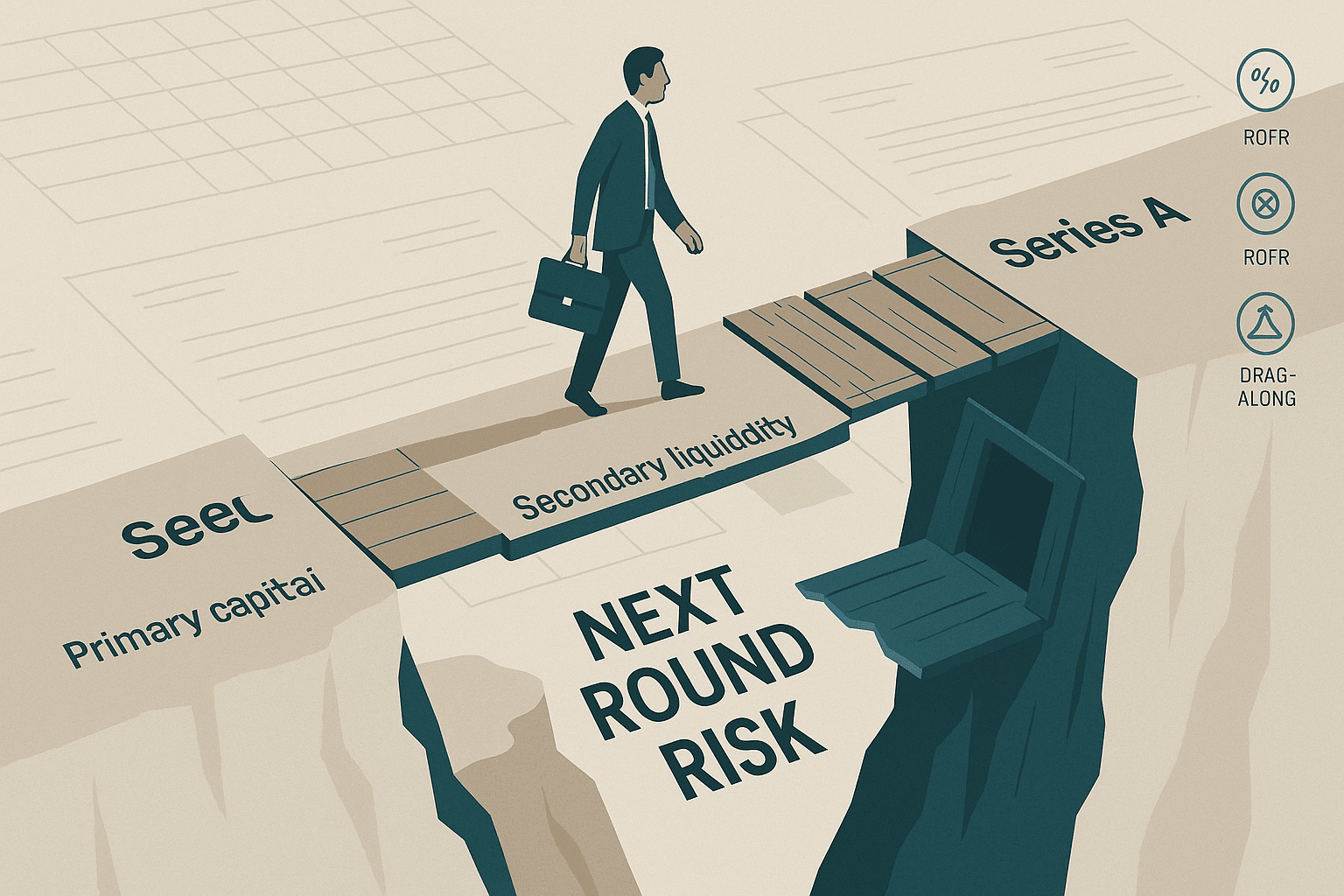
How founder liquidity at Seed and Series A can hurt your next round, and the cases where taking some money off the table actually helps.
The uncomfortable truth about secondaries
Founder secondary sales at Seed and Series A are one of those topics where everyone has an opinion, few people speak plainly, and almost every stakeholder has incentives to frame the story their way.
In theory, secondary liquidity is simple: a founder sells some existing shares to a new or existing investor, taking money off the table while the company raises little or no additional primary capital. In practice, early secondaries are a signal, and fundraising is largely a market for signals.
The contrarian part is that early founder liquidity isn’t always bad. Sometimes it’s the healthiest, most rational move for both founder and company. But it’s also a common way to sabotage your next round, often without realizing it, because the damage shows up later in diligence when the next lead investor reconstructs incentives, cap table dynamics, and governance constraints.
This article is opinionated: early secondaries are usually expensive in hidden ways. The goal isn’t to moralize (“founders shouldn’t cash out”), but to explain:
> Note: Nothing here is legal or tax advice. Secondary mechanics and consequences vary by jurisdiction, plan documents, and investor rights.
---
Definitions: primary vs secondary, and the versions people confuse
Before the strategy, get crisp on what’s happening economically.
Primary capital
Money goes into the company’s balance sheet in exchange for newly issued shares. This funds runway, hiring, product, and growth. Primary is what most investors want to see at Seed/A.
Secondary sale
Money goes to a seller (founder/employee/early investor) in exchange for existing shares. The company usually doesn’t get cash (except maybe a small portion if the round includes both primary and secondary).
Common variants
Why this matters
The market doesn’t interpret all secondaries equally. A modest founder secondary as part of a strong, oversubscribed round led by a top-tier investor is a different message than a founder insisting on liquidity as a precondition for the round.
---
The core problem: secondaries change incentives, and investors underwrite incentives
Venture investing is underwriting a set of risks: market risk, product risk, execution risk, financing risk. At Seed and Series A, the single biggest risk factor is usually the team, especially the founders.
Founder equity is the primary “bond” that keeps the founder’s incentives aligned with the long, painful path to an exit.
A founder secondary sale can be interpreted by future investors as one (or more) of these:
None of these are automatically true, but the next lead investor is paid to assume adverse selection.
This is why founder secondaries often “kill your next round”: not because you took money, but because you changed the perceived distribution of outcomes.
---
The signaling math: why a little can be fine, and a lot becomes toxic
Here’s the uncomfortable investor logic.
A founder’s expected value from continuing is tied to:
When a founder sells early, they are reducing the “need” component and potentially reducing the “upside sensitivity.” That can be fine if the founder remains massively motivated by mission, competitive drive, or still has a large equity stake.
But investors ask: if the founder’s marginal utility of additional wealth drops, does the probability of pushing for an outlier outcome also drop?
Behavioral economics supports the general concept of diminishing marginal utility, though individual motivation varies widely. Investors will model this pessimistically because it’s safer.
In other words: you’re not just selling shares, you’re selling part of the story.
---
How much founder liquidity is “too much”? Practical heuristics
There’s no universal threshold, but there are market norms. The danger zone depends on stage, traction, round size, founder ownership, and founder’s personal situation.
A useful framework: liquidity as a percentage of round and a percentage of founder stake
Investors look at both:
#### Common heuristics seen in the market (not rules)
#### Red flags (often round-killers at the next step)
A more founder-centric heuristic: “enough to remove fragility, not enough to remove ambition”
A reasonable case for early liquidity is to eliminate personal fragility:
The case becomes weaker when liquidity becomes lifestyle expansion rather than fragility reduction.
If you want a blunt line: if the secondary meaningfully changes how hard you’d fight for a 10x bigger outcome, it’s probably too much for Seed/A.
---
What VCs infer from founder liquidity (and what they rarely say out loud)
Investors often won’t tell you the real reason secondaries worry them, because it’s socially awkward and can poison the relationship.
Here are the common inferences:
1) “If they want liquidity now, fundraising may be harder later”
A founder demanding secondary can indicate limited access to capital or weak negotiating position, even if that’s not true. Future investors will ask: why did the founder need this then?
2) “There may be internal conflict”
Secondaries sometimes happen because cofounders disagree about risk tolerance, or because one founder is partially checking out. A new lead will probe team dynamics harder.
3) “The board let this happen, what else is loose?”
If a company has already institutional investors and the board approved meaningful founder liquidity early, a future investor may infer weak governance norms.
4) “This cap table might be full of landmines”
Secondaries sometimes come with:
Future investors hate uncertainty. They’d rather fund a slightly worse company with a clean cap table than a better company with hidden obligations.
---
The secondary structures that backfire later
Some secondaries are fine economically but toxic structurally. These are the traps that show up in diligence.
Trap #1: Secondary sold at a different price than the primary round
If founder shares are sold at a discount (or premium) to the primary price, it can create:
Generally, in a priced round, keep secondary at the same price per share (or have a clean, defensible rationale).
Trap #2: Giving the secondary buyer preferred-like protections on common
Sometimes secondary buyers try to get:
This is often a non-starter for later institutional leads. Common should remain common; don’t smuggle preferred economics into secondary common purchases.
Trap #3: ROFR/transfer restrictions that are overly broad or messy
Most companies have Right of First Refusal (ROFR) and co-sale provisions restricting transfers. If you waive ROFR for one transaction, you may set precedent.
Later, when you want to run an organized employee tender, you might find you’ve created:
Trap #4: Secondary that concentrates ownership in a “non-standard” investor
If the buyer is:
…future leads may price in governance and signaling risk.
Trap #5: Secondaries that reduce founder ownership below psychological thresholds
Investors care less about your exact percentage than you think, but they do care about whether you still have “founder-scale” exposure.
If a founder is moving from, say, 20% to 12% early, that can change the story. (Exact numbers vary widely by stage and dilution.)
Trap #6: Using secondaries to paper over an overvaluation
This is subtle but real: sometimes a company raises at a high price with minimal primary, plus secondary to satisfy the investor’s check size.
That can backfire because:
This is a cousin of the “Series A trap” generally, but secondaries can amplify it.
---
The fundraising dynamic: why secondaries can kill your next round specifically
The next lead investor will underwrite two things that your current investor may not:
Early secondaries can damage both.
Mechanism 1: Downstream investors assume you’ll ask again
If you took secondary at Seed/A, the next lead may assume:
Even if you won’t, investors model patterns.
Mechanism 2: It changes the internal narrative in partner meetings
A lot of funding decisions happen in rooms where someone says:
That single sentence can tilt a marginal decision toward “pass.” It doesn’t need to be fair; it needs to be plausible.
Mechanism 3: It complicates the “use of funds” story
In early rounds, investors want to see:
When part of the round is secondary, it invites a less flattering interpretation: that the round is partly about founder liquidity rather than business acceleration.
Mechanism 4: It can create insufficient runway
If you allocate too much of the check to secondary, you might end up raising again sooner, right when market conditions turn. That’s how “harmless” secondary becomes fatal.
---
When founder liquidity actually helps
Founder secondaries aren’t inherently unethical or irrational. In some cases they are not just acceptable but strategically beneficial.
1) Removing founder fragility increases company resiliency
A founder who is one unexpected medical bill away from disaster is not maximally effective.
A modest liquidity event can:
This is consistent with the idea that constraints can distort decision-making. The best founders are intense; they don’t need additional existential pressure.
2) It can prevent premature acquisition
A founder with zero liquidity may take a mediocre acquisition to “end the suffering.” A small secondary can buy patience.
This is one of the strongest pro-secondary arguments, and it aligns investor and founder incentives: avoid low-value exits.
3) It can stabilize cofounder dynamics
If one cofounder is more financially stressed than the other, asymmetry can create resentment.
A structured, board-approved, small secondary can reduce internal friction, especially if paired with clear vesting and role expectations.
4) It can help with taxes from early exercise (sometimes)
If founders exercised early and face tax burdens (jurisdiction-dependent), liquidity may prevent forced sales later under worse conditions.
Be careful here: many investors will want specifics, and the solution might be better handled through planning rather than secondary.
5) It can be a recruiting signal (if done via employee liquidity later)
While this article focuses on Seed/A founder liquidity, note that the broader liquidity strategy matters. Later-stage tender offers can strengthen hiring by making equity feel real.
References worth reading on liquidity programs include a16z discussions of tender offers and secondary markets (e.g., Andreessen Horowitz content on employee equity and liquidity) and platform documentation from Carta/Forge/EquityZen on tender mechanics.
---
A realistic taxonomy: “good,” “okay,” and “bad” founder secondaries
Good
Okay
Bad
---
Negotiating secondaries without spooking future investors
If you decide liquidity is necessary, treat it like a high-stakes product launch: message discipline, clean execution, and minimize second-order effects.
1) Start with the principle: primary first
A simple rule that ages well:
If the company isn’t well-capitalized, secondary is almost always a mistake.
2) Keep it small enough that it doesn’t become the story
In partner meetings, you want the line to be:
Not:
This is a narrative threshold, not a mathematical one.
3) Make the rationale legible and non-defensive
You don’t owe every investor your personal finances, but you do need a coherent explanation.
Good framing:
Risky framing:
Those may be emotionally true, but they trigger the wrong inference.
4) Prefer pro-rata or existing investors as buyers (often)
Future investors are generally less spooked when:
A random new secondary buyer with bespoke demands creates diligence anxiety.
5) Don’t add special rights to the secondary
Keep the purchased shares as-is. Avoid:
If the buyer wants protections, they should buy preferred in the primary.
6) Avoid creating “secondary expectations” in the market
If you take secondary at A, you may be expected to offer it again later. You can mitigate this by:
7) Put it in the board minutes and disclose cleanly
Future diligence will uncover it anyway. Better to control the narrative:
Hidden secondaries or “wink and nod” arrangements can become a trust issue, which is deadly in fundraising.
---
Term sheet mechanics: where secondaries show up and what to watch
Secondaries intersect with a few common term sheet and charter topics.
ROFR and co-sale
Most venture financings include transfer restrictions. If you’re doing a founder secondary, you’ll likely need:
Be careful about setting a precedent that future sellers can cite.
Investor consent and protective provisions
Depending on the charter and stockholder agreements, a secondary transfer might require certain consents.
Future investors will look for whether approvals were proper. Sloppy governance is a bigger issue than the secondary itself.
Vesting and founder employment
Sometimes investors will allow secondary but require:
This can be reasonable, but it can also become punitive or distort incentives. The best versions are simple: maintain meaningful unvested equity that keeps the founder aligned.
Option pool interactions
Be cautious if the company simultaneously expands the option pool and permits founder liquidity. It can look like:
Even if it’s not true, the optics can be damaging internally and externally.
---
The cap table optics: secondaries vs the “cleanliness premium”
Investors pay a premium for clean structures:
Secondaries can erode this “cleanliness premium” if they introduce new stakeholders or rights.
If you must do a secondary, aim to preserve cleanliness:
---
Counterargument: “Founders are underpaid and take enormous risk, why not allow liquidity?”
This critique is valid, and the industry is slowly adapting.
Founders often:
The strict “zero secondary until IPO” norm is not only unrealistic; it can be counterproductive.
But the key is: venture is not a wage market, it’s a power law outcomes market. The entire system is built around the assumption that founders are swinging for outlier outcomes.
So the reasonable compromise many top investors converge on is:
This isn’t moral judgment. It’s aligning the incentives that make the venture model work.
---
A decision checklist for founders (Seed/Series A)
Use this as a pre-flight checklist before you request or accept founder liquidity.
Company readiness
Signaling and narrative
Structure and governance
Personal incentive alignment
If you can’t answer these cleanly, delay the secondary.
---
How to talk about prior secondaries in your next round
If you already did a founder secondary and you’re raising again, you can still manage the situation.
What not to do
What to do
A future lead is not looking for sainthood; they’re looking for predictable incentives and clean governance.
---
References and further reading
Because secondaries are both legal and market-structure heavy, it helps to triangulate from multiple sources:
(These references won’t answer “how much secondary is okay” directly, because norms are market-driven, but they anchor the mechanics and context.)
---
The bottom line
Founder secondaries at Seed and Series A are not inherently a betrayal of ambition. They can be a rational tool to remove fragility, prevent premature exits, and help founders play the long game.
But they are also a high-risk signal. The secondary trap is thinking of liquidity as a private matter between you and a buyer. It isn’t. It’s a market event that changes how future investors price your motivation, your governance, and your financability.
If you take anything from this: keep it small, keep it clean, fund the company properly first, and protect the narrative you’ll need for the next round.
RaiseSimpli Team
Author