Soft-Circled Demand: Oversubscription That Backfires
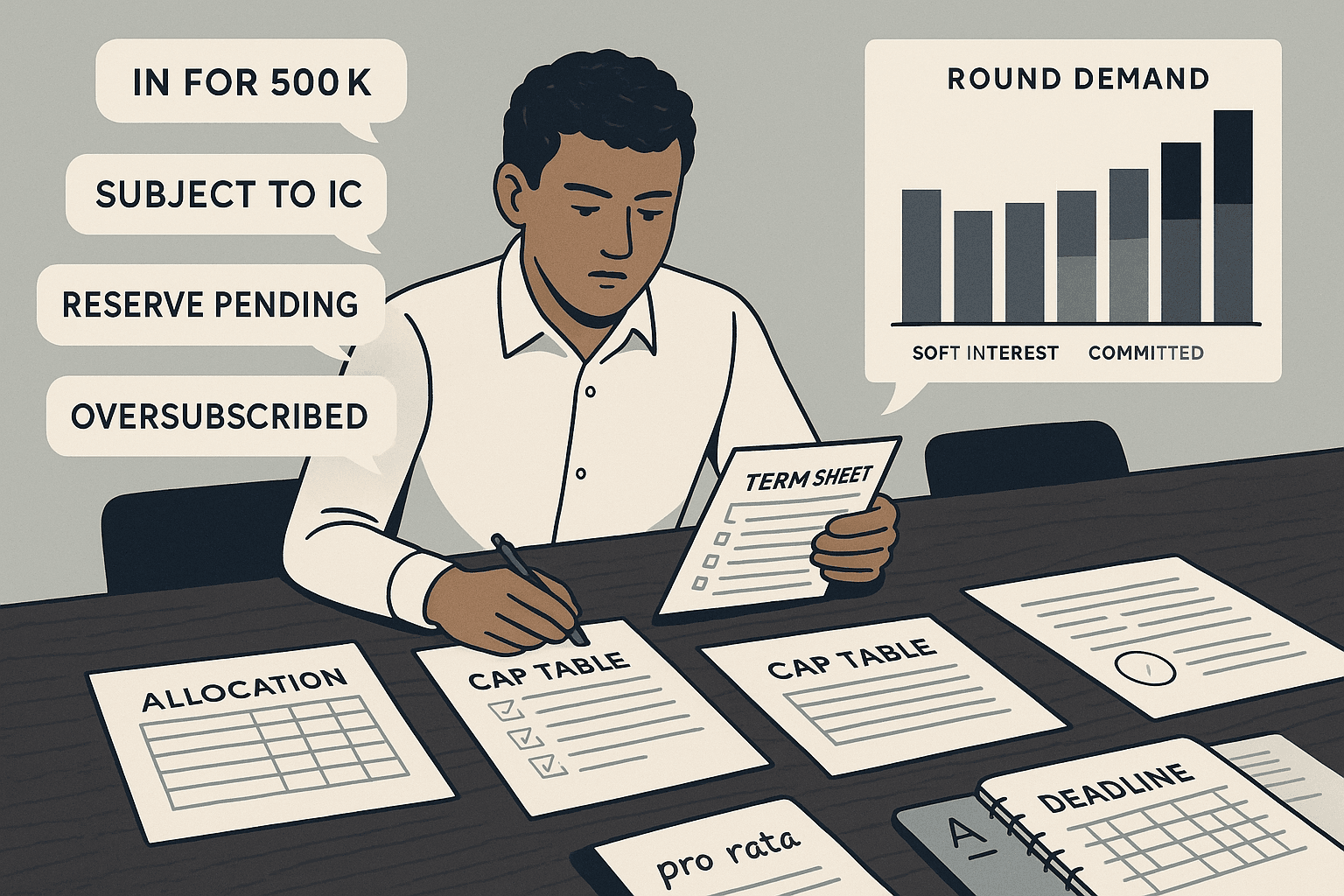
How soft-circled demand can create false pricing power against founders, and how to tell real oversubscription from a round that is not firm.
So the founder does what almost everyone does in that moment: tightens process, accelerates diligence, starts talking about “limited room,” and pushes valuation a turn higher than originally planned.
Three weeks later, one fund cuts its interest in half because of portfolio concentration. Another says the check is now contingent on a lead coming in. One investor that had “verbally committed” moves to the next fund cycle. The micro-VC that sounded certain comes back with an internal note: strong company, but not enough ownership available at this price. The round was never truly oversubscribed. It was undersubscribed the entire time. It just wore the costume of oversubscription long enough to reset negotiating leverage against the founder.
That is the undersubscribed oversubscription trap.
It happens constantly. It is rarely called out in real time because everyone benefits from the ambiguity until someone does not. Investors use soft demand to pressure founders into valuation anchors and process timelines. Founders use investor logos and “momentum” language to create scarcity and force fence-sitters to move. Sometimes this is ordinary signaling. Sometimes it is smart process management. But often it becomes something more dangerous: founders pricing rounds, allocating access, and rejecting terms based on demand that is neither hard nor durable.
The real issue is not that investors express conditional interest. Conditionality is normal. The issue is that soft-circled demand is routinely translated into hard pricing power before it deserves that status.
If you are a founder, you should care because fake scarcity changes who controls the term sheet. It influences whether you optimize for valuation versus certainty. It shapes whether investors ask for pro rata, board rights, MFN cleanup, option-pool expansion, or tranche mechanics. Most importantly, it causes founders to negotiate against a mirage. And when the mirage disappears late in the process, the only thing left is lost time and worse terms.
The problem is not oversubscription. It is the softness hiding inside it.
A genuinely oversubscribed round is simple. The company wants $4 million. It has at least $6 million of investable capital at the proposed terms, on a timeline that matches the close, from investors with authority and appetite to wire. Some of that $6 million may still be pending final documents or routine diligence, but the round clears even if one or two names fall out.
An undersubscribed oversubscription looks different. The same $4 million round may be described internally as having $6 million or $7 million of “interest,” but that number is made up of soft circles, contingent allocations, internal placeholders, and signaling behavior that does not survive contact with actual documentation.
Here is what commonly sits inside the headline number:
None of this is illegitimate. But none of it should be valued the same as a signed term sheet from a lead with decision authority, target ownership appetite, and completed high-risk diligence.
The trap emerges when founders flatten all demand into one number and negotiate as though dollars are fungible across commitment levels.
They are not.
Why current fundraising approaches fail
Most founders are told to manufacture momentum. Run a tight process. Cluster meetings. Create deadlines. Signal scarcity. Never let an investor believe they have infinite time.
This advice is directionally right. The problem is that it is incomplete. It teaches process theater without enough underwriting discipline.
The standard playbook fails in four ways.
1. It treats investor intent as binary when it is actually a spectrum
Founders often bucket investors into “in” and “out.” Real life has at least six states:
When a founder says the round is “covered,” what stage does that refer to? In many cases, half the amount is sitting in stage 3 or 4. That is not coverage. That is probabilistic pipeline.
A useful way to think about this is weighted demand, not gross demand.
Suppose you are raising $5 million and have the following investor indications:
Gross demand looks like $5.75 million. Oversubscribed.
Weighted demand is different:
You are really looking at around $3.875 million of weighted expected capital, maybe less if conditions correlate. That is not oversubscribed. That is a financing risk.
The mistake is not in hoping these checks close. The mistake is in pricing the round as though the $5.75 million is real today.
2. It overweights social proof and underweights decision authority
Founders routinely get trapped by prestigious names saying all the right things without actually controlling the outcome. Associates love a company. Principals want a slot. Platform partners offer warm language. None of this matters if the partner who owns the fund’s risk budget has not decided.
Demand should be weighted not just by size, but by authority.
A $1 million soft indication from someone who still needs Monday partner meeting approval is worth less than a $500,000 hard commitment from an angel with immediate wire capacity.
Yet in practice, founders often do the opposite. They use the big-brand soft signal to raise price against smaller but more real money. Then the brand stalls, and the founder has already strained the relationship with the investor who would actually have closed.
3. It ignores correlation risk inside the syndicate
A lot of “demand” is not independent demand.
If four investors are all waiting for a credible lead, you do not have four separate checks. You have one contingent cluster. If the lead disappears, the cluster disappears. If the lead retrades, the cluster may retrade too.
Founders routinely count these as additive demand when they are actually branches of the same underlying event.
Consider this round:
The founder may say there is $4.25 million of interest. In truth, there is only $2 million of autonomous demand. The remaining $2.25 million is correlated.
That distinction matters because correlated soft demand does not create pricing power. It borrows pricing power from someone else’s commitment.
4. It mistakes speed for leverage
When founders hear “this round is moving fast,” they often respond by accelerating pricing conversations. But speed without commitment is just motion. Investors know that urgency language influences anchoring. A founder who believes the round is hot becomes less price-flexible with serious investors and more dismissive of diligence questions.
That can backfire. The serious investor may conclude the founder is overplaying hand strength. If that investor walks, the founder learns that the “fast-moving” round was mostly reversible enthusiasm.
The core insight: pricing power comes from loss-bearing commitment, not conversational demand
This is the central idea founders need to internalize: real pricing power exists only when investors have crossed enough internal and external thresholds that walking away becomes costly.
That cost can take several forms:
Until some combination of those costs exists, most demand is cheap talk.
Cheap talk is not worthless. It can become real. But founders should stop translating it automatically into valuation power.
A good heuristic is this:
Price off the weakest capital required to close, not the strongest enthusiasm expressed.
If your round closes only when two soft-circled funds decide to convert, you do not have pricing power. If your round closes comfortably with one hard lead plus existing investor support, and the rest of the demand simply determines final allocation, then you do.
That sounds obvious. In practice, founders do the reverse. They price off the best-case syndicate and then discover too late that the floor was lower.
How fake scarcity changes term-sheet leverage
Soft demand does not just change valuation discussion. It changes every other term around the valuation.
When founders believe demand is stronger than it is, they often optimize for headline price and concede on hidden economics or control points.
Example 1: Higher price, bigger option pool
Assume a company is deciding between two proposals for a $6 million Series A.
Term Sheet A
Term Sheet B
On headline price, B looks better. Founders sometimes accept B because they think the round is oversubscribed and they can dictate terms later. But cap table math says otherwise.
Let us calculate founder dilution impact.
#### Term Sheet A math
Pre-money = $24 million
Raise = $6 million
Post-money = $30 million
Investor ownership post-close = 20%
If the 5% option pool expansion is included in pre-money, the effective dilution to existing holders is the investor 20% plus the pool refresh burden embedded before the financing.
Assume before financing:
To create a new 15% post-close pool from a 10% pre-close pool, you need additional shares. Simplifying, existing holders absorb the refresh before the money comes in. The result may bring founders from 70% down to roughly 54.4% after financing, depending on precise share counts.
#### Term Sheet B math
Pre-money = $27 million
Raise = $6 million
Post-money = $33 million
Investor ownership post-close = 18.18%
Looks better. But the pool refresh to 22% post-close from 10% pre-close is much larger. Existing holders bear that expansion. Founders can end up around 50.9% instead of 54.4%, despite the higher headline valuation.
The exact percentages depend on starting capitalization, but the point is clear: fake scarcity often makes founders fixate on valuation and miss that the investor is recovering economics through pool math and control terms.
Why does this happen? Because perceived oversubscription weakens founder vigilance. The founder thinks, “Investors are competing for access. I can hold line on economics.” In reality, no one was truly competing. The investor offering the high price knew it had leverage elsewhere.
Example 2: The super pro rata bait-and-switch
Suppose an insider says it wants to take $2 million in a $5 million round at a $20 million pre. The founder treats that as strong support and tells new investors the round is nearly covered.
Then a new lead offers a $24 million pre but wants primary allocation. The insider now says it will only take strict pro rata, which is $600,000. The founder has already pushed valuation expectations upward based on the assumed $2 million insider support. New investors hear “hot round.” But the actual capital stack is short $1.4 million.
Now the founder has three bad choices:
This is how mirage demand converts directly into term-sheet leverage against founders.
Example 3: The allocation bluff that kills your only real lead
A founder raising $3 million tells a serious lead there is only $750,000 left because the round is heavily oversubscribed. The lead, which wanted $1.5 million ownership, declines because the position is too small to matter. Two weeks later, the founder discovers that the “allocated” investors were mostly soft circles and conditional followers.
The founder did not just fail to create scarcity. The founder used performative scarcity to repel the only investor with actual conviction.
This is more common than people admit. Many funds have minimum ownership targets. If your signaling makes them think they cannot get there, they may politely step out. A founder who overstates demand can accidentally select against the most serious money.
What diligence artifacts reveal real demand versus performative demand
Founders need a way to audit demand quality. Do not just ask, “Are you in?” Ask for artifacts that reveal where the investor really is.
Here are the most telling indicators.
1. Decision-map clarity
Ask directly:
Serious investors can answer these clearly. Performative demand stays vague.
Bad answer: “We are excited and just need to socialize internally.”
Good answer: “Partner sponsor is aligned, Monday IC decides, main open item is two customer references and a security review, target check is $1 million.”
2. Ownership specificity
Real investors know what they are trying to own.
Ask:
A fund saying “We could do anywhere from $500,000 to $2 million” is not necessarily lying, but it has not actually decided. That range may hide weak conviction.
3. Diligence depth progression
Investors who are serious create work. They request data-room items, speak to customers, pull in finance or legal colleagues, and pressure-test metrics. Founders often dislike this because it feels demanding. But operational friction is often a healthier sign than glowing but content-light enthusiasm.
A good rule: if an investor is signaling urgency but not increasing diligence intensity, the urgency may be performative.
4. Documentation behavior
Real demand starts leaving paper trails.
Examples:
Again, paper is not everything. Deals still die late. But performative demand tends to avoid document specificity because specificity creates social and reputational cost.
5. Internal consistency over time
Soft demand changes shape. That is expected. But watch whether the investor’s story remains coherent.
If someone begins at “high conviction, fast process, meaningful check” and then repeatedly reframes around ownership constraints, market conditions, or waiting for a lead, you are not seeing normal diligence evolution. You are seeing confidence that was never as firm as it sounded.
6. Willingness to survive price discipline
One of the cleanest tests of real demand is what happens when valuation is held constant and time-to-decision is shortened.
Investors with authentic conviction may negotiate, but they continue engaging. Investors whose “demand” was mostly optionality often fade when forced to choose under real constraints.
A practical framework: grade the round, not the vibes
Founders should run a demand ledger. Not a CRM full of optimistic notes. A financing-risk ledger with explicit commitment grading.
Use categories like these:
Grade 1: Hard committed
Grade 2: High-probability conditional
Grade 3: Soft-circled with process motion
Grade 4: Signaling interest
Grade 5: Tourist demand
Then apply weighting.
For example, in a $4 million raise:
Gross indicated demand = $7.0 million.
Weighted likely demand = $3.2 million.
That is the truth you should negotiate from.
Notice what this changes. If you need $4 million and only have $3.2 million of weighted demand, you should not run a victory-lap process. You should either:
How founders can avoid pricing against a mirage
The solution is not to reject momentum tactics. It is to pair them with verification discipline.
1. Separate valuation discovery from allocation theater
Do not tell yourself that interest equals price validation.
You need to know:
These are different roles. Treat them differently.
If only one investor is actually underwriting the valuation and everyone else is waiting to see what happens, then your market-clearing price is being determined by one node, not by broad demand.
2. Use explicit deadline architecture
Deadlines are useful only if they reveal truth, not if they merely create noise.
A good process has three dates:
This matters because many founders jump straight to “we are filling up the round” without first requiring investors to express commitment in comparable form. You cannot evaluate demand quality if everyone communicates differently.
3. Force specificity on check size and conditions
When an investor says, “We would love to participate,” the correct response is not gratitude. It is calibration.
Ask:
You do not need a binding document from everyone. But you do need enough specificity to stop counting fantasy dollars as real dollars.
4. Build allocation policy before scarcity claims
Founders often weaponize oversubscription language without a coherent allocation policy. That is backwards.
Write down your priorities:
Then communicate consistently.
Example allocation framework for a $5 million round:
This prevents the classic mistake of telling everyone the round is tight while silently hoping enough loose interest hardens later.
5. Verify insider demand independently
Inside money is often the most overstated category in fundraising narratives.
Ask insiders:
Do not tell the market an insider is “doubling down” unless you know what that means in dollars, conditions, and approval status.
6. Preserve one honest path to close
Every process needs a no-drama close path.
That means if soft demand disappears, you still know how the round gets done. Maybe it is:
Founders get in trouble when they reject perfectly financeable outcomes because they are negotiating based on a phantom best case.
A round that closes cleanly at a slightly lower price is almost always better than a supposedly hot round that slips eight weeks and ends with structure creep.
A negotiation scenario with real numbers
Imagine a SaaS company with $2.4 million ARR, growing 110% year over year, gross margin 82%, burn $250,000 per month, 12 months of runway left. It is raising a $7 million Series A.
Current cap table before financing:
The founder believes there is $9 million of demand:
Gross demand: $9.0 million.
Weighted reality might be:
Even generously, you may only have around $4.0 million to $4.3 million of credible demand today.
Now compare two strategic choices.
Path A: Founder prices aggressively off gross demand
Founder tells Fund L the round is heavily oversubscribed and asks for:
Fund L likes the company but sees limited room for ownership and some process bluffing. It counters late with:
Meanwhile Insider S cuts from $1.5 million to $500,000 because the price moved up. Fund F2 drops because the lead is no longer tier-one enough for its mandate. Angels delay.
The founder now has one real term sheet but weaker total support than before. Because time has passed, Fund L knows its leverage improved. The final deal may close at:
Let us approximate founder ownership after close.
With pre-money $29 million and raise $7 million, new money buys 19.44% post-money before considering pool adjustment. The pool refresh from 15% to 12% post-close might seem like no issue, but if hiring plan actually needs 18% and the investor forces refresh differently, founders can absorb hidden dilution. If founders began at 62%, they may end around 48% to 49% depending on refresh mechanics.
Path B: Founder negotiates off weighted demand and close certainty
Instead, founder tells Fund L:
Fund L offers:
Founder then goes back to insider and followers with a real lead in hand.
This is not as flashy. But it is real. The company closes in three weeks, not nine. The founder ends with clearer governance, fewer surprises, and likely comparable effective ownership once hidden term differences are accounted for.
In venture, the best negotiation outcome is not the highest theoretical price. It is the strongest combination of price, certainty, speed, and clean structure.
Soft demand distorts that calculus by making certainty look free. It is not.
What investors are doing, and why founders should see it clearly
To be fair, VCs are not uniquely villainous here. They are behaving rationally.
Funds signal interest early because optionality has value. They want a seat at the table, access to diligence, and influence over process without paying full commitment cost too soon. That is normal portfolio behavior.
Founders do something similar. They use investor logos, meeting velocity, and selective updates to create urgency before all pieces are actually locked. Also rational.
The problem begins when one side confuses signaling with settlement reality.
Investors know soft orders can move price. Founders should know this too.
If three funds tell you they are excited but none will set terms, you do not have a market. You have an audience.
If one investor will set terms and the rest are allocation-sensitive, then that one investor has far more pricing power than your update email suggests.
The takeaways founders should actually use
First, stop using gross indicated demand as your internal truth. Track weighted, authority-adjusted, correlation-adjusted demand.
Second, never let soft circles determine valuation posture before you know your minimum close path.
Third, ask for artifacts, not adjectives. Decision path, check size, conditions, ownership target, diligence status.
Fourth, recognize that oversubscription can be performative on both sides. Investors use it to preserve optionality. Founders use it to create leverage. Neither should mistake the performance for commitment.
Fifth, negotiate term sheets on effective economics, not just headline pre-money. Option pool mechanics, governance rights, pro rata, allocation control, and timing risk all matter.
Sixth, be careful with scarcity signaling around investors with minimum ownership needs. Telling a real lead that only scraps remain may push out the only party capable of actually closing the round.
Seventh, create deadline architecture that converts soft interest into comparable data points. If investors cannot specify amount, authority, and conditions by a certain date, stop counting them as demand.
Finally, remember the contrarian truth: many rounds that look hottest in partner meetings are structurally fragile. They appear oversubscribed because everyone wants the option to participate. But optionality is not commitment, and commitment is what sets price.
Founders do not lose leverage because investors are sophisticated. Founders lose leverage when they borrow confidence from capital that has not truly arrived.
Do not price your company against applause. Price it against who will still wire if the room goes quiet.
RaiseSimpli Team
Author