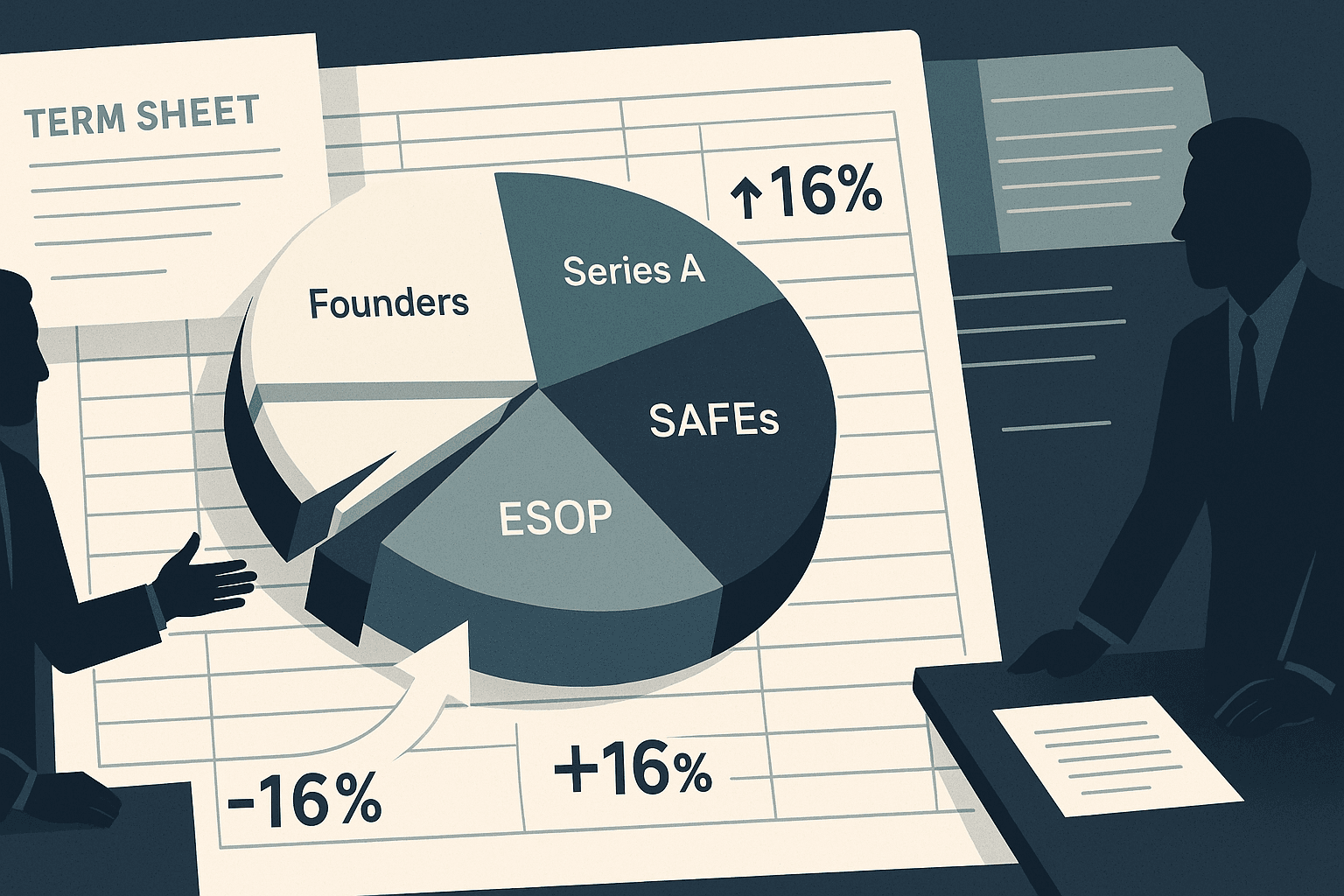
How SAFE conversions can turn your Series A option refresh into founder-only dilution, and how to model the pool before negotiating.
Then the model comes back.
There is a large SAFE stack outstanding, raised across two years at different caps. Those SAFEs convert at the financing. The new investor defines the capitalization used for the price per share one way, defines the post-closing option pool another way, and quietly frames the “refresh” as occurring in a fully diluted world that already includes converted SAFE holders, but before the investor’s own money gets the benefit of those added shares. The result is not just dilution. It is targeted dilution. Founders absorb most of the ESOP recut, while the new money is largely insulated.
This is one of the most underappreciated mechanics in venture financings: when an unpriced instrument stack meets a priced round and the board agrees to a pool increase at closing, the ordering, definitions, and modeling assumptions can turn “standard hiring math” into a founder-only ownership reset.
This article is about that trap: how it works, why investors push it, where term sheets and cap table models hide it, and what founders can negotiate instead.
The problem is not the option pool itself
An option pool increase is not inherently abusive. If a company is under-pooled going into a growth phase, someone has to bear the dilution required to recruit executives and key employees. The real question is not whether a pool should exist. The real questions are:
The trap appears when those questions are blurred together.
Investors often present the pool refresh as if it were operational rather than economic. They say, correctly, that the company needs equity to hire. But they omit the second half of the sentence: the company may need equity to hire, but the financing documents decide who pays for it.
If you already have a large SAFE stack, the “who pays” question becomes much more sensitive. SAFEs already increased the eventual fully diluted share count. If the Series A investor requires a fresh pool sized as a percentage of the post-financing company, and that pool is effectively created on a pre-money basis, the founders can get hit twice:
That second hit is what many founders do not see clearly enough before signing.
Why current approaches fail founders
Most founders make one of three mistakes.
1. They focus on valuation, not ownership mechanics
A founder hears “$48 million pre” and negotiates that number hard. But pre-money is not a complete economic term when SAFEs and pool refreshes are in the picture. A nominally attractive pre-money can be undermined by a capitalization definition that expands the pre-money denominator.
If the investor says the company is worth $48 million pre-money but the share price is calculated after including a large SAFE conversion and after reserving a larger option pool, that is a very different transaction from a plain-vanilla preferred financing at $48 million pre.
Same headline valuation, different founder outcome.
2. They accept “10% post-close pool” as market without asking “10% of what?”
“Top up the pool to 10% post-close” sounds standard. It is not self-executing. That sentence hides at least four modeling choices:
If you do not specify the exact definition, the model will specify it for you.
And the model tends to be drafted by counsel working from the investor’s assumptions.
3. They let the hiring plan be reverse-engineered from the target pool percentage
A disciplined financing should start with a use case: how many hires, at what levels, over what time period, with what grant sizes? Instead, many Series A negotiations start with a conventional target such as 10% or 15% and then rationalize it afterward.
That is backwards.
A company might need only 6% of net new pool for the next 18 months. Or it might need 14% because it is replacing a founder-CRO with a true VP Sales, building a machine learning team, and recruiting an independent board member package. But the number should come from hiring needs, not folklore.
The “standard 10%” argument is often less about talent planning and more about risk transfer: investors want enough pool so they do not have to suffer additional dilution from grants made shortly after their investment.
That incentive is rational from their perspective. It is not neutral from yours.
The core insight: the recut is a denominator game disguised as recruiting prudence
The unpriced ESOP recut trap is fundamentally about denominators.
The lead investor wants to buy a certain ownership percentage for a given check size. They also want the company to have sufficient equity to hire after the round. If they can require the company to create that hiring equity before their money is effectively counted in the denominator that bears the dilution, then the cost of future hiring is shifted away from the investor and onto the pre-money holders.
When SAFEs convert at closing, the pre-money holder set is no longer just founders and existing common/preferred. It includes the SAFE holders too. But in practice, the founders often still bear the majority of the burden because they are usually the largest common holders and because many SAFEs already negotiated economics that preserve their conversion benefit independent of the pool top-up.
That is why I call this an ownership reset. The founders think they are doing one unavoidable thing, raising a Series A, but mechanically they are doing three things at once:
The danger is not obvious because each component sounds independently reasonable.
Combined, they can produce a very non-standard founder outcome.
A concrete cap table example
Let’s use real numbers.
Before the Series A
Assume the company has:
Outstanding SAFEs:
For simplicity, assume all SAFEs convert into an aggregate of 1,800,000 shares at the Series A based on their caps/discount mechanics.
So immediately before the new money but after SAFE conversion, the company is effectively at:
Assume the Series A investor proposes:
Sounds straightforward. It is not.
Scenario 1: Founder-unfriendly “standard” model
The investor model defines the pre-money capitalization to include:
The investor then buys Series A preferred based on the resulting price per share.
Let:
Share price = $48,000,000 / (10,800,000 + X)
Investor shares:
Y = $12,000,000 / share price = 25% of (10,800,000 + X)
Post-money FD shares = 10,800,000 + X + Y
The term sheet requires the unissued pool to equal 10% of post-money FD. There are currently 400,000 unissued shares left, so the incremental new reserve X must be enough such that total unissued pool after the refresh equals 10% post-close.
To keep the math simple, assume the target refers to total unissued reserve and existing grants remain outstanding separately in FD. Then required unissued reserve after close is:
10% × (10,800,000 + X + Y)
Because Y = 25% × (10,800,000 + X), we get:
Post-money FD = 10,800,000 + X + 0.25(10,800,000 + X)
= 1.25(10,800,000 + X)
= 13,500,000 + 1.25X
Required unissued pool = 10% × (13,500,000 + 1.25X)
= 1,350,000 + 0.125X
Existing unissued pool is 400,000, so:
400,000 + X = 1,350,000 + 0.125X
0.875X = 950,000
X = 1,085,714 shares
Now compute investor shares:
Y = 25% × (10,800,000 + 1,085,714)
= 2,971,429 shares
Final post-money FD shares:
10,800,000 + 1,085,714 + 2,971,429
= 14,857,143
Ownership:
At first glance, 20% for $12 million on a $60 million post-money looks normal.
But here is what happened economically:
This means the hiring reserve was effectively purchased almost entirely by the pre-money side.
Scenario 2: Pool created after the financing, shared pro rata by everyone
Now assume the company and investor agree on the same $48 million pre and $12 million raise, but the pool increase is done after the financing and all holders, including the new investor, share dilution pro rata.
Ignore the pool for pricing. Price the round on 10,800,000 shares.
Share price = $48,000,000 / 10,800,000 = $4.4444 per share
Investor shares = $12,000,000 / 4.4444 = 2,700,000 shares
Post-close before pool increase:
10,800,000 + 2,700,000 = 13,500,000 shares
Current unissued pool remains 400,000. Suppose the company still wants unissued pool equal to 10% post-refresh. Let the incremental pool now be Z, created after closing and diluting all holders.
Then:
400,000 + Z = 10% × (13,500,000 + Z)
400,000 + Z = 1,350,000 + 0.1Z
0.9Z = 950,000
Z = 1,055,556 shares
Final FD shares = 14,555,556
Ownership:
Notice the difference.
In Scenario 1, the investor got 20.00% and founders ended at 53.85%.
In Scenario 2, the investor got 18.55% and founders ended at 54.96%.
That roughly 1.11 percentage point founder delta is not “noise.” On a successful company, that can be worth millions or tens of millions of dollars.
And this example is not particularly aggressive. The distortion gets worse with:
Where the term sheet hides the recut
The trap usually hides in three places.
1. The capitalization definition
Look for language like:
> The Company’s capitalization immediately prior to the Closing shall include all shares issuable upon conversion of outstanding SAFEs and all shares reserved under the Company’s equity incentive plan as increased to [10]% of the Company’s fully diluted capitalization immediately following the Closing.
That one sentence tells you almost everything.
It means:
This is the essence of the recut.
2. The fully diluted definition
“Fully diluted” is not a universal constant. In venture documents it is a negotiated construct.
Questions to test:
Founders often assume “fully diluted” means one thing throughout the deal. It often means slightly different things in different clauses, and those differences matter.
3. The cap table model sent the night before signing
The legal term sheet may stay high-level. Then the company receives a spreadsheet showing the “agreed” economics. Buried in one tab are circular references or hard-coded assumptions around:
Founders read the headline outputs and skip the mechanics. That is exactly how the recut survives.
Why investors frame this as standard hiring math
Because it is a good story with partial truth.
Investors are not wrong that under-pooled companies face hiring constraints. They are not wrong that a Series A should capitalize the company to hit milestones before the next round. And they are not wrong that it is inefficient to renegotiate a pool expansion six months later.
But those facts do not answer the allocation question.
The investor’s preferred framing is:
The founder’s correct response is:
That is the missing argument many founders fail to make.
The investor is trying to buy into a company that already has enough equity inventory to execute the next plan. Rational. But if that inventory is created in a way that preserves the investor’s target ownership while pushing the entire cost to founders and earlier holders, then the investor is effectively receiving a free hedge against near-term hiring dilution.
That hedge has value. Price it accordingly.
A more aggressive example: when the SAFE stack is huge
Now let’s turn the dial.
Assume:
So pre-new-money FD after SAFE conversion is 14,000,000 shares.
Series A:
Founder-unfriendly pre-money pool model
Let incremental pool = X.
Investor ownership implied by price = $15m / $60m = 25% of pre-closing capitalization including X.
Thus investor shares Y = 25% × (14,000,000 + X).
Post-money FD = 14,000,000 + X + Y = 1.25(14,000,000 + X).
Target unissued pool = 12% of post-money FD.
Existing unissued pool = 300,000, so:
300,000 + X = 12% × 1.25(14,000,000 + X)
= 0.15(14,000,000 + X)
= 2,100,000 + 0.15X
0.85X = 1,800,000
X = 2,117,647 shares
Investor shares:
Y = 25% × 16,117,647 = 4,029,412 shares
Post-money FD = 20,147,059 shares.
Founder ownership = 7,500,000 / 20,147,059 = 37.23%
That is brutal. Some of that is due to the SAFE stack, yes. But the pre-money pool recut amplifies the effect.
Shared-dilution post-close pool model
Without pool in pre-money pricing:
Share price = $45,000,000 / 14,000,000 = $3.2143
Investor shares = $15,000,000 / 3.2143 = 4,666,667
Post-close pre-refresh FD = 18,666,667
Need 12% unissued after refresh:
300,000 + Z = 12% × (18,666,667 + Z)
= 2,240,000 + 0.12Z
0.88Z = 1,940,000
Z = 2,204,545
Final FD = 20,871,212
Founder ownership = 7,500,000 / 20,871,212 = 35.94%
Wait, that looks worse for founders. Why?
Because in this example, the investor got more shares upfront when the pool was excluded from pre-money pricing, since the same $45 million pre was spread over fewer shares. The point is not that post-close pooling is always better in every isolated math setup if the headline valuation is held constant without re-trading economics. The point is that the package of valuation plus cap-definition plus pool timing determines outcome.
This is crucial.
Founders often argue pool timing without re-trading price. Sophisticated investors understand that these are linked terms. If you move the pool out of pre-money, the investor may push for a lower valuation or larger ownership target. So the right negotiation is not a simplistic “pool after close” demand. The right negotiation is: what is the investor’s target effective ownership, and how is dilution from future hiring shared after giving effect to the SAFE stack?
That is the real deal.
What founders should negotiate instead
Here are the most effective alternatives, in order of practicality.
1. Negotiate from a fully built cap table, not headline pre-money
Do not negotiate valuation in the abstract. Ask the lead to confirm economics using a cap table that shows:
Then force discussion on effective ownership outcomes, not rhetoric.
A founder should literally ask:
> On the exact pro forma cap table, what percentage does the lead own immediately after close, what percentage of dilution from the pool top-up is borne by founders, SAFE holders, and the new investor, and how would that change if the pool were sized to the hiring plan rather than a standard percentage?
If they cannot answer that crisply, they either do not understand the model or do not want you to.
2. Tie the pool size to a hiring plan
Do not accept “10% because market.” Ask management and the board to define:
Then calculate the required incremental reserve.
Example:
Total expected grants = 6.25%
Add execution cushion and recruiting variance, maybe net required pool = 7.5% rather than 10% or 12%.
That difference matters enormously.
On a 15 million share post-money company, the gap between 7.5% and 10.0% is 375,000 shares. For a founder with 8 million shares, that is a meaningful ownership swing.
3. Ask that some or all of the refresh be post-close dilution shared by all holders
This is the cleanest conceptual position, even if not always fully achievable.
A good compromise is:
Example:
This eliminates the investor’s free hedge against hypothetical hires that may never happen.
4. Exclude some SAFE-driven distortion through valuation adjustment or fixed investor ownership math
If the lead insists that converted SAFEs and a fresh pool are both included in the pre-money capitalization, founders should reframe the ask.
Instead of arguing definitions clause by clause, say:
> Fine, but then the valuation or check size must be adjusted so the lead’s effective post-close ownership reflects the fact that founders are already absorbing substantial dilution from the SAFE stack.
Or:
> Let’s agree the lead gets [X]% post-close on a cap table with [specific pool amount], and any pool above that is shared pro rata by all holders.
This moves negotiation to the actual economic endpoint.
5. Cap the pool increase numerically, not just percentage-wise
A term like “increase pool to 10% post-close” is too loose. Better:
> Increase the unissued option pool at closing by no more than 750,000 shares, resulting in no less than 6.5% and no more than 8.0% unissued post-close, based on the capitalization set forth in the agreed pro forma schedule.
That removes spreadsheet drift and last-minute games.
6. Require the term sheet to attach the pro forma cap table
This is one of the highest ROI negotiation points in early venture financings.
Attach a schedule showing:
If the investor later says “this is just implementation detail,” you can point to the schedule.
Without that schedule, “implementation detail” is where economics move.
A term sheet comparison founders should understand
Here is a simplified comparison.
Investor-friendly language
Meaning: investor buys after SAFE conversion and after pool increase are loaded into pre-money denominator.
Founder-friendlier language
Meaning: some immediate hiring reserve is funded at close, but excess refresh is not silently loaded onto founders.
That is a much better risk allocation.
Negotiation scenario: what to say in the room
Suppose the lead says:
> We always top the pool to 10% post-money. That is standard and necessary to recruit.
Weak founder response:
> Can we make it 8% instead?
Better founder response:
> We agree the company needs recruiting capacity. What we do not agree with is treating the entire refresh as pre-money holder dilution after a large SAFE conversion. Show us the exact cap table impact by holder class and let’s size the pool to the 18-month hiring plan. We are open to funding immediate hiring needs at close, but any excess reserve should dilute everyone or be reflected in price.
This does three things:
If the investor pushes back with “this is market,” say:
> Market is not the issue. Economic effect is. With this SAFE stack, the pool recut is not neutral. If you want the company capitalized for hiring without sharing that dilution, that is a price term, not an admin term.
That is the right frame.
What boards and counsel often miss
Even good company counsel can miss the practical significance here because they are accustomed to “standard” preferred financings. But SAFEs changed the setup. In a world where companies arrive at Series A with multimillion-dollar unpriced stacks, the old intuition around routine pool refreshes is less reliable.
Boards should ask for sensitivity tables showing founder ownership under at least three cases:
Run those cases across different SAFE conversion outcomes if caps and discounts vary. It is common for one assumption tweak to move founder ownership by 1 to 3 percentage points.
At Series A, that is not trivial. It affects:
An “invisible” one-point shift today can become a very visible problem later.
The contrarian takeaway
The contrarian point is simple: option pool refreshes are not operational side notes. In SAFE-heavy Series A financings, they are major pricing terms.
If large SAFE conversions happen at closing, an investor-requested ESOP top-up can quietly function as a founder-only or founder-heavy dilution transfer, especially when the term sheet defines fully diluted capitalization to include both converted SAFEs and the increased pool for pricing purposes.
Founders should stop treating the pool as a standard checkbox and start treating it like what it is: a negotiated allocation of future hiring cost.
Here are the practical takeaways:
The phrase to remember is this: if the pool is “standard,” the dilution should be transparent.
If someone cannot explain exactly who pays for the ESOP refresh once SAFEs convert, they are not describing a standard term. They are describing a transfer.
And founders who miss that transfer are often shocked only after the round closes, when they realize the company did not just raise a Series A. It quietly recut the cap table underneath them.
RaiseSimpli Team
Author