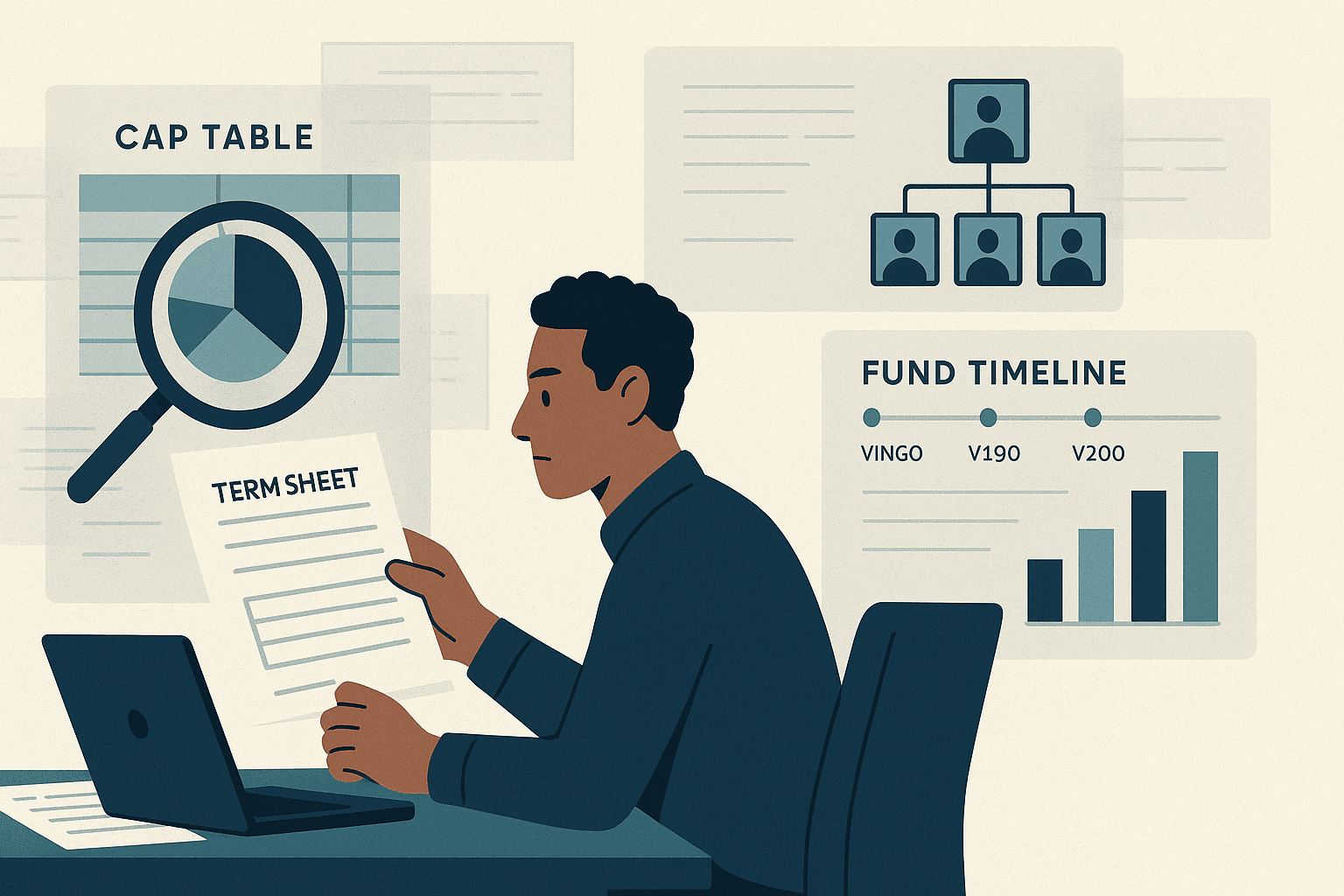
How to investigate investors before signing a term sheet, which questions and reference checks matter, and what red flags founders should not ignore.
Why “reverse diligence” matters more than ever
Founders treat fundraising like a one-way evaluation: investors assess market, team, traction, and risk. But the asymmetry is real, you live with your investors far longer than they live with any single deal. The wrong capital isn’t just expensive; it can be fragile, distracting, and even destructive when things get hard.
Reverse diligence is the discipline of investigating your prospective investors with the same rigor they apply to you, before you sign a term sheet. It’s not about paranoia. It’s about understanding:
How the firm behaves when growth slows and options narrowWhether your deal is strategically important to them (or “tourist capital”)What partner incentives, firm politics, and fund math will do to their supportWhere the term sheet hides control or asymmetryThe goal isn’t to find a perfect investor (they don’t exist). The goal is to pick the investor whose incentives and operating style align with your company’s likely future, including the part where things go sideways.
This playbook is tactical: the questions to ask, the documents to request, how to run references, what to look for in track records, reserves, and governance, and how to interpret the answers.
> Framing principle: You’re not just raising money. You’re selecting a board member (or future board member), a follow-on capital source, and a high-leverage advisor with their own career incentives.
---
Step 0: Define what you actually need (so you can evaluate fit)
Before investigating investors, define your own constraints. Otherwise you’ll optimize for prestige, valuation, or vibes.
0.1 Your company’s “funding reality”
Write down (one page):
The next 2–3 credible milestones that unlock the next round (or profitability)Your base-case runway and burnYour most likely failure mode (go-to-market doesn’t scale, regulatory delays, margin collapse, etc.)Whether the next round is likely to be up, flat, or down (be honest)This informs the investor profile you need: e.g., firms with strong reserves and a history of supporting down rounds versus firms that only want momentum.
0.2 The investor archetype you want
Different stages and business types benefit from different investor behavior:
High-iteration product companies often benefit from investors who are hands-on with hiring, GTM experiments, and pricing.Deep tech / biotech / hardware often need investors with patience, reserves, and board-level operational discipline.Founder-led long arcs (hard problems, defensibility) often need investors who don’t force premature scaling.Write your “must-haves” (e.g., follow-on capacity, relevant operator network, calm in crisis) and “deal-breakers” (e.g., rigid control terms, signaling risk, partner turnover).
---
Step 1: Separate the partner from the firm
A core mistake: diligence the brand, then get surprised by the individual partner’s incentives and internal politics.
1.1 Partner-level questions
You are choosing a human who will:
sell internally for follow-onsrepresent you in partner meetingsinfluence hiring and strategypotentially control consent rightsInvestigate:
Seniority: Are they a GP, Partner, Principal? Do they actually have check-writing authority?Ownership of the deal: Are they leading, or “helping” another partner?Attention bandwidth: How many boards, how many active deals, how many new deals per year?Decision-making style: Consensus-driven? Autocratic? Data-first? Narrative-first?1.2 Firm-level questions
A supportive partner trapped in a weak firm can still fail you.
Investigate:
Fund size and strategy consistency (stage, check size, geography)Reserves and follow-on policyConcentration: how many companies per partner, per fundInternal governance: who can block follow-onsFirm stability: partner departures, fundraising cadence, LP pressure> Opinionated take: Your “investor” is an incentive system: the partner’s career + the firm’s fund math + the partnership politics. Diligence all three.
---
Step 2: Track-record analysis (beyond the cherry-picked wins)
Investors will show you logos and unicorns. Your job is to understand their full distribution.
2.1 What to request (and what you can infer)
You rarely get full DPI/TVPI. But you can still learn a lot.
Ask for:
Portfolio by fund vintage (at least: active, exited, written-off)Which companies they led vs followedBoard roles and who sat on boardsFollow-on behavior: how often they participated in the next round when things got harderCross-check with public data:
Press releases, Crunchbase/PitchBook (use cautiously; data can be incomplete)SEC filings for some funds (limited, but sometimes helpful)Founder announcements about shutdowns, recapitalizations, acqui-hires2.2 The questions that actually matter
Rather than “How many unicorns?”, ask:
How many investments returned the fund? (or plausibly could)How many were “living dead” for years? What did the firm do, support, force sale, or abandon?What percentage of companies raised a strong next round?In down markets, did they keep investing?Look for a firm that’s coherent:
If they market themselves as “early-stage conviction,” you should see leadership in early rounds and consistent follow-ons.If they market themselves as “platform + support,” you should see evidence founders actually used it (not just a slide).2.3 Identify “tourist capital” patterns
“Tourist” capital isn’t necessarily malicious, it’s just structurally unreliable.
Signals:
Frequent dabbling outside stated thesis (random sectors because they were hot)Lots of small checks across many companies with minimal ownershipFew follow-ons unless the company is already obviously winningPartners who rotate themes every 12–18 monthsThe risk: when markets tighten, tourists go home.
---
Step 3: Reference calls, how to get real signal
Reverse diligence lives or dies on reference quality. Do not only call the references they give you.
3.1 Build a reference list (your list, not theirs)
Aim for 8–12 calls for a lead investor if possible:
2 founders of clear winners2 founders of “moderate outcomes” (acquisitions, steady businesses)2 founders of struggling or shut-down companies1–2 co-investors (other VCs)1 executive hire who interacted with the investor during recruitmentOptional: former employees who saw board dynamics (use discretion)How to find them:
Portfolio pages + LinkedInFunding announcements (who led?)Second-degree intros from other foundersCo-investor lists in rounds> Tactic: Ask each reference, “Who else should I talk to that might have a different perspective?” This snowballs into off-list truth.
3.2 Questions that expose behavior under stress
You’re trying to simulate the future:
On decision-making and support
“What did they do in the first 30 days after investing?”“How did they help with hiring, specific candidates or generic advice?”“When you disagreed, how did they handle it?”On hard moments
“Tell me about a time the company missed targets. What happened in board meetings?”“When runway got tight, did they push for layoffs early or late?”“How did they behave in a down round or flat round?”On follow-on and signaling
“Did they invest pro rata? If not, how did they communicate it?”“Did their non-participation hurt your next raise?”“Were they constructive with new investors or territorial?”On integrity and alignment
“Did they ever surprise you with a term interpretation or consent right?”“How did they handle founder equity / refresh grants discussions?”“Did they push you toward outcomes that benefited them but not the company?”3.3 Interpret references like an engineer, not a fan
Founders have biases:
Winners often love everyone involved.Losers may blame investors for broader market failure.Your job is pattern recognition:
Do multiple people describe the same behavior (e.g., “calm in crisis,” “political,” “ghosts you”)?Are the specifics consistent?Do they own their mistakes when describing failures, or is it always “the founder’s fault”? Investors who never self-critique are risky.---
Step 4: Understand partner incentives and internal politics
VC firms are partnerships. Your champion must repeatedly “sell” you internally, for follow-ons, for time, for reputation.
4.1 Key incentive mechanics to ask about
Ask directly (politely, matter-of-factly):
How are partners compensated? (carry split, deal attribution)Do partners have individual carry by deal or pooled carry?Who decides follow-on allocation?Can one partner block a follow-on?Why it matters:
If carry is heavily deal-attributed, partners may hoard time for “their” deals.If follow-ons are a partnership vote, a skeptical partner can quietly starve you.4.2 The “junior partner” risk
A hungry junior investor can be amazing, responsive, high-effort, eager to prove themselves.
But if they can’t win internal battles, you may lose follow-on support when it matters.
Mitigations:
Ensure a senior GP is explicitly backing the deal.Ask for clarity on who will sit on the board.Ask who signs off on reserves.4.3 Fundraising cycle pressure
VC behavior changes when the firm is:
Raising a new fund (incentive to mark up, chase hot rounds)Struggling to raise (incentive to conserve reserves, avoid “bad optics”)Ask:
“Where are you in your current fund deployment?”“When do you plan to raise your next fund?”“How sensitive are you to interim marks?”You’re not asking to judge them; you’re asking to model their constraints.
---
Step 5: Reserves and follow-on capacity (the downturn test)
In a downturn, your best investor is often the one who can keep writing checks.
5.1 What “reserves” really mean
Reserves are capital set aside for future rounds (pro rata and sometimes more). Firms vary widely:
Some reserve heavily (e.g., 1:1 follow-on to initial)Some reserve lightly and rely on “recycling” or new fundsSome reserve selectively for the top decileAsk:
“What is your typical reserve ratio per initial check?”“Do you reserve at the fund level or company level?”“Under what conditions do you not follow on?”5.2 Beware the ‘pro rata’ mirage
Many firms promise pro rata “in principle” while keeping discretion.
Clarify:
Is pro rata a policy or a preference?Who decides exceptions?Have they historically maintained pro rata through Series B/C for companies that were merely okay?5.3 Signaling risk: the silent killer
If your lead doesn’t follow on, new investors may interpret it as insider doubt.
Not following on can be rational (portfolio construction), but it still has consequences.
Diligence question:
“If you choose not to follow on, how do you communicate that to the market and to prospective investors?”A strong answer includes: early warning, clear rationale, willingness to support fundraising anyway, and no behind-the-scenes undermining.
---
Step 6: Term sheet reverse diligence (find the hidden control)
Most founders focus on valuation and dilution. In many cases, control and optionality clauses matter more.
You should have strong legal counsel. But you also need to understand the intent behind terms.
6.1 Clauses that deserve extra scrutiny
1) Board composition and control
Who gets a board seat now vs later?Is there an independent? Who selects them?Are observer rights broad?Board control isn’t inherently bad. But you need clarity on how governance will function when you disagree.
2) Protective provisions (investor consent rights)
These can be standard, but watch scope:
budgets / hiring/firing executivestaking on debtchanging business linessecondary salesM&A / liquidation preferences changesOverbroad consent rights can turn routine operations into negotiation.
3) Pay-to-play / pull-forward provisions
Some terms penalize investors who don’t participate in future rounds (pay-to-play). These can protect the company by forcing insiders to support.
But they can also create conflict in syndicates. Understand how likely your investor is to insist on these and whether that aligns with future fundraising.
4) Participation rights and liquidation preference
Non-participating preferred is common.Participating preferred can materially change outcomes.Stacked preferences across rounds can trap common shareholders.Know what you’re signing. Model outcomes.
5) Redemption rights
Often ignored because they’re rarely exercised, but they can create pressure later.
6) Information rights and inspection
Standard reporting is fine. Overly invasive rights can become a distraction or leak risk.
7) Most-favored-nation (MFN) clauses in SAFEs/notes
MFNs can create surprising obligations if later terms are better.
6.2 The meta-question: why do they want this term?
Reverse diligence isn’t just legal review; it’s behavioral prediction.
Ask:
“Help me understand the reason for this provision. When have you needed it before?”You’re listening for:
thoughtful risk management vs vague power accumulationwillingness to narrow languagetransparency about edge cases6.3 Don’t confuse ‘standard’ with ‘safe’
“Standard” often means “standard for the investor.” What’s standard varies by stage, geography, and market cycle.
Use market references:
NVCA model documents (widely referenced baseline in US venture deals)Experienced startup counsel with current deal flow(See: NVCA Model Legal Documents: https://nvca.org/model-legal-documents/)
---
Step 7: Evaluate their actual value-add (not the platform slide)
Every firm has a platform team, talent help, GTM help, comms, etc. Some are excellent; some are marketing.
7.1 Ask for proof, not promises
Requests that produce signal:
“Can you introduce me to 2–3 portfolio founders who used your talent/team and found it high impact?”“Can you show examples of executive searches you drove that closed?”“For GTM support: what is a concrete engagement you did in the last quarter?”7.2 Match value-add to your stage
Early-stage value-add that matters:
hiring first sales leader, first eng managerpricing and packaging experimentsdesign partners and lighthouse customersLater-stage value-add that matters:
finance leadership, audit readinessscaling sales ops, comp designM&A navigationBe wary of generic claims (“we help with go-to-market”) without a mechanism.
---
Step 8: Check their reputation with other investors (the syndicate lens)
Your investor must cooperate with others for future rounds.
Call 2–3 co-investors and ask:
“How are they in syndicates, collaborative or territorial?”“Do they try to re-trade terms late?”“Do they behave differently when they’re not leading?”“How do they handle conflicts?”A VC who is difficult in syndicates can reduce your future financing options.
---
Step 9: Identify early warning signs (and what to do about them)
9.1 Red flags that usually matter
Fast term sheet, slow diligence: They rush you into exclusivity but don’t invest real time understanding the business.Vague reserve answers: “We always support our companies” without specifics.Over-promising intros: A long list of “we can introduce you to everyone” with no prior examples.Term-sheet power grabs: Non-standard control terms justified as “minor” or “just in case.”Inconsistent partner involvement: The enthusiastic partner disappears and you get handed to someone else.Back-channel negativity: Other founders mention subtle undermining.9.2 Yellow flags (context-dependent)
They haven’t done your exact sector before (could be fine if they learn fast).They are early in the fund (could mean strong reserves but also pressure to deploy).They are late in the fund (could mean focus but less capital left).9.3 What to do if you still want the deal
Sometimes the investor is valuable despite risks. Mitigate:
Build a stronger syndicate (add a stabilizing co-lead)Negotiate clearer governanceGet follow-on expectations in writing (not enforceable like a contract, but clarifying)Avoid broad consent rightsConfirm board/observer structure---
Step 10: A practical reverse diligence checklist
Use this as a working doc.
10.1 Firm and fund
[ ] Fund size, vintage year, deployment pace[ ] Stage focus and check size consistency[ ] Reserves policy and typical follow-on behavior[ ] Number of active portfolio companies per partner[ ] Partner turnover in last 3–5 years[ ] Next fund timing and fundraising status (if discussable)10.2 Partner
[ ] Decision authority and internal sponsorship[ ] Board load and time availability[ ] Operating style and conflict handling[ ] Incentives: carry attribution vs pooled[ ] Reputation with co-investors10.3 References
[ ] Winners, average outcomes, failures[ ] Specific examples of help[ ] Behavior in a down round / missed plan[ ] Communication quality and trustworthiness10.4 Term sheet
[ ] Board control and observer rights[ ] Protective provisions scope[ ] Liquidation preference and participation[ ] Pay-to-play / redemption / MFN[ ] Information rights---
Multiple perspectives: what VCs might say (and how to respond)
Good investors will sometimes push back on reverse diligence. Some of that pushback is reasonable.
“Our track record is confidential.”
Reasonable: LP agreements and confidentiality exist.
Your response:
“I’m not asking for fund returns; I’m asking for behavioral proof, how you support companies, follow-on patterns, and founder references across outcomes.”“We can’t commit to pro rata in every case.”
Also reasonable: portfolio construction is real.
Your response:
“Understood. What are the criteria you use? Can you share examples of when you did and didn’t follow on, and how you supported the company either way?”“Those terms are standard.”
Sometimes true.
Your response:
“Standard can still be too broad. Can we narrow to the minimum needed to protect the investment? I’d like governance that keeps us fast.”A strong VC will engage with these questions without defensiveness.
---
Conclusion: Choose investors who are built for your bad days
The best time to evaluate an investor is when they’re trying to impress you. The most important time to have picked well is when:
growth stallsthe next round is hardyou need a painful pivotyou’re considering layoffsyou’re negotiating a flat or down roundReverse diligence is the mechanism for choosing investors who don’t just fund your upside, they underwrite your uncertainty.
If you do only three things, do these:
Call founders from failed or struggling portfolio companies. That’s where truth lives.Understand reserves and follow-on behavior. This is the downturn difference.Read the term sheet for control and signaling risk, not just valuation.Pick investors with aligned incentives, coherent strategy, and demonstrated integrity. Your future self, likely operating under stress, will care far more about that than the logo on the slide.
---
References and useful resources
NVCA Model Legal Documents (term sheet and financing docs baselines): https://nvca.org/model-legal-documents/Y Combinator library (fundraising, term sheets, investor dynamics): https://www.ycombinator.com/libraryBrad Feld, Venture Deals (foundational term sheet and VC mechanics reference): https://www.venturedeals.com/Paul Graham essays on fundraising and investor dynamics (contextual, founder-oriented): http://www.paulgraham.com/articles.htmlNote: Data vendors (PitchBook, Crunchbase) can be helpful for triangulation but are often incomplete; founder references and observed follow-on behavior tend to be more predictive than database fields.