Valuation-First Fundraising and 2026 Term Sheet Traps
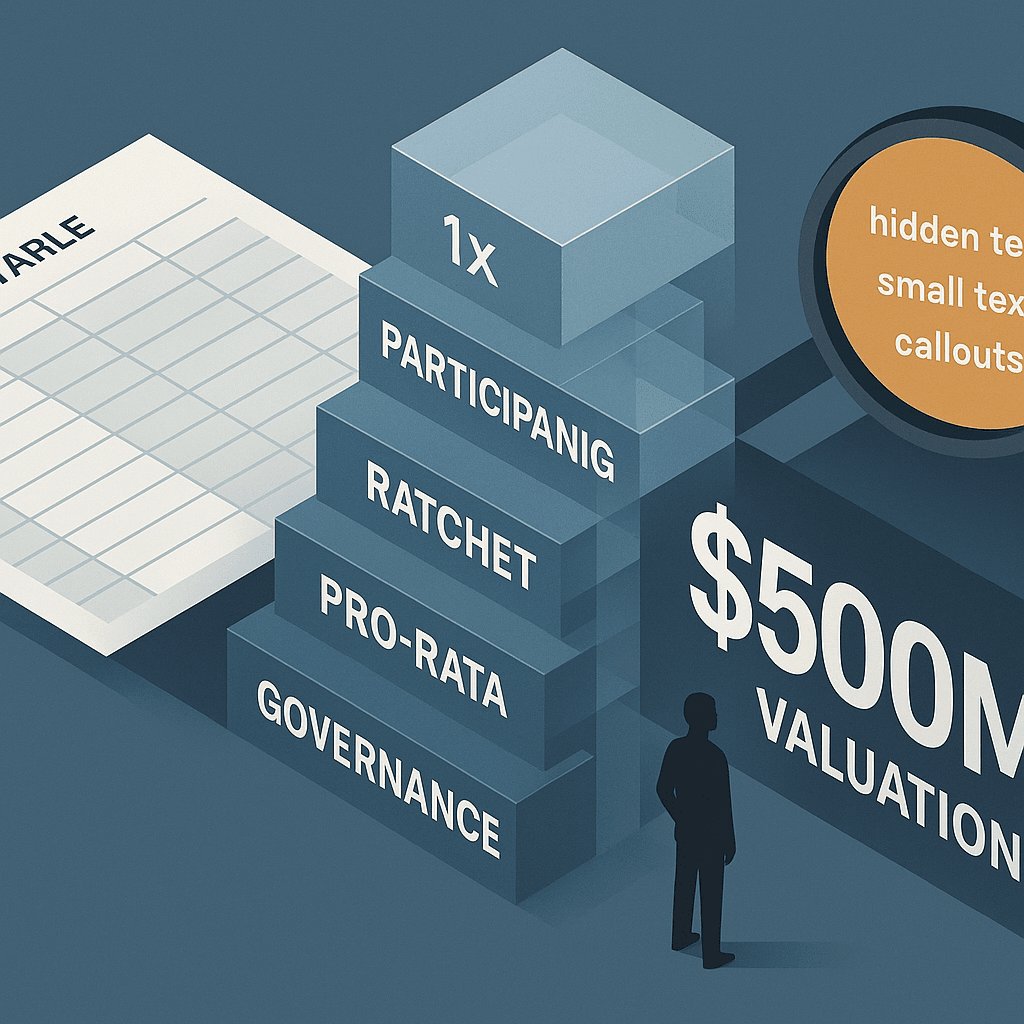
Why chasing the highest valuation backfires in 2026, and which term sheet traps can erode the payoff behind a good-looking headline number.
The 2026 fundraising mistake: optimizing the headline, not the payoff
Founders still pitch and negotiate like it’s 2021: “What valuation can we get?” In 2026, that question is increasingly the wrong optimization target.
Yes, valuation matters. But in a market where investors are more cautious, more data-driven about downside, and under pressure to manufacture acceptable IRRs, risk is being shifted through structure rather than price. The result is a familiar pattern:
This is not a conspiracy; it’s rational behavior. When capital is scarcer and outcomes are more dispersed, investors protect themselves with terms that reshape the distribution: they preserve downside and sometimes siphon a disproportionate share of the upside.
The trap is that many founders still evaluate offers primarily using:
…while ignoring the mechanisms that can dominate actual outcomes: liquidation stacks, participation, ratchets, redemption, pay-to-play dynamics, pro-rata and super pro-rata, governance vetoes, and protective provisions.
This article explains what’s changing, how to model it, how to spot hidden dilution, and how to negotiate for real upside.
> Important note (not legal advice): term sheets are legal contracts with jurisdiction-specific nuances. Use this as a practical framework, then work with counsel.
---
Why valuation-first thinking fails in 2026
1) Price is easy to market; structure is easy to hide
A high valuation is a trophy: it signals momentum to customers, recruits, and the press. Structure, by contrast, is technical and often buried in dense language.
That asymmetry invites “financial engineering”: terms that look standard to a time-pressed founder but materially alter outcomes.
2) Investors are underwriting to a more uncertain exit market
IPO windows are episodic; M&A pricing is more disciplined; and many businesses are exiting later than planned. When investors perceive longer duration and uncertain liquidity, they seek:
This is consistent with what you’d expect from basic venture portfolio theory: downside protection becomes more valuable as the probability mass shifts toward mediocre outcomes.
3) Competitive rounds shift from “who pays most” to “who offers the best risk-adjusted deal”
Founders often believe they’re negotiating a single variable (valuation). In reality, sophisticated investors negotiate a vector:
If you push valuation up aggressively, the other side frequently “gets paid back” via structure.
4) The compounding effect: today’s structure becomes tomorrow’s stack
Bad terms don’t just affect this round. They become the substrate for every future round:
The result is a liquidation overhang that can make even a decent acquisition feel like a failure for common shareholders.
---
The four term-sheet traps that matter most in 2026
Below are the recurring traps that show up in modern “valuation-first” deals.
Trap #1: Participation turns “1x preference” into a stealth tax on founders
Liquidation preference is the right to get paid before common stock in a liquidation event (sale, merger, sometimes asset sale). A standard VC term is 1x non-participating preferred: investors choose either:
Participating preferred changes this: investors get their preference and then also share in the remaining proceeds pro-rata (sometimes until a cap).
#### Why it backfires
Participation can dramatically reduce common proceeds in mid-range exits, the exact outcome band many venture-backed companies actually experience.
#### Simple example (single investor)
Case A: 1x non-participating
Case B: 1x participating
Same valuation, same ownership, wildly different result.
#### What’s “market”?
In many Silicon Valley-style financings, 1x non-participating has long been considered founder-friendly baseline (e.g., NVCA model docs often assume non-participating as typical). But in tighter markets, participation appears more often, sometimes justified as “we need downside protection at this price.”
References:
Trap #2: Liquidation stacks + seniority create an exit “dead zone”
Most founders understand a 1x preference in isolation. Fewer model what happens when multiple rounds stack on top of each other.
A liquidation stack is the total preference senior to common. Seniority defines who gets paid first.
#### Why it backfires
If your company sells for an amount near or below the stack, common may receive little or nothing, even if you grew revenue, built a real product, and created substantial enterprise value.
This creates a dead zone where:
#### Practical rule
Model at least these exit points:
…and compute common proceeds under the actual seniority and participation terms.
References:
Trap #3: Ratchets and anti-dilution that rewrite the cap table later
Anti-dilution protects preferred holders if a future round is priced lower.
Common types:
#### Why it backfires
Full ratchets can transfer massive ownership from founders/common to preferred in a down round, even if the down round is small.
They also distort incentives:
#### A reality in 2026
Ratchets increasingly show up not only as classic conversion price resets, but as “price protection” side letters, milestone-based share top-ups, or warrants that replicate ratchet economics.
References:
Trap #4: Governance and control terms that quietly reduce your strategic freedom
Economic terms get the attention. Governance terms often do the damage.
Watch for:
#### Why it backfires
Governance terms can force a company into a path optimized for investor liquidity preference rather than company health:
These clauses are also often where “structure as risk shift” hides, because they don’t change the cap table on day one, but they change what choices are available later.
References:
---
How hidden dilution actually happens (even without more shares issued)
Founders typically equate dilution with “how much ownership do I give up this round.” In 2026, a more useful concept is:
> Outcome dilution: how much of the exit proceeds common receives across plausible exits.
You can lose outcome value without losing a single percentage point of nominal ownership at close.
Hidden dilution mechanisms include:
The key: a “clean” 20% dilution round can be much worse than a “messy” 25% dilution round depending on structure.
---
Model the waterfall: a founder’s practical toolkit
If you don’t model, you’re negotiating blind. You need a waterfall model: who gets paid what at each exit value.
Step 1: Gather the exact inputs
From term sheets and existing charter docs:
Step 2: Define realistic exit scenarios
Use a distribution, not one number. At minimum:
If you have revenue, consider using multiples consistent with current comparables and public comps, but haircut for liquidity/scale.
References (for market context and data, not as a formula):
Step 3: Compute payouts by class at each exit value
A simplified sequence:
Step 4: Convert payouts into what founders care about
A useful metric:
> Common break point: the exit value where common receives, say, 10% of proceeds.
If that number is uncomfortably high relative to plausible outcomes, the deal is economically founder-hostile regardless of valuation.
Step 5: Stress-test future rounds
Assume at least one of:
Then model anti-dilution and stack growth.
Many founders negotiate as if this is the last round. It rarely is.
---
“But we need the high valuation for signaling”, the best arguments for valuation-first
There are rational reasons to push valuation. Pretending otherwise is simplistic.
Signaling is real
A high-priced round can:
Employee morale and option strike price
Higher 409A valuations can be a downside (higher strike prices), but a strong priced round can reduce fear and improve retention.
Protective dilution avoidance
If you can raise at a high valuation with clean terms, you preserve founder ownership.
So the real lesson isn’t “valuation doesn’t matter.” It’s:
> Valuation matters only in combination with structure.
If you can get both (high valuation and clean terms), great. If not, founders should usually prefer clean economics and clean governance over an inflated headline.
---
The negotiation playbook: get to “clean” without losing the round
1) Trade valuation for simplicity explicitly
Instead of haggling solely over price, propose a structured trade:
This reframes the conversation into risk sharing rather than adversarial bargaining.
2) Cap participation or eliminate it
If an investor insists on participation:
A capped participating preferred can be a compromise, though it still harms mid-range exits.
3) Push for pari passu where possible
Seniority is often justified for later rounds, but it can crush common incentives. If you must accept seniority, negotiate:
4) Avoid full ratchet anti-dilution
If you face price protection pressure:
5) Beware “shadow ratchets”: warrants and top-ups
Sometimes the term sheet says “weighted average,” but a side letter grants:
Treat these as anti-dilution by another name, and model them.
6) Keep governance terms aligned with building, not forcing liquidity
Red flags to negotiate hard:
Ask: “What decisions could you block that would prevent us from building a durable business?” Then narrow those provisions.
7) Control the option pool conversation
Option pools are often used to create hidden dilution pre-money.
If an investor asks for a large pool increase pre-money, quantify it:
A founder-friendly approach:
References:
---
A quick checklist: term-sheet “smells” that should trigger modeling
If you see any of these, don’t rely on intuition, model the waterfall.
---
The meta-problem: incentives diverge under structured downside protection
One under-discussed reason valuation-first deals backfire is incentive design.
If investors are heavily protected on the downside and participate meaningfully in the upside, their payoff curve becomes more bond-like with equity sweeteners. Founders and employees remain pure equity.
That can produce misalignment:
Cleaner terms keep everyone in the same game.
---
What “good” looks like in 2026
There is no universal best term sheet. But founder-aligned deals tend to share traits:
The precise combination depends on company leverage. A seed-stage company with limited traction will concede more. A company with strong metrics can demand cleaner structure.
The key is to avoid the common failure mode:
> “We got our valuation, and the rest is standard.”
In 2026, “standard” is often where the economic story is written.
---
A founder’s decision framework: choose your term sheet like a product requirement
Instead of “maximize valuation,” write requirements.
Requirement 1: Common must have meaningful value in plausible exits
If your realistic M&A range is $100M–$300M, ensure common participates meaningfully there.
If the stack makes common irrelevant until $500M+, you have created a morale and incentive crisis.
Requirement 2: Future financing must remain possible
Over-structured rounds can block future investment:
Requirement 3: Governance must allow operating flexibility
Overly tight vetoes and board control can turn routine decisions into negotiations.
Requirement 4: Terms must be legible to future investors
If the next lead investor can’t understand your cap table in 30 minutes, you’ve added financing risk.
---
Conclusion: stop fundraising by headline; start fundraising by distribution
The 2026 shift isn’t that investors became “worse.” It’s that the market is more honest about risk, and investors are using structure to price that risk without reducing headline valuation.
Founders who optimize for valuation alone are effectively agreeing to a hidden bet: that the company will land in the narrow band of outcomes where the structure doesn’t matter.
A better approach is to negotiate and model based on the full distribution of outcomes:
Fundraising is not only about the price of capital. It’s about the shape of your payoff curve, and whether your team will still believe in the upside two years from now.
---
Further reading (practical, founder-relevant)
RaiseSimpli Team
Author